- 186 pages
- English
- ePUB (mobile friendly)
- Available on iOS & Android
eBook - ePub
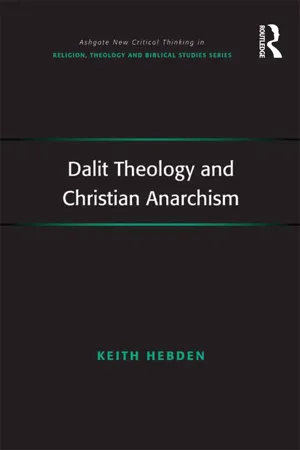
Dalit Theology and Christian Anarchism
About this book
A second generation of emerging Dalit theology texts is re-shaping the way we think of Indian theology and liberation theology. This book is a vital part of that conversation. Taking post-colonial criticism to its logical end of criticism of statism, Keith Hebden looks at the way the emergence of India as a nation state shapes political and religious ideas. He takes a critical look at these Gods of the modern age and asks how Christians from marginalised communities might resist the temptation to be co-opted into the statist ideologies and competition for power. He does this by drawing on historical trends, Christian anarchist voices, and the religious experiences of indigenous Indians. Hebden's ability to bring together such different and challenging perspectives opens up radical new thinking in Dalit theology, inviting the Indian Church to resist the Hindu fundamentalists labelling of the Church as foreign by embracing and celebrating the anarchic foreignness of a Dalit Christian future.
Information
Understanding the Postcolonial Context
Chapter 1
Subversion and Resistance in Postcolonial Discourse
They called this area ‘India’, a term then alien to the peoples of south Asia and imprecise even in European usage and they conceived this ‘India’ as a distinct Asian entity and hence, by the criteria of colonial expansion, as a legitimate subject of dominion.1
Rarely does a theology find the imagination to step behind the big assumptions of the secular world. Anarchism is a tradition born out of enlightenment Europe and the emergence of the nation state as a far from benign power and it allows us to do just that. Because anarchists remind us that the nation state is a modern novelty that evolved and emerged by coercion and much violence it helps us to see the theologies that suit the nation state emerge in the same way and at the same time. Once we grasp these twin developments of theology and nation we are able to step away from both somewhat and see a bigger picture of our context of oppression than political theologies normal allow.
The first half of this chapter is a gentle introduction to the breadth of anarchist thought showing how Christian anarchism might be distinctive among it. We must also have the right linguistic tools to make clear that this is a spiritual as well as political engagement with the forces that oppress Dalits across India and continue to trouble them. We must find ways to name and describe these. Again, the enlightenment philosophers and economists as well as the biblical theology of Walter Wink – a key writer for Christian anarchists if not one himself – came in to play to support what is a radical theologically approach to Dalit liberation theology. When it has been established what Christian anarchism is and how it might work we can go on to use its assertion to pull out from history the political and theological developments that must be challenged. To understand where the Christian Dalit movement is and where it might go we first must understand how it got there and what it may have lost along the way.
An Anarchist Critique: Tools for Deconstructing the Statist Ideology
Liberation theology begins with an evaluation of context, moving to reflection from a scriptural perspective by the poor. To facilitate evaluation and reflection, appropriate tools must be identified. These tools are often Marxist economics of one form or another. Christian anarchism provides alternative tools and highlights those aspects of liberation theology that resonate with Dalitness. Anarchism is a way of understanding the dynamics of power and how they relate to justice; it is an enlightenment response to an enlightenment problem – the nation state. This problem of the violent nation state is one that has been exported to India and, while foreign to the subcontinent, has been taken as natural. It is appropriate then to at least have available the same tools to critique as are available in the West – namely the anarchist response. However, in bringing anarchism into dialogue with indigenous practice and from a Christian anarchist perspective it is possible to both understand the politics of India theologically and the Church’s political responses.
Anarchic theory gives greater importance to social organisation than state-promoting theories such as democratic liberalism, or Marxism. The literal meaning of the word anarchy is ‘without ruler’.
By derivation, anarchism is the doctrine [that] contends that government [the state] is the source of most of our social troubles and that there are viable alternative forms of voluntary organization. And by further definition the anarchist is the man who sets out to create a society without government.2
For its anti-state doctrine, Anarchist theory relies on a reading of history that has been developed to show that the growth of the nation state necessitates the perpetuation of fear and violence and an unequal social system. Anarchy is a social theory of what to do to bring about justice and how to understand the causes of injustice.
There are overlapping schools of thought within the history of anarchy which must be identified and evaluated before moving to a theologically, politically, appropriate model of Christian anarchism. Andrew Vincent, in his anthology of Political ideologies, traces five distinct and mutually exclusive schools of anarchism. A brief outline of these will show their strengths and weakness and inform a constructive approach to Christian anarchism. First, Individualist anarchism, this school emphasises the sovereignty of the individual and his or her right to private property and self-promotion. This is a nihilistic and very literal understanding of the term anarchy that is blatantly destructive of community and goes against the rights of the poor. Second, Collectivist anarchism, influenced by Michael Bakunin, celebrates the freedom of the community over that of the individual and celebrates the ‘destructive urge’ as a creative force for change. Collectivism envisions society in relational and un-managed groups. Third: Communist anarchism, with proponents Peter Kropotkin, Colin Ward and Murray Bookchin. The desire to cooperate and to hold goods in common is understood as natural to society when it is not dominated and coerced by market forces and the state. Fourth, Mutualist Anarchism, private property is approved of when it does not conflict with the needs of others, economic contracts are encouraged. However, this form of anarchy stresses the importance of equality only among men, the interests of women and children are left ‘unradicalised’. Finally, Anarcho-syndicalism: a militant and union-oriented form of anarchism. This form of anarchism is closer to the concept of the Socialist state built on the influence of powerful, anti-intellectual trade unions.3 Unionism, however, is just another form of government by the Other and cannot really be considered anarchic. There is no unified theory of anarchism and this presents a problem when establishing criteria for assessing other more structured philosophies, such as Dalit theology.
A workable model of Christian anarchism must go beyond the selfishness of individualism thus avoiding Western pietistic soteriology and rejecting nihilism. However, it must not fall into the impersonal restrictions of Collectivism that would oppress the individual and favour vocal conservatism. Democracy should not be considered a naturally Indian ally; the Dalits prefer a model of group consensus. The group and the individual are equal in value. A useful model of anarchism follows that utilitarian ethics are inappropriate. It must be as practical in its approach to property as Mutualist anarchism is and as committed to the rejection of the free market as is Communism. Neither communism nor economic liberalism challenges the caste system because they do not challenge statism. Christian anarchism rejects the violent anti-intellectualism of anarcho-syndicalism and the violence inherent in the Liberation theology motif while celebrating the non-literate societies as empowered regardless of formal education. This thesis pushes Christian anarchism toward polycentric-monotheism, through its interaction with Dalit traditions. The two worldviews (anarchic and Dalit) help to define one another.
There are precursors to the Dalit Christian anarchism that this book journeys towards in Indian thought and practice but they are few. Two movements inspired by Gandhi are the core of this. The first during his lifetime and under his leadership and philosophy of ‘Satyagraha’. The second after his death: the Sarvodaya movement.4 The Sarvodaya movement that emerged in 1951 was organised and led by Vinoba Bhave, a charismatic young high caste Hindu who reapplied Gandhi’s principles of Satyagraha (Truth in action) and Swaraj. Bhave’s most popular contribution to reform was ‘Boodhan’, – a campaign to get landowners to voluntarily hand over their land to the villages via the Panchayat (village council). Bhave also claimed that the Panchayat had moved away from its original anarchic form. He inspired a form of consensus-based organising in which leaders lived simply and with diverse roles. He rejected all forms of government that went beyond self-government; two thirds of the movement’s members did not vote in the 1962 general election. Bhave also argued for a society free from state or administrative interference idealised as ‘Rajya-Mukti’ (‘monarchy-liberated’) or ‘Arajya’ (‘anarchy’). Other members of the Sarvodaya movement added their own understanding of postcolonial reform. Two federalist anarchists within the movement were Dada Dharndikari and J.P. Narayan. Dharnkikari criticised state democracy as corrupt and police ‘goons’ as agents of the landlords at the financial and social cost of the landless. Narayan, a cautious anarchist, campaigned to eliminate party politics from the present democratic system. The Sarvodaya movement, exciting as it was remained a predominantly caste movement and could not take advantage of the radical insights that the poorest and most disposed and ancient of Indian wisdom could offer to a resistance and reform movement. A radical anarchist movement would need to be a Dalit movement.
It is only very recently that Alexandre Christoyannopoulos made the first published attempt at an outline of what is meant by Christian anarchism in his almost exhaustive book of the same title.5 Christoyannopoulos outlines a broad school of thought and among other things he observes:
Christian anarchism teases out the revolutionary political implications of Christianity and in so doing acts as an invitation to reflect, both individually and collectively, on a range of issues of importance today – such as the omnipotence of the modern state, the wisdom of adopting violent means to reach however laudable ends, the usual methods for dealing with criminals in society, for tackling poverty and famine and so on.6
Christian anarchism, as understood in this book, is the assumption that a hermeneutic of nonviolent resistance to violence should be applied to both text and historical narrative to draw out the statist agenda of all protagonists and challenge the assumption that the powerful, rather than the kingdom of God, is the Christian mode of salvation. As such it is a rejection of all forms of nationalism since the kingdom of God transcends temporal modes of belonging. It is not utopian in that it assumes that the struggle for liberation is ongoing and that, because the social propensities to oppress and serve will always exist, so must the revolutionary moment. Because it is not utopian, Christian anarchism reconfigures eschatology in the present continuous: the coming of the kingdom is a constant proclamation and its arrival is already assumed.
Liberation theologies such as Dalit theology apply a hermeneutic circle: the consistent return to empiricism, especially of the oppressed, as the foundation for reading and retelling the text. This model of hermeneutic fits a Christian anarchist one since both critique structures that oppress. This model would envisage a society in which rules, the ‘Law’, are replaced by covenants of action and consequence. It is no less utopian and unrealistic than the gospel theme of the ‘Kingdom of God’. Christian theology, in the Western and liberationist traditions, is fully conversant with the impractical and improbable vision of society under God’s just reign. Christian anarchism addresses the contradiction inherent in anarchic praxis and illuminates Christian Liberation theology. It is a form of anarchism that does not allow for the oppression of humans or their exaltation above one another: ‘there is but one Lord’ (1 Cor. 8:6). Such a proposition shifts away from the theological justifications of any form of nationalism, patriotism, or sense of belonging beyond that of those with whom the Christian has an actual relationship.
Dave Andrews, who set up anarchic Christian communities in Delhi and Australia, defines Christian anarchy, or Christi-Anarchy, in a way that has striking parallels with both anarchism and Liberation theology.
A lifestyle that is characterized by the radical, nonviolent, sacrificial compassion of Jesus the Christ. A way of life distinguished by commitment to love and to justice; marginalized and disadvantaged; so as to enable them to realize their potential, as men and women made in the image of God; through self-directed, other-oriented intentional groups and organizations.7
Andrews emphasises the community, the intentional group, namely the group who are marginalised and seek justice; his is a liberationist approach. For Indian theology, the ‘marginalised and disadvantaged’ have been identified as Dalits by Dalits. However, Dalit theology is more introspective than ‘Other-oriented,’ focusing on developing self-identity through various means, such as history and literature.
Christian anarchism exposes weakness in Liberation theology in general and Dalit theology in particular, because Liberation theologies are both by the poor and for the poor hence they tend to look to the oppressed to find virtues and to the oppressor to find fault. There is a lack of challenge in this approach. On the other hand, a Christian anarchist approach looks rather to structural injustices and the corporate responsibility of both oppressed and oppressor to liberate the cosmos in an ongoing struggle with the Powers.
Furthermore, because political context is understood primarily in terms of economics rather than a broader view of the politics of rulership Liberation theology is not immune to the tendency to replace one oppressive group with another. Critic Arthur McGovern notes that the Marxist model first used by Liberation theologians continues to ...
Table of contents
- Cover Page
- Half-Title Page
- Title Page
- Copyright Page
- Dedication
- Table of Contents
- List of Abbreviations
- Foreword
- Preface
- Introduction
- Part I Understanding the Postcolonial Context
- Part II Resisting the State in Colonial and Postcolonial India
- Part III Dalit Theology and Christian Anarchism: A Subversive Synthesis
- Select Bibliography
- Index
Trusted by 375,005 students
Access to over 1.5 million titles for a fair monthly price.
Study more efficiently using our study tools.
Frequently asked questions
Yes, you can cancel anytime from the Subscription tab in your account settings on the Perlego website. Your subscription will stay active until the end of your current billing period. Learn how to cancel your subscription
No, books cannot be downloaded as external files, such as PDFs, for use outside of Perlego. However, you can download books within the Perlego app for offline reading on mobile or tablet. Learn how to download books offline
Perlego offers two plans: Essential and Complete
- Essential is ideal for learners and professionals who enjoy exploring a wide range of subjects. Access the Essential Library with 800,000+ trusted titles and best-sellers across business, personal growth, and the humanities. Includes unlimited reading time and Standard Read Aloud voice.
- Complete: Perfect for advanced learners and researchers needing full, unrestricted access. Unlock 1.5M+ books across hundreds of subjects, including academic and specialized titles. The Complete Plan also includes advanced features like Premium Read Aloud and Research Assistant.
We are an online textbook subscription service, where you can get access to an entire online library for less than the price of a single book per month. With over 1.5 million books across 990+ topics, we’ve got you covered! Learn about our mission
Look out for the read-aloud symbol on your next book to see if you can listen to it. The read-aloud tool reads text aloud for you, highlighting the text as it is being read. You can pause it, speed it up and slow it down. Learn more about Read Aloud
Yes! You can use the Perlego app on both iOS and Android devices to read anytime, anywhere — even offline. Perfect for commutes or when you’re on the go.
Please note we cannot support devices running on iOS 13 and Android 7 or earlier. Learn more about using the app
Please note we cannot support devices running on iOS 13 and Android 7 or earlier. Learn more about using the app
Yes, you can access Dalit Theology and Christian Anarchism by Keith Hebden in PDF and/or ePUB format, as well as other popular books in Teologia e religione & Religione. We have over 1.5 million books available in our catalogue for you to explore.