Hollywood's live-action superhero films currently dominate the worldwide box-office, with the characters enjoying more notoriety through their feature film and television depictions than they have ever before. This book argues that this immense popularity reveals deep cultural concerns about politics, gender, ethnicity, patriotism and consumerism after the events of 9/11. Superheroes have long been agents of hegemony, fighting for abstract ideals of justice while overall perpetuating the American status quo. Yet at the same time, the book explores how the genre has also been utilized to question and critique these dominant cultural assumptions.
eBook - ePub
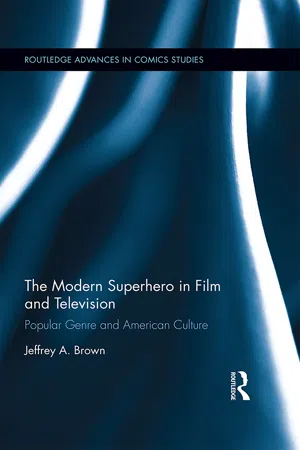
The Modern Superhero in Film and Television
Popular Genre and American Culture
- 182 pages
- English
- ePUB (mobile friendly)
- Available on iOS & Android
eBook - ePub
About this book
Information
1 Hollywood Superheroes
Commercial Economy, Spectacle, and the Universe
During the opening routine of the 2015 Academy Awards, host Neil Patrick Harris performed a whimsical song about the importance, emotional appeal and inspiring power of Hollywood films. Part way through the number, comedian Jack Black, who was sitting in the audience, interrupted with a more critical verse. Black sang: “This industry’s in flux, it’s run by mucky-mucks, pitching tents for tentpoles and chasing Chinese bucks. Opening with lots of zeroes, all we get is superheroes. Superman, Spider-Man, Batman, Jedi man, sequel man, prequel man. Formulaic scripts.” After a brief exchange, Harris resumed his optimistic song and Jack Black returned to the audience in mock disgust. But the intrusion of an alternative perspective voiced by Black humorously exposed some of the tensions that circulate around superhero movies. While the Academy Awards are designed to praise the best of the film industry there is no denying that Hollywood in the twenty-first century is dominated by superhero franchises. In fact, while the 2015 Awards celebrated the industry’s artistic achievements in 2014, the more important results of box-office success proved that Black was right. Six of the top 12 earners in 2014 were superhero movies (Guardians of the Galaxy, Captain America: Winter Soldier, X-Men: Days of Future Past, Big Hero 6, The Amazing Spider-Man 2, and Teenage Mutant Ninja Turtles) … seven if you count The Lego Movie that included a satirical version of Batman as a central character. The commercial dominance of superhero movies is indicative of the genre’s overwhelming popularity with moviegoers around the world. It also exposes the financial and corporate appeal of these characters for studios. Superheroes are the current bedrock of economic stability that helps sustain multi-billion dollar media empires. The overwhelming dominant genre of live action superhero films (and, to a lesser extent, television) is a product of industry changes within Hollywood’s corporate structure since the late 1990s, and reveals a complex commercial arrangement designed to capitalize on global markets, digitization and transmedia properties.
As perhaps the most visible component of the modern media landscape, Hollywood films have become increasingly important properties well beyond just their box-office revenues. While the movie industry has always been profit driven, the necessity for a select few film franchises to anchor the profit margin of multi-media corporations has become more and more crucial. Hollywood’s relatively recent large-scale embrace of superheroes is born out of economic necessity as much as it is from cultural desires to see comic book heroes brought to life. In his chronicling of the shifting corporate structure of the Hollywood film industry, Thomas Schatz argues: “The most salient development in contemporary Hollywood has been the formation of the so-called Big Six media conglomerates and their hegemony over the American film (and TV) industry” (2009: 21). Changes to corporate legal and international regulations in the late 1980s and 1990s led to sweeping merger-and-acquisitions in order to consolidate and maximize entertainment distribution and profits. The resulting Big Six of American media corporations include Disney, Time-Warner, Viacom, NBC Universal (GE), CBS Corporation, and Newscorp. Between them these conglomerates are estimated to control over 90 percent of all the media produced in America. Each of these six parent corporations own dozens of film studios, television networks, publishing organizations, internet properties, record labels, radio stations, gaming studios, theme parks, and shopping outlets. The complex industry model utilized by all of the Big Six corporations relies on being able to leverage their entertainment products for maximum exposure and profit through all of their interrelated holdings. As Tino Balio notes in her discussion of contemporary Hollywood: “The CEOs of the media companies are clear and unequivocal about what they want from their movie studios – more and bigger franchises that are instantly recognizable and exploitable across all platforms and all divisions of the company” (2013: 25). In this context, superhero films satisfy a corporate need and represent the pinnacle of millennial Hollywood industrial practices.
Early big budget superhero movies provided evidence of the efficacy and profitability of marketing and selling single characters across a range of formats. The unprecedented success of Richard Donner’s Superman (1978) starring Christopher Reeves demonstrated the immense popularity of superhero movies and enjoyed a significant boost from the sale of related merchandising. More importantly, the release of Tim Burton’s Batman (1989), starring Michael Keaton, established the enormous impact that cross-media promotions and corporate synergies could create around a single popular film. The merger of Warner Communications Inc. (which had purchased DC Comics in 1971) with Time Inc. just months prior to the release of Batman positioned DC Comics and their characters as subsidiaries of the newly formed media giant Time-Warner. DC Comics granted the rights to a Batman film to independent filmmakers Peter Gruber and Jon Peters who produced the film for distribution under Warner Brothers. With the newly consolidated Time-Warner funding and distributing the property, Batman became a juggernaut of cross promotion marketing and merchandising through multiple Time-Warner media holdings. In her insightful analysis of Batman as a corporately owned commercial intertext, Eileen R. Meehan (1991) charts the various ways that Time-Warner promoted and capitalized on Batman via in-house subsidiaries including their music division for the soundtrack and related albums, their publishing division for book and comic book adaptations, MTV for repeated airings of the Prince “Batdance” video, and so on. “The film per se becomes only one component in a product line that extends beyond the theater,” Meehan argues, “even beyond our contact with mass media, to penetrate the markets for toys, bedding, trinkets, cups and other minutiae comprising one’s everyday life inside a commoditized, consumerized culture” (1991: 49). This type of synergistic cross-promotion of a single intertext—Batman the movie—became a corporate model for maximizing the potential profits made available by superhero characters. Of course, it is also a strategy utilized to great affect by a range of popular culture properties, like Star Wars, Harry Potter and James Bond, but the long history and cultural recognizability of superheroes increases their stock market potential.
With the benefit of being in-house Time-Warner properties, the Christopher Reeves’ Superman franchise and the Michael Keaton Batman (though Keaton was replaced by Val Kilmer and then George Clooney for the third and fourth films) allowed DC Comics’ superheroes to greatly outpace their rivals at Marvel in feature films. Despite the drastic decline in the quality and popularity of each series’ later installments, Superman and Batman established the possible blockbuster status of superhero feature films. In contrast, Marvel, without the economic and industrial security of a major media corporation behind them, suffered financially throughout the late 1980s and 1990s. In fact, by the late 1990s Marvel was in bankruptcy as the comics industry went into sharp decline following an early 1990s boom period when fans and speculators flocked to comics and a range of new creator-controlled publishing companies flooded the market. To augment their losses, Marvel was forced to license out some of their most popular characters to different film studios which resulted in several unremarkable low budget films, including The Punisher (1989) starring Dolph Lundgren, The Fantastic Four (1994) with little-known actors, and the made-for-TV movie Nick Fury: Agent of S.H.I.E.L.D. (1998) featuring David Hasselhoff in the title role. The fortunes of Marvel based feature films began to turn in 1998 with the somewhat surprise success of New Line Cinema’s adaptation of Blade. Blade is a relatively minor character in the Marvel Comics line-up, but one with a dedicated fan base, who straddles the superhero and horror genres as a half human and half vampire who hunts monsters. The film version of Blade, starring Wesley Snipes, emphasized the vampire hunter aspect of the character rather than positioning him as a superhero. Blade made over $70 million at the box-office and garnered two sequels, Blade II (2002) and Blade: Trinity (2004), and a television series Blade: The Series (2006). Following the success of Blade, the Marvel based films X-Men (2000) from 20th Century Fox and Spider-Man (2002) from Sony-Columbia became landmark blockbusters and ushered in the current era of superhero feature film dominance. Directed by Bryan Singer, X-Men earned $158 million and spawned seven sequels/reboots/spin-off films thus far. Likewise, the Sam Raimi directed Spider-Man made over $400 million at the box-office and has had four sequels and reboot films, with several more on the horizon.
Inspired primarily by the popularity of the Blade, X-Men, and Spider-Man series, as well as the smaller successes of two Fantastic Four films (2005 and 2007) by 20th Century Fox, and bolstered by the profits from licensing out these characters, Marvel took the bold step in 2005 of establishing their own film production division, Marvel Studios, in order to maintain creative control of their remaining characters and with the goal of developing an interrelated universe of superhero adventures. Not all of the Marvel licensed properties developed by various studios performed as well at the box office as was hoped. The 2003 films Daredevil by New Regency Pictures and Hulk by Universal Pictures each earned over $100 million but were derided by critics and comic book fans, thus threatening the overall appeal of Marvel movie franchises. While Marvel had exerted some influence on the development of the film characters licensed out to various Hollywood studios, primarily through the executive production of Avi Arad and Kevin Feige, the executives at Marvel believed their fully developed and integrated comic book universe could provide a new model for feature film franchises that would maximize cross-promotion, and could appeal to a wide audience. Marvel Studios’ first independent release Iron Man (2008) was a critical and financial triumph ($320 million) and established a new approach to film properties. As Derek Johnson (2012) argues in his excellent review of Marvel Studio’s development of industrial convergence: “Marvel launched a unique model for cinema production in the age of convergence: an independent company with expertise in a different media industry drove block-buster film content” (52). Under the leadership of Kevin Feige, Marvel Studios built upon the success of Iron Man and its sequels (2010, 2013), with the feature film versions of The Incredible Hulk (2008), Thor (2011), and Captain America: The First Avenger (2011). The distinctive value of the Marvel Studio brand was leveraged in the promotional material for each new project with the posters for Thor declaring “From the Studio that brought you Iron Man” and the one for Captain America noting “From the studio that brought you Iron Man and Thor.” The coherent and interrelated vision Marvel Studios brought to their films proved popular with audiences as every film they developed became more and more profitable. The Marvel film division became so lucrative that in 2009 Disney bought Marvel for just over $4 billion and retained Feige to continue developing Marvel feature films.
By setting all of the Marvel Studio films in the same fictional world, both before and after being purchased by Disney, Marvel was able to create the Marvel Cinematic Universe (MCU) that mirrors the world of Marvel comics. All of the events and characters in Marvel Studio films exist in the same reality, which not only pleased fans but also facilitated promotion of the entire Marvel Cinematic brand across films (and television, games and merchandising). The unprecedented interlinking of the Marvel Cinematic Universe began with the conclusion of Iron Man during a post credit scene where Nick Fury (Samuel L. Jackson) approaches Tony Stark (Robert Downey, Jr.) about possibly joining the Avengers Initiative he is putting together. Similar scenes appeared at the end of The Incredible Hulk, Thor, and Captain America: The First Avenger, thus setting the stage and whetting audience anticipation for the mega-blockbuster team-up The Avengers (2012). Moreover, characters started cross-populating each other’s films in cameos and supporting roles, and several key objects (or Easter Eggs as fans refer to them) from comic book storylines, like the Cosmic Cube and the Infinity Stones, appeared in various films to lay the groundwork for major integrated plotlines that will become the focus of future MCU films. By crafting a cohesive diegetic universe rather than just a series of completely distinct and self-contained superhero franchises, the MCU could develop any number of other Marvel properties that do not have the built-in recognition of some of their biggest characters. The “From the studio that brought you…” tagline on promotional materials allowed past successes to be an endorsement for more unusual heroes. For example, the film version of little known Marvel comic book Guardians of the Galaxy declared on its early posters that it was from the makers of Iron Man, Thor, Captain America and The Avengers, thus firmly situating an outer space adventure as part of the superhero genre and the Marvel Universe. Even more explicitly cross-referenced was the campaign for Ant-Man with a series of posters depicting the tiny, shrinking hero perched on Iron Man’s shoulder, on Thor’s hammer, and on Captain America’s shield with the text declaring “From the studio that brought you The Avengers. No Shield. No Hammer. No Problem.” The general public may not have known who Ant-Man was but the campaign clearly marked him as a hero in the same vein as Marvel’s other successes.
It was this push for an interconnected universe that made Marvel Studios a desirable property for Disney CEO Robert Iger. Many critics and market analysts derided Disney’s $4 billion dollar purchase of Marvel because several of the company’s most popular characters were already under license to rival studios, including Spider-Man to Sony and the X-Men to Fox. Disney’s stock value actually sank significantly when the Marvel purchase was announced. But when Iger met with Feige in 2008, he recognized the potential of a franchise not linked just to specific characters. “They live and breathe Marvel full time just like the Pixar folks live and breathe Pixar full time,” Iger claimed in interviews, comparing Marvel to Disney’s most profitable film acquisition to date,
And then there were the films Marvel had in development. They were interconnected and primed the audience for not just one Avengers feature but also a sequel. They had a huge road map that took them well into the future.
(Leonard 2012: 68)
The continued success of Marvel films under Disney has disproven industry naysayers and demonstrated the appeal of interweaving storylines that contribute to the sense of a cohesive cinematic universe. In contrast to traditional franchise economics that assume a 10–30 percent decrease in returns, the sequels to Iron Man, Thor and Captain America have actually seen an increase in ticket sales. Moreover, the pinnacle of this interconnected universe, The Avengers, became the third highest grossing film of all time, earning over $1.5 billion and a sequel, Avengers: Age of Ultron, which grossed over $1.4 billion.
The incredible popularity of the Joss Whedon-directed Avengers films was not solely due to their quality as films and the elaborate lead up to combining multiple characters from different individual movies. The Avengers was also a high point in modern media convergence, advertising, and cross-promotion with the full weight of the Disney empire invested in its success. As an article about Kevin Feige and Marvel films in Bloomberg Businessweek noted:
The Avengers didn’t triumph at the box office only because it was a good movie. Until then, most of Marvel’s films had been distributed by Paramount Pictures. Disney threw every division of the company, from theme parks to television to consumer products, behind The Avengers. “All Paramount cares about is the distribution fee,” says Iger. “Now that we distribute these movies, it’s not about a fee. It’s not even about box office. It’s about the entire entity doing well, which ultimately lifts the Disney stock.”
(quoted in Leonard 2012: 68)
With a five-year plan leading up to the summer 2012 release of The Avengers, Disney promoted, merchandised and licensed The Avengers to maximum effect across every conceivable platform and targeted multiple demographics. For children there were toys, games, costumes, clothing, candy, cereal, and new cartoons including The Super Hero Squad Show for pre-schoolers, and The Avengers: Earth’s Mightiest Heroes and Marvel’s Avengers Assemble for grade school kids. Clothing, shoes, skateboards, hats and a variety of computer games were targeted at teenagers. For adult consumers there was a range of higher priced merchandising from clothing to limited edition statues and replicas to automobile promotions. Disney set up hundreds of licensing and retail deals for Avengers products with the likes of Hasbro, Hallmark, Lego, Under Armour, Dr. Pepper, Wal-Mart, Toys ‘R’ Us, Target, and Forever 21. According to the merchandising trade magazine License! Global:
The evolution and expansion of The Avengers is not only an example of Disney Consumer Products’ commitment to franchise development, but it is also a benchmark case study of how a big screen blockbuster is morphing into a bona fide, year-round tentpole brand.
(Lisanti 2013: 122)
In a larger sense, the MCU solidifies the Marvel brand as a financial juggernaut well beyond just a blockbuster film. The License! Global Article also noted that while the film made an impressive $1.5 billion in ticket sales, even that phenomenal earning paled in comparison to the profits from related merchandise: “on the licensing side of the business, the Marvel franchises represent $6 billion in retail sales of licensed merchandise worldwide in 2011” (Lisant...
Table of contents
- Cover
- Half Title
- Title Page
- Copyright Page
- Dedication
- Table of Contents
- Introduction: The Live-Action Superhero Genre
- 1 Hollywood Superheroes: Commercial Economy, Spectacle, and the Universe
- 2 Supermen and Wonder Women: Gender Ideals and Live-Action Superheroes
- 3 Superheroes Rewriting 9/11 and Remasculinizing America
- 4 America, Nostalgia, and Exceptionalism
- 5 Diversity and Marginalization
- 6 Spoofs, Parody, and Camp
- Conclusion: Superhero Fatigue?
- References
- Index
Trusted by 375,005 students
Access to over 1.5 million titles for a fair monthly price.
Study more efficiently using our study tools.
Frequently asked questions
Yes, you can cancel anytime from the Subscription tab in your account settings on the Perlego website. Your subscription will stay active until the end of your current billing period. Learn how to cancel your subscription
No, books cannot be downloaded as external files, such as PDFs, for use outside of Perlego. However, you can download books within the Perlego app for offline reading on mobile or tablet. Learn how to download books offline
Perlego offers two plans: Essential and Complete
- Essential is ideal for learners and professionals who enjoy exploring a wide range of subjects. Access the Essential Library with 800,000+ trusted titles and best-sellers across business, personal growth, and the humanities. Includes unlimited reading time and Standard Read Aloud voice.
- Complete: Perfect for advanced learners and researchers needing full, unrestricted access. Unlock 1.5M+ books across hundreds of subjects, including academic and specialized titles. The Complete Plan also includes advanced features like Premium Read Aloud and Research Assistant.
We are an online textbook subscription service, where you can get access to an entire online library for less than the price of a single book per month. With over 1.5 million books across 990+ topics, we’ve got you covered! Learn about our mission
Look out for the read-aloud symbol on your next book to see if you can listen to it. The read-aloud tool reads text aloud for you, highlighting the text as it is being read. You can pause it, speed it up and slow it down. Learn more about Read Aloud
Yes! You can use the Perlego app on both iOS and Android devices to read anytime, anywhere — even offline. Perfect for commutes or when you’re on the go.
Please note we cannot support devices running on iOS 13 and Android 7 or earlier. Learn more about using the app
Please note we cannot support devices running on iOS 13 and Android 7 or earlier. Learn more about using the app
Yes, you can access The Modern Superhero in Film and Television by Jeffrey A. Brown in PDF and/or ePUB format, as well as other popular books in Media & Performing Arts & Film & Video. We have over 1.5 million books available in our catalogue for you to explore.