eBook - ePub
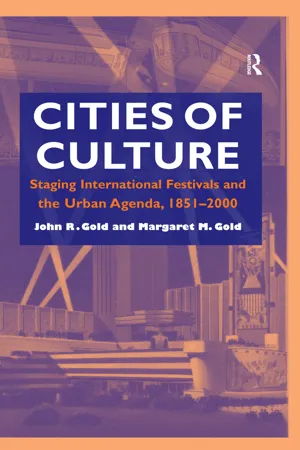
Cities of Culture
Staging International Festivals and the Urban Agenda, 1851–2000
- 326 pages
- English
- ePUB (mobile friendly)
- Available on iOS & Android
eBook - ePub
About this book
City authorities in recent years have competed vigorously to gain the right to host international festivals. In doing so they are heirs to a long tradition, since cities have always served as a natural location for festivals and fairs, providing settings on a scale impossible elsewhere. Cities of Culture examines the role of the Western city as the scene of staged cultural events over the last 150 years. Adopting a lively comparative perspective, it highlights the development of international festivals since London's Great Exhibition of 1851. Making extensive use of case studies and illuminating examples, it offers thought-provoking insight into the material and symbolic significance of international festivals in urban affairs. The book opens with an historical analysis of the role of the city as centre for celebrations, rites and festivities from Antiquity to the French Revolution. The next three sections of the book each focus on a different form of international festival. The first deals with the history of staging the International Expositions, with case studies of the Great Exhibition (1851), New York's World's Fair (1939-40) and Montreal's Expo 67 (1967). The next part covers the Summer Olympic Games from their revival at Athens in 1896 to the Atlanta Games (1996), discussing the implications of their fluctuating fortunes for their host cities. The third section discusses the history of a recently-founded event that is assuming ever-greater importance - the European Cities of Culture programme. The conclusion provides an overview of the events that celebrated the Millennium and examines the prospects for international festivals as part of the urban agenda of the twenty-first century. Cities of Culture will appeal to students of cultural history, urban and cultural geography, specialists in arts and heritage events management, and anyone with an interest in the development of the contemporary Western city.
Chapter One
Introduction
After the Midway, Grace and I decided to take a gondola ride, A maze of canals wove through the exposition to create an illusion of Venice – a sweet-scented, idealized Venice, and after the Midway a haven of peace. We glided beneath carved bridges decorated with classical sculpture; we passed hanging gardens and miniature waterfalls. The exposition's extravagant Spanish Renaissance architecture surrounded us in a riot of colours, from red to warm ivory. ... Was it beautiful, this city of the imagination brought to life? From here on the gondola it was. From here it seemed eternal; there was no sense that it was merely a plaster stage set that in six months would be bulldozed back to farmland.
Lauren Belfer (1999, 317–18)
In July 2002, athletes from 71 countries assembled in Manchester in northwest England to attend the seventeenth Commonwealth Games. Although less prestigious than premier sporting festivals like the Olympics or football's World Cup, the Commonwealth Games are still events of some pedigree. The current series was inaugurated as the British Empire Games at Hamilton (Ontario, Canada) in 1930 and, apart from the break caused by the Second World War, has been held at four-yearly intervals ever since. The Empire Games were themselves effectively heirs to the sporting competitions that started at the Festival of the Empire in London (1911). Those, in turn, traced their origins back to 1891 when John Astley Cooper, an Australian living in London, proposed the establishment of a periodic Pan-Britannic festival to celebrate the industrial, cultural and athletic prowess of the Anglo-Saxon race (Moore, 1991; see also Chapter 6).
This brief genealogical sketch indicates that, like many other such events, the Commonwealth Games occupy a distinct niche in international affairs that transcends sporting contests. Although some would see its rationale as part of a former colonial nation's attempts to preserve its past dominance by surrogate means, the Games undoubtedly bolster links between a geographically disparate group of states with little in common other than their imperial past. Accompanying symbolism reinforces these ties. Like all major sporting festivals, the Commonwealth Games have embedded protocols. Manchester's opening ceremony, for example, featured the arrival of a special baton that had left Buckingham Palace, the Queen's London residence, on Commonwealth Day 2002 (11 March). The baton then toured the territories of member countries in Africa, the Caribbean, the Americas, Europe, Oceania, and Asia before arriving theatrically at the stadium on 25 July.1 The speeches, the unfurling of flags, parades and general spectacle testified to the rhetoric of an 'international family' assembling for its regular four-yearly meeting. Eleven days later, Queen Elizabeth II declared the Games closed. A prominent part of the rain-lashed closing ceremony – which included concerts, parades, and the inevitable fireworks – was the solemn promise that the participants would convene again in Melbourne (Australia) in 2006. The next family gathering thereby firmly entered the diary.
Ancillary activities enhanced the occasion. As with the Olympics, with which they share a close affinity, the Commonwealth Games grew out of a philosophy that regarded sports, the arts, technology and culture as interrelated enrichments of human life (see also Chapter 6). The sporting events were but the centrepiece of a multifaceted international cultural festival. Manchester entertained the twelfth Commonwealth International Sport Conference just before the Games (19–23 July 2002), which included the Annual Conference of the British Association of Sport and Exercise Sciences, and the eighth International Congress on Kinanthropometry. Elsewhere, the city's burgeoning arts sector, with its swathe of new museums, theatres and galleries, ran extensive programmes to cater for any spare time that visitors might have on their hands. Tourist and heritage attractions put on special events and gala evenings. Taken together with the Games, these activities substantiated the idea, at least in the minds of the city's planners, of Manchester as an important city of culture for 2002 and beyond.
This packaging of events around a major focus is now a common strategy. For Manchester 2002, staging the Commonwealth Games offered opportunities to boost the city's employment prospects and improve its potential for gaining inward investment. More specifically it provided a chance to initiate the regeneration of east Manchester – a 2800-acre (1120-hectare) area immediately east of the central business district that contains some of the city's most deprived districts. The Games required a new 38 000-seat venue to house the athletics events that, in turn, would convert into a state-of-the-art 50 000-seat football stadium.2 Manchester itself would gain from improvements to roads and other communications. More generally, there was the possibility of boosting the city's standing in the world. Although it bid in vain for the right to host the 1996 and then the 2000 Olympic Games, Manchester was nominated as the City for Drama in 1994 and selected as the location for the follow-up congress to the Rio Earth Summit (Girodano and Twomey, 2002, 52). Victory in the bidding process for the 2002 Commonwealth Games reinforced the city's growing confidence about its ability to compete on an international stage.
A survey3 carried out immediately after the Games argued that most of these objectives had been met. Construction and preparatory work generated substantial short-term economic returns, with northwest England witnessing the strongest growth in new industrial orders in the United Kingdom during 2001–2. The Games directly created 6000 temporary jobs and brought in £600 million in investment. Chris Clifford, regional director for the Council of British Industry, noted that:
Local companies have benefited from a huge procurement programme in all sorts of areas, ranging from the provision of uniforms to fencing, security and food. On top of that, there was a big upsurge in confidence, as businesses took pride in what Manchester and the northwest could achieve.
The survey concluded that the city gained a permanent legacy of improved transport, extra sporting facilities and a higher profile – a combination thought likely to attract 300 000 extra visitors a year to the region.4
Some months later, although dissenting voices questioned the underlying approach to policy (for example, Peck and Ward, 2002), the prevailing assessment remained dominantly positive. Unusually for such events, the seventeenth Commonwealth Games made a profit, some of which was returned to the bodies that donated the original funds. The British Government received around £2 million, Manchester City Council £3 million and Sport England £4 million. More generally, the Games had given 'a headstart' to the regeneration of east Manchester and imparted a lasting sense of achievement in the city as whole.5 When talking about the Games in advance, Manchester's political leaders were fond of using a sporting metaphor, which held that the city had to be as competitive as the sporting competitions that it sought to attract (Ward, 1998, 233). With critical reaction generally affirming that the goal had been accomplished, they had grounds for asserting that any future bids that Manchester made for international festivals would, at least, be taken seriously.
That sentiment had significance beyond Manchester. London, bidding for the 2012 Summer Olympics, had suffered a series of reverses that threw doubt on the United Kingdom's commitment to compete for such events. These included, among others, the failure to build a new athletics stadium at Pickett's Lock in the Lea Valley, which meant relinquishing the nomination to host the 2005 World Athletics Championship; repeated delays in rebuilding the national football stadium at Wembley, with endless wrangling over finance and design; and the high-profile financial failure of the Millennium Dome (see Chapter 9). Evidence of a city within the United Kingdom organising a successful event could only help the national cause. As one observer noted: 'The Manchester Games helped reverse the idea that Britain was incapable of providing the kind of tip-top facilities and support required by international sporting events.'6
International Festivals
Sporting events of this type, in turn, have a wider historical context. The last 150 years have seen exponential growth of large-scale, prolonged and spectacular celebrations of human achievements in the arts, sport and science (Bassett, 1993; Bianchini and Parkinson, 1993; Carreras, 1995). These 'international festivals', the term that we use here, are roughly equivalent to what other authors have called 'mega-events' (Roche, 1992, 2000; Spezia, 1992), 'meta-spectacles' (Bergmann, 1999, 13), 'hallmark events' (C.M. Hall, 1989), 'landmark events' (Hiller, 1990) or 'world festivals' (Proudfoot et al., 2000). They include gatherings ranging from sports meetings, garden festivals, song competitions, and arts festivals to major trades fairs, awards ceremonies, and scientific congresses. Some are held regularly in the same city. Others are ambulatory, rotating in a fixed sequence from city to city or staged in whichever city has successfully bid to hold them.
Yet although they may have different origins, the practices and protocols adopted cannot be seen in isolation. The organisers of major festivals seldom start from scratch when planning their programmes, but draw directly on the accumulated experience of previous festivals and, increasingly, also on the practices of related attractions such as modern theme parks. This broader context, of course, constrains as well as empowers. The consensus that underpins many festivals generally favours a predictable blend of pedagogy, family-oriented entertainment and spectacle as the formula for attracting sufficient numbers of visitors. Repeated applic...
Table of contents
- Cover
- Half Title
- Dedication
- Title
- Copyright
- Contents
- List of figures
- List of tables
- Preface and acknowledgements
- 1 Introduction
- 2 The Place of Spectacle
- 3 The Great Exhibition, London 1851
- 4 New York's World's Fair, 1939
- 5 Expo 67
- 6 The Making of the Modern Olympics
- 7 The World's Games
- 8 European Cities of Culture
- 9 The Millennium and After
- Bibliography
- Index
Trusted by 375,005 students
Access to over 1.5 million titles for a fair monthly price.
Study more efficiently using our study tools.
Frequently asked questions
Yes, you can cancel anytime from the Subscription tab in your account settings on the Perlego website. Your subscription will stay active until the end of your current billing period. Learn how to cancel your subscription
No, books cannot be downloaded as external files, such as PDFs, for use outside of Perlego. However, you can download books within the Perlego app for offline reading on mobile or tablet. Learn how to download books offline
Perlego offers two plans: Essential and Complete
- Essential is ideal for learners and professionals who enjoy exploring a wide range of subjects. Access the Essential Library with 800,000+ trusted titles and best-sellers across business, personal growth, and the humanities. Includes unlimited reading time and Standard Read Aloud voice.
- Complete: Perfect for advanced learners and researchers needing full, unrestricted access. Unlock 1.5M+ books across hundreds of subjects, including academic and specialized titles. The Complete Plan also includes advanced features like Premium Read Aloud and Research Assistant.
We are an online textbook subscription service, where you can get access to an entire online library for less than the price of a single book per month. With over 1.5 million books across 990+ topics, we’ve got you covered! Learn about our mission
Look out for the read-aloud symbol on your next book to see if you can listen to it. The read-aloud tool reads text aloud for you, highlighting the text as it is being read. You can pause it, speed it up and slow it down. Learn more about Read Aloud
Yes! You can use the Perlego app on both iOS and Android devices to read anytime, anywhere — even offline. Perfect for commutes or when you’re on the go.
Please note we cannot support devices running on iOS 13 and Android 7 or earlier. Learn more about using the app
Please note we cannot support devices running on iOS 13 and Android 7 or earlier. Learn more about using the app
Yes, you can access Cities of Culture by John R. Gold in PDF and/or ePUB format, as well as other popular books in History & World History. We have over 1.5 million books available in our catalogue for you to explore.