eBook - ePub
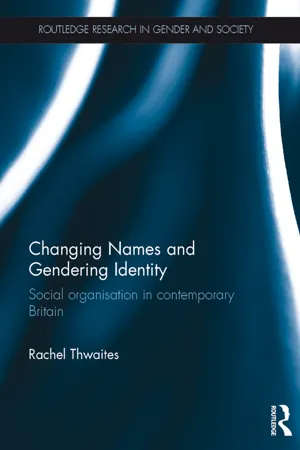
Changing Names and Gendering Identity
Social Organisation in Contemporary Britain
- 154 pages
- English
- ePUB (mobile friendly)
- Available on iOS & Android
eBook - ePub
About this book
This book investigates contemporary naming practices on marriage in Britain, drawing on survey data and detailed interview material in which women offer their own accounts of the reasons for which they have changed or retained their names. Exploring the ways in which names are used to create and understand family, to cement commitments and make it clear to the self and to others that subject is in 'true love', Changing Names and Gendering Identity considers the manner in which names are used to make sense of the self and narrate life changes and choices in a coherent fashion. A critique of the gender-blindness of sociological theories of individualisation, this volume offers evidence of the continued importance of traditions and the past to the functioning of contemporary society. In dissecting the everyday, taken-for-granted ritual of name changing for women on marriage, it sheds light on the nature of an enduring set of unequal gender relations which are used to organise society, behaviour and interpersonal relations. Engaging with questions of power, heteronormativity, and gender relations, this analysis of a significant ritual of contemporary heterosexual marriage will interest sociologists and scholars of gender studies with interests in the family, identity and gender relations.
Information
1 Introduction
The importance of names to gendered social organisation
Names both single us out and link us in. They are a symbol of our individual identity and yet also of our collective identity, with first names usually chosen by others, sometimes in honour of others or for a particular meaning, and last names representative of family, history, and genealogy. Geographical, ethnic, cultural, or other ties may be made clear through names; they have both specific and general resonances. They are an important part of cultures and are not given, taken, or shared randomly; they are understood within cultures and their specific boundaries. Without names, we cannot address one another or make it clear whom we are discussing; without names, we become a mass with no public individuality. Names are a part of delineation, organisation, collectivity, and individualism. They act as an identity ‘hook’ and are therefore a part of the process of calling ourselves selves and thinking of ourselves as individuals with significant and important life stories, tied up by the public (and private) symbol of that life – the name.
The last name, which is the real focus of this book, is also intimately connected with ideas of kinship, genealogy, and history, both personal, familial, and societal. It acts as a means to differentiate one Catherine from another, but also to connect that Catherine in with others and make it clear who she belongs to, who belongs to her, and who she can count as family and kin. Names are a part of personal and wider social identities. Yet in a temporal moment of rapid social change, names are also more complex than ever before, and taking them, changing them, or retaining them displays these social changes and personal preferences, but also makes it clear where society has remained constant or attached to an idea of certain traditions and socially meaningful rituals. This book has one of these naming rituals at its heart – naming decisions on marriage – and will explore why it remains socially meaningful and significant to identity building.
Thus far sociology has left names a little in the background (Finch, 2008). Yet, names are a prime means of social organisation. Last names may seem unproblematic, almost natural, in the way they are passed along, taken, shared, or disposed of at certain points in a life, but this is to ignore the specific patterns involved in that passing, taking, sharing, and disposing. In the case of marriage, ignoring the gendered patterns of naming is to accept and silence the more subtle ways in which gender remains significant to how we live our lives and construct our sense of self.
The name (both first and last together) is a significant symbol of our identities, both in a bureaucratic and a personal sense. The name is an important symbol of who a person is, and a sense of identity can be built up around this symbol; yet women are asked to change their last name at pivotal moments in their lives. Schimmel argues that the name and the person named are one and the same (Schimmel, 1989: ix) – they are interchangeable symbols for one another, so closely related that to think of one is generally to conjure up an image of the other. Even when a person’s name is simply written on paper, the name will produce images and have connotations for the reader, who will attempt to classify that person based on what is before them. Without a name, a person cannot legally exist and cannot be properly referred to in conversation between people. The name becomes a symbol of life events, achievements, and the actions of the person named, and therefore represents the person’s worth in society. Even after death, the idea of burying a body without a name is seen as tragic and prevents families from properly moving on (Bodenhorn and vom Bruck, 2009: 1).
The name goes beyond the letters grouped together to make a word or a means of distinguishing people from one another. It is invested with emotion and is a part of social organisation, as well as social ideals. Some of those I have spoken to about my project have become irate at the suggestion this needs to be investigated and my emphasis on the need to explore a wider range of possibilities for naming. The very idea that women should consider other options can produce anger, personal questioning, and a desire to have me validate my entire ideological and political standpoint; there has also been excitement, interest, and instant understanding of the project’s aims. There is much wrapped up in these reactions and some connect with the experience of my participants, which will be discussed further throughout this book. Significantly though, names – how we use them, and what they mean – are not value-free. They are an important part of our social organisation and therefore reflect social and cultural values. Our use of names remains political.
As well as this, names are a part of the everyday, and it is the everyday and mundane which underpins our social world and workings. Though more spectacular events may occupy much sociological thought, the everyday is increasingly recognised as important to interrogate (Smart, 2012). The everyday shows us clearly what is meaningful in a society, what ‘oils the wheels’ of social relations, what is lauded and what undermined. Without a desire to probe the seemingly innocent parts of our lives, there is little possibility of coming to any greater knowledge of how society works. As Hockey et al. (2010) show in their work on heterosexuality, the things we take for granted, things that we can often hardly articulate our reasons for acting upon and being attracted to, are often the most significant practices and social organisers in any given society.
Major themes
Tradition and choice
This book will explore a number of ways in which names are significant to (gendered) identity building and social organisation, building on the thoughts and experiences of the women who took part in this research (more on the sample in Chapter 2). The substantive chapters will explore tradition, choice, feminism, love and heterosexuality, family, expressions of selfhood, and transgression. Chapters 3 and 4 will examine two major justifications for name changing – tradition and individual choice – which between them suggest the naming decision can be seen as one entirely without agency or one entirely with agency. It is a decision with a long past (though not equally as long in every part of the United Kingdom, as will be seen below) and therefore tradition can be safely appealed to as a reasonable reason for wishing to change a last name.
Shils argues that ‘All existing things have a past’ (1971: 122). In moments of both change and consistency, the past of an event, process, or person is pertinent and cannot be dismissed (1971: 122). As Adams says, the past continues to influence us all through its ‘codes of practice’ (2003: 227). These codes of practice are the traditions and norms passed down from one generation to the next. As May argues, ‘traditions have not disappeared, but rather remain important features of contemporary societies though their nature and role may have shifted’ (Vanessa May, 2011: 365). People use the practices that have become fairly stable over time to help guide their decisions in the present (Young in Vanessa May, 2011: 366). They may well act with little knowledge of what they are doing rather than in a deliberate and careful manner (Vanessa May, 2011: 367), but enacting these social norms within lived relationships gives them continued meaning. Our traditions remain alive, meaningful, and significant to action, but the assumptions they carry will stem from a past historical moment.
This focus on the past and its importance may seem to jar with individualisation theories, which have become so important to recent sociological debate (Giddens, 1996; Bauman, 2003; Beck and Beck-Gernsheim, 2010). The theories of these four major theorists of late modernity will be discussed in more detail in Chapter 3, but the overall sense is of a loosening of tradition. This narrative of choice, increasing freedom for the individual, and the suggestion therein of more happiness and fulfilment in life is powerful – my data are testament to this. However, the continued use of the name change clearly displays the equal significance of tradition and well-understood ritual acts within British society. The tension between the need to reach out to and make use of traditions, while appealing to a narrative of choice and freedom, comes through in the stories of the name changers.
Feminism
This significant narrative of choice is one often linked to feminism and the opening up of new possibilities to women in all aspects of their life (see for example, Snyder-Hall, 2010). In Chapters 4 and 5, I will explore the importance of a feminist narrative to the name retainers as a justification for their actions, but also the tensions between feminism and choice, which have concerning links to a more neoliberal agenda (Craven, 2007), where ‘choice’ is co-opted to maintain the status quo by not interrogating why certain decisions are made. Saying one is following a norm as an individual ‘choice’ can actually be a means of masking the maintenance of gendered, hierarchical social relations.
Scholarship on names has focused on identity building and feminism in the main, and the complex interactions between them, particularly within the American cultural context (Foss and Edson, 1989; Spender, 1998; Mills, 2003; Goldin and Shim, 2004; Suter, 2004; Hoffnung, 2006; Laskowski, 2010; Hamilton et al., 2011). This theoretical background shows clearly the continued importance of tradition in decision-making around names (Suter, 2004) and explores the possibilities for better understanding the more subtle ways in which patriarchy is maintained in contemporary (Western) societies (Hoffnung, 2006; Hamilton et al., 2011). The individual (self) and the collective (family; others) continue to be pitted against one another in discussions of naming, with Hamilton et al. (2011) suggesting a stronger connection with a liberal individualism when non-traditional naming options are supported and a more collective and traditional outlook when they are not. This literature also makes clear the connection of non-traditional naming options – that is not changing one’s name – with feminism and the complex and even conflicting identity categories women may feel a need to contend with in forming a coherent sense of self (Mills, 2003). This literature therefore acts as both context and also a means of validating my own data, which is in accord with this, mostly American, research.
Love, emotion work, and heterosexuality
In Chapter 6, I will explore love, emotion work, and heterosexuality. Heterosexuality is ‘a largely silent principle of social organisation’ (Johnson, 2005: 5). It is something taken-for-granted, presumed to be ‘natural’ and therefore not worth investigating. This is not to suggest that work critiquing heterosexuality has not occurred, because such work can be traced back to the 1970s (Jackson, 1999: 2), but that too little attention has been paid to it. Both heterosexuality and love are often presented as timeless, ‘trans-historical and universal’ (Johnson, 2005: 40). They are seen as ‘natural’ parts of human society and love as a deeply held emotion which can barely be described, never mind subjected to scrutiny (Jackson, 1993: 201). This leaves major structures within our society under-researched and badly understood: love should not be thought of as an unchanging emotion, entirely natural and free from society’s influence, yet researchers are loath to tackle it seriously (Johnson, 2005: 45).
Heterosexuality, as Hockey et al. note, can be hard to research as it is barely articulated (2010: 2). Heterosexuals see themselves as the norm, and conversations about heterosexual relationships rarely foreground the fact a heterosexual relationship is being discussed: people use ‘vague yet important yardsticks’ to discuss how ‘good’ their relationships are (Hockey et al., 2010: 3). People are aware there is a way of being a heterosexual in that they worry over transgressing boundaries – what is not heterosexual can be described, but what is is more difficult (Jackson, 2003: 77; Hockey et al., 2010: 10). It pervades our lives yet remains ‘absolved from scrutiny, explanation, condemnation or tolerance’ (Hockey et al., 2010: 5); even if we do not define as heterosexual, we continue to be governed by it as it is such a dominant organising principle (Johnson, 2005: 11). As Rich famously defined it, heterosexuality is ‘compulsory’ (Rich, 1980) – it is seen as the ‘natural’ state, around which our society is structured. Thinking about heterosexuality as a specific identity rather than a natural given can cause consternation: the act of labelling – naming – this category is a political act in itself (Kitzinger et al., 1992: 297–298). Heterosexuality is not only natural, however, and to refrain from investigating it leaves this illusion intact, without interrogating the interests that are being served by its present existence (Ingraham, 2008: 16).
In approaching this complex system and attempting to destabilise it scholars have looked empirically at marriage and heterosexual coupledom, revealing power relations, the distribution of labour within the household, gendered emotion work, and the continued power of gendered roles (Leonard, 1980; Askham, 1984; Mansfield and Collard, 1988; Duncombe and Marsden, 1993; Jamieson, 2003; Hockey et al., 2010), some of which will be described in more detail below. Work looking at the convergence of class, gender, and respectability has helped to define the boundaries of heterosexuality and examined the ways in which women’s lives are organised by it (Skeggs, 2001).
Theorists have also interrogated heterosexuality on a theoretical level as an organising principle of society which is a normalised part of how the world is perceived and understood (Ingraham, 1996; Wittig, 1996; Beasley et al., 2012). Wittig described this as ‘the straight mind’ (Wittig, 1996: 146), which takes heterosexuality as a natural and given state upon which knowledges of the world can be built. Ingraham’s idea of the ‘heterosexual imaginary’ (1996: 168) is a similar idea of the way in which the world is perceived through a heterosexual lens, one which structures how the world is viewed. This, she argues, is most worrying when feminist sociologists take heterosexuality for granted and fail to investigate it critically, therefore reinforcing the patriarchal narratives they wish to undermine (1996: 181). Instead, heterosexuality must be problematised and its position of dominance destabilised: recognising its contours, complexities, and contradictions has become a project recognised as vital to feminism (Smart, 1998). Heterosexualities becomes a more salient term than heterosexuality (Smart, 1998: 179).
Feminist scholars have grappled with the tensions of living a heterosexual life, especially when one defines as a feminist (Ramazanoglu, 1992; Jackson, 1999: 11). Domestic living arrangements within heterosexual relationships have been a point of interest for much sociological research but, as Van Every argues, heterosexual domestic life does not have to equate to a hegemonic construction of – and lived experience of – heterosexuality (1998: 53). In attempting to re-imagine heterosexuality away from essentialist ideas of gendered power the argument that heterosexuality is a viable and possibly radical position for feminists to hold has begun to be discussed (Rowland, 1992). The tensions of living as a heterosexual who defines as a feminist will be discussed in Chapter 5, in reference to my participants.
As Jackson argues, everyday heterosexuality is experienced in a number of ways through various rituals, practices, and divisions of behaviour and routine (1999: 26). The ‘natural’ heterosexual relationship on which so much of social, political and economic policy is based includes the wedding as a pivotal (and taken-for-granted, ‘everyday’) moment. The relationships my participants have with their names may well have changed significantly on this day; they will each have had to reflect upon their name around this point in their lives, whatever their decision. Marriage is both an individual and a collective experience – people make choices for themselves and can be creative, but marriage continues to have a social and cultural aspect from which it cannot be severed, and which influences the decisions people make (Mansfield...
Table of contents
- Cover
- Title
- Copyright
- Contents
- List of figures
- List of tables
- Preface
- Author’s declaration
- 1 Introduction: the importance of names to gendered social organisation
- 2 Research design and methodology
- 3 Names and tradition
- 4 Names, ‘choice’, and gender
- 5 Power, politics, and naming
- 6 Maintaining the status quo? Love, heterosexuality, and emotion work
- 7 ‘Displaying’ and ‘doing’ family: genetics, social connection, and respectability
- 8 Names, (gendered) self, and society
- 9 Accounting for transgression
- 10 Conclusion
- Index
Trusted by 375,005 students
Access to over 1.5 million titles for a fair monthly price.
Study more efficiently using our study tools.
Frequently asked questions
Yes, you can cancel anytime from the Subscription tab in your account settings on the Perlego website. Your subscription will stay active until the end of your current billing period. Learn how to cancel your subscription
No, books cannot be downloaded as external files, such as PDFs, for use outside of Perlego. However, you can download books within the Perlego app for offline reading on mobile or tablet. Learn how to download books offline
Perlego offers two plans: Essential and Complete
- Essential is ideal for learners and professionals who enjoy exploring a wide range of subjects. Access the Essential Library with 800,000+ trusted titles and best-sellers across business, personal growth, and the humanities. Includes unlimited reading time and Standard Read Aloud voice.
- Complete: Perfect for advanced learners and researchers needing full, unrestricted access. Unlock 1.5M+ books across hundreds of subjects, including academic and specialized titles. The Complete Plan also includes advanced features like Premium Read Aloud and Research Assistant.
We are an online textbook subscription service, where you can get access to an entire online library for less than the price of a single book per month. With over 1.5 million books across 990+ topics, we’ve got you covered! Learn about our mission
Look out for the read-aloud symbol on your next book to see if you can listen to it. The read-aloud tool reads text aloud for you, highlighting the text as it is being read. You can pause it, speed it up and slow it down. Learn more about Read Aloud
Yes! You can use the Perlego app on both iOS and Android devices to read anytime, anywhere — even offline. Perfect for commutes or when you’re on the go.
Please note we cannot support devices running on iOS 13 and Android 7 or earlier. Learn more about using the app
Please note we cannot support devices running on iOS 13 and Android 7 or earlier. Learn more about using the app
Yes, you can access Changing Names and Gendering Identity by Rachel Thwaites in PDF and/or ePUB format, as well as other popular books in Sozialwissenschaften & Genderforschung. We have over 1.5 million books available in our catalogue for you to explore.