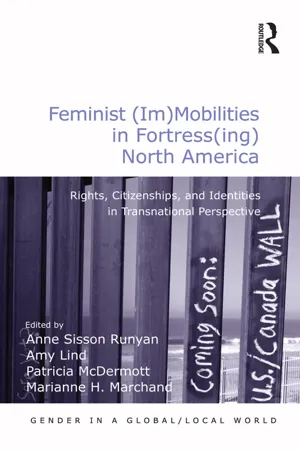
eBook - ePub
Feminist (Im)Mobilities in Fortress(ing) North America
Rights, Citizenships, and Identities in Transnational Perspective
- 278 pages
- English
- ePUB (mobile friendly)
- Available on iOS & Android
eBook - ePub
Feminist (Im)Mobilities in Fortress(ing) North America
Rights, Citizenships, and Identities in Transnational Perspective
About this book
Since the establishment of the North American Free Trade Agreement (NAFTA) tensions concerning immigration trends and policies, which continued to escalate at the turn of the millennium resulted in revised national security policies in Mexico, Canada, and the United States. These tensions have catalyzed the three governments to rethink their political and economic agendas. While national feminist scholarship in and on these respective countries continue to predominate, since NAFTA, there has been increasing feminist inquiry in a North American regional frame. Less has been done to understand challenges of the hegemonies of nation, region, and empire in this context and to adequately understand the meaning of (im)mobility in people's lives as well as the (im)mobilities of social theories and movements like feminism. Drawing from current feminist scholarship on intimacy and political economy and using three main frameworks: Fortressing Writs/Exclusionary Rights, Mobile Bodies/Immobile Citizenships, and Bordered/Borderland Identities, a handpicked group of established and rising feminist scholars methodically examine how the production of feminist knowledge has occurred in this region. The economic, racial, gender and sexual normativities that have emerged and/or been reconstituted in neoliberal and securitized North America further reveal the depth of regional and global restructuring.
PART I
Fortressing Writs/Exclusionary Rights
Chapter 1
Codifying Fortress North America: Receding Rights, Relative Sovereignties, and Gendered and Racialized Restructuring under NAFTA
Introduction
North America as an imagined community (Anderson 1983) is not a shared identity. Rather it is being constituted through the marriage of economic growth with territorial security, best represented by the notion of Fortress North America. The 1994 North American Free Trade Agreement [NAFTA] between Canada, Mexico, and the United States, is a framework intended to create a unified North American economy. After the September 11, 2001 attacks on the World Trade Center in New York, these three governments embarked on a strategy of deep integration where national defense and economic security would become inextricably linked. As of August 2009, the Joint Statement of the North American Leaders claims that global competitiveness, well-being, and security are goals that are “rooted in [the] shared values, complementary strengths, and the dynamism of our peoples” (White House 2009).
However, a number of critical and critical feminist studies contradict this assumption that there exists a North America with shared values that form the basis of trilateral cooperation (Adams 2003, Ipsos Reid 2004, Wolfe 2004, Barlow 2005, Lusztig and James 2005, Grinspun and Shamsie 2007, Ayres and Macdonald 2007, Clarkson 2008a and 2008b, Capling and Nossal 2009, Hay 2009). Moreover, as far as deep integration is concerned, often the claims of the Security and Prosperity Partnership (SPP) do not match the policy choices within each territory (Clarkson 2008a, Archibold 2010). And Stephen Clarkson (2008a) illustrates that in the Canadian context, talk of deeper integration is not considered to be a trilateral endeavor even among political and diplomatic elites.
If North America is not an imagined political community based on widely shared identities and values, then what is it? In this chapter, I argue that North America is not much more than a new legally constructed “… jurisdiction … in which a new philosophy of international investment is understood” (Factum of the Respondent 2005: paragraph 74), tantamount to a corporate fantasy in which security and prosperity are extended only to the few. To demonstrate this, I offer three “stories”—of security, sovereignty, and restructuring, particularly in the Canadian and Mexican contexts—that together reveal how market reforms precipitated before and after NAFTA have been secured at the expense of non-marketized human rights and security, state protection of marginalized populations and the environment, and the economic well-being of women, racial minorities, indigenous peoples, and the poor more generally.
My first story focuses on the securitization of economic reform as displayed in the brutalization and mass arrests of people protesting economic decline and the erosion of public services at the 2010 G8/G20 in Toronto in the wake of the onset of the economic recession in 2008. Despite people-centered narratives of human security issued by UN bodies, I argue that human rights and security have become predicated on market reforms and laws to protect them (and the territories in which they are implemented), and the language of human rights and security provides cover for the privileging of market-based economic restructuring and the (violent) suppression of protest against it. Thus, narratives of human security play a significant role in legitimating the institutional framework of multilateral trade agreements such as NAFTA, thereby obscuring the long-term effects of these kinds of agreements on the people who live in the states party to them, on the environment, and on other living beings. Because of this, the issue of state sovereignty, particularly the ability of governments to protect human rights and implement environmental protections, is brought into question and is central to debates around the effects of trade agreements such as NAFTA.
My second story therefore focuses on state sovereignty in the context of NAFTA through a focus on the Canadian Charter challenge to the Chapter 11 Tribunals of NAFTA. This unsuccessful court challenge was brought to release the Canadian government from the strictures of Chapter 11, which privilege the interests of corporations and private investors in policy-making and, thus, are implicated in worsening gender discrimination, human rights violations, and environmental degradation. That such challenges to NAFTA designed to (re) assert state sovereignty in the interests of people as opposed to private investors are necessary (although, I argue, not sufficient) is underscored in my final story on the economic restructuring of Mexico and Canada required for and since the ratification of NAFTA. The historical data presented show that this restructuring has been deeply gendered and racialized as well as classed, having the most negative impacts on the poor generally and women of color in North and South, im/migrants, indigenous peoples, and the elderly in particular. Thus, far from producing security and prosperity, NAFTA has delivered greater human insecurity in the region. Thus, I conclude that North America is best understood as a corporate fantasy, materializing as a fortressing and neocolonial project in which the rights of marginalized peoples across the region are further abridged, necessitating continued mobilizations for resistance.
Security for Market Reform
“Recovery and New Beginnings” was the theme for the G8 and G20 summit meetings held in Muskoka and Toronto in 2010 as part of the extended response to the global economic crisis of 2008 (Government of Canada 2010b). Police were mobilized from across the country and although reports vary, between 19,000 and 20,000 officers were engaged in the G8/G20 security project. Their tasks, according to Toronto Police Chief William Blair, were “to maintain public safety in public spaces” and “to protect the G20 security zone” (Toronto Police Service 2010). The arrest and detention of over 900 people some of whom were released without charges surpasses any mass arrest in Canadian history (Booth 2010, French and Jordan 2010, Mahoney and Hui 2010). The cost of this event was in excess of one-billion dollars, 900 million of which was devoted to security (Weltman 2010).
By June 25, 2010 when the first organized march against the G20 was to take place in downtown Toronto, there were widespread rumors that Ontario Premier Dalton McGuinty had conspired with Toronto Police Chief William Blair to pass a secret law extending the police powers (Yang 2010, Gridin 2010, Doctorow 2010). Although reports on the exact nature of this amendment vary, what this regulation supposedly did was empower the police to demand identification and search anyone within five meters of the security zone. Refusal to provide identification or to permit search and seizure would result in a fine or in certain cases arrest. The law in question was a purported amendment to the Public Works Protection Act [PWPA]. According to one local newspaper, this law was approved on June 2, 2010 through an order-in-council without debate in the legislature. It was supposedly discussed by the legislation and regulations committee of McGuinty’s cabinet before approval and published quietly on e-laws (Rider, Benzie, Ferguson and Doolittle 2010). However, it was later revealed that the version of the law enforced by police never actually existed on paper (Radwanski 2010, The Canadian Press 2010).
None of the PWPA, the imaginary new five-meter rule or the actual temporary amendment extended the powers of police to beat people. On the 25th June, I witnessed a man of color in a blue shirt being brutalized by a police officer. I learned later that he was deaf. Although his interpreter had been with him at the demonstration, he was denied an interpreter and legal council while in police custody. This occurred more than 2km away from the G20 security zone (Boesveld and Paperny 2010). I also learned that in the days following this incident police brutalized activists and community organizers while raiding their homes in the early hours of the morning, many people were arrested without warrants, and many more were subjected to violent and degrading treatment in the detention centre (Blackandred 2010a, 2010b, CBC 2010b, Draper 2010, Grindin 2010b, Groves 2010, Puscas 2010). While police suffered no serious injuries, according to nurse Sarah Reaburn and doctor Abeer Majeed of Toronto Street Medics, police inflicted severe injuries ranging from concussions to broken bones (Ship 2010; Defenestr8or 2010). Is this the road to recovery and new beginnings? Or is this simply the road already traveled for decades in the interest of trade liberalization.
This over one-billion-dollar event took place in a city where many of the people have been living in a state of economic crisis all of their lives (United Way 2007, YWCA 2008, Pollution Watch 2010, City of Toronto 2010a). The federal, provincial, and territorial governments of Canada have been consistently criticized by United Nations [UN] human rights treaty monitoring bodies for their failure to address poverty and for perpetuating economic and social conditions that exacerbate poverty, violence and other discriminatory practices against First Peoples, sexual minorities, differently-abled, racialized, and gender-based groups (Poverty and Human Rights Centre 2007, United Nations 1993, 1994, 1997, 1998, 1999, 2002, 2003, 2006a, 2006b, 2007a, 2007b). The Committee on Economic, Social and Cultural Rights [CESCR] has stated that Canada is a wealthy enough country that its governments, federal, provincial, and territorial, should “eliminate gaps in the area of poverty as a matter of priority” recognizing “the immediate nature” of its obligations under the Covenant and to “reconsider all retrogressive measures adopted [by the federal, provincial and territorial governments as a result of former Finance Minister Paul Martin’s federal budget] in 1995” (United Nations 2006a). Paul Martin is both one of the principal architects of the economic restructuring of Canada and the G20. He also exported his model of fiscal austerity from the 1990s to the United Kingdom in the wake of the 2008 economic crisis.
Neither the federal government of Canada nor the Ontario government has taken steps to honor the 2006 CESCR recommendations. And according to Ontario Coalition Against Poverty organizer John Clarke: “Today people would need a 55 percent increase in social assistance rates to bring them back to the level they were at … in the 90s” (quoted in Bonner 2010). Homelessness is not only a problem in Ontario but across the country and the food banks regularly run out of food (Poverty and Human Rights Centre 2007 Government of Canada 1994). Despite all of this the federal government of Canada could find roughly 10 percent of the 2010-2011 social transfer for all ten provinces and three territories in Canada to spend on security, accommodations including a resort and food, for an already wealthy group of politicians and their staff over a single weekend. In July of that same year, over twice the amount of total social transfer was found to pay for a fleet of fighter jets that will also require an estimated maintenance fee of almost 30-billion US dollars to keep them operational (Campbell and Chase 2010,Yalkin et al. 2011).
Ten years ago, former Secretary General of the United Nations Kofi Annan rearticulated the vision of human security outlined in the 1994 Human Development Report of the United Nations Development Fund [UNDP]. This vision includes: the protection of communities and individuals from internal violence, freedom from want, fear and the freedom of future generations to inherit a healthy natural environment (UNDP 1994; Annan 2000, 2001). In 2010, current Secretary General of the United Nations Ban Ki-moon reasserted this vision calling for strong and stable institutions and people-centered reforms to aid in the goal of enhancing economic growth while ensuring “that the gains of today are not lost to the crises of tomorrow” (United Nations News Service 2010). It would seem, however, that this vision of security is being systematically ignored in all three of NAFTA countries and the other G20 countries. Violent, militarized police forces combined with irreparable physical and psychological harm have become some of the hallmarks of economic restructuring, trade talks and financial summits today. This kind of internal violence has occurred before at past G8 and G20 summit meetings, past summit meetings of the Americas, past EU summit meetings, past World Trade Organization meetings, in response to the current economic restructuring of Greece and the fiscal austerity measures introduced in the United Kingdom (Feffer 2005, Cutler 2009, Smyth 2009, Bilefsky 2010).
The claim that Annan and the UNDP’s combined vision was ignored in these examples, however, depends on how internal violence and violent conflict are understood. International narratives of human security lead to the equation: human rights + economic prosperity (growth and competition) + protection of territory and populations from internal and external violence + environmental protection = sustainable development (Annan 2000). The G20 statement reflects elements of this narrative (Government of Canada 2010b). The implementation of this larger narrative, however, often serves to “delegitimize social dissent in general” (Thede 2008: 35). For example, the violent suppression of dissent that occurred at the 2010 G20 meetings deflected media attention away from what the G20 were doing and cast those who publicly oppose the social effects of economic restructuring and trade liberalization as “terrorists,” “thugs,” and “hooligans” (Bell 2010, Calabrese 2010, Hui 2010, CTV 2010). But despite the violence, the ethos of the human security narrative was successfully implemented outside this summit: the human of human rights was successfully sutured to the militaristic defense of territory and the symbol of economic prosperity. Each individual member of the G20 was successfully defended from the rogue bodies of those unpredictable others. The terrorists, thugs, and hooligans who would breach the territorial boundary protecting the embodiment of economic prosperity that exists to foster economic recovery, “narrow the development gap” and “share best practices” for environmental protection (Government of Canada 2010b: paragraphs 44, 45 and 47). But, the narrative of human security is much larger than this.
This narrative is generally found in the literature on international development, the United Nations Millennium Development Goals and foreign aid in reference to countries variously called: “low-income”, “developing”, “under-developed”, “fragile”, “failed or “weak” states (Escobar 1994, Buzan et al. 1998, World Bank 2004, Bendana 2008). The outward looking progress narrative underlying this vision, a narrative that generally accompanies foreign policy initiatives that are invested in development or reconstruction projects, produces a set of ineffective states that need to be brought into line by the effective ones (Duffield 2001). Three ways to achieve this according to documents produced by the World Bank and scholars that support these initiatives are through market reform, the strengthening of financial institutions, and the imposition of the rule of law (Shihata 1997, de Soto 2000, Santos 2006, Trubek 2010). The 2010 G20 Summit Declaration reinforces these goals and adds that the International Monetary Fund (IMF) and International Financial Institutions are “platforms for our global cooperation” (Government of Canada 2010b: paragraph 10).
Canada, the United States, and Mexico, are considered developed countries that have undergone market reforms and are governed by the principles of the rule of law (Thede 2008). Yet, Annan and Ban Ki-moon’s visions seem like elusive prospects for many of the people that reside in all three of these countries. Each of these countries was significantly affected by the global economic crisis that has been repeatedly compared to the Great Depression of the 1930s (Spiegel 2008,da Costa and Lagorio 2009). Opportunities and choices had also been constrained long before and remain so: many people are struggling to meet subsistence level needs in all three of these countries. And Eugenia Correa and Mario Seccareccia (2009) describe in detail how the institutional structure of NAFTA exacerbated what began with the subprime mortgage crisis in the United States spreading an economic crisis that could have potentially been contained across the globe.
Underlying the reform strategy outlined in the 2010 G20 statement is the very same outward-looking progress narrative that accompanies the story of states that have achieved economic development—a strategy that according to Bruce Campbell (2010) reduced people to “collateral damage” in a “dangerous high stakes game.” This is a seeming contradiction to Ban Ki-moon’s call for people-centered reforms. Also underlying the outward looking progress narrative is a story about how integration and institutional reform are especially needed in those other places far away from here in order to stabilize the economic system by protecting it from the unpredictable others (Escobar 1994, Fox 2007). Within this narrative endures the pernicious story that if there is want and fear in the developed world, it is by and large because of the personal failings of individuals and communities, whether they be the corrupt bankers on Wall Street, the terrorists among us, or the poor people, not the failures of the rule of law, market reform, economic systems, public policies, or trade agreements that (re)produce regimes of competition where the corrupt bankers, the terrorists and the poor people are ultimately made possible (Thede 2008). The proposed G20 reforms continue this narrative by obscuring and denying the long-term deleterious consequences of trade liberalization, overproduction and overconsumption not only on those living in the “ineffective states” but also on those living in the developed world before, during and beyond the global economic crisis of 2008 (Government of Canada 2010b).
Receding Sovereignty
The Keynesian welfare state is often cited as the solution to the problems of market fundamentalism (James and Russell 1986, Moscovitch and Albert 1987, Baines et al. 1991, McQuaig 1993, McClean and Squires 2002, Correa and Seccareccia 2009). Keynes, however, was theorizing and his theories were applied at a time when markets coincided more directly with territorial boundaries, and the state functioned as a “buffer insulating the domestic economy from the vagaries of the international economy” (Grinspun and Kreklewich 1994: 35). Clarkson (2008a: 14) illustrates that since the first decades after the Second World War “accelerating technological and organizational interconnections” began to unravel the connection between markets and territorial boundaries. In the latter part of the twentieth century, the economic restructuring of countries whose governments entered into multilateral, bilateral, or regional trade agreements containing provisions like those found in the NAFTA, effectively eliminated the buffer through deregulation and undermined the capacity of these states to regulate the new global form that markets were taking. Ricardo Grinspun and Robert Kreklewich (1994) argue that trade agreements like the NAFTA serve as conditioning frameworks that restrict policy-making autonomy at the state level. In the case of Mexico the NAFTA was a consolidation of the restructuring that had occurred in the two decades before it, and in the case of Canada, NAFTA was the catalyst to promote this kind of large scale economic restructuring. Because there is not typically widespread popular support for the kinds of policy reforms that are required under NAFTA-style trade regimes, economic restructuring is often anti-democratic and elite driven. And the reforms generated to facilitate these trade regimes are locked in by the trade agreements and intended to be irreversible.
For instance, under Chapter 11 of NAFTA, investors can hold member governments accountable through international arbitration tribunals (Shrybman 2007, Clarkson 2008a). Because corporate entities can now claim damages against sovereign states directly under Chapter 11 of NAFTA and the arbitral awards can amount to significantly large sums of money, many argue that NAFTA provisions delimit national sovereignty by usurping the powers of domestic courts and interfering with member states’ ability to retain policy-making autonomy (Clarkson Affidavit 2004, Sornarajah Affidavit 2004). Although NAFTA Chapter 11 Tribunals cannot give directives to member states to amend or repeal domestic legislation, and domestic courts can review arbitral awards, the argument is that in order to avoid the possibility of costly arbitration, governments will tailor their policy choices to suit the interests of private investors (Factum of the Applicants 2004). The accompanying concern is that because private investors are primarily interested in profit, realizing their interests often involves engaging in practices that perpetuate discriminatory gender regimes, violate human rights and contribute to environmental degradation (Factum of the Applicants 2004).
This was the subject of the Canadian constitutional challenge to the NAFTA Chapter 11 Tribunals. In this case, the Attorney General of Canada argued, and both the Court of Appeal for Ontario and the Ontario Superior Court of Justice held, that concerns over policy-making autonomy and the usurpation of the powers of the Canadian Courts were unfounded. They also held that a consideration of possible breaches o...
Table of contents
- Cover Page
- Title Page
- Copyright Page
- Contents
- List of Figures and Tables
- List of Contributors
- Series Editors’ Preface
- Acknowledgments
- Introduction
- PART I FORTRESSING WRITS/EXCLUSIONARY RIGHTS
- PART II MOBILE BODIES/IMMOBILE CITIZENSHIPS
- PART III BORDERED/BORDERLAND IDENTITIES
- References
- Index
Trusted by 375,005 students
Access to over 1.5 million titles for a fair monthly price.
Study more efficiently using our study tools.
Frequently asked questions
Yes, you can cancel anytime from the Subscription tab in your account settings on the Perlego website. Your subscription will stay active until the end of your current billing period. Learn how to cancel your subscription
No, books cannot be downloaded as external files, such as PDFs, for use outside of Perlego. However, you can download books within the Perlego app for offline reading on mobile or tablet. Learn how to download books offline
Perlego offers two plans: Essential and Complete
- Essential is ideal for learners and professionals who enjoy exploring a wide range of subjects. Access the Essential Library with 800,000+ trusted titles and best-sellers across business, personal growth, and the humanities. Includes unlimited reading time and Standard Read Aloud voice.
- Complete: Perfect for advanced learners and researchers needing full, unrestricted access. Unlock 1.5M+ books across hundreds of subjects, including academic and specialized titles. The Complete Plan also includes advanced features like Premium Read Aloud and Research Assistant.
We are an online textbook subscription service, where you can get access to an entire online library for less than the price of a single book per month. With over 1.5 million books across 990+ topics, we’ve got you covered! Learn about our mission
Look out for the read-aloud symbol on your next book to see if you can listen to it. The read-aloud tool reads text aloud for you, highlighting the text as it is being read. You can pause it, speed it up and slow it down. Learn more about Read Aloud
Yes! You can use the Perlego app on both iOS and Android devices to read anytime, anywhere — even offline. Perfect for commutes or when you’re on the go.
Please note we cannot support devices running on iOS 13 and Android 7 or earlier. Learn more about using the app
Please note we cannot support devices running on iOS 13 and Android 7 or earlier. Learn more about using the app
Yes, you can access Feminist (Im)Mobilities in Fortress(ing) North America by Amy Lind,Marianne H. Marchand, Anne Sisson Runyan in PDF and/or ePUB format, as well as other popular books in Economics & Political Economy. We have over 1.5 million books available in our catalogue for you to explore.