Copyright © 2017 Pan Stanford Publishing Pte. Ltd.
1.1 Introduction
Light as a tool for cooling matter was considered already in 1929 by P. Pringsheim [1]. The experimental realization of the laser [2] paved the way for experiments on different laser cooling techniques. Among these, Doppler cooling of dilute atomic gases is probably the most common [3, 4 and 5], first successfully investigated in the 1980s [6]. As an important step, this technique along with further evaporative cooling allowed for the realization of Bose–Einstein condensation of different atomic [7, 8] and molecular species [9] and has today grown into a robust research area. An alternative approach for cooling is anti-Stokes cooling in multilevel systems, culminating, for example, in the cooling of solids. For the first time suggested in 1950 [10] and experimentally realized in 1981 [11], this technique leads nowadays to a significant cooling of heavy metal fluoride glass doped with, for example, trivalent ytterbium ions [12, 13].
In this chapter, we review results on laser cooling by redistribution of radiation in dense gas mixtures. Redistribution of fluorescence is a well-known effect observed in experiments of magneto-optically trapped atoms, where it acts as the main loss mechanism of the trap [5]. Considering atomic collisions at room temperature, redistribution of fluorescence is a consequence of collisional aided excitation [14]. In a theoretical work in 1978, P. Berman and S. Stenholm proposed a cooling mechanism based on collisionally aided fluorescence and the related energy loss in a two-level system [15]. Corresponding experiments with gases at moderate densities never reached the cooling regime [16]; only heating for blue-detuned excitation was observed for these conditions.
Using a high-pressure environment with a system of rubidium atoms subject to 230 bar of argon buffer gas, our group experimentally demonstrated laser cooling by redistribution of fluorescence in 2009 [17]. At the used buffer gas pressures of a few hundred bars, the optical transitions are broadened to linewidths that are in the same order of magnitude as the thermal energy, kBT, in frequency units, where kB is the Boltzmann constant and T the temperature of the gas mixture. To obtain an idea of the cooling principle in this regime, assume the formation of transient, alkali–noble gas quasi-molecules during each binary collision of the two species. The atomic resonances are thus perturbed by means of the rising intermolecular potential, allowing for absorption of far reddetuned incident radiation. For typical parameters, the radiative lifetime of the excited state exceeds the time of such a collision by 3 to 4 orders of magnitude, which is a few nanoseconds compared to picoseconds.
Subsequent decay of the excited state occurs mostly at larger interatomic distances where the alkali resonance frequency is close to its unperturbed value. In this manner, the mean emitted fluorescence has a smaller wavelength than the absorbed photon; thus energy in the order of the thermal energy is extracted from the sample, cooling the dense mixture.
In the following sections, we initially discuss the mechanism of redistribution of radiation in a more detailed way (Section 1.2) and subsequently present the experimental setup and the high-pressure chambers in Section 1.3. Experimental results will be reviewed throughout Sections 1.4 and 1.5, before concluding and giving an outlook in Section 1.6.
1.2 Redistribution of Radiation
Before discussing the cooling principle for the case of alkali–noble gas mixtures in more detail, we give a brief overview of the basic principle of redistribution of radiation.
1.2.1 Basic Principle
Collisionally induced redistribution of radiation is based on the interaction between an incident light field with an optically active atom of species A surrounded by perturbing atoms of species B. Binary collisions between atoms of the two species can lead to broadening of atom’s A resonances [18, 19]. This enables absorption/emission of radiation at a wavelength nonresonant to the free and unperturbed atom. The effect has been observed for the first time in strontium vapor at low buffer gas pressures [20], while a theoretical prediction can be found in Refs. [21, 22].
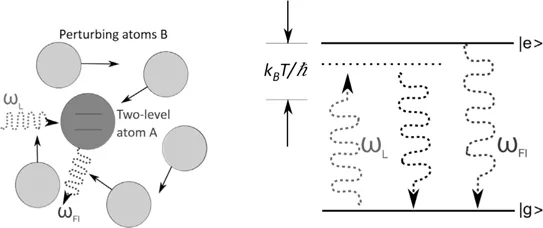
Let us consider photons with energy ħωL. We will further consider that the difference between the transition energy ħω0 and the photon energy is small compared to the thermal energy kBT of the perturbers. In this case, the photons are either scattered elastically in terms of Rayleigh scattering, or they are absorbed and reemitted as fluorescence (frequency ωFl) if the energy gap is overcome by energy transfer from the perturbing atoms. A schematic of the described process is shown in Fig. 1.1. Note that in the case of a multilevel atom A surrounded by perturbing atoms, it is possible to achieve excitation into levels that would be too far off resonant in the undisturbed case.
If we consider the collisional pair (A − B) to form a quasi-molecule at small interatomic distances, we can intuitively understand the redistribution process. When the collision takes place, the atom A absorbs the incident photon. The quasi-molecule is thus excited from the ground state into the excited state. Following the collision, the distance between the collisional partners grows and after its 1/e natural lifetime—which is of the same order as in the unperturbed case [23]—the electronically excited state decays under the emission of a fluorescence photon. Since the energy levels at larger interatomic distances approach those of the unperturbed radiating atom A, the frequency of the emitted photon ωFl will be close to the resonance frequency of atom A.