eBook - ePub
Nomadic and Indigenous Spaces
Productions and Cognitions
- 298 pages
- English
- ePUB (mobile friendly)
- Available on iOS & Android
eBook - ePub
Nomadic and Indigenous Spaces
Productions and Cognitions
About this book
This volume is devoted to aspects of space that have thus far been largely unexplored. How space is perceived and cognised has been discussed from different stances, but there are few analyses of nomadic approaches to spatiality. Nor is there a sufficient number of studies on indigenous interpretations of space, despite the importance of territory and place in definitions of indigeneity. At the intersection of geography and anthropology, the authors of this volume combine general reflections on spatiality with case studies from the Circumpolar North and other nomadic settings. Spatial perceptions and practices have been profoundly transformed by new technologies as well as by new modes of social and political interaction. How do these changes play out in the everyday lives, identifications and political projects of nomadic and indigenous people? This question has been broached from two seemingly divergent stances: spatial cognition, on the one hand, and production of space, on the other. Bringing these two approaches together, this volume re-aligns the different strings of scholarship on spatiality, making them applicable and relevant for indigenous and nomadic conceptualizations of space, place and territory.
Information
Chapter 1
Nomadic and Indigenous Spaces: Paths and Perspectives
This is the age of smartphones and internet-based maps. If you want to get from one place to another, digital technology makes it easy to find your way. There is no need to pester locals with questions, no need to unfold a printed map or thumb through a timetable book. Directions are clear. We all know how to use these devices. ‘Turn left after 200 metres. You have reached your destination’. All this works perfectly – provided there is electricity – in most parts of the United States and Europe, at least. Yet in many other parts of the world, relying on iPhone and Google Maps would be foolish. It does not really make sense to ask your iPhone for directions to Boultoum in Niger (see Chapter 3) or Olenek in Siberia (Figure 1.1, see Chapter 8). For what the smartphone instructions from Leipzig to Olenek do not mention is that the last few hundred kilometres are winter roads that run across ridges and over frozen rivers. Even in a suitable vehicle, it is impossible to reach the place without local knowledge. You would not travel on your own to these places, but rely on collective means of transportation, personal contacts established in advance and the assistance of local travellers. Where snow, frozen rivers, or sand are the surfaces that facilitate movement, the predictability of transportation known from Western settings, measured in hours and minutes of estimated travel time, no longer holds. Instead, moving involves waiting: waiting for the right time, the right moment to depart, the right weather, the right person to travel with. It is about taking lifts and taking chances.
The title of this volume, Nomadic and Indigenous Spaces, is shorthand for our central proposition that spatiality has its distinct properties when comprehended in nomadic or indigenous contexts. Rather than demarcating nomadic from sedentary spaces or indigenous spaces from settlers’ spaces, the idea is to highlight and analyse the ways members of nomadic and indigenous communities perceive space, navigate in space, move and dwell, entertain relations with that what surrounds them, leave their own marks in the landscape, carry the marks of living in a certain place, take that place with them, tell their own stories and produce their own meanings of space. Indigenous and nomadic will be juxtaposed below; their meaning may be legally fixed or simply hinge on ad-hoc identifications, and these two words play out their significance mostly in encounters with a hegemonic or sedentary Other.
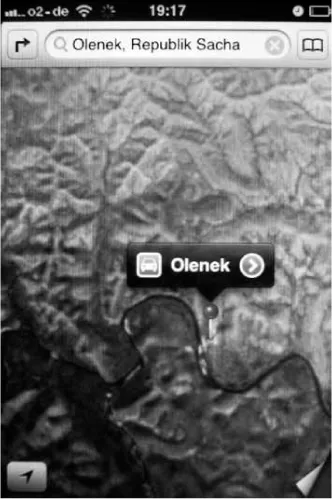
Figure 1.1 Leipzig to Olenek: 9,390 kilometres, 6 days and 12 hours by car, according to iPhone maps and instructions
Source: Joachim Otto Habeck, 1 December 2012
It is not our intention to romanticize the indigenous and nomadic. Returning to the above example of movement, newly invented technologies, such as GPS or mobile phones, have without any doubt a strong bearing on livelihoods and everyday practices in all modes of life, be they nomadic or sedentary: they create and sustain new forms of togetherness as much as personal accountability, they enhance multilevel communication as much as top-down surveillance. In addition, and often in tandem with technological innovations, there are shifting or newly emerging scales of social action and interaction, such as transnational arenas. Not only do these changes affect people’s spatial organization and orientation, they also challenge subjective and collective identifications.
The editors of this volume come from different backgrounds, they have their scientific roots in different disciplines – social anthropology and geography – and followed different interests when starting to investigate nomadic and indigenous spaces. They have worked in two scientific projects of one research programme.1 They decided to join forces to combine two sets of approaches to space that usually stand apart: the volume’s subtitle renders these as production and cognition. On the one hand, there are production of space approaches that help explain how, by whom and to what ends space is produced within certain social conditions and how it might have effects on them. Cognition of space approaches, on the other hand, focus on processes of perception and navigation, their dynamics and stabilities. Both perspectives will be introduced in more detail below. The aim of this volume is to employ both perspectives to assess how nomadic and indigenous groups go about space and make a living in changing political and technological settings.
Most contributors present case studies from the North – notably, Canada, northern Europe, and Siberia – which is owed to the regional research foci of the editors. These case studies are complemented by one West African example (Retaillé’s chapter) and rounded off by three general contributions (those of Donahoe, Wood and Ingold). The individual chapters are summarized at the end of this introduction. First, however, we draw comparisons on how the concepts of space, spatial cognition, and production of space have been treated in the two disciplines that we represent – anthropology and geography. We continue with a brief juxtaposition of nomadic and indigenous, take a look at Deleuze’s and Guattari’s (1987) idea of ‘smooth space’ (or ‘nomad space’) versus ‘striated space’, and then sketch out some strands we consider to be particularly productive for transdisciplinary research on spatiality in nomadic and indigenous settings.
Space for Anthropologists, Space for Geographers
Since our authors are geographers and social or cultural anthropologists, we briefly summarize how in these two disciplines the meaning of space has changed over time. One hundred years ago it was valid to claim that geography is the study of the Earth – more precisely, its surface – and anthropology the study of the peoples thereon. Both disciplines involved long-distance travels and expeditions.2 Geography had the task of making inventories and describing all sorts of objects in their spatial distribution or spatial dimension. Mapping had a heuristic function in generating questions concerning location and distribution, but was also the prime technique of analysis and visualization of research findings. Anthropologists were to examine and map cultural diversity. Along with other factors (political conditions in the age of colonialism and the powerful scientific paradigm of evolutionism), it was the mere distance in space that made anthropologists perceive and construct their objects of research as the Other. Space in anthropology was what isolated the researchers from their objects. Naturvölker were attributed their own spaces, different and distant from that of Kulturvölker. By the same token, ethnographies, as descriptions of indigenous and nomadic peoples, usually started with a description of the space that the examined group populate, and discussed at length the ways in which that group made use of their natural environment.
In anthropological scholarship, space has thus been credited with high significance, first and foremost as a stage, a spatial setting in which this or that people earns its livelihood. Yet in addition to portraits of land and resource use, what we also find in many ethnographies are data on labour division and the social partitioning of space (both inside buildings and outside) and the symbolic order of space, on different scales from the interior of the dwelling to entire cosmologies (for Siberia: Anisimov 1963, Harva 1938). It is in these data that indigenous productions of space become elicit. Ethnographic publications themselves, however, also constitute distinct narratives of indigenous spaces insofar as descriptions and representations of indigenous life-worlds are always necessarily selective and arbitrary. Moreover, by locating indigenous peoples in distant spaces, ethnographic accounts also contributed to the discursive construction of a hierarchically conceived global space.
Ethnographies often point to conflicts between different groups, indigenous and non-indigenous, over land and natural resources, and thus conflict over space. In the wake of colonialism and with the formation of indigenous movements, anthropologists increasingly directed their attention to conflicts between the state and native populations. To give a few examples from the North, anthropologists and colleagues from related disciplines became confronted with debates around the construction of the Trans-Alaska Pipeline System in the 1960s and 1970s (Berger 1985), the James Bay Project in Quebec in the 1970s and 1980s (Feit 2000), the Alta hydroelectric power plant in northern Norway around 1980 (Paine 1996), and the Baikal-Amur Mainline Railway at about the same time (Anderson 1991, see also Povorozniuk 2011). More recently, a focus has been placed on conflicts over indigenous rights to marine resources (for example, Scott 2004, Scott and Mulrennan 2010). Conflicts over land and water (space) and natural resources occur throughout the world, but they acquire a particularly problematic character in nomadic settings, where entitlements to land and resources often contradict sedentary bureaucrats’ ideas of discrete, neatly bounded and fixed territories and of property in real estate.
As a component of the descriptions of different peoples’ natural environment and land use, anthropologists also frequently investigated their informants’ orientation in space. For example, in the late 1960s and the 1970s there was a remarkable interest in wayfinding strategies of marine navigators in the Pacific (see the section on Spatial Cognition below). Practices of map-making and map-reading also became a subject of anthropological research (Gell 1985). However, it was only in the 1990s that anthropologists turned to explicitly problematizing concepts of space and place, and at about the same time some scholars embarked on constructivist interpretations of space, as will be laid out below (in the section on Spatial Production).
In geography, space has not only been credited with a high significance but has always been treated as a core concept of geographic approaches to the natural as well as to the social world (for example, Livingstone 2002: 7–42, Mayhew 2011, Withers 2011). This strand of reasoning (Staatenkunde, Länderkunde) was closely related to the formation of dominions and nation states, thus focusing on its natural endowments and human development in terms of spatial orders of population, agriculture, manufacturing, settlements, infrastructure etc.3 Equally influential was an entirely different understanding of space – space as landscape – resulting from the human adaption to and appropriation of nature. This has been continued and broadened by geographers who committed themselves to the study of environmental challenges and human responses, conceived as components of human-environment ecological systems (Haggett 1972). However, a growing prevalence for systems, organization, relations, diffusion etc. solidified an abstract and technical understanding of space. This came along with and was based on new technical possibilities that could be applied to mapping and map generation, and on methodological preferences for modelling, mathematical calculus and statistical tools (for example, Chorley and Haggett 1967) as well as on correspondent theoretical underpinnings provided mainly by critical rationalism (Harvey 1969). In contrast to anthropology with its aim of understanding different and distant cultures and ways of living, geography has increasingly been driven by a self-understanding of an applied science, the task of which is to serve planning purposes (notably, physical and regional planning). This, in turn, has strengthened spatial concepts deriving from the political-administrative-hierarchical organization of the state and its territory. Parallel with anthropology, geography has thus contributed to a hegemonic construction of a patterned and hierarchized global space. Moreover, it also contributed to a reified understanding of space as a dimension that does not derive from human activity but precedes it as a putatively neutral stage or container.
Alternative approaches were developed by radical and Marxist geographers (Peet 1985, 1998: 76–111) who have emphasized the socially produced and thus instrumental nature of space for a long time. This will be addressed in more detail below. Beyond this, fixed patterns of geographical reasoning were challenged when geographers became involved in the cultural turn (Barnett 1998, Castree 1999, Cook et al. 2000).4 This has raised new debates about the understanding of culture in geography (for example, Cosgrove 1983, Price and Lewis 1993, Sayer 2000) by which totalizing and ‘superorganic’ concepts of culture have been called into question, rejected and largely abandoned (Mitchell 1995). Here an interesting symmetry occurs to what has been said about the field of anthropology before: Whereas anthropology has been facing a new reflexivity on space, geography has been confronted with knowledge-based concepts of culture emphasizing the role of symbols, representation, semiotic processes and performativity (Agnew 1997, Nash 2000, Smith and Katz 1993). Moreover, the cultural turn has also initiated a debate on new understandings of space and spatiality. Although strands differ remarkably in detail, they share an understanding of space that reflects its socially constructed and instrumental nature. This comes along with a growing interest in the subject and subjectivity, on the one hand, and discourse, on the other (Gibson 2001, Pile 2008).
Within geography, a substantial body of research on the co-evolution of objective and subjective, material and discursive, and abstract and concrete spatialities sprouted from a critical reading of social theory (for example, Crang and Thrift 2000, Gregory 1998, Harvey 2000a [1989]). Moreover, very recently and after a period of disregard, a new debate on territory has emerged (for example, Antonsich 2010, Elden 2007a–c, 2010), fathoming territoriality as a technology of power. Taking the ontological and epistemological dimensions of social-reality research (Woodward, Jones and Marston 2010) into due account, there is now a reinvigorated discussion on the role of the state as well as its spatial and territorial means in framing everyday practices, and the ways that everyday practices in turn reframe those means. While the theoretical outcomes of these debates are remarkable, studies applying the concepts to empirical investigations are underdeveloped. Our volume is an attempt to close the lacuna between advanced theoretical discussions, on the one hand, and comprehensive empirical investigations, on the other; as all authors illuminate their theoretical abstractions by rich fieldwork.
Spatial Cognition in Anthropology and Geography
In anthropology, interest in the cognition of space emerged from various roots. As mentioned, non-Western peoples’ orientation in space has periodically attracted attention in anthropological studies. Istomin and Dwyer (2009: 29) list the pertaining ...
Table of contents
- Cover Page
- Title Page
- Copyright Page
- Contents
- List of Figures
- List of Maps
- Notes on Contributors
- Acknowledgements
- 1 Nomadic and Indigenous Spaces: Paths and Perspectives
- 2 A Place Off the Map: The Case for a Non-Map-based Place Title
- 3 From Nomadic to Mobile Space: A Theoretical Experiment (1976–2012)
- 4 Where is Indigenous? Legal Productions of Indigenous Space in the Russian North
- 5 The Nellim Forest Conflict in Finnish Lapland: Between State Forest Mapping and Local Forest Living
- 6 Sámi–State Relations and its Impact on Reindeer Herding across the Norwegian-Swedish Border
- 7 Identity Categories and the Relationship between Cognition and the Production of Subjectivities
- 8 Learning to Be Seated: Sedentarization in the Soviet Far North as a Spatial and Cognitive Enclosure
- 9 Shamanist Topography and Administrative Territories in Cisbaikalia, Southern Siberia
- 10 From Invisible Float to the Eye for a Snowstorm: The Introduction of GPS by Nenets Reindeer Herders of Western Siberia and Its Impact on Their Spatial Cognition and Navigation Methods
- 11 Narratives of Adaptation and Innovation: Ways of Being Mobile and Mobile Technologies among Reindeer Nomads in the Russian Arctic
- 12 From Inuit Wayfinding to the Google World: Living within an Ecology of Technologies
- 13 Epilogue
- Index
Trusted by 375,005 students
Access to over 1.5 million titles for a fair monthly price.
Study more efficiently using our study tools.
Frequently asked questions
Yes, you can cancel anytime from the Subscription tab in your account settings on the Perlego website. Your subscription will stay active until the end of your current billing period. Learn how to cancel your subscription
No, books cannot be downloaded as external files, such as PDFs, for use outside of Perlego. However, you can download books within the Perlego app for offline reading on mobile or tablet. Learn how to download books offline
Perlego offers two plans: Essential and Complete
- Essential is ideal for learners and professionals who enjoy exploring a wide range of subjects. Access the Essential Library with 800,000+ trusted titles and best-sellers across business, personal growth, and the humanities. Includes unlimited reading time and Standard Read Aloud voice.
- Complete: Perfect for advanced learners and researchers needing full, unrestricted access. Unlock 1.5M+ books across hundreds of subjects, including academic and specialized titles. The Complete Plan also includes advanced features like Premium Read Aloud and Research Assistant.
We are an online textbook subscription service, where you can get access to an entire online library for less than the price of a single book per month. With over 1.5 million books across 990+ topics, we’ve got you covered! Learn about our mission
Look out for the read-aloud symbol on your next book to see if you can listen to it. The read-aloud tool reads text aloud for you, highlighting the text as it is being read. You can pause it, speed it up and slow it down. Learn more about Read Aloud
Yes! You can use the Perlego app on both iOS and Android devices to read anytime, anywhere — even offline. Perfect for commutes or when you’re on the go.
Please note we cannot support devices running on iOS 13 and Android 7 or earlier. Learn more about using the app
Please note we cannot support devices running on iOS 13 and Android 7 or earlier. Learn more about using the app
Yes, you can access Nomadic and Indigenous Spaces by Judith Miggelbrink,Joachim Otto Habeck,Nuccio Mazzullo,Peter Koch in PDF and/or ePUB format, as well as other popular books in Scienze fisiche & Geografia. We have over 1.5 million books available in our catalogue for you to explore.