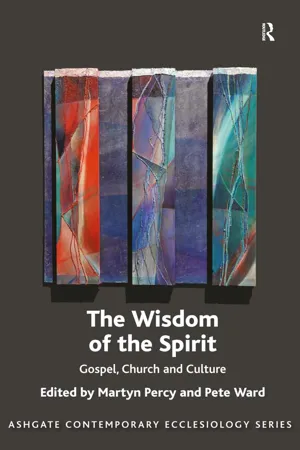
- 228 pages
- English
- ePUB (mobile friendly)
- Available on iOS & Android
eBook - ePub
About this book
In this groundbreaking book exploring Christianity and contemporary culture, internationally-renowned scholars (including David Martin, Alister McGrath, Billy Abraham, Billy Kay and Pete Ward), interface with the legacy of Andrew Walker's work and look forward in their own predictions of trends. Following Walker's special interests in house churches, charismatic renewal, culture and faith, this book picks up on these themes and also looks more broadly at topics such as Pentecostalism, Alpha and post-Evangelicalism.
Information
Chapter 1
Retrieval and Renewal: Andrew Walker, C.S. Lewis, and ‘Deep Church’
Alister E. McGrath
How can the church renew itself without having to constantly reinvent itself? Is there a means by which it can draw on the wisdom and insight of previous generations, without becoming trapped in the past? The constant demand for innovation and originality on the part of many within today’s churches risks losing contact with the Christian heritage, which is often dismissed in its entirety as ‘out of date’, or ‘belonging to a past age’. There is ample evidence, however, of a growing realization of the superficiality of such demands. Untried theories, untested models of ministry, and immature theological perspectives are all too often presented as if they are self-authenticating truths. Paradoxically, it is the most recent innovations that often seem to date the most quickly.
So how are we to negotiate the interplay between innovation and retrieval? Both have their place; each is inadequate on its own. In this chapter, I propose to explore one specific aspect of Andrew Walker’s rich theological vision, which is reflected both in his founding and directing of the C.S. Lewis Centre for the Study of Religion and Modernity from 1985 to 1995, and his later development of the notion of ‘Deep Church’. Walker argues that a fundamental consensual orthodoxy provides the church with a basis for its life and mission. It is through connecting with this ‘great tradition’ and retrieving its themes that churches can anchor themselves in a deeper vision and understanding of reality, enabling them to engage contemporary culture without capitulating to it.
I must begin by paying tribute to Andrew Walker’s theological vision. I had the privilege of succeeding him in 2008 as head of the Centre for Theology, Religion and Culture at King’s College London, and I take great pleasure in honouring his landmark contributions to the renewal of a seriously and intentionally theological approach to the life of the church. While some theologians at King’s College in the 1990s regarded what we might now call ‘practical theology’ with something approaching derision, Walker articulated a vision of the relation of theology and the ministry of the church that has the potential to enrich both the academy and church. Theology, for Walker, is seen at its best when it informs, nourishes and occasionally critiques the life of the community of faith.
Why the Appeal to C.S. Lewis?
In pursuing this vision, Walker came to align himself with some of the concerns of the literary critic and lay theologian C.S. Lewis (1898–1963). It proved to be a shrewd move in terms of institutional positioning, and a productive move in terms of its outcomes. Why?
In the first place, Lewis was a high-profile defender of a basic consensual Christian orthodoxy. (For details of Lewis’s life see McGrath, 2013a.) Lewis himself chose to describe this trans-denominational articulation of faith as ‘Mere Christianity’ (McGrath, 2013b). Throughout the 1940s and 1950s, Lewis provided intellectually articulate and imaginatively winsome accounts of the Christian faith which gained wide support across denominations and secured significant cultural traction.
Yet perhaps more importantly, Lewis was highly critical of those who breezily dismissed the riches of the past in order to pursue short-term intellectual and cultural agendas. Lewis’s critique of what he called ‘chronological snobbery’ remains one of his most important legacies to Christian theology. For Lewis, the reading of literature – above all, the reading of older literature – is an important challenge to some premature judgements based on ‘chronological snobbery’. In his essay ‘On the Reading of Old Books’ (1944), Lewis argues that a familiarity with the past provides readers with a standpoint which gives them critical distance from their own era and thus allows them to see ‘the controversies of the moment in their proper perspective’ (Lewis, 2000, p. 439). The reading of old books thus enables us to avoid becoming passive captives of the Spirit of the Age by keeping ‘the clean sea breeze of the centuries blowing through our minds’ (Lewis, 2000, p. 440).
A deep knowledge of the riches of the Christian tradition does more than root us in the wisdom of the past; it gives us a different way of seeing things. It opens our eyes, offering new perspectives for evaluation and reflection (Lewis, 1992, pp. 140–41):
My own eyes are not enough for me, I will see through those of others … In reading great literature, I become a thousand men and yet remain myself. Like the night sky in the Greek poem, I see with a myriad eyes, but it is still I who see.
Engaging with the Christian past thus enables us ‘to see with other eyes, to imagine with other imaginations, to feel with other hearts, as well as our own’ (Lewis, 1992, p. 137). It offers us an imaginative representation of reality which challenges our own. At certain points, it needs to be corrected. But at other points, it must be allowed to correct us.
Walker found Lewis a congenial role model and dialogue partner at several points. For example, he commended Lewis’s ‘knack of writing for “everyman”’, (Walker and Patrick, 1990, preface, xi) and regarded this as essential if theology were to reconnect with the life of the church and culture at large. Lewis himself learnt to adapt to audiences the hard way, largely through his lectures to Royal Air Force aircrews and groundcrews during the Second World War. (For the importance of this to Lewis’s apologetics, see McGrath 2013c.) For Walker, it was essential to reach ‘the intelligent lay-person with the minimum amount of academic jargon’. It was not enough to defend a basic Trinitarian orthodoxy; this had to be articulated in ways that connected up with its potential audiences.
In applying Lewis’s ideas to the contemporary situation of the church, Walker picked up on Lewis’s suggestive phrase ‘Deep Church’. Lewis used this in a letter of 1952 – the year of the publication of Mere Christianity – indicating that he understood it to mean an attitude of valuing and an act of reconnecting with the Christian tradition, especially its core themes such as the Incarnation and Resurrection (Lewis, 2004). Walker uses Lewis’s phrase in a developed sense, arguing that it conveys the ‘championing of a common tradition’ and ‘commitment to a ‘thick’ or ‘maximalist’ form of Christianity’ (Walker, Bretherton, 2007, pp. 1–29). Similar ideas have also been expressed in a North American context by Jim Belcher (2009). Belcher also cites Lewis’s 1952 letter as the inspiration for his approach, without engaging with Walker (Belcher, 2009, pp. 13–14). Belcher’s concern is more to bridge the gap between two forms of North American Protestantism: fundamentalism on the one hand, and ‘emerging church’ movement on the other. Walker’s approach is ecclesiologically broader, tends to reflect a British context, and makes more judicious use of the notion of the ‘Great Tradition’. This was to be set within a context of an ‘hospitable, orthodox approach to the Christian faith’ that is more concerned with thinking about ‘the nature of faithful and enlivening witness in the contemporary context’ than policing denominational boundaries (Walker, Bretherton, 2007, xvi).
Walker saw this form of Christianity as present – though perhaps sometimes in somnambulant or underdeveloped forms – in both Catholicism and evangelicalism, and encouraged them to learn from each other. He was, of course, clear that his adopted Orthodoxy was firmly committed to valuing and using the resources of the past. Note, for example, his appeal to Vladimir Lossky and Georges Florovsky in his essay ‘Deep Church as Paradosis: On Relating Scripture and Tradition’ (Walker, Bretherton, 2007, pp. 59–80). Yet while Catholicism has always had a deep sense of respect for the past, evangelicalism had yet to develop such an attitude, tending to see such a strategy as enmeshing the church in ideas and practices of questionable value. Walker had by this time established himself as an authority on the modern charismatic movement in the United Kingdom, especially the ‘House Churches’ (Walker, 1985) For Walker, it was the charismatic renewal movement which provided the context for the emergence of a new interest in the critical reappropriation of the riches of the Christian tradition. ‘There is a wind of change blowing through the evangelical world, carrying on its wings a new watchword, which is neither “renewal” nor “revival”, but “retrieval”’ (1985, p. 59).
For Walker, the key to growth and resilience lay in the selective retrieval of the believing past. It was a move that resonated with many in the 1990s and beyond, especially within evangelicalism. (See for example Holmes, 2002, Bacote, Miguelez and Okholm, 2004, Williams, 2005.) Some were anxious that the movement appeared rootless, ungrounded in a deeper tradition of biblical engagement and interpretation (McGrath, 2000). Older evangelical writers – such as James Orr and J.I. Packer – saw themselves as exponents of such a ‘Great Tradition’. (On Orr (1844–1913), see Scorgie, 1988.) For Packer’s use of Orr, see Packer (1996).) Yet evangelicalism’s emphasis on innovation and entrepreneurial initiative inevitably tends to privilege the contemporary over the traditional. At a deeper level, the historical origins of evangelicalism in the eighteenth century led to it being shaped by at least some core assumptions of the Enlightenment – perhaps most notably, its tendency towards individualism and seeing the past as a burden to be discarded. For an excellent case study, see Yeager (2011), pp. 41–70. More generally, see Dupré (2004), pp. 229–68. Yet many evangelicals came to realize that the rise of postmodernity posed a threat, not to evangelicalism itself, but to the modernism that the movement had absorbed through the circumstances of its historical origins. Was this an opportune moment to correct this imbalance?
The Deep Church slogan ‘remembering our past to face our future’ summarizes the movement’s commitment to immersion in the past as a tool for developing theological and spiritual depth, and recovering ministerial practices and wisdom that have been marginalized through the rise of modernity. This approach encourages evangelicals to reconnect with the faith and practice of the early church as they seek resources to live as disciples in a postmodern world. It also reaffirms and recalibrates the notion of the ‘Great Tradition’ as a way of doing theology and living the Christian life which ensures contemporary vitality is supplemented by historical resilience. For various ways of understanding the idea of the ‘Great Tradition’, see Cutsinger (1997).
So what is the substance of Walker’s proposal for ‘Deep Church’, and what benefits might it bring to the contemporary church? In what follows, we shall consider the two core elements that characterize Walker’s vision, setting to one side the question of whether this is quite what C.S. Lewis meant in proposing the term in 1952.
Basic Consensual Orthodoxy, not Theological Revisionism
One of Walker’s objects in founding the C.S. Lewis Centre was to retrieve a basic Christian orthodoxy, partly by defending it in the face of its critics, and partly by offering telling criticisms of those who argued for a short-sighted radical revision of core Christian beliefs, or a potentially destructive cultural accommodation. Walker emphasized that the Centre was not a ‘C.S. Lewis appreciation society’, but was rather ‘a research organization dedicated to tackling the problems of the modern world from the perspective of the gospel’ (Walker and Patrick, 1990, x–xii). The important thing was to continue Lewis’s work, rather than sanctify his memory. For Walker, the ‘broad Trinitarian orthodoxy’ advocated by Lewis held the key to the survival and flourishing of Christianity in a post-Enlightenment culture.
This idea of such a broad, consensual orthodoxy is most famously articulated in Lewis’s ‘mere Christianity’, a phrase borrowed from the writings of Richard Baxter. Although Lewis published the book of this name in 1952, he had developed the idea and phrase earlier. For example, in 1944, he argued for a ‘standard of plain, central Christianity (‘mere Christianity’ as Baxter called it) which puts the controversies of the moment in their proper perspective’ (Lewis, 2000, p. 439). (For Lewis’s dependence on Baxter at this point, see Keeble, 1981.)
Walker rightly saw Lewis as the advocate of an approach which was capable of being adopted across denominational boundaries. Although Lewis was a layman of the Church of England, he never saw himself as an ‘Anglican’ in any ecclesiologically developed sense of the term (McGrath, 2013b). Walker rightly saw that such an approach did not weaken allegiance to specific denominations; rather, it enabled collaboration across boundaries on issues of mutual interest. Indeed, in 1990 Walker noted with pleasure how Orthodox writers were reading and engaging Lewis (1990, pp. 63–7).
In the landmark publication Different Gospels, marking the twenty-fifth anniversary of Lewis’s death in 1988, Walker assembled a rich array of Christian writers drawn from a range of denominations, united by their shared commitment to a ‘basic consensual orthodoxy’ (Walker, 1988). (A second edition with additional material was published by SPCK in 1993. Walker regarded these collections of essays as attempts to continue Lewis’s apologetic ministry, not to engage or assess it.) The basic attitude that emerged from the book was that, while there was an acknowledgement of the need to develop and adapt theological ideas in the light of changing cultural contexts, the core themes of faith possess a timeless relevance which is compromised by the approach of well-meaning modernizers. Different Gospels emphasizes the need to affirm a core ‘gospel’, while recognizing this needs to be articulated in culturally appropriate ways. Such ‘cultural articulations’ of the gospel are to be recognized as provisional, embedded in specific contexts, thus possessing local rather than universal significance.
There is an interesting parallel here with the approach of the Swiss theologian Emil Brunner (1889–1966), who has been needlessly neglected since his death. For Brunner, the gospel demanded and deserved constant rearticulation and restatement, without losing sight of its changeless and timeless relevance. ‘There is indeed an evangelium perennis but not a theologia perennis … The gospel remains the same, but our understanding of the gospel must ever be won anew’ (Brunner, 1949, p. 816). (For a reconsideration of Brunner’s relevance for the contemporary situation, see McGrath, 2014.) The notion of some permanently valid theological formulation seemed pointless to Brunner, in that it would amount to the petrification of something that was meant to be dynamic and living. For Brunner, theology was an activity, rather than an outcome – a process of reflection, engagement, and connection.
Reclaiming and Re-Engaging Tradition
The most important theme in Walker’s vision for the renewal of contemporary Christianity is that of retrieval. Like Lewis before him, Walker is strongly critical of the dominant cultural attitude, deeply grounded in the values of the Enlightenment, which privileges the recent and dismisses the traditional. Ecclesial and theological regeneration were threatened by the tyranny of the contemporary, which regarded the ‘traditional’ as a cultural liability. Yet the term ‘tradition’ is too easily confused with ‘traditionalism’. As Jaroslav Pelikan once remarked, ‘Tradition is the living faith of the dead, traditionalism is the dead faith of the living’ (Pelikan, 1984, p. 63).
Walker insists on the importance of tradition (paradosis), which he understands as the ‘apostolic tradition of the New Testament’ which was ‘handed on and jealously guarded by the community of faith’ (Walker, Bretherton, 2007, p. 61). Yet Walker does not regard tradition as a fixed body of beliefs – an ‘official list of approved doctrines’; rather, he understands it in a way which holds together tradition and scripture. ‘Tradition is not to be contrasted with Holy Scripture but seen as including it; Scripture exists within Tradition’.
Walker’s approach clearly resonates with the notion of ‘living tradition’, especially as this is found in Orthodox writers, particularly Georges Florovsky’s landmark essay of 1963, ‘The Function of Tradition in the Ancient Church’ (Florovsky, 1987, pp. 73–92). Commenting on Vincent of Lérins’s attempt to establish a consensual statement of the basics of faith, Florovsky pointed out that it was possible and desirable to hold together scripture itself and the Christian community’s understanding of what scripture actually meant (1963, pp. 74–5). Florovsky’s analysis can be supplemented with the reflections found in Guarino (2006):
Tradition was not, according to St. Vincent, an independent instance, nor was it a complementary source of faith. ‘Ecclesiastical understanding’ could not add anything to the Scripture. But it was the only means to ascertain and to disclose the true meaning of Scripture. Tradition was, in fact, the authentic interpretation of Scripture. And in this sense it was coextensive with Scripture. Tradition was actually ‘Scripture rightly understood’. And Scripture was for St. Vincent the only, primary and ultimate, canon of Christian truth.
Walker’s concern was to show how some such notion of the interconnection of scripture and tradition could be seen as ecclesially uncontroversial and theologically productive. Florovsky was an ideal resource to allow Walker to make this point, with his constant insistence on the coinherence of tradition and scripture. This theological device enables the wisdom of the past to nourish the present, but not to imprison it. For Florovsky, tradition (paradosis) is an interpretation of scripture, not an independent source of revelation (1963, p. 79):
Tradition was in the Early Church, first of all, an hermeneutical principle and method. Scripture could be rightly and fully assessed and understood only in the light and in the context of the living Apostolic Tradition, which was an integral factor of Christian existence. It was so, of course, not because Tradition could add anything to what has been manifested in the Scripture, but because it provided that living context, the comprehensive perspective, in which only the true ‘intention’ and the total ‘design’ of the Holy Writ, itself of Divine Revelation, could be detected and grasped.
Walker’s careful restatement of Florovsky’s approach provided a framework by which it could be adopted by anyone who was open to the notion of ‘mere Christianity’. Walker’s experience of engagement in denominational discussions and debates alerted him to the ‘red flags’ that such an approach might encounter, especially within evangelical and Pentecostal contexts. Walker argues that, when rightly understood, Christians across the denominational spectrum could reclaim and re-engage with the notion of tradition without – and this is the crucial point – ‘abandoning a high view of Scripture or capitulating to traditionalism’ (Walker, Bretherton, 2007, p. 76).
Walker’s theologically astute rendering of the notion of tradition may not have been original; it was, however, winsome and culturally plausible. It also resonated with certain themes that recur in the writings of C.S. Lewis. Perhaps the most obvious of these is the need to read the Bible with the common Christian consensus in mind, avoiding giving priority to innovative and individualist readings of the text. ‘The basis of our Faith’, Lewis once remarked, ‘is not the Bible taken by itself but the agreed affirmation of all Christendom’ (Letter to Janet Wise, 5 October, 1955 in Lewis, 2004, vol. 3, p. 653.) Lewis clearly regarded what Walker termed paradosis as vital to both good theology and the life of the church. His essay ‘On the Reading of Old Books’ remains perhaps one of his finest defences of the positive and productive use of tradition in engaging with religious (and literary) questions.
A Changing Cultural Mood: The Growing Interest in Retrieving the Past
The notion of ‘deep church’, as articulated by Walker and others, clearly resonates with shifts in the cultural mood in recent decades. A number of factors indicate growing suspicion of the core assumptions of modernity, and a realization of the need to recover insights from the past which were allegedly discredited, yet in reality were merely dismissed or suppressed. For an interesting anthropological reflection on the ‘ancient-modern’ interplay in American evangelicalism, see James S. Bielo (2011, pp. 70–117). The resurgent popularity of Lewis in the early twenty-first century undoubtedly reflects growing receptivity towards his attitudes to the past, encouraging a reconnection with its rich theological resources, without being obliged to appropriate its cultural liabilities.
So what is the future for Walker’s approach? ...
Table of contents
- Cover Page
- Title Page
- Copyright Page
- Contents
- List of Contributors
- Introduction
- 1 Retrieval and Renewal: Andrew Walker, C.S. Lewis, and ‘Deep Church’
- 2 Catholic Charismatics and Restorationism in the UK
- 3 Symbiotic Alchemy: Mapping the Futures of English Revivalism and Evangelicalism
- 4 Pentecostalism
- 5 Exploring Alpha
- 6 Fatherhood in British Evangelical Christianity: Negotiating with Mainstream Culture
- 7 The Widening Gyre: Counter-Trends in Evangelical Theology and Subculture
- 8 Post-Evangelicalism: Exploring Progressive Orthodoxy
- 9 The Charismata and the Second Naïveté
- 10 Andrew Walker: On Walking the Interface between Sociology and Theology
- 11 From the Linear to the Prototypical: An Ecclesiology of the Third Article
- 12 Ahead of the Game: Andrew Walker – An Academic Appreciation
- 13 Interview with Professor Andrew Walker
- References
- Index
Trusted by 375,005 students
Access to over 1.5 million titles for a fair monthly price.
Study more efficiently using our study tools.
Frequently asked questions
Yes, you can cancel anytime from the Subscription tab in your account settings on the Perlego website. Your subscription will stay active until the end of your current billing period. Learn how to cancel your subscription
No, books cannot be downloaded as external files, such as PDFs, for use outside of Perlego. However, you can download books within the Perlego app for offline reading on mobile or tablet. Learn how to download books offline
Perlego offers two plans: Essential and Complete
- Essential is ideal for learners and professionals who enjoy exploring a wide range of subjects. Access the Essential Library with 800,000+ trusted titles and best-sellers across business, personal growth, and the humanities. Includes unlimited reading time and Standard Read Aloud voice.
- Complete: Perfect for advanced learners and researchers needing full, unrestricted access. Unlock 1.5M+ books across hundreds of subjects, including academic and specialized titles. The Complete Plan also includes advanced features like Premium Read Aloud and Research Assistant.
We are an online textbook subscription service, where you can get access to an entire online library for less than the price of a single book per month. With over 1.5 million books across 990+ topics, we’ve got you covered! Learn about our mission
Look out for the read-aloud symbol on your next book to see if you can listen to it. The read-aloud tool reads text aloud for you, highlighting the text as it is being read. You can pause it, speed it up and slow it down. Learn more about Read Aloud
Yes! You can use the Perlego app on both iOS and Android devices to read anytime, anywhere — even offline. Perfect for commutes or when you’re on the go.
Please note we cannot support devices running on iOS 13 and Android 7 or earlier. Learn more about using the app
Please note we cannot support devices running on iOS 13 and Android 7 or earlier. Learn more about using the app
Yes, you can access The Wisdom of the Spirit by Martyn Percy,Pete Ward in PDF and/or ePUB format, as well as other popular books in Theology & Religion & Christianity. We have over 1.5 million books available in our catalogue for you to explore.