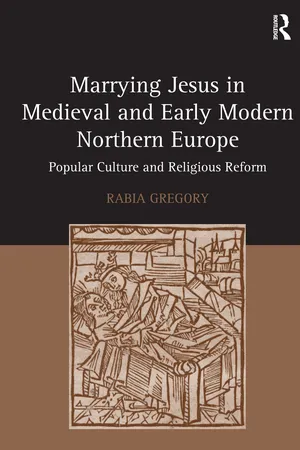
eBook - ePub
Marrying Jesus in Medieval and Early Modern Northern Europe
Popular Culture and Religious Reform
- 280 pages
- English
- ePUB (mobile friendly)
- Available on iOS & Android
eBook - ePub
Marrying Jesus in Medieval and Early Modern Northern Europe
Popular Culture and Religious Reform
About this book
The first full-length study of the notion of marriage to Jesus in late medieval and early modern popular culture, this book treats the transmission and transformation of ideas about this concept as a case study in the formation of religious belief and popular culture. Marrying Jesus in Medieval and Early Modern Northern Europe provides a history of the dispersion of theology about the bride of Christ in the period between the twelfth and seventeenth centuries and explains how this metaphor, initially devised for a religious elite, became integral to the laity's pursuit of salvation. Unlike recent publications on the bride of Christ, which explore the gendering of sanctity or the poetics of religious eroticism, this is a study of popular religion told through devotional media and other technologies of salvation. Marrying Jesus argues against the heteronormative interpretation that brides of Christ should be female by reconstructing the cultural production of brides of Christ in late medieval Europe. A central assertion of this book is that by the fourteenth century, worldly, sexually active brides of Christ, both male and female, were no longer aberrations. Analyzing understudied vernacular sources from the late medieval period - including sermons, early printed books, spiritual diaries, letters, songs, and hagiographies - Rabia Gregory shows how marrying Jesus was central to late medieval lay piety, and how the 'chaste' bride of Christ developed out of sixteenth-century religious disputes.
Information
Chapter 1
Portraits of the Bride of Christ
Disú wort sprichet got zů der geminten sele:
Ein bilde miner ewige gotheit,
ein spiegel miner heiligen drivaltekeit,
daz bistu liebú sele min,
wenne sich min gotheit neiget darin.
Du bist miner claren gotheit ein spiegel,
wanne ich gewan nie creator lieber.
Dú bist min ebenmasse,
wanne dú alle ding durch minen willen lessest.
Minne mich alz ich dich,
wanne nieman mag erfullen dich denne ich.
Ich gap minen lip, min blůt fur dich,
daz ich mit mir selber erfulte und gewerte dich.
Ein bilde miner ewige gotheit,
ein spiegel miner heiligen drivaltekeit,
daz bistu liebú sele min,
wenne sich min gotheit neiget darin.
Du bist miner claren gotheit ein spiegel,
wanne ich gewan nie creator lieber.
Dú bist min ebenmasse,
wanne dú alle ding durch minen willen lessest.
Minne mich alz ich dich,
wanne nieman mag erfullen dich denne ich.
Ich gap minen lip, min blůt fur dich,
daz ich mit mir selber erfulte und gewerte dich.
[God speaks these words to the beloved soul:
An image of my Eternal Godhead,
A mirror of my Holy Trinity,
You are those things, my dear soul,
When my Godhead inclines therein.
You are a mirror to my limpid Godhead,
Because I never won a dearer creature.
You are [reflected as] my equal
When you view all things through my will.
Love me as I love you
Because no one can fulfill you better than I.
I gave my body, my blood for you.
So that I could fulfill and defend you with myself.]
An image of my Eternal Godhead,
A mirror of my Holy Trinity,
You are those things, my dear soul,
When my Godhead inclines therein.
You are a mirror to my limpid Godhead,
Because I never won a dearer creature.
You are [reflected as] my equal
When you view all things through my will.
Love me as I love you
Because no one can fulfill you better than I.
I gave my body, my blood for you.
So that I could fulfill and defend you with myself.]
—# 43 Ps. Engelhart of Ebrach's Book of Perfection
The Strasbourg Sermon
It was late summer in Strasbourg, in 1334. The pope in Avignon had placed the city under interdict, and visits from famous preachers were uncommon. Townsfolk and travelers crowded into one of the city's churches to hear a sermon about the bride of Christ. In the crush were two unmarried women dedicated to a communal life of prayer, work, and abstinence as beguines. Heilke von Staufenberg and Gertrud von Ortenberg shared a home in the Ortenberg beguinage, a collection of homes for women converted to an apostolic fonn of Christianity focused on poverty. The two often attended sermons in neighboring towns together. Gertrud, a mother and widow, identified intensely with the human protagonist of the sermon. She was bound to Christ in a spiritual marriage and feared that her many small betrayals had shattered that union. Overwhelmed with remorse, Gertrud wept during the sermon, lingered in tears until the church doors were drawn closed, and continued crying after returning home. When asked why she cried, Gertrud lamented: "I am the pauper who has broken the spiritual marriage between myself and my spouse."1 That night Gertrud received a vision of Christ, dressed in rags, begging from door to door through the beguinage; he reassured Gertrud that small spiritual lapses could not shatter the marriage vow uniting her and God.
This scene from the spiritual biography of Gertrude von Ortenberg focuses intently on an inconsolable widow's inner turmoil. Gertrud's story is itself remarkable, though little known and I shall return to it later in this book. The congregation who witnessed Gertrud's tears and those who later recorded and studied her visions comprise an almost impressionistic backdrop to her solo performance of penitent devotion, but their presence is significant. Possibly delivered at the Strasbourg Cathedral or the Dominican chapter house, this sermon addressed a community of acquaintances and strangers discernible now only dirough this brief passage in the life of a holy woman. The listening audience, those they told about the sermon, and the copyists who recorded its message shared the same vocabulary of salvation, recited the same prayers, read the same books, and, like Gertrud of Ortenberg, were espoused to Christ. I do not mean that they had each spoken vows or married Christ in heaven, as Gertrud had, or that they were professional religious—the clerics and members of monastic orders who sometimes received rings and wed themselves to Christ in a formal ritual of monastic profession that marked their leaving secular life. Rather, as I shall prove, many late medieval Christians believed that every baptized Christian had wed Christ because late medieval preachers and theologians taught that layfolk and religious professionals benefitted equally from guidance in pleasing their heavenly spouse. Just as Gertrud's tears reveal a network of otherwise unknown Christians who walked alongside her or marveled at her accomplishments, images conjured by preachers' words, devotional books, and contemporary art, expose networks of individual brides of Christ seeking salvation. Some conversed with the subjects of religious biographies; others appear in ownership marks they left in books.
As the verses which open this chapter explain, each created human's soul reflects the image or figure [Bild, figura] of her divine creator. The creator's love for humanity is expressed through Christ's ransom on the cross. By submitting to divine will and returning that love, an individual achieved salvation, represented by the interpenetration of human and divine. Surviving alongside the writing of named "mystical" authors in over 100 manuscripts, this anonymous poem characterizes how the bride of Christ suffused late medieval devotion and survived the Reformations. Like the image of God inclining in(to) the beloved Soul, medieval and early modern understandings of the bride of Christ depended on distinct but interpenetrating understandings of the relationship between the Christian God and created beings. Though many were destroyed or defaced during the wars of religion, medieval objects depicting a marital union between Jesus and Christians such as altarpieces and manuscripts remained in use centuries after Europe ceased to be medieval. New technologies and theologies indisputably disrupted Christianity in the sixteenth century, but the devotional objects circulating between religious communities and pious burghers before the introduction of print and paper survived the censorship and warfare in the sixteenth century and inspired imitations. Medievalists sometimes consider marginal or aberrant the belief that every Christian should strive to become Christ's bride. This understanding was widely represented in medieval media and remained relevant through and after the Reformations—and thus. I argue, part of Christian popular culture.
Marriage to Jesus unfolded in a mixed space where popular and sacred, lay and learned, acted upon each other, responding to, and prompting a sometimes-frenzied desire for, objects enabling self-transformation. In the late twelfth century, monasteries produced Latin theological treatises explaining marriage to Jesus and instructing spiritual beginners to wed Christ. In the thirteenth and fourteenth centuries, new ideas about marriage to Jesus were explained to novices, catechumens, and pious layfolk by beguines, traveling preachers, and reputable nuns. By the late fourteenth century, marrying Jesus had become a crucial component of teaching doctrinally orthodox Christian soteriology. By the end of the fifteenth century, vernacular devotional media across Europe explained sacraments through Christ's marriage to the soul. This narrative also framed some sacramental disputes of the early Reformation. As this book documents, the bride of Christ was a mosaic image comprised of beliefs about God and humanity which migrated from Latin to vernacular, from manuscript to fresco to printed page, and from monastic to lay readers, tearing through the boundary between sacred and profane. Through this ongoing dialogue, new combinations of religious images and beliefs were evaluated for relevance in that moment, but those which endured remained meaningful through the long afterwards of the slowly unfolding modern.
A Professor's Response to the Pope
Almost exactly 200 years after the Strasbourg sermon, Protestant theologian Martin Luther explained his doctrine of salvation through the marriage of Christ and humankind in a letter and short treatise responding to Pope Leo X's bull, Exsurge Domine. On the Freedom of a Christian was one of three treatises leading to Luther's final split with the institutional church in Rome in 1520. An embattled Luther defending himself against the threat of excommunication with the promise of Christ's love for a sin-stained bride is as iconic as the 1517 delivery of the 95 Theses or the rapid translation of the New Testament into German while in hiding at Wartburg Castle. In On the Freedom of a Christian, Luther expresses his understanding of salvation as a late medieval German Christian using vocabulary appropriate to that time and place: "[T]he soul joins with Christ like bride and bridegroom" with a bridal ring of faith [braudtring, das ist der glaub], the soul's sins are cleansed by her sinless spouse as a wedding gift [mahlschatz].2 Anyone who has taught the history of the Reformation will appreciate how elegantly this brief passage encompasses Luther's new doctrine of salvation, just as anyone who has read late medieval German accounts of the bride of Christ will recognize Luther's use of rings and wedding gifts. An anonymous sermon for the dedication of a church in Basel told the congregation that Christ was waiting at the altar for "sine gemahelun. Ivwer iegelichis sele" [his spouse, your individual soul].3 In late fourteenth-century Strasbourg, a companion of Rulman Merswin preached. "Dirre brútegoume ist Cristus und menschliche nature ist die brut. Ach lieben kint, nuo heissent wir alle Cristus brute" [The bridegroom is Christ and human nature is the bride, Ah dear child, now we are all called Christ's brides].4 The fourteenth-century Dominican preacher Johannes Tauler explained that the bride was "die brut daz sin wir: din und min sele" [your soul and mine].5 For these preachers, as for Luther, the exchange of rings, gifts, and vows between Christ and a human bride was a transaction in salvation that cleansed a sinful individual with redemptive love.
Even after finalizing his break with Rome, the soul's marriage to Christ was one of the few elements popular in late medieval Christianity that Luther retained. Though he would reevaluate the sacraments and reject the cult of the saints following his break with Rome, Luther continued to explain his doctrine of salvation through faith as a marriage between Christ and each believing Christian until close to his death in 1546. A more mature elaboration of this image appears in a compilation of Luther's conversations and off-the-cuff exegesis titled Table Talk [Tischreden]:
He is our Bridegroom and we are lus bride.... Whatever we have, it is [also] his. But it is truly an unbalanced transaction. He has eternal innocence, righteousness, life, and blessedness, which he gives to us when he makes himself eternally ours. We are ensnared by the devil, subject to sin and death. He has delivered us from the devil's sovereignty [by] smashing his skull, capturing him, casting him [back] into hell.... Even though the dear Lord gives [himself in] a spiritual wedding and marriage [heirath und Ehe] with us, betrothing himself to us to be our eternal Bridegroom, blesses and adorns us with his celestial goods [innocence, righteousness, life, blessedness] and also vowing that he wants to be our eternal priest, this is in vain; the teeming mass runs on in the name of the devil, whores against him, prays to foreign idols, like the Jews served Baal, Astaroth, etc, and like we beseeched the saints during the Papacy.6
In this reported conversation, Luther now draws clear distinctions between those saved through faith and wed to Christ, and those who have broken the bonds of that union by whoring their souls out to false gods and false religious practices.
Like the fourteenth-century preachers whose books he studied and edited, Luther believed that marriage to Christ was possible for humans, that it could be achieved through study, and that Christ's elect spouses were liberated from the devil. Luther excluded large swathes of humanity from this marriage due to their mistaken religious beliefs, limiting the bride of Christ's identity to a community of right-believers, solid in their theological and sacramental knowledge. This view was typical of polemical writing in the 1530s, as Christians of all denominations distinguished between their elect communities wed to Christ and the theologically misguided who fled or broke their marriages.
An Augsburg Scribe
In 1436, almost exactly 100 years between Martin Luther and Gertrud von Ortenberg, a 13-year-old Augsburg scribe recorded his own desire to be eternally joined to the spousal trinity. "[Q]uis hoc schribebat joranimus muller nomen habebat. Her|re| zů ainem gesponsen hab dir aller menschen sel des bit ich dich huet und yminer mit got dem vater und dem sun und dem hailigen gaist ainen. Amen" [The one who copied this book is named Joranimus Müller. Lord, you have taken as a spouse all human souls; I pray of you today and forever to be made one with God the Father and the Son and the Holy Ghost. Amen].7 Copied into the empty space between two entries in a palm-sized German devotional miscellany, Müller's handwritten plea to be eternally joined with his divine spouse characterizes the brides of Christ this book examines. This inscription appears in a fifteenth-century devotional manuscript now owned by the Bavarian State Library in Munich. From a second manuscript Müller collaborated on in 1457, it seems possible that he worked in a professional scribal workshop in Augsburg.8 Far less is known about the scribe Jerome Müller than Martin Luther or Gertrud von Ortenberg, but his inscriptions and the abridged texts in this miscellany represent a partial network which explains how media technologies dispersed the belief that every individual could wed Christ.
This inscription conjures the image of a young scribe copying out devotional texts, contemplating the meaning of their words as his hand shaped the forms of the letters, inking the red tails of ...
Table of contents
- Cover
- Half Title
- Dedication
- Title
- Copyright
- Contents
- List of Figures and Tables
- Preface and Acknowledgements
- 1 Portraits of the Bride of Christ
- 2 Any Body's Bridegroom
- 3 Transmedia Stories of Jesus and the Loving Soul
- 4 Created to Be a Bride
- 5 Taking Jesus as a Second Husband
- 6 Sisters and Brides of Christ
- 7 Confessions of "True" Brides of Christ
- 8 Brides of Christ, Contemporary Christianity, and American Popular Culture
- Bibliography
- Index
Trusted by 375,005 students
Access to over 1.5 million titles for a fair monthly price.
Study more efficiently using our study tools.
Frequently asked questions
Yes, you can cancel anytime from the Subscription tab in your account settings on the Perlego website. Your subscription will stay active until the end of your current billing period. Learn how to cancel your subscription
No, books cannot be downloaded as external files, such as PDFs, for use outside of Perlego. However, you can download books within the Perlego app for offline reading on mobile or tablet. Learn how to download books offline
Perlego offers two plans: Essential and Complete
- Essential is ideal for learners and professionals who enjoy exploring a wide range of subjects. Access the Essential Library with 800,000+ trusted titles and best-sellers across business, personal growth, and the humanities. Includes unlimited reading time and Standard Read Aloud voice.
- Complete: Perfect for advanced learners and researchers needing full, unrestricted access. Unlock 1.5M+ books across hundreds of subjects, including academic and specialized titles. The Complete Plan also includes advanced features like Premium Read Aloud and Research Assistant.
We are an online textbook subscription service, where you can get access to an entire online library for less than the price of a single book per month. With over 1.5 million books across 990+ topics, we’ve got you covered! Learn about our mission
Look out for the read-aloud symbol on your next book to see if you can listen to it. The read-aloud tool reads text aloud for you, highlighting the text as it is being read. You can pause it, speed it up and slow it down. Learn more about Read Aloud
Yes! You can use the Perlego app on both iOS and Android devices to read anytime, anywhere — even offline. Perfect for commutes or when you’re on the go.
Please note we cannot support devices running on iOS 13 and Android 7 or earlier. Learn more about using the app
Please note we cannot support devices running on iOS 13 and Android 7 or earlier. Learn more about using the app
Yes, you can access Marrying Jesus in Medieval and Early Modern Northern Europe by Rabia Gregory in PDF and/or ePUB format, as well as other popular books in Literature & Literary Criticism. We have over 1.5 million books available in our catalogue for you to explore.