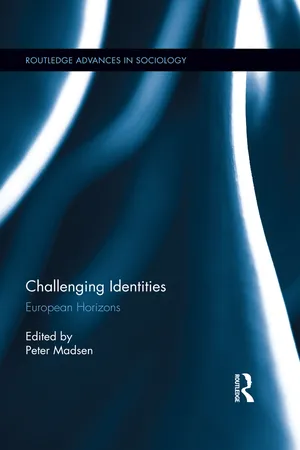
Identity is a keyword in a number of academic fields as well as in public debate and in politics. During the last decades, references to identity have proliferated, yet there is no simple definition available that corresponds to the use of the notion in all contexts. The significance of the notion depends on the conceptual or ideological constellation in which it takes part. This volume on one hand demonstrates the role of notions of identity in a variety of European contexts, and on the other hand highlights how there may be reasons to challenge the use of the term and corresponding social, cultural, and political practices. Notions of national identity and national politics are challenged by European integration, as well as by the increasing demographic heterogeneity due to migration, and migrants experience conflicts of identification stemming from clashes between cultural heritage and the cultures of the new habitat. European horizons - frames of mind, historical memories, and expectations at the level of groups or communities, at the national level, and at the general European level - are at odds. Analyzing a series of issues in European countries from Turkey to Spain and from Scandinavia to the Balkans, the contributions demonstrate uses and abuses of the notion of identity.
- 276 pages
- English
- ePUB (mobile friendly)
- Available on iOS & Android
eBook - ePub
About this book
Information
1
Encyclopaedia Europaea
Some Preliminary Observations
At a moment when Europe is being transformed dramatically by the process of enlargement and the resurfacing of religious and civilizational issues, students of European identity need to capture more adequately such facts in their accounts.1
A Manifesto, 2003
Despite representing quite different theoretical traditions and attitudes, Jürgen Habermas and Jacques Derrida agreed years back to compose a common manifesto for The Rebirth of Europe. It was published on the last day of May, 2003 in both Frankfurter Allgemeine Zeitung and Libération, and was followed up by contributions from other prominent European intellectuals, including Umberto Eco in La Repubblica, Gianni Vattimo in La Stampa, and Fernando Savater in El Païs, with replies from Ralf Dahrendorf and Timothy Garton Ash. The initiative attracts our attention for two main reasons.
In the first place, it outlines the existence of a European public sphere that is larger than the more restricted sub spheres circulating around the European institutions of economic collaboration and policy-making. Secondly, the manifesto opens up space for a different and a more in-depth study of common European issues inasmuch as it reveals a basic concern for European identity rather than day-to-day problems.2 The explicit motivation for publishing the manifesto goes back to the contrasting opinions among European leaders of President George W. Bush and the American strategy of pre-emptive war in the aftermath of 9/11.3 With Spanish Prime Minister José María Aznar taking the lead, some European leaders gave consent to the invasion of Iraq, whereas France and Germany chose not to join the war efforts under American command. This ‘no’ to a common Western initiative to overthrow the government of Saddam Hussein, however, provoked the American secretary of defense at the time, Donald Rumsfeld, to sow further discord among the Europeans by launching a simplifying rhetoric of New Europe against Old Europe.4 In Washington’s view, France and Germany, the two core European countries, the reconciliation of which had been a decisive factor in the European integration process after World War II, had not yet understood what Francis Fukuyama had established as an undeniable truth in his 1992 book The End of History and the Last Man.
Only a few years after the Fall of the Berlin Wall, this American political philosopher felt entitled to proclaim the end of history and the final triumph of liberal democracy and the market economy, which left little space for the European model of wider social and political compromise.5 Due to this kind of reasoning, there was not really much to discuss. Based on forms of knowledge known from neoconservative think tanks, the American leadership in the Bush period sought to deprive Europe of its specific modus vivendi et intelligendi, i.e., of its specific hermeneutic and historicistic approach not only to its own past but to its own future as well, based on what Benedetto Croce had once called an “a priori synthesis of experience”.6 What the Italian philosopher had in mind was the idea of a continuous accumulation and reelaboration of knowhow as a result of both the moments of success and the numerous shortcomings and defeats that have characterized European history and culture.
With the major superpower taking the road of disastrous wars to which Europe had mostly turned its back after a long experience of civil wars from 1914 to 1945,7 followed by a cold war and an exhausting process of decolonization, Habermas and Derrida felt invited to advance the validity of Europe’s own historical identities. In contrast to American global strategies, the manifesto points to the necessity of taming neoliberal capitalism in order to assure social justice and an international order and is thus more dedicated to the ius gentium and the republican vision outlined in Kant’s 1795 Zum ewigen Frieden than it is subjugated by the supremacy of superior force. In this respect, European history covers a wide range of experiences, among which the two authors list an entire inventory of encyclopedic entries: Christianity, science, technology, Roman law, French civil law, urbanism, labor movement, democracy, human rights, secularism, and trust in institutions and in the capability of the state vìs-à-vìs mistrust in the auto-regulative power of the market. Of course, Habermas and Derrida are well aware of the contradictory complexities of these phenomena when underlining the increasing consciousness among Europeans of what Adorno and Horkheimer had once called ‘the dialectics of the Enlightenment’, with reference to the catastrophic repercussions to human life and society caused by the separation of technology, economics, and political power from universal values of human rights, including the principles of the Rechtsstaat.
Identity and Human Sciences
Etymologically, the concept of identity, also used explicitly in the manifesto with specific reference to European identity, derives from the Latin word idem, meaning ‘the same’. Originally, it belongs to the field of mathematics (2 + 2 are identical to 4). Or as Leibniz once said, “eadem sunt quorum unum potest substitui alteri salva veritate”: if A = B, then A and B are interchangeable in any context, without consequences for the validity of truth. We might add, following Krzysztof Pomian, that outside context-free mathematics, you do not find sameness but only similarity (see below). Nevertheless, the French-Polish cultural historian and director of the Scientific Committee of the Museum of Europe in Brussels argues for the application of the concept of identity outside the field of mathematics as well. Transferred to the blurrier field of human sciences, Pomian suggests that the concept, as a definiendum, is closely related to words like stability, memory, and heritage.8 However, the identification of synonyms does not quite resolve the problem of definition, but seems to postpone it.
First, we must ask ourselves why the concept of identity has gained such a dominant position within the human sciences today. In this respect, the concept has its own history and appears, at least to some extent, to match the failure of traditional, often Marxist and structuralist, schemes of modernity. In the work of sociologists such as Pierre Bourdieu and Anthony Gid-dens, agency models (already known from Antonio Gramsci’s filosofia della prassi) seem to have replaced earlier concepts of functions and structures, leaving more space for the performative and constructivist aspects of human activity and cognitive behavior. Furthermore, Bourdieu’s concept of habitus indicates a renewed interest in the repetitive character of our thinking and behavior. This also applies to Giddens’ concept of ‘ontological security’, which emphasizes the routinization of everyday life as destined to supersede the ruptures of modernity and the continuous threads to wider standards of normality.
At this point, I wish to emphasize at least two sets of distinctive but nevertheless overlapping presuppositions of importance for understanding the concept of identity, now being transferred from one context of scientific research, that of mathematics and logics, to quite another, that of the humanities, characterized to a large extent by historistic and hermeneutic turns and returns:
- The first set regards that of historicity, which links the concept of identity to a diachronic axis, one that is endowed with a rather paradoxical frame of features. In fact, Krzysztof Pomian and Zygmunt Bauman both held transgressivity to be specific to Europe as a “transgressive civilization […] a mode of life that is allergic to borders—indeed to all fixity and finitude […]. In its European rendition, ‘civilisation’ ([…]) is a continuous process […] of remaking the world”.9 On the other hand (and these two aspects may very well sound like a logical contradiction to a mathematician), history shows many signs of reversibility inasmuch as historical phenomena are submitted to processes of repetition and serial reproduction. Surely, this second aspect does, in fact, challenge the putative superiority of the moment of irreversibility, embedded in the genuinely modernist concept of progress10 and expressed in the entire idea as well of Europe moving toward an ever more brilliant future of no return, conveyed in the writings of Condorcet and Hegel. However, already in the 1744 Scienza Nuova, the Italian philosopher Giambattista Vico had warned the European nations of their vanity (la boria), stating that the evolution of the nations from the period of the barbarians to the period of civilized people (in his terminology, the corso of human things), could soon be replaced by the ricorso, the returning of the nations to the very first steps of human history.
In his historiographic approach, the Italian microhistorian Carlo Ginzburg pleads for continuous up- and downscaling procedures, distinguishing—following Siegfried Kracauer—between close up, long shot, and even extreme long shot studies.11 So too does the French historian Fernand Braudel, known for the concept of la longue durée, who asks in his principal work on the Spanish King Philip II and the Mediterranean in the second half of the sixteenth century, “Is it possible somehow to convey simultaneously both that conspicuous history which holds our attention by its continual and dramatic changes—and that other, submerged, history, almost silent and always discreet, virtually unsuspected either by its observers or its participants, which is little touched by the obstinate erosion of time?” He furthermore points to the historian’s distinction between structure and conjuncture, “the former denoting long-term, the latter, short-term realities”,12 which seems to endow the concept of identity with an element of unstable stability and vice versa.
To the diachronic feature of historicity, we might therefore add a synchronic one, due to the fact that any identity-construction, specified in time and space, reveals a stratified and often contradictory hybridity, meaning that identity is always composed of different markers linking each of us to a specific civilization, nation, region, city, sex and gender, age, profession, and so on and so forth. Identity is thus always composed of different layers of relationships to context-defined conditions and premises that, however, undergo continuous change due to the ever-shifting forms of domination and hegemony. Being European largely implies all of these layers of identity, and which layer ends up being most dominant or hegemonic depends on the specific goals and priorities as defined by the European communities and their member groups, to which every individual belongs.13 In summary, historicity as a constitutive feature deprives identity construction of any essentialist substance, making it contingent and dependent on time- and space-based contextual conditions that stress the historical flow of beginnings, consolidations, and closures.
- b. The second set of presuppositions or constitutive features is that of reflexivity, i.e., of response to what is happening around the individuals, which can be divided into two interdependent activities of cognitive behavior. In the words of Anthony Giddens, reflexivity “should be understood not merely as ‘self-consciousness’, but as the monitored character of the ongoing flow of social life”. The British sociologist continues, “To be a human being is to be a purposive agent, who both has reasons for his or her activities and is able, if asked, to elaborate discursively upon those reasons (including lying about them)”.14 So, reflexivity refers not only to the question of what is around us but also to questions of who we are or what are we doing, of why are we doing this and not that, and of the extent to which we can choose our own identity when we must respect the rules of socialization and accept the undeniable fact that many of our procedures of identity making are unconscious or subconscious.15 Trying to operationalize Giddens’ observations, we might say that identity deals not only with an individual or with a collective classification of all of the artifacts and values we meet in our everyday lives and which define our surroundings. It refers also to our degree of adoption of and identification with the ‘things’ that surround us and of which our social and personal lives are composed. The moment of reflexivity highlights the importance of subjectivity and of hermeneutic approaches to the objectively given or constructed world of artifacts and values that has been handed down to us from the past and will remain a...
Table of contents
- Cover
- Title
- Copyright
- Contents
- List of Figures
- List of Tables
- Introduction: Discourses of Identity
- Part I
- Part II
- Part III
- Part IV
- Contributors
- Index
Trusted by 375,005 students
Access to over 1.5 million titles for a fair monthly price.
Study more efficiently using our study tools.
Frequently asked questions
Yes, you can cancel anytime from the Subscription tab in your account settings on the Perlego website. Your subscription will stay active until the end of your current billing period. Learn how to cancel your subscription
No, books cannot be downloaded as external files, such as PDFs, for use outside of Perlego. However, you can download books within the Perlego app for offline reading on mobile or tablet. Learn how to download books offline
Perlego offers two plans: Essential and Complete
- Essential is ideal for learners and professionals who enjoy exploring a wide range of subjects. Access the Essential Library with 800,000+ trusted titles and best-sellers across business, personal growth, and the humanities. Includes unlimited reading time and Standard Read Aloud voice.
- Complete: Perfect for advanced learners and researchers needing full, unrestricted access. Unlock 1.5M+ books across hundreds of subjects, including academic and specialized titles. The Complete Plan also includes advanced features like Premium Read Aloud and Research Assistant.
We are an online textbook subscription service, where you can get access to an entire online library for less than the price of a single book per month. With over 1.5 million books across 990+ topics, we’ve got you covered! Learn about our mission
Look out for the read-aloud symbol on your next book to see if you can listen to it. The read-aloud tool reads text aloud for you, highlighting the text as it is being read. You can pause it, speed it up and slow it down. Learn more about Read Aloud
Yes! You can use the Perlego app on both iOS and Android devices to read anytime, anywhere — even offline. Perfect for commutes or when you’re on the go.
Please note we cannot support devices running on iOS 13 and Android 7 or earlier. Learn more about using the app
Please note we cannot support devices running on iOS 13 and Android 7 or earlier. Learn more about using the app
Yes, you can access Challenging Identities by Peter Madsen in PDF and/or ePUB format, as well as other popular books in Social Sciences & Human Geography. We have over 1.5 million books available in our catalogue for you to explore.