- 272 pages
- English
- ePUB (mobile friendly)
- Available on iOS & Android
eBook - ePub
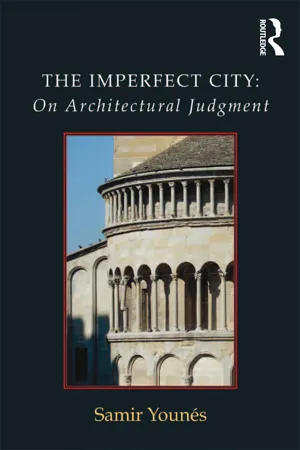
The Imperfect City: On Architectural Judgment
About this book
If architectural judgment were a city, a city of ideas and forms, then it is a very imperfect city. When architects judge the success or failure of a building, the range of ways and criteria which can be used for this evaluation causes many contentious and discordant arguments. Proposing that the increase in number and intensity of such arguments threatens to destabilize the very grounds upon which judgment is supposed to rest, this book examines architectural judgment in its historical, cultural, political, and psychological dimensions and their convergence on that most expressive part of architecture, namely: architectural character. It stresses the value of reasoned judgment in justifying architectural form -a judgment based on three sets of criteria: those criteria that are external to architecture, those that are internal to architecture, and those that pertain to the psychology of the architect as image-maker. External criteria include, philosophies of history or theories of modernity; internal criteria include architectural character and architectural composition; while the psychological criteria pertain to 'mimetic rivalry', or rivaling desires for the same architectural forms. Yet, although architectural conflicts can adversely influence judgment, they can at the same time, contribute to the advancement of architectural culture.
Information
PART ONE
EXTERNAL CRITERIA FOR ARCHITECTURAL JUDGMENT
PREAMBLE TO CHAPTERS 1, 2, AND 3
Architectural history provides narratives that connect a long sequence of buildings in relation to other cultural productions including artistic movements and products, ethical and political ideas. Describing buildings as embodiments of these social forces, historians are not content with simply narrating the conditions that surrounded their emergence, they also speculate on the meanings and directions that historical events and buildings might be taking. Historians and philosophers of history also extend their conjectures in order to assert that past and future events happened or will happen as if by necessity. One example of such scholarship is the teleological thinking that animates some broad surveys of architectural history. But historians also resist philosophizing about the direction of history, even if their thorough reflection on historical material makes it quite difficult to avoid such philosophizing. Therefore, architectural judgment based on history requires the architect’s familiarity not just with the results of historical scholarship, but also its underlying philosophical aims as well as the historians’ own evaluation of their discipline.
Permeating all aspects of cultural life nowadays is an acute awareness of history. Science and religion, art and architecture, and ethics and politics, explain their present qualities in comparison to a selected sequence of historical events alternately emphasizing continuities or ruptures where one or the other are needed. Within this broad intellectual ecology architectural judgment based on history presents a particular dilemma. On the one hand architecture receives its justification from cultural history broadly considered. On the other, architecture has its own specificity as the art form that gives form and contains the very milieu where most human activity takes place: the City. Architecture and architectural meaning, justification, and evaluation at once mold the City and emerge from it. Consequently, architects are torn between how much in architectural justification and evaluation is to be based on cultural history, or on a philosophy of history, and how much is to be based on architectural principles such as urbanism, composition, or tectonics which themselves have their own histories. The dilemma resides in favoring one over the other, as both choices entail different consequences. Therefore, architects turn at once to the historians of architecture, to philosophers of history, as well as to their own experience as makers of form. Many architects will at one point or another attempt a rapprochement, or even conciliation between history and philosophy in relation to their practice. This thinking is usually found behind justificatory statements such as: “mine is an architecture of our time”, or “at this point in history my architecture is the result of a decisive rupture from the historically given”. Here is where architectural judgment based on history encounters complications.
Historical narratives, as we mentioned, usually reveal an underlying philosophy of history which is brought to bear on the material history of architecture. To the extent that architects accept the historical explanation (as we shall see) they tacitly accept the linkage between the history of ideas, philosophical conjectures regarding the direction of history, and their convergence on architectural form. Whereas many of them agree on the general relevance of such a linkage, many will disagree on its specific relevance because of the difficulty in proving how historical or philosophical beliefs help to produce architectural form. Here, we are in the presence of an old problem: to what extent do ideas play a causal role in the production of forms? This problem is related to ideas of causality, becoming, finality, determinism, indeterminism, irreversibility, teleology, and the philosophy of time. Nonetheless, many architects do judge buildings based on the history of ideas and the material history of forms, and in so doing their explanations follow those of historians and philosophers in suggesting that architectural forms had to appear the way they did, as if by necessity.
The difficulty concerning architectural judgment based on history, resides in reconciling what is asserted to be a general historical necessity with the nature of the architectural object that is presented as if it were a symptom of such necessity.
The next three chapters will engage this intricate problem on three levels. Chapter 1 will consider the triangular relationship between the architect, the historian, and the philosopher. If history and philosophy mutually condition one another, then in what ways is such conditioning useful for architectural judgment especially in relation to competing historical narratives?
Chapter 2 will examine how historians think about history, exemplified by how grand historical narratives, Classicism and Historicism, shaped architectural culture. It also examines how the retreat of grand narratives gave way to a multitude of smaller histories where the individual historian’s theoretical inclinations (whether it is post-structuralism, critical theory, or new historicism) are brought to bear on architectural judgment based on history. The increase in theoretical presuppositions on the part of historians is invariably accompanied by an increase in the relativism of values and evaluations, thus complicating judgment even further. Architects benefit from the demands they make on history as well as knowing the demands that historians themselves make on history. Yet although historians, philosophers, and architects make different uses of architectural history, it is important to note that for many architects judgment based on history is based mostly on the historian’s model, that is, the methodologies and conclusions embodied by the history of ideas broadly considered, and architectural history in particular. But architects also need to acknowledge that the aims of the historian and the philosopher do not necessarily coincide with the aims of the architect. Might there be another model for architectural judgment based on history than the one provided by the historian? Might there be a way to consider an architectural history that is written from the standpoint of the architect?
This leads us to Chapter 3, whose aim is to provide a new outline for a history, one that is made from a combination of the scholarly methods of the historian and the operative design methods of the architect. Chapter 3 offers another way to study history that goes beyond periodization and classificatory schemes and beyond theories that purport to explain the aims of history. Instead, it adopts an approach to architectural history that is built less on the premises of the historian and more on the ways in which architects might conceive of their art. It proposes an approach based on the nature, ends, and means of architecture without negating all that is useful in the scholarship of the historian or the speculations of the philosopher.
1
Architectural Judgment Based on History, Part 1
… all the characters of history or historiography are reducible to the definition and identification of history with individual judgment. And, as individual judgment, history is a synthesis of subject and predicate, or representation and concept. The intuitive as well as the logical elements are inseparable in history.1
THREE GROUPS OF JUDGING ARCHITECTS
Architectural judgment is significantly shaped by versions of architectural history and by their underlying theoretical or philosophical content. Architects deploy conclusions derived from such contents in order to justify preferred forms and trends, or by contrast, in order to repudiate disapproved forms and trends. When architects justify their work based on traditions and their conventions (precedents), they use the kind of historical justification in which architectural history is considered as a receptacle of exemplars, an accumulation of lessons from which they learn how others approached similar problems. Exemplars are chosen paradigmatically2 depending on their previous success, and new buildings are made by combining judicially selected parts of previous buildings. Judgment based on history, in this case, depends primarily on the success of architectural composition in the sense of imitatio and inventio, of combining and re-combining pre-existing forms. Judgment pertains to measuring the individual architect’s work in relation to the established rational use of conventions from which architects learn and to which they contribute.
Other architects justify their work based on a theory or philosophy of history that validates the architectural forms they produce by virtue of their present position inside a historical sequence. This sequence is linked to hypotheses concerning a general order inherent in history, a grand narrative (e.g. historicism) containing philosophical pre-suppositions (e.g. progress) about the becoming of architectural form, inexorably moving this form toward an aim, a finality.3 New buildings are composed with a critical awareness of the architect’s position within this sequence while presenting a dense opacity toward the historically given, its larger traditions and its regional conventions.4 Judgment, in this case, rejects imitative theory and considers invention as inventio ex nihilo, an invention out of nothing, following the commanding impetus of a technologically determined society. Judgment based on history, depends on the extent to which deliberate distancing or rupture from the historically given justifies the acceleration to reach a desired historical finality – a finality that may materialize in the imminent present or in some distant future.
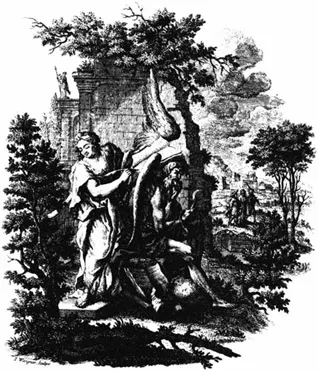
1.1 Historia, Iconologia, Cesare Ripa, Historiae et Allegoriae.
Even if their uses of history differ widely, both of these groups share an ever-heightened consciousness of the individual’s choice and agency in history. For the first group, historical continuity is directly instrumental in everyday practice. This group is made up of traditional architects. For the second, a radical opposition to continuity instrumentalizes history in order to justify an architectural practice which, once established, can then proceed to sever its connections to history. This second group is made of modernist architects. Both groups maintain a state of tension between two qualities: to integrate architecture into a historical continuity or to differ from such continuity in order to fulfill another historical purpose. To integrate or to distinguish became two parts of the mystique that provided an élan vital, a vital impetus, for the architect’s disegno, the will-to-make, and gave impetus to judging the work of others. In other words, history for these two groups remains the scenographic backdrop that empowers their explanations as well as their justifications.
A third group, however, rejects this historical scenographic backdrop altogether. It denounces grand historical narratives as well as claims to know history in its objective totality, and it denies consensus and unity as bases for the legitimization of architecture. Among its beliefs are the avoidance of assertions about the universal validity of ideas, the encouragement of difference, and the promotion of multiple historical methodologies because no single methodology can make an exclusive claim to reveal the truth about history. Only local and fragmentary histories are now possible; and given the relativity of opinions about history, where historians write their individual narratives based on their own value judgments, judgment
based on history is an impossibility. It is also irrelevant to the cultural justification or legitimization of architecture since buildings are primarily the individual or rather the differentiated expressions of their authors.

1.2 Portrait d’architecte revenant de voyage, 19th Cent., V. Dahlerup.
Architectural judgment based on history is here understood as the validation or repudiation of a movement, a period, a building, under one or another of the three aforementioned categories. As forms of dialectical reasoning, each of these three approaches involves a kind of synthetic judgment because architectural history does not only offer buildings on the one hand, and architects as inscrutable subjects on the other, but rather individuals or groups who thoroughly engage the contingencies of their specific historical situations. Architects seek to be influential cultural agents; they do not remain passively influenced by histories of architecture. They take part in debating, or questioning the nature and ends of the historical endeavor, the historian’s methodologies and the philosopher’s conjectures. They take sides and alternatively become protagonists or antagonists of various positions on history. They enjoy historical speculation, but would like to know their proper stand in history with a high degree of certainty. They recognize empirical facts, but they wonder about the meaning of that diffused infinity of atomized forms at their disposition. They entertain the idea of a metahistorical construction of a prior unity of reason within history, but they worry that this philosophy will crush the individual historical phenomenon. They revolt against the notion of being determined by historical forces, but they delight in the idea of being carried by history to the culminating point which they presently wish to occupy. Most of all, they cherish the historical explanation that justifies their preferred forms.
To explain a historical event or architectural form is not only to describe why it happened, how it came about, what are its antecedents, or how it relates to other homologous phenomena; it also includes the knowledge claims, inferential methodologies and classificatory schemes of history as a discipline (the knowledge of it). Historians pursue this evidence-dependent knowledge with the tacit belief that the reality of the past is accessible through their rigorous methodologies. Philosophers, or theoretically inclined architects and historians, add yet another layer of inquiry regarding a historical event or architectural form. They inquire about the sort of object architecture is by reflecting on its nature – for example the ideas of type, of character – and the justification of its existence in a time and place in comparison to how the mind apprehends, categorizes, judges, or constructs historical reality (the ontology of it). Naturally, there are numerous exceptions to these generalizing statements. There are many historians who inquire into the a priori suppositions of the mind, and many philosophers who prefer empirical episte...
Table of contents
- Cover Page
- Dedication
- Title Page
- Copyright Page
- Contents
- List of Figures
- Acknowledgements
- Introduction
- PART ONE EXTERNAL CRITERIA FOR ARCHITECTURAL JUDGMENT
- PART TWO INTERNAL CRITERIA FOR ARCHITECTURAL JUDGMENT THE FACES OF CHARACTER
- Conclusion: The Usefulness of Conflict for Judgment
- Bibliography
- Index
Trusted by 375,005 students
Access to over 1.5 million titles for a fair monthly price.
Study more efficiently using our study tools.
Frequently asked questions
Yes, you can cancel anytime from the Subscription tab in your account settings on the Perlego website. Your subscription will stay active until the end of your current billing period. Learn how to cancel your subscription
No, books cannot be downloaded as external files, such as PDFs, for use outside of Perlego. However, you can download books within the Perlego app for offline reading on mobile or tablet. Learn how to download books offline
Perlego offers two plans: Essential and Complete
- Essential is ideal for learners and professionals who enjoy exploring a wide range of subjects. Access the Essential Library with 800,000+ trusted titles and best-sellers across business, personal growth, and the humanities. Includes unlimited reading time and Standard Read Aloud voice.
- Complete: Perfect for advanced learners and researchers needing full, unrestricted access. Unlock 1.5M+ books across hundreds of subjects, including academic and specialized titles. The Complete Plan also includes advanced features like Premium Read Aloud and Research Assistant.
We are an online textbook subscription service, where you can get access to an entire online library for less than the price of a single book per month. With over 1.5 million books across 990+ topics, we’ve got you covered! Learn about our mission
Look out for the read-aloud symbol on your next book to see if you can listen to it. The read-aloud tool reads text aloud for you, highlighting the text as it is being read. You can pause it, speed it up and slow it down. Learn more about Read Aloud
Yes! You can use the Perlego app on both iOS and Android devices to read anytime, anywhere — even offline. Perfect for commutes or when you’re on the go.
Please note we cannot support devices running on iOS 13 and Android 7 or earlier. Learn more about using the app
Please note we cannot support devices running on iOS 13 and Android 7 or earlier. Learn more about using the app
Yes, you can access The Imperfect City: On Architectural Judgment by Samir Younes,Samir Younés in PDF and/or ePUB format, as well as other popular books in Architecture & Architecture General. We have over 1.5 million books available in our catalogue for you to explore.