- 270 pages
- English
- ePUB (mobile friendly)
- Available on iOS & Android
eBook - ePub
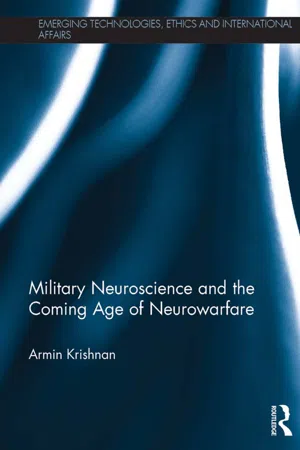
Military Neuroscience and the Coming Age of Neurowarfare
About this book
Krishnan describes military applications of neuroscience research and emerging neurotechnology with relevance to the conduct of armed conflict and law enforcement. This work builds upon literature by scholars such as Moreno and Giordano and fills an existing gap, not only in terms of reviewing available and future neurotechnologies and relevant applications, but by discussing how the military pursuit of these technologies fits into the overall strategic context. The first to sketch future neurowarfare by looking at its potentials as well as its inherent limitations, this book's main theme is how military neuroscience will enhance and possibly transform both classical psychological operations and cyber warfare. Its core argument is that nonlethal strategies and tactics could become central to warfare in the first half of the twenty-first century. This creates both humanitarian opportunities in making war less bloody and burdensome as well as some unprecedented threats and dangers in terms of preserving freedom of thought and will in a coming age where minds can be manipulated with great precision.
Information
1Introduction
Jonathan Moreno was onto something big when he published the first academic book on military neuroscience in 2006. This was at the very beginning of the trend of the US military exploring military applications for civilian research in neuroscience (Moreno, 2006a). Since then, the American National Research Council and the Royal Society have issued several studies that relate to neuroscience and security, which form the basis for this monograph. The goal is to go beyond this established body of literature and to theorize about the relevance of military neuroscience to contemporary warfare. The main argument presented here is that possible future breakthroughs in neuroscience have the potential to fundamentally alter human society, human consciousness, warfare and security. This could make the human mind a distinctive new domain of war. Systematic efforts of dominating this new domain could be termed ‘neurowarfare’, which will be sketched in this book. The new ‘mind control’ weapons could turn populations into new WMD, or result in new forms political repression. In anticipation of these threats, the book advocates radical transparency in the field of military neuroscience and international arms control regulation of future neuroweapons.
1.1Advances in neuroscience
Why is there reason to believe that neuroscience and neurotechnology (neuro S/T) could bring anything new or substantive to the practice of modern warfare? At least some neuroscientists (not all) believe that the secrets of the human brain and the human mind can be eventually unlocked. For example, the recently deceased neuroscientist Richard F. Thompson stated a few years ago in the preface to a revised edition of his book on the brain:
Will we one day develop instruments with which we can ‘read’ minds? Will it be possible one day to insert thoughts into minds or transmit them from one mind to another? Will we be able to greatly enhance our intellectual abilities through ‘symbiosis’ with artificial intelligence? …Previously I believed that it was unnecessary to discuss these possibilities today. I was wrong. Developments in neuro- and computer sciences are advancing so rapidly that many of these possibilities that seem akin to science fiction could become reality in our life times.
(Thompson, 2012: X)
It is not difficult to see how such technologies, if they turn out to be feasible, could completely alter human reality quite literally. Humans could control machines and communicate alone by thought; they could be plugged into a Matrix-like virtual reality to gain experiences that they could not otherwise have, at no risk; the quality of human life could be vastly improved in numerous ways, including better mental health and life extension; and society may be uplifted by making its members smarter and better able to reach their full potential, resulting in a new golden age of discovery and invention.
Neuroscience is the scientific effort of understanding the workings of the human brain and the human mind, relying on brain imaging and other forms of measurement and modeling. Neuroscience is thus a fairly complicated and diverse scientific field, comprising of diverse disciplines such as ‘calculus, general biology, genetics, physiology, molecular biology, general chemistry, organic chemistry, biochemistry, physics, behavioral psychology, cognitive psychology, perceptual psychology, philosophy, computer theory, and research design’ (Moreno, 2012: 32). Research that identifies itself as ‘neuroscience’ receives quite substantial government and corporate funding. The neuroscientist James Giordano estimated in 2013 that the global market for neuro S/T is $150 billion annually and that it is rapidly growing with large investments in Asia and South America, which will supersede American spending by 2020 (Canna, 2013).
Breakthroughs in the field have come from the development of advanced brain imaging technologies like MRI, fMRI, fNIRS, PET, CAT, CT and MEG that have given invaluable insights in the functioning of a living brain and from the development of Brain-Machine Interfaces (BMI) (Kaku, 2014: 9). Particularly important with respect to brain monitoring and BMIs is functional neuroimaging, which either measures the blood flow in the brain or the electromagnetic fields generated by neural activity, as neurons use both chemical and electrical processes for communicating with each other (R.H. Blank, 2014: 49–51). Unfortunately, the ‘mapping’ of the brain through functional neuroimaging is complicated by ‘brain plasticity’, or the tendency of the brain to constantly reorganize itself. Science journalist John Horgan claimed that brain plasticity may very well stand forever in the way of fully understanding the human mind since there may not even be any ‘code’ that can be ‘decoded’ (Horgan, 2004).
However, there are strong pressures for science to try. Over two billion people suffer from neurological diseases and psychiatric illnesses, who could benefit from neuroscience research (Lynch, 2009: 4). Alzheimer’s disease alone will present itself as a major problem to all aging Western societies: almost half of all people over 85 have Alzheimer’s and 13 per cent of all people over 65 have it. There are now more people, as young as 30, with an early onset of the disease (Alzheimer’s Association, 2015). RAND estimated that current health costs related to treating Alzheimer’s alone in the US are in the range of $159 billion to $215 billion and could double by 2040 (Hurd et al., 2013).
Apart from this big push factor, there is also a powerful pull factor for expanding neuroscience research: the promise of life extension and, possibly, the immortality of the mind. Transhumanists like Ray Kurzweil, who heads Google’s R&D in artificial intelligence (AI), consider the human brain to be little more than a biocomputer that can be emulated on a computer. They claim that not only will it be possible to simulate the mind on a computer, but even to copy or upload a human mind into a computer, thereby becoming immortal (Kurzweil, 2005: 198–205). If we just replicate all the complex connections of a living brain, so the argument goes, consciousness would supposedly emerge. It then mostly becomes a challenge of creating sufficient computing power and memory for ‘running’ or simulating a mind on a computer.
Roboticist Hans Moravec claimed that the entire brain of a human being could be stored on a computer in less than hundred million megabytes or 1015 bits, which means that storing the brains of the entire world population would only require 1028 bits (Moravec 1999: 166). Ray Kurzweil similarly argues ‘that to functionally simulate the brain would require between 1014 and 1016 calculations per second (cps) and used 1016 to be conservative’ (Kurzweil, 2012: 196). Kurzweil thinks that brain plasticity poses no obstacle since it can all be emulated on software. Based on his calculations of brain power and projections of future computing power, it would be possible to model the brain by 2020; to run a nuanced simulation of a mind by 2029; and to have human and machine intelligence increased by a billion-fold by 2045 (Barrat, 2013: 131; Kurzweil, 2005: 199–200).
Neuroscientist Kenneth Hayward has agreed that the basic assumptions made by transhumanists are valid, stating: ‘I am virtually certain that mind uploading is possible’, while suggesting this is ‘probably centuries away’. However, Hayward argued that in principle ‘all these perceptual and sensorimotor memories are stored as static changes in the synapses between neurons’, which could be preserved in a connectome model of the brain (Shermer, 2016). But it is not likely that the wealthy of the world would want to wait for so long: various Silicon Valley entrepreneurs like Peter Thiel, Sergey Brin and Larry Ellison are now investing significant sums of money in immortality, as this is the ultimate prize (Isaacson, 2015). In Russia, billionaire Dimitry Itskov has launched the 2045 Initiative, which aims to realize mind uploading technology by 2045 (2045.com). Whether these are pipedreams or not, what matters is that globally large amounts of resources are directed towards understanding the brain for different reasons and that eventually the knowledge gained could be used (or abused) for military or political purposes.
1.2Large-scale government brain initiatives
In 2007, US scientists declared at George Mason University the ‘decade of the mind’ with the explicit goal of ‘mapping’ the mind similar to the ‘mapping’ of the human genome, calling for $4 billion in funding (Kavanagh, 2007: 1321). The proposal stressed the urgency caused by the great economic burden of mental disorders in the US.
1.2.1The BRAIN initiative
President Obama subsequently announced the $3 billion BRAIN Initiative in April 2013 to revolutionize our understanding of the brain. The President explained that it will be a long-term scientific effort comparable to the human genome project and that it could impact ‘the lives of not millions, but billions of people on this planet’ (White House, 2013). The original plan was to spend $100 million in federal money and $200 million in private sector money on neuroscience research for ten years, but it has been extended to twelve years and a total of $4.5 billions (Requarth, 2015). The project is led by the NIH, the NSF, the FDA, DARPA and IARPA in conjunction with private sector partners such as the Allen Institute for Brain Science, the Howard Hughes Medical Institute, the Kavli Foundation and the Salk Institute for Biological Studies (Insel et al., 2013: 687). According to the White House:
The BRAIN Initiative will accelerate the development and application of new technologies that will enable researcher to produce dynamic pictures of the brain that show how individual brain cells and complex neural circuits interact at the speed of thought. These technologies will open new doors to explore how the brain records, processes, uses, stores, and retrieves vast quantities of information, and shed light on the complex links between brain function and behavior. (my emphasis)
(White House, 2013)
The BRAIN Initiative is pretty clear on the goal of ‘deciphering’ the brain and about the extensive involvement of the private sector, which is by no means limited to medical research. It thereby acknowledges that the current neuroscience revolution is driven by civilian applications in such diverse areas as health, security, marketing, finance and politics (Lynch, 2009). In 2010 alone, 800 neurotechnology patents have been filed – a doubling of patents per year from the previous decade. Most patents were filed by the marketing research company Nielsen (100) and by software giant Microsoft (89), which shows that neurotechnology has already gone beyond medical applications and is poised to proliferate across society (Griffin, 2015).
1.2.2The Human Brain Project and similar projects
The European Union inaugurated a similar neuroscience research effort called the Human Brain Project (HBP) in October 2013. The EU pledged to spend €1 billion over ten years to ‘gain fundamental insights into what it means to be human, develop new treatments for brain diseases, and build revolutionary new Information and Communications Technologies (ICT)’ (Markram 2012, 8). The project is coordinated by the Ecole Polytechnique Federale de Lausanne (EPFL) and has 13 subprojects, which include: Strategic Mouse Brain Data (SP 1), Strategic Human Brain Data (SP 2), Cognitive Architectures (SP 3), Theoretical Neuroscience (SP 4), Neuroinformatics (SP 5), Brain Simulation (SP 6), High Performance Computing (SP 7), Medical Informatics (SP 8), Neuromorphic Computing (SP 9), Neurorobotics (SP 10), Applications (SP 11), Ethics and Society (SP 12) and Management (SP 13). The HBP project website states:
The Human Brain Project (HBP) is a European Commission Future and Emerging Technologies Flagship that aims to accelerate our understanding of the human brain, make advances in defining and diagnosing brain disorders, and develop new brain-like technologies…A major goal of the HBP is to deliver a collaboratively built first draft ‘scaffold’ model and simulation of the human brain by 2023. This will not be a complete simulation of every detail, but rather provide a framework for integrating data and knowledge related to the structure and function of the human brain from research and clinical studies around the world. The model and simulations will provide a community test bed for hypotheses and theories of brain function in health and disease.
(HBP, 2015)
The goal of the HBP to build a working computer model of the brain is apparently inspired by the EPFL and IBM collaboration Blue Brain Project that was launched in 2005, which receives most of the funding (Frégnac and Laurent, 2014: 28). Similar large-scale brain research projects have been initiated in several other countries, including Australia, Canada, Japan, Israel and China. While the focus of these research initiatives is clearly civilian in nature with curing Alzheimer’s high on the priority list, it is also obvious that some of the research can be repurposed for military usage (Marchant and Gaudet, 2014). Robert McCreight suggested that ‘this “competitive environment” could feed into a sort of neurological space race, a contest to control and commoditize neurons’ (quoted from Requarth, 2015).
Table 1.1Neuroscience initiatives
| Country | Initiative name | Initiated | Funding | Research funding programs |
| United States | BRAIN Initiative | 2014 | $3 billion | • Multi-scale integration of t... |
Table of contents
- Cover
- Half Title
- Series Information
- Title Page
- Copyright Page
- Table of contents
- List of tables
- Acknowledgements
- List of abbreviations
- 1 Introduction
- 2 Cold War brain research and germ warfare
- 3 Neuroscientific enhancement
- 4 Intelligence and prediction
- 5 The degradation technologies I: Drugs and bugs
- 6 The degradation technologies II: Waves and bytes
- 7 The strategic context
- 8 Neurowarfare
- 9 Dangers and solutions
- Bibliography
- Index
Trusted by 375,005 students
Access to over 1.5 million titles for a fair monthly price.
Study more efficiently using our study tools.
Frequently asked questions
Yes, you can cancel anytime from the Subscription tab in your account settings on the Perlego website. Your subscription will stay active until the end of your current billing period. Learn how to cancel your subscription
No, books cannot be downloaded as external files, such as PDFs, for use outside of Perlego. However, you can download books within the Perlego app for offline reading on mobile or tablet. Learn how to download books offline
Perlego offers two plans: Essential and Complete
- Essential is ideal for learners and professionals who enjoy exploring a wide range of subjects. Access the Essential Library with 800,000+ trusted titles and best-sellers across business, personal growth, and the humanities. Includes unlimited reading time and Standard Read Aloud voice.
- Complete: Perfect for advanced learners and researchers needing full, unrestricted access. Unlock 1.5M+ books across hundreds of subjects, including academic and specialized titles. The Complete Plan also includes advanced features like Premium Read Aloud and Research Assistant.
We are an online textbook subscription service, where you can get access to an entire online library for less than the price of a single book per month. With over 1.5 million books across 990+ topics, we’ve got you covered! Learn about our mission
Look out for the read-aloud symbol on your next book to see if you can listen to it. The read-aloud tool reads text aloud for you, highlighting the text as it is being read. You can pause it, speed it up and slow it down. Learn more about Read Aloud
Yes! You can use the Perlego app on both iOS and Android devices to read anytime, anywhere — even offline. Perfect for commutes or when you’re on the go.
Please note we cannot support devices running on iOS 13 and Android 7 or earlier. Learn more about using the app
Please note we cannot support devices running on iOS 13 and Android 7 or earlier. Learn more about using the app
Yes, you can access Military Neuroscience and the Coming Age of Neurowarfare by Armin Krishnan in PDF and/or ePUB format, as well as other popular books in Politics & International Relations & Politics. We have over 1.5 million books available in our catalogue for you to explore.