- 300 pages
- English
- ePUB (mobile friendly)
- Available on iOS & Android
eBook - ePub
About this book
The ability of organisations to cyberconnect is becoming increasingly important for superior performance. Cyberconnecting: The Three Lenses of Diversity by Dr Priya E. Abraham explains how to establish connections across technological, cultural and social boundaries, mirrored in organisations succeeding in today's hybrid business world. Some companies create and innovate technology; others use and adopt it; but in the cyberage, both must closely interconnect tech with human behaviour. Face-to-face and cyber-interactions are at the heart of effective work-based relationships, which in turn increase organisational performance. To build these effective business relations, organisations must foster the discovery muscle - curiosity combined with skills - in individuals. Priya E. Abraham shows how seemingly opposing domains (technology, business anthropology and diversity) best leverage interactions for the benefit of organisation development, using findings from practitioner-focused research conducted when leading complex cross-boundary projects in the telecommunications and mobile learning industries. Tools from business anthropology help uncover people's diverse needs and expectations in a cyberconnected world. Identity portfolios need reflection in development solutions of face-to-face and mobile applications. Solutions uncovered by qualitative research methods help close the gap between human behaviour and tech to engage internal and external stakeholders. The book presents a much-needed strategic framework required for cyberconnecting: 'The Three Lenses of Diversity', designed to organise thinking in the navigation of technological, cultural, and social boundaries.
PART I
The Context
Chapter 1
The Cyberconnected World of Work
At the heart of this book lie one definition and two premises. For our purposes, ‘cyberconnecting’ will be defined as building interconnectivity in the digital world. The first premise is that the way we connect is changing; the second is that today’s most innovative companies are inviting various stakeholders to be co-creators. For technology to work, it must be human-centric, and this can only be achieved through the process of co-creation.
One significant change driver among many in the world of work is the unprecedented pace of development in information technology (IT). Technology is handing back aspects of banking, travelling, health and wellbeing, and will soon inform literally every aspect of our lives. As a consequence it shapes the ways we connect with others, the ways we perceive ourselves and others, and the environment in which our interactions take place. This will have major implications for underlying business models and the ways we connect with peers, clients, competitors and stakeholders. Face-to-face and cyberinteractions are at the heart of effective relationships. In this technology-induced world of work, we need to think how best to leverage interactions for the benefit of organisation development.
The ability of organisations to cyberconnect is becoming increasingly important for superior performance. This book presents diversity as the vehicle to build interconnectivity, which means to build effective face-to-face and virtual relationships across boundaries, characteristic of today’s cyberconnected world of work. In response to this need, the book presents a much-needed strategic framework required for building interconnectivity: ‘The Three Lenses of Diversity’, designed to organise thinking in the navigation of technological, cultural and social boundaries.
It is a solution-oriented approach to building interconnectivity in the digital age. The ramifications of diversity inherent to today’s cyberconnected world of work can be examined, not isolated from business, but embedded in actual cross-boundary work situations, where an appreciation of multiple identity constructions, perception of self and others, and the environment can make a difference in outcome and performance. Cross-boundary work situations are captured in two life cases which describe projects in the telecommunications and mobile learning industries.
Building Interconnectivity
Interconnectivity is the intentional building of reciprocal relationships with awareness of the intricacies of any human interaction with other people or technology across various boundaries. It grows out of the willingness to explore, discover and span the multifaceted, coexisting layers of social, technological and cultural boundaries.
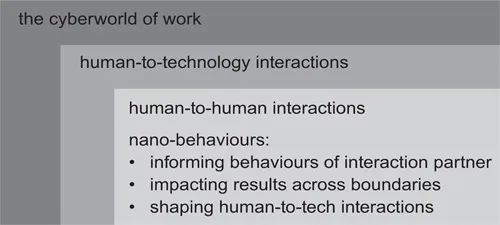
Figure 1.1 The cyberworld of work
The heart of the cyberconnected world1 of work marks the human-to-human interactions which through human-to-technology interactions make the cyberworld fail or succeed (see Figure 1.1). The superior quality of these interactions enables people to break through the silos typical to the world of work. These entail technological, functional, cultural and hierarchical boundaries, all of which contain further vertical and horizontal boundaries.
Nano-behaviours are the subtle, almost imperceptible behaviours over which we tend to step due to heavy workloads or which we have not developed the skills to look out for, but which greatly impact the way we interact with one another on projects that inform technology development or its adoption, irrespective of our background or expertise.
Human-to-tech interaction captures people interacting with technology in the role of end consumer or shaper. Using a laptop, exploring a smart-phone or adopting a wearable is pre-informed by the underlying human-to-human interaction in the making of the item.
Leveraging human-to-human and human-to-tech interactions is marked by spanning social, technological and cultural boundaries dominant in the cyberworld of work, which describes the non-physical place in global interaction, which is in turn made from human-to-human interaction.
The core of cyberconnecting in this book is mobile technology, its enablers and its human interface; it will be presented through a life case based on a project of the company SonaConn. Making enterprises and organisations mobile is no longer a matter for debate. Today’s mobile users, customers and employees alike, expect interaction at their fingertips. Apps2 have become a dominant delivery mechanism, generating a multi-billion industry; however, enterprise mobility goes well beyond mobile apps – it influences the way enterprises and organisations run their businesses and, in particular, how they connect and interact with their client and users.
In the quest for new opportunities in the cyberconnected world of work, enterprises and organisations are looking into new ways to attract consumer purchases and new referrals from prospective customers. They apply innovative approaches to align employee behaviour with organisational strategies, tasks and disciplinary plans, resulting in better acceptance of management plans along with increased productivity and low attrition. They develop, design and implement gamified mobile learning programmes in order to assist employees and clients in adopting positive behaviour change. At the heart of this endeavour lies gamification, that is, the selected use of game elements in a non-game environment. It describes the process of game thinking and game mechanics to engage users and to solve problems.
Gamification can be a component of the Internet of Things, which is embedding itself into everyday items. From toothbrushes, fridges and thermostats to cars and cities, everything around us, including health, is getting connected. The Internet of Things is part of the book inasmuch as the devices benefit from superior user experience (UX) to find ultimate user acceptance, whose materialisation requires the acknowledgement of the diversity of future users. The users’ underlying identities have personal, psychological, social and commercial value. The collection and use of personal data can have benefits for individuals, organisations and government, by offering greater insights through data analysis and the development of more targeted and more effective services.
Cyberconnecting today is unthinkable without big data. Big data needs a refreshed, ethical and human-centric view of decision-making, anticipated outcomes, purpose and value to clients. In this book the focus lies on the qualitative work that provides us with insights into what people’s motivation drivers really are. Thus, ethnographic significance should be integrated as a complement in collaboration with statistical significance, aiming at the complementary approach between causation and correlation.
All of the above items are embedded in the cloud, which describes the use of files and applications over the internet, and is more of a journey than a business destination, whatever the industry sector, and wherever on the globe. Cyberconnecting understands the cloud as a ubiquitous design principle to everything organisations deliver, a true driver to business change, bringing together a range of public and private services, to deliver agility, scalability, simplicity and speed to market.
Naturally, Cyberconnecting recognises the potential for criminal exploitation or misuse of data and the ways it enables people to connect. Cybercrime as such will not be covered in this book; however, it acknowledges that people require greater transparency, accountability and autonomy concerning their data. Authorities are charged not only with setting the rules in which the digital world will emerge, but also adapting their own processes towards cyberconnecting. This book takes the position that cyberconnecting is constructive, productive and fundamental to achieving positive relationships between people and commercial organisations, that is, meaningful and effective business relationships. It focuses on the mindful and ethical use of the opportunities it entails.
Who We Are – Our Identity Map
Building interconnectivity requires us to show ‘who we are’, usually generated by our identity. Identity is a construct. In today’s cyberconnected world it refers to how we perceive ourselves and express our individuality in the world. Identity is enacted through face-to-face and online social interactions with others. We have coexisting, multifaceted and overlapping identities, whose importance shifts depending on context. The tangible identities such as gender or ethnicity are encrypted in our body, whereas the less visible characteristics of our identity, the intangible elements, are either chosen, in cases such as our political affiliations, or developed, in cases such as our further education. The latter are likely to change over the course of our life, shaped by the dialogical relationship of self-determination and control or ascription of others.
Our identity informs our role in our larger social environment, the cognition we have about others in different spaces, the way we interact with others, and thereby the way we are seen and categorised by others. The contextual nature of identity instructs the emphasis we put on selected parts of our identity: at home we might be a caring parent or a loving partner, at work we might be an innovative leader, online we might want to explore a new identity by using an avatar, for example in order to become an opinion maker.
Because online information and communication technologies have the potential to shape identity processes in meaningful ways, it is important to consider the identity implications of social media practices and other online tools in general. The knowledge about and the awareness of our identity map and those of others help build effective relationships, in the traditional face-to-face and the cyberconnected world of work.
Boundary-Spanning
Building interconnectivity in the digital age requires some important boundary-spanning competencies. These competencies enable you to establish relationships with business partners by temporarily altering the emphasis you put on selected identities of your identity portfolio. The shift in the importance of coexisting identities must happen with awareness of environmental contingencies, and the business partner’s perception of self, you and other key stakeholders. For successful establishment of relationships, knowledge about global trends and socioeconomic drivers, skills such as observation and listening, and finally, the adoption of behaviours such as reflecting, redesigning, mobilising and customising are essential.
Boundary-spanners are those who have developed these competencies and actively seek to work across boundaries and find benefit in the process. In today’s cyberconnected world of work, the group of boundary-spanners has grown in size and has become wider in rank. Literally everyone is concerned with boundary-spanning activities whereas formerly it was restricted to a selected and often privileged group of expats whose responsibility was to work across boundaries.
The intercultural component upon which cyberconnecting in part rests is covered throughout the book, specifically by the presentation of the SonaConn project. It features additional intercultural insights based on hands-on examples from the delivery of a large-scale change project in the Middle East and North African (MENA) region.
The Roadmap to Interconnectivity – The Three Lenses of Diversity
If in your boundary-spanning role you are required to build interconnectivity it might be useful to understand:
• the coexisting and overlapping identities people bring into interactions;
• the appraisal they have of self and the other, in connection with which perception it is important to understand and to respond to potential stereotypes; and
• the environment in which all of this happens.
The book presents a much-needed strategic framework required for building interconnectivity: ‘The Three Lenses of Diversity’, designed to organise thinking in the navigation of technological, cultural and social boundaries. The framework consists of:
• The Lens of Multiple Identity for the exploration of people’s coexisting and overlapping identities.
• The Lens of Perception for the examination of potential stereotypes and their impact on the interaction.
• The Environmental Lens for the analysis of the geopolitical, cultural, financial and business environment.
As a central reference point, the framework is useful not only when a problem has already arisen but also as a form of inquiry and to prevent it ever happening.
The Three Lenses of Diversity rest on the research findings that show that ‘Diversity is a process’ generated from interactions. As such diversity is:
• dynamic;
• regenerative;
• perc...
Table of contents
- Cover Page
- Title Page
- Copyright Page
- Contents
- List of Figures
- List of Tables
- List of Boxes
- List of Abbreviations
- PART I THE CONTEXT
- PART II THE PRACTICE
- PART III THE APPLICATION
- Bibliography
- Index
Trusted by 375,005 students
Access to over 1.5 million titles for a fair monthly price.
Study more efficiently using our study tools.
Frequently asked questions
Yes, you can cancel anytime from the Subscription tab in your account settings on the Perlego website. Your subscription will stay active until the end of your current billing period. Learn how to cancel your subscription
No, books cannot be downloaded as external files, such as PDFs, for use outside of Perlego. However, you can download books within the Perlego app for offline reading on mobile or tablet. Learn how to download books offline
Perlego offers two plans: Essential and Complete
- Essential is ideal for learners and professionals who enjoy exploring a wide range of subjects. Access the Essential Library with 800,000+ trusted titles and best-sellers across business, personal growth, and the humanities. Includes unlimited reading time and Standard Read Aloud voice.
- Complete: Perfect for advanced learners and researchers needing full, unrestricted access. Unlock 1.5M+ books across hundreds of subjects, including academic and specialized titles. The Complete Plan also includes advanced features like Premium Read Aloud and Research Assistant.
We are an online textbook subscription service, where you can get access to an entire online library for less than the price of a single book per month. With over 1.5 million books across 990+ topics, we’ve got you covered! Learn about our mission
Look out for the read-aloud symbol on your next book to see if you can listen to it. The read-aloud tool reads text aloud for you, highlighting the text as it is being read. You can pause it, speed it up and slow it down. Learn more about Read Aloud
Yes! You can use the Perlego app on both iOS and Android devices to read anytime, anywhere — even offline. Perfect for commutes or when you’re on the go.
Please note we cannot support devices running on iOS 13 and Android 7 or earlier. Learn more about using the app
Please note we cannot support devices running on iOS 13 and Android 7 or earlier. Learn more about using the app
Yes, you can access Cyberconnecting by Priya E. Abraham in PDF and/or ePUB format, as well as other popular books in Business & Business General. We have over 1.5 million books available in our catalogue for you to explore.