eBook - ePub
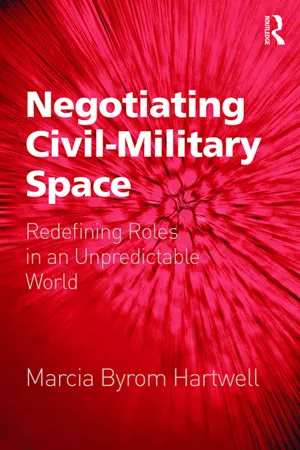
Negotiating Civil-Military Space
Redefining Roles in an Unpredictable World
- 170 pages
- English
- ePUB (mobile friendly)
- Available on iOS & Android
eBook - ePub
About this book
This book begins discussion at a point where many civil–military conversations end. Hartwell identifies underlying dynamics, key issues, and challenges that civilian and military organizations encounter when negotiating their roles in real and virtual volatile environments. These include managing expectations, understanding organizational missions and cultures, building trust, and exploring different approaches to violence. The impact of applied technologies on decision making processes and interventions is discussed in terms of recent and future complex crises. Linking earlier history to current discussions, this study makes an important contribution by reframing issues and outlining strategies to avoid unintended consequences and more effectively protect civilians in future operations. While geographic focus is on the Middle East, Africa, Central Asia, and Asia-Pacific, the core issues are applicable to negotiating civil–military relationships in a wide range of environments.
Trusted by 375,005 students
Access to over 1.5 million titles for a fair monthly price.
Study more efficiently using our study tools.
Information
Subtopic
PoliticsPart I Setting the stage
DOI: 10.4324/9781315597645-2
1 Winning “hearts and minds” in Vietnam
DOI: 10.4324/9781315597645-3
The thread of many unresolved civil–military issues discussed here and in the remainder of this book can be traced back to US civil–military experiences and unlearned lessons during the Vietnam era. Lessons not learned from Vietnam led to misleading assumptions by the US military and government about the success of the “unity of effort” “hearts and minds” models that were the basis for expectations about international civil–military relationships in Afghanistan and for US civilian organizations and military forces in Iraq. This chapter gives an overview of US civil–military roles as they changed from separate assignments for civilian workers and military advisors after World War II to the merging of civil–military programs under the 1967 Civil Operations and Revolutionary Development Support (CORDS) attempt to win “hearts and minds” in Vietnam. It discusses how contentious this change was for US civilians implementing these programs and concludes with key lessons from Vietnam that continue to be relevant.
Developing the model
My introduction to a civilian viewpoint about civil–military roles in Vietnam was during a conversation with a US Agency for International Development (USAID) employee who had worked there and asked if I would like to see the unpublished 1975 Viet Nam Terminal Report (USAID 1975 a, 1975 b, 1975 c). These typed manuscripts documented the USAID work in Vietnam from the beginning of US civilian and military assistance in 1954, throughout the Vietnam War, 1965–1969, to the fall of Saigon on April 30, 1975 (USAID 1975 b: Vol. I, 4–5, 7/11). USAID employees had rushed to complete these reports by the end of 1975 only to see their efforts buried and ignored. Someone eventually scanned them to preserve as historic documents that described projects, personal observations and internal conflicts about the transition from civilian to military-led collaboration.
The civil–military model used in Vietnam was patterned after the successful 1945 Allied Marshall Plan named for US Secretary of State George C. Marshall that rebuilt infrastructure, the economy, and reformed European legal systems and governments following World War II (USAID 2014). Prior to US civilian and military assistance to Vietnam in 1954 a portion of the large scale military and economic assistance given to post-World War II France in the Marshall Plan was channeled to Vietnam, which was still a French territory (USAID 1975 a: 3/96). This aid was administered by Allied forces who recruited civil administrators, city planners, urban development specialists, and administrators experienced with modern cities and governments to rebuild Europe (Cuny 1989). With few non-governmental organizations and the United Nations and international relief system in their infancy military forces were depended upon for support in humanitarian operations. As they demobilized Allied armies constructed refugee camps, distributed food, blankets, cots, conducted mass inoculations against typhus, typhoid, cholera, and donated military surplus to millions of displaced civilians. The 1947 Berlin Airlift solidified the military’s humanitarian role when only airplanes were used to supply the entire city with food. The success of this operation contributed to the modern assumption that planes are necessary for delivering emergency relief, which in reality has proved to be an expensive often unsustainable mode of transporting supplies. A similar post-World War II era civil–military model was implemented in India, Palestine and other decolonizing countries as well as Korea, Greece, and Cold War flashpoint areas during the late 1940s (Cuny 1989).
During the 1950s Cold War era international assistance based on the Marshall Plan model expanded to include populations displaced by conflict and natural disasters inside newly emerging nations and as a tool in the power struggle between the US and Russia (Cuny 1989). The idea was that international civilian populations would choose democracy over communism if they were helped to develop democratic institutions and systems. President Harry S. Truman’s 1950 Point Four Program formalized an international development assistance strategy with two goals, one was to create new markets for US business by reducing poverty and increasing production in developing countries, and the other was to reduce the communist threat by helping countries achieve prosperity through capitalism. From 1952–1961 programs that supported technical assistance and capital projects were the major form of US aid and important components of US foreign policy (USAID 1975 b: Vol. I, 4–5). The earliest US aid to Vietnam was established in 1950 when the Special Technical and Economic Mission was created to provide assistance in cooperation with the French to their de facto colonies Associated States of Indochina including North and South “Vietnam.” This early program helped to develop marine fisheries, civil aviation, health services, adult literacy, government information services and the Port of Saigon (USAID 1975 b: Vol. I, 1/94). By 1954 Vietnam international aid had become an intrinsic part of American foreign policy as had the US view of itself as a benevolent force for preventing the spread of communism and supporting fledgling democratic countries.
Prior to USAID created by President John Kennedy in 1961, US international assistance was administered by three separate agencies, the Mutual Security Agency, the Foreign Operations Administration, and the International Cooperation Administration (USAID 2014: History). Under USAID consolidation the 1960s became known as the “decade of development” (USAID 2014: History) when US economic aid to South Vietnam was unparalleled in scope and activities (USAID 1975 b: Vol. I, 4–5). As operations increased relief agencies turned to UN international peacekeeping forces who had begun working alongside military forces to supply logistical and material support. This formed the basis for the US civil–military humanitarian, aid, and development model during the 1950s and 1960s in Vietnam.
US civil–military aid to Vietnam
Formal US civil–military aid to South Vietnam began after the 1954 Geneva Accords when the United States Operations Mission (USOM) was established to “plug the financial gap” left by the departure of the French and to assist South Vietnam’s transition from a dependent territory to an independent state (USAID 1975 b: Vol. I, 1/94). This followed a hundred years of conflict between the Vietnamese and their French colonizers, which had ended in a French defeat by pro-communist nationalists in the northwest corner of Vietnam at Dien Bine Phu (Brigham 2004). North and South Vietnam were temporarily divided at the seventeenth parallel with the understanding they would reunify after elections that would determine if they would incorporate under communist rule led by North Vietnam or by under a fledgling democracy in South Vietnam. Having recently ended the Korean War where they had successfully fought to protect the new South Korea democracy the US government and military were determined to stop the spread of communism in South Vietnam (USAID 1975 b: Vol. I, 1/94).
In a series of multilateral agreements eventually known as the Southeast Asia Treaty Organization or SEATO the US attempted to push back against the threat of communist rule by focusing on nation-building (Brigham 2004) in a “South Vietnam” that now had increased their population by 8 percent with an influx of an estimated 900,000 refugees from the north between 1954 and 1955 (USAID 1975 b: Vol. I, 3/96). From 1954–1958 US civilian aid projects focused on resettling these refugees and forming the new government. Included were efforts to reorganize and train a national army capable of maintaining internal security and resisting “external aggressors,” rehabilitating and integrating over two million refugees into the economy, and assisting displaced populations and demobilized soldiers who might be vulnerable to “communist subversion.” These aid projects were designed to make the government more responsive to the needs of the people and to increase popular support (USAID 1975 c: 4–5). South Vietnam experienced relative security, financial stability, and fairly impressive economic development until 1959 when increased Viet Cong activity began to impact development programs. This activity was accompanied by budget deficits, inflationary pressures and a stagnating economy as instability grew to a point where the US civil–military presence took “a quantum leap forward” (USAID 1975 c: 4/97).
Renegotiating civil–military roles
Civilian and military roles in Vietnam changed dramatically after violence accelerated in 1961. Prior to this time civilians administered humanitarian assistance and supervised economic and development projects, and military advisors embedded in the South Vietnamese military trained and built up South Vietnam’s forces (USAID 1975 b: Vol. I, 4–5, 12/43). As the US military launched large scale search and destroy operations in 1964 inhabitants of entire hamlets and villages were displaced. This resulted in large numbers of internal “refugees” (later called internally displaced populations) and pressure for jointly administered civil–military relief and rehabilitation programs. These included “temporary relief” that provided food, shelter, other items at official temporary government of Vietnam (GVN) camps throughout the country; “return to village,” which assisted displaced populations who wished to return home to build new houses, community schools, dispensaries, roads, markets, wells, and buy food before new crops were harvested; “resettlement” to assist displaced populations establish new homes and communities in secure areas; and “in-place war victims” that helped those who had lost their homes and/or experienced death or injury of family members due to military actions and temporary displacement. Oversight of refugees was transferred from a provincial field program to a new USOM Office of Refugee Coordination in October 1965 led by an Assistant Director with refugee experience (USAID 1975 c: Vol. II, 1/479, 3/481).
Responding to congressional pressure about the growing refugee crisis USAID formed the USAID Associate Directorate for Relief and Rehabilitation to liaise across civil–military agencies including USOM staff, the US military, GVN refugee offices, international organizations, and to provide technical advice to a new cadre of civilian provincial refugee advisors (USAID 1975 c: Vol. II, 1/479, 3/481). The State Department then formed an interagency Vietnam Task Force that included the Defense Department, USAID, the US Information Agency and the Central Intelligence Agency (CIA) to reconsider US objectives. Two 1961 study missions inside Vietnam, one led by civilian Eugene Staley and the other by General Maxwell Taylor called for additional political and administrative reforms, new rural economic programs, increased US advisory and supply efforts, and developing and training a larger Vietnam military force. USAID was to implement rural economic programs and administrative reforms alongside military counterinsurgency programs operating inside hamlets, the lowest administrative level of provincial government.
USAID staff’s reactions to USAID’s role in these “short-term civil counterinsurgency programs” were sharply divided. Those opposed to this new civil–military collaboration designed to “stave off defeat” argued that their best contribution toward South Vietnam’s stability would be to continue implementing programs designed to strengthen Vietnamese institutions and reinforce orderly economic and social development. They held the view that a direct response to the “guerilla crisis” was the responsibility of the Military Advisory Assistance Group (MAAG) and fell outside the traditional roles of the US Operations Mission and economic assistance programs (USAID 1975 b: Vol. I, 12/43, 11/268). USAID staff in favor of working on counterinsurgency activities believed that unless the high level of violence was jointly addressed in the short term further development of long term institutions would be impossible. Internal conflicts intensified between 1962 and 1963 as debates on the appropriate level of USAID participation in counterinsurgency activities continued to be a primary internal issue. As US projects integrated with counterinsurgency strategies they evolved into partnering with military forces to develop a pacification program known as the Vietnamese Revolutionary Development. As the US and South Vietnam forces secured territory this civilian-led aid and development program would establish, expand and consolidate government control in villages by providing services, expanding economic programs, and lessening the impact of economic and social “consequences” resulting from military operations (USAID 1975 b: Vol. I, 11/268, 5/20–7/22). Several long term economic stability programs such as USAID’s Commercial Import Program continued but the major focus from 1962 onward was to achieve short term civil–military political and security objectives (USAID 1975 b: Vol. I, 12/43–13/44).
The role of US forces had been evolving since 1960 when US Army civil affairs (CA) personnel were initially deployed on temporary duty assignments to help US Special Operations forces train South Vietnam’s military (White 2009: 3). They were assigned to the III Marine Amphibious Force and 1st Infantry Battalion to assist thousands of civilians displaced by the fighting and to support the new Civilian Irregular Defense Groups (CIDGs) in Vietnam’s Central Highlands. CA personnel built schools and taught modern agricultural techniques to improve the quality of life and encourage local tribes to fight the National Liberation Front (NLF) and the Viet Cong (VC) out of loyalty to the US military (Coffey 2006). In 1960 the US MAAG helped the Vietnamese Army organize and train 60 Vietnamese ranger companies in “antiguerrilla” tactics and prepared an organized pacification plan that served as a blueprint for later counterinsurgency/pacification efforts. As areas of instability broadened USAID and MAAG increased their staff. MAAG doubled its staff from 685 to 10,000 advisors and civilian-led USOM and MAAG had assigned advisors to each province by the end of 1962 (USAID 1975 b: Vol. I, 11/42–12/43).
A CA unit 41st CA Company made up of 16, six man refugee teams was deployed in the winter of 1965. Each CA company included about 60 officers and 100 enlisted men with approximately 80 percent generalists and each CA unit was composed of one team leader (a captain/O–3 rank), a medical doctor, construction officer, a counter-intelligence officer and several CA “generalists.” They often operated at 15–20 percent under full personnel capacity. CA missions had three key goals: eliminate the VC insurgency in South Vietnam, end VC recruitment in South Vietnam, and convince indigenous tribes living in South Vietnam to take up arms against the VC and the NLF in North Vietnam (White 2009: 3).
President Lyndon Johnson was determined to make the “pacification” of Vietnam into more than a military operation by winning the support of the local Vietnamese and building Vietnam into a model of economic, social, and political development in Asia. He envisioned this “other war” as a type of large US public works project that was a combination of the Tennessee Valley Authority and the Rural Electrification Administration on a national scale (Jones 2005: 105). President Lyndon Johnson declared “we must be ready to fight in Vietnam, but the ultimate victory will depend on the hearts and minds of the people who actually live out there” (Johnson quoted in Dixon 2009: 362). In 1965 the military advisory mission officially shifted to full combat status and integrated civil–military counterinsurgency programs were underway.
Winning hearts and minds
The concept of implementing a “hearts and minds” strategy to achieve national stability is often linked to Sir Gerald Templer, leader of the successful British counterinsurgency during the Malaya War (1948–60), who declared that military success was not achieved by “pouring more troops into the jungle, but in [winning] the hearts and minds of the people” (Templer quoted in Dixon 2009: 361). Templer interpreted winning “hearts” as gaining local emotional support and “minds” as responding to a population’s “rational self-interest” (Dixon 2009: 363). He argued that influencing the political will of internal populations was critical to winning local support for national governments as communities would then be more willing to provide valuable information about insurgencies and less likely to join them. If the government in power inspired little confidence individuals would gravitate toward the insurgent group they deemed most likely to lead the next government. Templer believed these objectives could be achieved through the judicial use of “minimum force.” Military forces would be expected to engage in social activities, civic projects, and psychological operations to reinforce a positive message and avoid alienating local populations. This would help reestablish a “cohesive” system of government rather than being solely focused on defeating an enemy (Dixon 2009: 358–9).
Templer’s counterinsurgency approach caught the attention of the US. Prior to becoming commanding general of Military Assistance Command, Vietnam (MACV) General William C. Westmoreland visited Malaya accompanied by key US officials from Saigon and Sir Robert Thompson, head of the British advisory team to Vietnam, to better understand the chain of command that the British had utilized in their “hearts and minds” counterinsurgency strategy during that war. Westmoreland concluded that establishing a unity of command for advisors at the provincial level was essential for recreating a similar success in Vietnam (USAID 1975 b: Vol. I, 23/280). Reinforcing this approach Robert Komer who would soon lead CORDS cautioned that providing more security in the short term would not guarantee victory in what was essentially a political war. Warning of potentially negative effects and the risk of increasing anti-Americanism in correlation with an increasingly visible military presence (Jones 2005: 108), Komer insisted that US pacification should primarily advise and support, stating “we do not intend to take over what the GVN and the ARVN [Army of the Republic of Vietnam] must do as an essentially Vietnamese task” (Komer 1970: 58).
American interpretation and use of the words “pacification and counterinsurgency” described a wide range of operations carried out by the US and Vietnamese (USAID 1975 b: Vol. I, 2/259). “Pacification, counterinsurgency, rural construction, revolutionary development and civic action” were the most frequently used terms. In early years “counterinsurgency” indicating military operations against enemy insurgents and “pacification,” which was an English language interpretation of an ancient Vietnamese term to describe actions that made a government more attractive to its constituents, were often used interchangeably. In later years English speakers used pacification to indicate military actions that sought to “gain control of a population” and the term counterinsurgency fell into disuse. “Development” referring to the process of improving government services in rural areas was frequently used by civilians in the earliest years of program ...
Table of contents
- Cover Page
- Half Title Page
- Title Page
- Copyright Page
- Table of Contents
- Preface
- Acknowledgments
- Introduction
- Part 1 Setting the stage
- Part 2 Reframing the issues
- Part 3 Looking ahead
- Bibliography
- Index
Frequently asked questions
Yes, you can cancel anytime from the Subscription tab in your account settings on the Perlego website. Your subscription will stay active until the end of your current billing period. Learn how to cancel your subscription
No, books cannot be downloaded as external files, such as PDFs, for use outside of Perlego. However, you can download books within the Perlego app for offline reading on mobile or tablet. Learn how to download books offline
Perlego offers two plans: Essential and Complete
- Essential is ideal for learners and professionals who enjoy exploring a wide range of subjects. Access the Essential Library with 800,000+ trusted titles and best-sellers across business, personal growth, and the humanities. Includes unlimited reading time and Standard Read Aloud voice.
- Complete: Perfect for advanced learners and researchers needing full, unrestricted access. Unlock 1.5M+ books across hundreds of subjects, including academic and specialized titles. The Complete Plan also includes advanced features like Premium Read Aloud and Research Assistant.
We are an online textbook subscription service, where you can get access to an entire online library for less than the price of a single book per month. With over 1.5 million books across 990+ topics, we’ve got you covered! Learn about our mission
Look out for the read-aloud symbol on your next book to see if you can listen to it. The read-aloud tool reads text aloud for you, highlighting the text as it is being read. You can pause it, speed it up and slow it down. Learn more about Read Aloud
Yes! You can use the Perlego app on both iOS and Android devices to read anytime, anywhere — even offline. Perfect for commutes or when you’re on the go.
Please note we cannot support devices running on iOS 13 and Android 7 or earlier. Learn more about using the app
Please note we cannot support devices running on iOS 13 and Android 7 or earlier. Learn more about using the app
Yes, you can access Negotiating Civil-Military Space by Marcia Byrom Hartwell in PDF and/or ePUB format, as well as other popular books in Politics & International Relations & Politics. We have over 1.5 million books available in our catalogue for you to explore.