- 256 pages
- English
- ePUB (mobile friendly)
- Available on iOS & Android
eBook - ePub
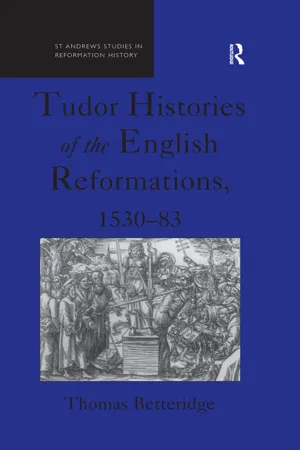
Tudor Histories of the English Reformations, 1530–83
About this book
This book examines the Tudor histories of the English Reformation written in the period 1530-83. All the reforming mid-Tudor regimes used historical discourses to support the religious changes they introduced. Indeed the English Reformation as a historical event was written, and rewritten, by Henrician, Edwardian, Marian and Elizabethan historians to provide legitimation for the religious policies of the government of the day. Starting with John Bale's King Johan, this book examines these histories of the English Reformations. It addresses the issues behind Bale's editions of the Examinations of Anne Askewe, discusses in detail the almost wholly neglected history writing of Mary Tudor's reign and concludes with a discussion of John Foxe's Acts and Monuments. In the process of working chronologically through the Reformation historiography of the period 1530-1583 this book explores the ideological conflicts that mid-Tudor historians of the English Reformations addressed and the differences, but also the similarities often cutting across doctrinal differences, that existed between their texts.
Chapter One
John Bale, Edward Halle and the Henrician Reformation
Where by divers sundry old authentic histories and chronicles it is manifestly declared and expressed that this realm of England is an empire, and so hath been accepted in the world, governed by one supreme head and king having the dignity and royal estate of the imperial crown of the same, unto whom a body politic, compact of all sorts and degrees of people divided in terms and by names of spirituality and temporality, be bounden and owe to bear next to God a natural and humble obedience ...
The Act of Appeals (1533)1
The Henrician Reformation from its advent claimed legitimacy on the basis of history and social order: authentic histories declared the naturalness of a body politic ruled by one supreme head. This famous extract from the prologue to the Act of Appeals is, however, riddled with rhetorical sleights of hand and doctrinal tension. What did it mean to claim that history declared the status of England as an empire? Whose and what history made this declaration? And in what way was the monarch's supreme headship next to God? Despite all their assertions and proclamations apologists for the Henrician Reformation never could finally or even satisfactorily answer these questions. This failure is marked in their texts by moments of polemical collapse and textual hiatus. In particular, Tudor Reformation historiography constantly found itself confronted with three key issues: who or what made Reformation happen? Was it a secular or spiritual event? And what was its historical status?
These issues were made more pressing, and more problematical, due to the presence of images of publicness and public spheres in magisterial Tudor histories of the English Reformations. The act of speaking for the public and arguing that the public sphere had been corrupted and needed reform, took on explicit, and potentially dangerous, political meanings within a historical discourse. If purgation of the public sphere was a religious historical event did this mean that membership of the public was equally historical or religious? Two radical possibilities are embodied in this question, that magisterial status itself was historical and, even more subversively, that one was authorized to speak in public, not on the basis of social position, but in terms of the sanctity of one's relation to God. Magisterial Tudor historians had to find ways of explaining the process of Reformation that avoided foregrounding these issues. Their histories had to represent the emergence of a strong reforming public in ways that protected the prevailing political and social order, and in particular the status of the monarch.
These issues determined the content and form of Tudor Reformation historiography from the moment that Henry VIII enacted his break with Rome. This chapter briefly examines a number of eariy Henrician defences of the Royal Supremacy. It discusses the production in these texts of images of a Henrician public sphere explicitly centred on the king. It then goes on to look at the way publicness as a concept is used by William Tyndale to sustain his right to adopt an authoritative prophetic voice within the commonwealth. The second part of the chapter examines the representations of the Henrician Reformation contained in Edward Halle's Chronicle and John Bale's King Johan. It discusses the way these texts reflect the potential conflict between the magisterial and religious understandings of the process of Reformation within the context of an imagined mid-Tudor public sphere.
Publicness, polemic and the Henrician Reformation
During the early 1530s a plethora of texts were produced by government apologists defending Henry's divorce and his attack on the English Church. In many of these works ideas of publicness and history were deployed to whip up support for the actions of the Henrician regime. One should note, however, that this turn to history was neither inevitable nor unproblematic. It was fuelled by a desire to deny the novelty of royal policies and to provide textual motivation for representations of the Henrician Reformation as inherently supportive of the social order.2
A Glasse of the Truthe3 was one of the earliest tracts issued as part of the propaganda campaign the government instituted in the 1530s, initially to justify Henry's divorce and later, in the second half of the decade, to support the Royal Supremacy.4 G.R. Elton comments that 'The Glass of Truth is a successful piece of propaganda - readable, clear, lively, short enough but seemingly full of meat.'5 A Glasse is written in the form of a dialogue between a Divine and a Lawyer.6 The narrative motivation of this discussion is to put forward Henry's position on his marriage and divorce. One should note, however, that the form of A Glasse is not coincidental to the argument that it contains, rather it is fundamental to its polemical thrust. A Glasse constructs itself as a simple dialogue between two concerned members of the polity. It explicitly bases its authority, as a text, on its status as a dialogue, on the extent to which its form enacts and produces the truth of the king's great matter. As a dialogue A Glasse is at one level an image of a public sphere. It claims to embody a public dispute whose publicness and dialogical qualities are the basis of its textual authority.
The Prologue to A Glasse discusses the status of the dispute between the Divine and Lawyer that makes up the bulk of the text. This prologue opens with an apology to its readers telling them that:
You shall have here, gentle readers, a small Dialogue between the Lawyer and Divine: wherin, if there lack such eloquence, such drift of arguments and conveyance of reasons, as peradventure were requisite, and as ye shall desire: yet we shall most entirely pray you, that where we be not sufficient to supply the same, to content yourself with this our rudeness, declaring the pure truth alone, which you shall be right sure to find in this poor treatise.7
Although these claims to 'dullness' and lack of eloquence are entirely conventional this does not prevent them from also being significant. A Glasse presents itself as a piece of clumsy plain writing that nonetheless contains the truth. Indeed it is precisely this plainness that guarantees the status of the text's truth. A Glasse constructs itself as requiring active readers, people who are prepared to find the truth. The plainness of the text, its rudeness, ensures that the discriminating reader will discover the truth of the text and, therefore, of Henry's great matter. The prologue to A Glasse contains a representation of the tract's ideal reader that the dialogue form of the main body of the text then reinforces and sustains.
As a dialogue the central section of A Glasse allows its reader to experience the production of meaning, the slow but inevitable emergence of the truth of government policy. Indeed the very title of this tract, A Glasse of the Truthe, points to its status as a text that is a reflection of the truth, a produced image. The dialogue form of the text allows the reader the pleasure of seeing the truth emerge during the course of a witty exchange. For example the text opens with the following discussion.
The Lawyer. Me seemeth it is wisely and truly said, that the right way is ever the nearest way; and likewise the plain way most sure to try all manner of truth by.
The Divine. I think that it be true which you speak; but you speak so obscurely, that I wot nere what you mean thereby.8
The irony of this exchange, in which a lawyer paraphrases Scripture and a divine thinks it is true but is not sure because he finds the words obscure, and its combination of the polemic with the comic, is typical of A Glasse. It creates a situation in which the reader is being invited through humour to participate in the dispute on the side of the Lawyer. A Glasse incites its reader to share the Lawyer's humour and therefore to accept his discourse as their own. In the process it places its reader within the dialogue as active party in the dispute.
Later in the tract during a discussion over the Pope's power to dispense 'law divine' the following exchange occurs.
The Divine. ... yet one thing I must know your will in ere that I proceed any farther.
The Lawyer. What is that, I beseech you?
The Divine. Marry, sire, this is it, whether you will that I should shew you what the old ancient doctors do say, or what the moderns, which somewhat flattereth the Pope's authority, saith; other else declare you mine opinion, taketh out of both, which I trust shall not be far from the truth?
The Lawyer. The ancient doctors' and many also of the moderns' opinion hath been declared herein in many other books ... But is there, say you, difference amongst other of their opinions?9
Typical of A Glasse is the way this exchange is motivated by a series of pre-answered questions. The main polemical point of this passage is to construct those writers who claim that the Pope can dispense with 'law divine' as modern and untrustworthy. By establishing that there is a difference between the views of the ancients and moderns before the Lawyer explicitly asks if there is one, the reader is encouraged to become a knowing participant in the debate.
The dialogue form of A Glasse invites a form of active reading and constructs such readers as a potential public sphere. Membership of this symbolic space is, however, restricted to those readers whose reading of A Glasse produces the same truth as that of the text overall: one can only be of A Glasse's public sphere if one agrees with governmental policy. At the same time the public sphere imagined in this tract is confined to those within the country who have the right and duty to be concerned with the future of the commonwealth. The prologue points out that while the king's concern for a heir is simply human, and is restricted to his lifetime, the effects of a doubtful succession will be far greater for the intended audience of A Glasse.
if we well consider, [it] is much more our hindrance than his [Henry's]; for his lack of heirs male is a displeasure to him for his lifetime ... But our lack shall be permanent so long as the world lasteth, except that God provide ...10
The 'we' and 'our' in this passage refers to the readers of A Glasse; members of the polity concerned with matters of state, and implicitly with social order, but not part of the inner circle of royal government.11 A Glasse, however, does not address them as individuals but as a collective readership whose possession of the truth of the king's cause is fundamental to the prop...
Table of contents
- Cover
- Half Title
- Title
- Copyright
- Contents
- Acknowledgements
- Abbreviations
- Introduction
- 1 John Bale, Edward Halle and the Henrician Reformation
- 2 Anne Askewe, John Bale and the 'Unwritten Verities' of History
- 3 'Making New Novelties Old': Marian Histories of the Reformation
- 4 John Foxe and the Writing of History
- Conclusion: History and Persecution
- Bibliography
- Index
Trusted by 375,005 students
Access to over 1.5 million titles for a fair monthly price.
Study more efficiently using our study tools.
Frequently asked questions
Yes, you can cancel anytime from the Subscription tab in your account settings on the Perlego website. Your subscription will stay active until the end of your current billing period. Learn how to cancel your subscription
No, books cannot be downloaded as external files, such as PDFs, for use outside of Perlego. However, you can download books within the Perlego app for offline reading on mobile or tablet. Learn how to download books offline
Perlego offers two plans: Essential and Complete
- Essential is ideal for learners and professionals who enjoy exploring a wide range of subjects. Access the Essential Library with 800,000+ trusted titles and best-sellers across business, personal growth, and the humanities. Includes unlimited reading time and Standard Read Aloud voice.
- Complete: Perfect for advanced learners and researchers needing full, unrestricted access. Unlock 1.5M+ books across hundreds of subjects, including academic and specialized titles. The Complete Plan also includes advanced features like Premium Read Aloud and Research Assistant.
We are an online textbook subscription service, where you can get access to an entire online library for less than the price of a single book per month. With over 1.5 million books across 990+ topics, we’ve got you covered! Learn about our mission
Look out for the read-aloud symbol on your next book to see if you can listen to it. The read-aloud tool reads text aloud for you, highlighting the text as it is being read. You can pause it, speed it up and slow it down. Learn more about Read Aloud
Yes! You can use the Perlego app on both iOS and Android devices to read anytime, anywhere — even offline. Perfect for commutes or when you’re on the go.
Please note we cannot support devices running on iOS 13 and Android 7 or earlier. Learn more about using the app
Please note we cannot support devices running on iOS 13 and Android 7 or earlier. Learn more about using the app
Yes, you can access Tudor Histories of the English Reformations, 1530–83 by Thomas Betteridge in PDF and/or ePUB format, as well as other popular books in History & World History. We have over 1.5 million books available in our catalogue for you to explore.