- 280 pages
- English
- ePUB (mobile friendly)
- Available on iOS & Android
eBook - ePub
About this book
Bringing together Canadian, American, and British scholars, this volume explores the relationship between modernism and modern celebrity culture. In support of the collection's overriding thesis that modern celebrity and modernism are mutually determining phenomena, the contributors take on a range of transatlantic canonical and noncanonical figures, from the expected (Virginia Woolf and F. Scott Fitzgerald) to the surprising (Elvis and Hitler). Illuminating case studies are balanced by the volume's attentiveness to broader issues related to modernist aesthetics, as the contributors consider celebrity in relationship to identity, commodification, print culture, personality, visual cultures, and theatricality. As the first book to read modernism and celebrity in the context of the crises of individual agency occasioned by the emergence of mass-mediated culture, Modernist Star Maps argues that the relationship between modernism and the popular is unthinkable without celebrity. Moreover, celebrity's strange evolution during the twentieth century is unimaginable without the intercession of modernism's system of cultural value. This innovative collection opens new avenues for understanding celebrity not only for modernist scholars but for critical theorists and cultural studies scholars.
Information
PART 1
Celebrity Modernisms
Chapter 1
Adolescent Dorian Gray: Oscar Wilde’s Proto-Picture of Modernist Celebrity
Fame is the thirst of youth.—Lord Byron, Childe Harold’s Pilgrimage, 1812–1818Be Happy and You Will Be Virtuous.—Grant Allen, “The New Hedonism,” 1894
That the name “Oscar Wilde” still raises eyebrows after more than a century testifies to the longevity of Wilde’s notoriety. Throughout the 1880s and 1890s, and up to his conviction for gross indecency, Wilde was celebrated as an aesthete, artist, dandy, playwright, raconteur, savvy editor, and all around public personality. His success at meshing public persona and literary production is arguably unrivalled by any of his English literary peers. The net result of his self-promotion, so characteristic of celebrity culture, is that Wilde’s public persona assumed a life of its own, surpassing even his bodacious fashioning of self-image. As his career progressed, it became increasingly difficult to separate the artist, his work, and his persona. We get an early glimpse of the workings of this fame machinery alongside the orbit of Wilde’s rising status in the wry sketch that tracks the artist’s early career, “Days with Celebrities, Mr. Oscar Wilde,” published in 1882 in the weekly magazine Moonshine.1 As it comically records, Wilde was acclaimed and mocked, as he would be later castigated following his trials, imprisonment, and penurious death, as a celebrity in English society when the very category and term, as scholars and critics have shown, were just gaining traction in the popular vernacular. Indeed the scholarly community writing on celebrity has rightly come to regard him, along with a handful of his contemporaries on either side of the Atlantic, as helping to inaugurate the phenomenon of celebrity culture that is one hallmark of twentieth- and twenty-first-century modernity.
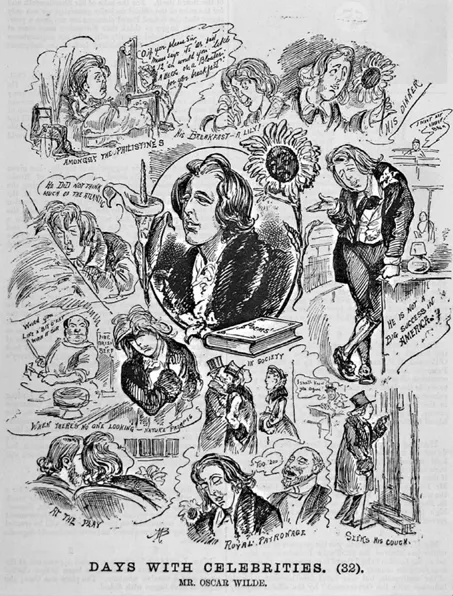
Fig. 1.1 “Days with Celebrities, Mr. Oscar Wilde,” Moonshine (January 28, 1882).
But the irreverent Moonshine caricature tells us more about Wilde and celebrity culture than first meets the eye. Taken as a perhaps playful forerunner of today’s paparazzi relentless hounding of the rich and famous, it not only highlights the conflation of artist, work, and image in one deft sketch. It also significantly points to the looming collapse of the barrier separating private from public life that mass media would aggressively come to exploit—no activity being too mundane or too private to escape public scrutiny, especially if it smacks of scandal. And, for Wilde, nowhere does the breakdown of public/private appear more wounding and the public appetite for exposé more voracious than when his private homosexual liaisons become common knowledge during the course of his trials. Such is the machinery of fame that we witness the legal assault on his juridical person and, in the same moment, the public attack and stigmatization of his public persona with Wilde the man having to bear the brunt on all fronts. Ironically, what both fuels and hastens his physical downfall is The Picture of Dorian Gray (1890, revised 1891).2 At his first trial and thereafter, this story serves as evidence of Wilde’s profligacy and his sodomitical associations, associations that persist down to the present. So while the novella continues willy-nilly to be read as a melodramatic parable of deviance, moral corruption, and self-destruction, it persists more radically as Wilde’s uncanny foretelling of his own cultural rise and physical ruin. Even in this more tolerant century, Dorian Gray popularly serves both as Wilde’s decadent back-story and his epitaph, and, conversely, the castigation of Wilde as an abject homosexual still haunts the reception of Dorian Gray.3 More than a hundred years after Wilde’s death, his notoriety and fate remains intertwined with Dorian’s and Dorian’s with his. Indeed, one could well argue that more than the diverse body of work he created, more even than his great social comedies, Wilde’s continuing celebrity owes to this singular gothic tale.
Given the role Dorian Gray has played as well as Wilde’s pivotal position in the arts, at the end of the Victorian era in the midst of the great social, cultural, and technological upheaval that modernism would register, there remains more to Wilde’s impact on celebrity formation that I wish to pursue here than merely observing the conflation of artist and objet d’art, collapse of private and public boundaries, and emergence of the scandal-mongering mass media and their gossiphappy audiences. In my earlier work, pressuring Andreas Huyssen’s famous critique of “the great divide,” which called attention to high cultural products versus their putative other, mass cultural ones, I shifted focus away from modernists’ artifacts to concentrate on the agents themselves by linking elite literary modernists and their devotees and disciples in the arts and academia to the rise of expert culture and the concomitant secularization of knowledge. Maintaining that hierarchy and the monopolization of knowledge became de facto as critical in the literary arts as it was in the sciences, I showed how modernists, as competitors in a burgeoning knowledge market, sought to distinguish their work as sui generis, and themselves as a class apart consistent with experts in other fields. Modernists sought prestige for themselves as artists and cultural capital for their experiments as nonpareil representations of the travails of modernity. In this essay, pursuing Jonathan Goldman’s cogent point that “signature styles of modernism and celebrity produce similar forms of cultural value” (Modernism Is the Literature of Celebrity 3) I consider the material and temporal conditions that conferred value on these two cultural phenomena in order to add to the collection’s conversation about the stage that modernism and celebrity culture came to share.
To accomplish this, I want to consider modernism and the cult of the celebrity in relation to my current work on youth culture and adolescence. Over the course of this essay, in terms of modernism, I will suggest that it is not enough to see the shift from a Victorian to a modernist sensibility on strictly technical or aesthetic grounds as traditionally presented. Nor is it sufficient to understand it primarily as generational conflict, even though for many, such as the Bloomsberries, a belief in their superiority as a generation underpinned their brash pronouncements about their stylistic innovations: think here of Lytton Strachey’s Eminent Victorians. By similar token, it is not enough to place the frisson within the sociological frame of dominant versus newcomer elaborated by Pierre Bourdieu in such works as The Field of Cultural Production and Distinction. Though these models retain considerable explanatory power, there remains more to the contention of a rupture with the past and embrace of the new advanced by modernist radicals from F.T. Marinetti to Ezra Pound, from Mina Loy to James Joyce. I contend that an underlying change equally profound and uniquely embodied was taking place, and it was happening around the dynamic of age itself. Most particularly, it occurred in the new and sweeping emphasis on youth and its categorical excrescence, that of adolescence, the impact of which shaped modernism no less than celebrity culture. So though celebrity may be a quintessential twentieth-century phenomenon as P. David Marshall and Richard Schickel have persuasively contended, and while it may be inextricably linked to modernism as the editors of this book have asserted, it is no less true that the celebrity and modernism arise at roughly the same juncture in which the age of the adolescence begins. I will suggest that these phenomena are more than coincidental; they are mutually enabling—a point I shall make by reference to Wilde’s The Picture of Dorian Gray. My claim is that the preoccupation of this fin de siècle text with age and, in particular, with the desire to indulge and prolong youthful potency rather than simply succumb to the decay of aging or surrender its beauty to the static province of art, gives us insight into a dynamic model that modernists and celebrities alike will increasingly trade on—one that will grant continuing cultural standing to their public personae and value to their aesthetic works.
To trace this paradigmatic shift occurring around age, first, I will explain how I approach the category of adolescence since it argues for a more nuanced treatment than the natural and social sciences provide and commonplace assumptions allow. For starters, whether one takes the developmental narrative pioneered in G. Stanley Hall’s Adolescence (1904), which understands adolescence as the penultimate stage in universal human maturation, or whether one subscribes to such progressive narratives as the one advanced much later in noted historian John Gillis’s Youth and History (1974), which sees adolescence as the necessary prolongation of youth brought on by the democratization of education, all adhere to some version of age segregation. I suggest, on the contrary, that the category is neither absolute nor, strictly speaking, age or time bound. Limited not just to the biological mandate of puberty or to the modernization of education, adolescence should more properly be seen as a dynamic model, the modern embodied counterpoint to senescence (aged subjects) on one hand, and the material counterpoint to obsolescence (outdated objects) on the other, that are together intrinsic to the rise of commodity culture and consumerism. In its preoccupation with the new and the ephemeral, and in its obsession with youthfulness, adolescence functions in the late modern period as the cultural apparatus par excellence for the perpetuity of the new that Walter Pater had imagined in The Renaissance and that Ezra Pound’s dictum “faire nouveau” would make the anthem of aesthetic modernism. As such, adolescence first comes to define, out of proportion to its alleged duration, that which late modern individuals will most prize and, then, to provide the cultural space that all will wish to occupy, never leave, or re-enter. Celebrity culture will thus thrive on it, modernism will launch its manifestos based on it, advertising will interweave it into the very fabric of material life, while in the social sciences, sociologists and psychologists will make it constitutive of our modern psyches and lived relations, with anthropologists supplying correlatives of faraway idyllic primitivism and economists extending the credit necessary to fund it. Over time, adolescence will become too huge a motor of twentieth-century industry and youth capital too valuable an asset to restrict to one age group.
So to begin with, we need to push the definitional boundary of adolescence beyond the received wisdom found in the natural sciences, which sees adolescence as a biological phase of human maturation, and beyond that in the social sciences, which attaches socialization and psycho-sexualization to the biological process. Rather, I propose that we view adolescence as a modern cultural phenomenon and an engine of modernity that puts in motion new forms of capital under the sign of youthfulness—the desire for lasting beauty, sexual potency, heightened consciousness, and uninhibited and unlimited gratification. Adolescence, in staking out that which late modern individuals most admire of youth and desire for themselves, enables new expressions of subjectivity to arise in tandem with a consumerist culture increasingly prone to novelty and innovation, to the conspicuous acquisition of objects, as identified by Thorstein Veblen’s The Theory of the Leisure Class (1899), and supported by an unfettered mobility to seek them out and the leisure time to indulge them. Properly understood, it is the apparatus par excellence for the cult of the new. It thus is perfectly in tune with the epoch Lord Henry Wotton extols in Dorian Gray as “a new Hedonism.” This, he asserts to the novel’s eponymous youth “is what our country wants” (DG 187).
One measure of the success of the new hedonism that I am associating with adolescence is to consider that, while at the beginning of the twentieth century adolescence is deemed to cover ages 12 to 25, by the end of the century scholars no longer agree on an age limit (some put the span at 12 to 34 years of age) or on what it actually comprises. Indeed, while scholars still agree that adolescence begins with puberty, there is little else they see eye to eye on. To put this ambivalence in context, let me offer this overview of G. Stanley Hall’s seminal 1904 work Adolescence: Its Psychology and Its Relations to Physiology, Anthropology, Sociology, Sex, Crime, Religion and Education. The first extensive scientific survey in English, this two-volume study had a number of profound effects. For the public at large, as well as for the scientific community, Hall’s work established adolescence as a decisive category of everyday human experience and the critical phase of maturation that was, importantly, a period of great instability. In turning adolescence into a distinct and worthy object of knowledge, moreover, Hall superimposed adolescence over the biological model of puberty, and, for all intents and purposes, supplanted its relevance, rendering puberty a mere marker of the onset of adolescence. The thrust of his work effectively gave adolescence its own privileged social and cultural space to develop and the scientific space to be investigated. All were conscripted into it and the future success, of the individual and the species, depended on it. Hall didn’t single-handedly invent adolescence or engineer its magnitude, but he did give a name to and the privileged space for this twentieth-century cultural phenomenon to flourish and be studied as science.
A committed Darwinist, Hall filled this space with late nineteenth-century notions of human evolutionary progress. For him, every human retraced or recapitulated the evolution of the species as a whole, thus from simple to complex organism, from instinct-driven to reason-governed individual, from savage primitive to civilized adult. As his contemporary Freud on the other side of the Atlantic would see polymorphous perversity leading to normative heterosexuality in his 1905 essays on sexuality, Hall categorized adolescence as “the period of sexual maturity” leading to marriage (II.40). Given the implicit telos, Hall asserted that adolescence constituted a second birth, one of as great consequence as an infant’s biological birth (I.xiii, 81). What is at stake we may gather from this passage in which he avers that adolescence “is preeminently the age of sense, and hence prone to sensuousness not only in taste and sex, where the danger is greatest, but in the domain of each of the sense species.” And continues, “whatever our philosophy, it is never so nearly true as at this age, that there is nothing in the intellect that does not get there through the senses, for now the chief activity of the mind is working over the sense capital thus acquired” (I.38–9, italics added). The great dangers of “taste and sex” and the exercise and accumulation of “sense capital” are those that Hall’s study aims at identifying and disciplining, for as he explains: “adolescence is the price modern man must pay for the prolonged prenubile apprenticeship to life” (II.108).
That this apparent economic apprenticeship of the senses—acquiring and spending sense capital to reach maturity—occurs over a protracted period, Hall significantly attributes to sexual evolution and to what he views as humankind’s increasing advancement, both of which he ascribes, in a curious turn, not to nature per se, but to modern times. Put simply, the “progressive increase of this interval is,” in Hall’s judgment, “another index of the degree of civilization” (II.232). In other words, human evolution is fundamentally progressive and dependent on civilization’s advance. The more civilized and the more modern humans become, the more prominent, prolonged, and charged “the period of sexual maturity.”4 The cost of modernity is protracted adolescence—with, however, two notable exceptions. Primitives and women, according to Hall, lacking the same evolutionary aptitude, are not advantaged by modernization in the same degree, but persist in a near perpetual state of adolescence.5 Their virtually irremediable circumstance, while it necessitates greater disciplinary vigilance, does not, however, trouble his larger argument. Nor, significantly, does the logic that advanced civilization only lengthens rather than reduces the period of adolescence for those most favored with evolutionary potential. His argument tellingly ignores the rather conspicuous fact that such positions muddle the distinction between culture and nature, thereby undermining the alleged separation between human and non-human worlds. For Hall the longer apprenticeship of adolescence for males in a modern society are offset by the shorter duration for the evolutionary disadvantaged: women and primitives … . Strikingly and from both directions, advantaged and disadvantaged, adolescence moves from being an acute stage of human maturity to a chronic condition of modernity.
From this recognition, it should come as no surprise that, for the social sciences, the length of adolescence has continued to expand alongside twentiethcentury modernization. Nor should it be a surprise that scholars disagree about what constitutes adolescence when human civilization (here read: technological advancement and urbanization) becomes part of evolutionary biology.6 In making evolutionary theory essentially teleological, when it is at base dysteleogical, Hall’s study sets forth ...
Table of contents
- Cover
- Half Title
- Dedication
- Title Page
- Copyright Page
- Table of Contents
- List of Figures
- List of Contributors
- Acknowledgements
- Introduction
- Part 1 Celebrity Modernisms
- Part 2 Modernist Celebrities/ Modernist Vernaculars
- Part 3 Stellar Afterimages
- Afterword
- Works Cited
- Index
Trusted by 375,005 students
Access to over 1.5 million titles for a fair monthly price.
Study more efficiently using our study tools.
Frequently asked questions
Yes, you can cancel anytime from the Subscription tab in your account settings on the Perlego website. Your subscription will stay active until the end of your current billing period. Learn how to cancel your subscription
No, books cannot be downloaded as external files, such as PDFs, for use outside of Perlego. However, you can download books within the Perlego app for offline reading on mobile or tablet. Learn how to download books offline
Perlego offers two plans: Essential and Complete
- Essential is ideal for learners and professionals who enjoy exploring a wide range of subjects. Access the Essential Library with 800,000+ trusted titles and best-sellers across business, personal growth, and the humanities. Includes unlimited reading time and Standard Read Aloud voice.
- Complete: Perfect for advanced learners and researchers needing full, unrestricted access. Unlock 1.5M+ books across hundreds of subjects, including academic and specialized titles. The Complete Plan also includes advanced features like Premium Read Aloud and Research Assistant.
We are an online textbook subscription service, where you can get access to an entire online library for less than the price of a single book per month. With over 1.5 million books across 990+ topics, we’ve got you covered! Learn about our mission
Look out for the read-aloud symbol on your next book to see if you can listen to it. The read-aloud tool reads text aloud for you, highlighting the text as it is being read. You can pause it, speed it up and slow it down. Learn more about Read Aloud
Yes! You can use the Perlego app on both iOS and Android devices to read anytime, anywhere — even offline. Perfect for commutes or when you’re on the go.
Please note we cannot support devices running on iOS 13 and Android 7 or earlier. Learn more about using the app
Please note we cannot support devices running on iOS 13 and Android 7 or earlier. Learn more about using the app
Yes, you can access Modernist Star Maps by Aaron Jaffe,Jonathan Goldman in PDF and/or ePUB format, as well as other popular books in Letteratura & Critica letteraria. We have over 1.5 million books available in our catalogue for you to explore.