- 198 pages
- English
- ePUB (mobile friendly)
- Available on iOS & Android
eBook - ePub
About this book
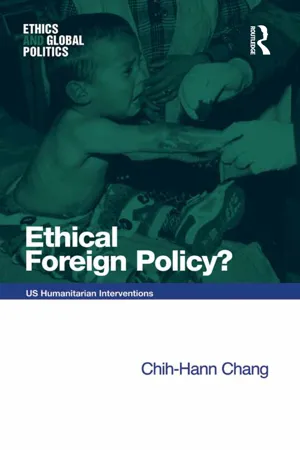
While the 1990s gave rise to a wealth of literature on the notion of ethical foreign policy, it has tended to simply focus on a version of realism, which overlooks the role of ethics in international affairs, lacking an empirical analysis of foreign policy decision-making, with relation to ethical values in the post-Cold War period. This book addresses this gap in the literature by exploring ethical realism as a theoretical framework and, in particular, by looking at US humanitarian interventions at an empirical level to analyse ethical foreign policy in practice. Furthermore, it moves beyond the debate on legality or legitimacy of humanitarian interventions and focuses on whether a state would intervene for humanitarian purposes. Chang provides a deeper understanding of ethical foreign policy in theory and practice by applying ethical realism as a theoretical framework to evaluate the Clinton administration's foreign policy on humanitarian intervention. She addresses concepts of moral leadership and pragmatic foreign policy in the field of international relations in general and foreign policy analysis in particular.
Information
Chapter 1
Introduction
The possibility of introducing ethics and values into international relations emerged strongly in the post-Cold War era. The 1990s gave rise to a wealth of literature on the notion of ethical foreign policy in the field of international relations. Much recent discussion has focused on the shift from the pursuit of national interests to the emphasis on moral responsibility to protect the rights and interests of others in foreign policy. In particular, the end of the Cold War led to religious and ethnic conflicts in several parts of the world. This soon raised the questions: “Where a government engages in genocide against a minority in its territory, what ought we to do about it?” and, “May we use force of arms to stop human rights abuses in other states?”1 It then raised the debate over whether a state should send its troops to save strangers in distant lands.2 Humanitarian intervention thus became a heatedly debated issue amongst international relations scholars in the post-Cold War period.
The idea of a foreign policy with an ethical dimension challenged the traditional understanding of foreign policy from the classical realist point of view – that governmental action should be determined by national interest. While the literature on this has provided critical analyses, it has tended to simply focus on a version of realism, which overlooks the role of ethics in international affairs, lacking empirical analysis of foreign policy decision-making, with relation to ethical values in the post-Cold War period. The purpose of this book is to address this gap in the literature, by exploring ethical realism as a theoretical framework and, in particular, by looking at US humanitarian interventions in the 1990s at an empirical level to analyse an ethical foreign policy in practice.
1.1 The Aims and Objectives of the Book
This book aims to make a contribution to developing a deeper understanding of ethical foreign policy in theory and practice by applying ethical realism as a theoretical framework to evaluate the Clinton administration’s foreign policy on humanitarian intervention. There are three objectives of this book. Firstly, it will explore ethical realism and the concept of responsible power. The traditional understanding of foreign policy has been that it is based on national interests and national security issues; however, increasingly, it has become widely debated whether ethical and moral concerns should dominate foreign policy. The debate has reflected the fact that there exists the conflicting tension between ethics and foreign policy. In particular, it seems to realists that the role of morality and ethics should not occupy in international politics at all.3 Nevertheless, it is important to note that ethical realists criticize idealists’ conceptions of utopianism, but not of morality. They propose the idea of responsible power as an opportunity for balancing the tension between ethics and foreign policy. The concept of responsible power comes from the work of Max Weber. In his classic essay ‘Politics as a Vocation’, Weber outlined the central problem of political ethics and proposed the idea of the ethics of responsibility, attempting to balance the tension between ethics and politics. The application of ethical realism to the conducting of international affairs involves the assertion that powerful states should have responsibilities and exercise leadership with ethical obligations. This seems particularly useful as a guiding philosophy for the United States and its role as the only superpower in the aftermath of the Cold War.
Thus, the second objective of this book will be to look at the foreign policies of the United States and its experiences of dealing with humanitarian interventions during the Clinton administration. There are two reasons that US humanitarian interventions in the 1990s provide an ideal arena to study the notion of ethical foreign policy in practice. The first is that following the collapse of the bipolar world in the 1990s, the role of America’s power has been essential. In Stephen Walt’s description, the United States was in a position of “unprecedented preponderance”.4 The United States witnessed the mobilization of a wide diversity of opinion among well-informed students of foreign relations regarding America’s proper international role in the post-Cold War era. In addition, the world’s only superpower had to set out new strategies to replace the obsolete containment policy that had guided America’s diplomatic behaviour for almost half a century. Therefore, the development of how the United States sought an alternative strategy and redefined its role in the new era is highly worthy of examination. The second reason is that the period of the 1990s witnessed several humanitarian crises, such as starvation in Somalia, genocide in Rwanda, a refugee crisis in Haiti, and ethnic cleansing in Bosnia and Kosovo. With the United States as the leader of the free world and Bill Clinton as its first genuinely post-Cold War president, it is important to explore the development of Clinton’s foreign policy on humanitarian interventions in order to examine the relationship between ethics and foreign policy. This is also important in order to see whether the United States could effectively promote liberal values, and make a commitment to moral goals in its foreign policy, rather than simply follow considerations of national security against the background of the end of the Cold War.
The criteria to underpin American engagement and the questions such as under what kind of circumstances the United States should intervene in the case of humanitarian crises beyond its borders, and how to intervene, militarily or diplomatically, dominated Clinton’s foreign policy agenda. This leads to the third and final objective of this book, which will be to explain the motivations for the Clinton administration’s interventions in Bosnia (in Clinton’s first administration) and Kosovo (in his second term). The collapse of communism and the end of the Cold War made the Balkans lose its strategic importance in the eyes of most Western policy-makers.5 Therefore, it is important to explore the reasons (for national interests or humanitarian purpose?) that motivated the United States to intervene. How did the United States perceive its national interest in the Balkans and define its relationship with US national security, especially in the post-Cold period? How did the United States perceive the implications of the Balkan war for international relations and international order? What kind of factors influenced and motivated the Clinton administration’s decision-making on humanitarian intervention in Bosnia and Kosovo? What role did moral conscience and the interests of humanity play in the process of decision-making? Why was the Clinton administration slow to respond to the Bosnian crisis in the early 1990s, but quick to respond to the Kosovo conflict in the late 1990s? The two case studies on the Balkans will provide a “levels of analysis”6 framework for understanding Clinton’s foreign policy decision-making process, covering the spectrum from the individual psychology of decision-makers (the individual level) to the role played by American domestic factors such as the power of Congress, public opinion, and the media (the national level) and to the changing international system in post-Cold War conditions (the global system level).
This work addresses concepts of moral leadership and pragmatic foreign policy in the field of international relations in general and foreign policy analysis in particular. It suggests that the United States, as the only world’s superpower, should not only pursue national interests, but should also shoulder the responsibility of power and demonstrate moral leadership; especially if the United States intends to keep its position of power in international politics. Actions that pursue narrow self-interest tend to lead to ethical failures of leadership. Besides, the maintenance of international order demands that powerful states have responsibilities and exercise leadership with ethical obligations; and a peaceful international society will help to consolidate the leading status of powerful states and enhance their security and prosperity. On the other hand, despite its role as a superpower, America’s superiority and strength are limited by its amount of resources. Moreover, as the world still divides itself into different sovereign states, statespeople7 are primarily responsible and accountable for their own citizens and for national survival. Therefore, it could be concluded that an ethical foreign policy is not an abstract moral conception; instead, it has to be based on a prudent calculation, “given the facts of international competition and human nature”.8 As a result, a foreign policy with an ethical dimension should be conducted in a selective and pragmatic way. This study thus bridges a link between the academic study of foreign policy and real-world foreign policy-making.
1.2 The Structure of the Book
This book consists of seven chapters. This first chapter provides the introduction, including a demonstration of the aims and objectives, and structure of this book. The second chapter provides an evaluation of the relevant literature in order to explore the debate over ethical foreign policy in the aftermath of the Cold War. The third chapter explores ethical realism and the idea of responsible power, and links these concepts to understand the essence of US foreign policy. This provides the theoretical framework where this study will be lodged. The fourth chapter discusses options for post-Cold War US foreign policy, reviews Clinton’s diplomacy, and briefly examines the experiences of the Clinton administration in dealing with humanitarian interventions in Somalia and Haiti. That chapter aims to demonstrate the nature of Clinton’s foreign policy in the post-Cold War international environment. The fifth chapter will examine the Clinton’s administration’s intervention in Bosnia. It first divides the policy decision-making process into three stages and then explains the administration’s decisions for intervention. The sixth chapter provides an in-depth analysis of the Clinton White House’s intervention in another case, Kosovo. It also divides the decision-making process into three stages and then explores the reasons why the administration decided to intervene. These two chapters provide a “levels of analysis” framework for understanding Clinton’s policy decision-making in resolving both the Bosnian crisis and the Kosovo conflict. The final chapter will provide the theoretical framework to evaluate the Clinton administration’s foreign policy on humanitarian interventions and examine its implications for future US foreign policy.
1 Mervyn Frost, Ethics in International Relations: A Constitutive Theory (Cambridge: Cambridge University Press, 1996), p. 2.
2 See e.g. Nicholas J. Wheeler, Saving Strangers: Humanitarian Interventions in International Society (Oxford: Oxford University press, 2000).
3 Tim Dunne and Brian C. Schmidt, ‘Realism’, in John Baylis, Steve Smith, and Patricia Owens (eds.), The Globalization of World Politics: An Introduction to International Relations, 4th edition (Oxford; New York: Oxford University Press, 2008), p. 93.
4 Stephen M. Walt, ‘Two Cheers for Clinton’s Foreign Policy’, Foreign Affairs, Vol. 79, No. 2 (March/April 2000), p. 64.
5 Richard Holbrooke, To End a War (New York: Random House, 1998), pp. 24-33.
6 Robert Jackson and Georg Sørensen, ‘Foreign Policy’, Introduction to International Relations: Theories and Approaches, 4th edition (Oxford: Oxford University Press, 2010), pp. 226-239.
7 “Statespeople”, according to Robert Jackson, “are the organizers and managers who attend the ordering and operating of the states system”. See Robert Jackson, The Global Covenant: Human Conduct in a World of States (Oxford: Oxford University Press, 2000), p. 34.
8 Michael J. Smith, Realist Thought from Weber to Kissinger (Bato Rouge: Louisiana State University Press, 1986), p. 9.
Chapter 2
Debates on Ethical Foreign Policy in the Aftermath of the Cold War
Introduction
Interwar debates between idealism (identified by values, morality, and ethics) and realism (identified by facts, power, and politics) resulted in Idealism/Liberalism and Realism becoming the mainstream theoretical traditions in International Relations (IR).1 During the Cold War, power politics between a much freer Western democratic system, led by the United States, and a communist system, led by the Soviet Union, helped to consolidate Realism’s status as the dominant intellectual framework in foreign policy and international relations theory. Realists recognize that the rules of international politics are that states exist in an anarchic, self-help system, and therefore states must engage in power politics in order to secure their survival. However, with the end of bipolarity in the post-Cold War world, political leaders and policy-makers in major states have claimed a central role for ethics, morality, and values in the shaping of international goals such as human rights, humanitarian intervention and international justice. As a consequence, the role of ethics in international relations became a hotly debated issue. As Leslie H. Gelb and Justine A. Rosenthal described the phenomena, “With the passing of the Cold War and America’s emergence as the sole superpower… the tradeoffs between security and ethics became less stark, and a moral foreign policy seemed more affordable.”2
Perhaps one of the more dramatic examples of the new power of morality on foreign policy agendas and international affairs has been humanitarian interventions in the 1990s. The issue has remained of whether states could intervene in the sovereign territory of other states to stop massive violations of human rights, such as genocide or ethnic cleansing.3 However, this book will not try to solve issues of legality or legitimacy on humanitarian intervention. Instead, it will focus on whether a state would intervene for humanitarian purposes. This chapter will examine the role of ethics returning to international relations and its place in fore...
Table of contents
- Cover Page
- Title Page
- Copyright Page
- Contents
- Acknowledgements
- 1 Introduction
- 2 Debates on Ethical Foreign Policy in the Aftermath of the Cold War
- 3 Ethical Realism and Responsible Power
- 4 US Foreign Policy after the Cold War: Clinton’s Foreign Policy
- 5 The Clinton Administration’s Intervention in Bosnia
- 6 The Clinton Administration’s Intervention in Kosovo
- 7 Conclusion
- Bibliography
- Index
Trusted by 375,005 students
Access to over 1.5 million titles for a fair monthly price.
Study more efficiently using our study tools.
Frequently asked questions
Yes, you can cancel anytime from the Subscription tab in your account settings on the Perlego website. Your subscription will stay active until the end of your current billing period. Learn how to cancel your subscription
No, books cannot be downloaded as external files, such as PDFs, for use outside of Perlego. However, you can download books within the Perlego app for offline reading on mobile or tablet. Learn how to download books offline
Perlego offers two plans: Essential and Complete
- Essential is ideal for learners and professionals who enjoy exploring a wide range of subjects. Access the Essential Library with 800,000+ trusted titles and best-sellers across business, personal growth, and the humanities. Includes unlimited reading time and Standard Read Aloud voice.
- Complete: Perfect for advanced learners and researchers needing full, unrestricted access. Unlock 1.5M+ books across hundreds of subjects, including academic and specialized titles. The Complete Plan also includes advanced features like Premium Read Aloud and Research Assistant.
We are an online textbook subscription service, where you can get access to an entire online library for less than the price of a single book per month. With over 1.5 million books across 990+ topics, we’ve got you covered! Learn about our mission
Look out for the read-aloud symbol on your next book to see if you can listen to it. The read-aloud tool reads text aloud for you, highlighting the text as it is being read. You can pause it, speed it up and slow it down. Learn more about Read Aloud
Yes! You can use the Perlego app on both iOS and Android devices to read anytime, anywhere — even offline. Perfect for commutes or when you’re on the go.
Please note we cannot support devices running on iOS 13 and Android 7 or earlier. Learn more about using the app
Please note we cannot support devices running on iOS 13 and Android 7 or earlier. Learn more about using the app
Yes, you can access Ethical Foreign Policy? by Chih-Hann Chang in PDF and/or ePUB format, as well as other popular books in Politics & International Relations & Human Rights. We have over 1.5 million books available in our catalogue for you to explore.