eBook - ePub
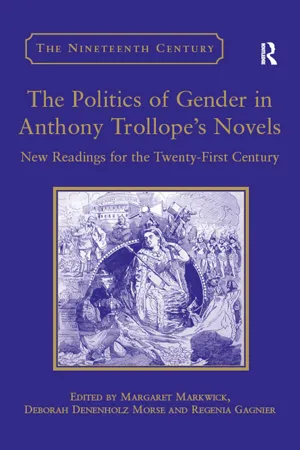
The Politics of Gender in Anthony Trollope's Novels
New Readings for the Twenty-First Century
- 274 pages
- English
- ePUB (mobile friendly)
- Available on iOS & Android
eBook - ePub
The Politics of Gender in Anthony Trollope's Novels
New Readings for the Twenty-First Century
About this book
Bringing together established critics and exciting new voices, The Politics of Gender in Anthony Trollope's Novels offers original readings of Trollope that recognize and repay his importance as source material for scholars working in diverse fields of literary and cultural studies. As the editors observe in their provocative introduction, Trollope more than any of his contemporaries is studied by scholars from disciplines outside literary studies. The contributors here draw together work from economics, colonialism and ethnicity, gender studies, new historicism, liberalism, legal studies, and politics that convincingly argues for the eminence of Trollope's writings as a vehicle for the theoretical explorations of Victorian culture that currently predominate. The essays variously examine imperial and postcolonial themes in the context of economic, cultural, aesthetic, and demographic influences; show how gender-sensitive readings expose Trollope's critique of capitalism's influence; address Trollope and sexuality in the context of queer studies, the law, archetypal constructions, and classical feminism; and offer new approaches to narrative theory through examination of Victorian understandings of male and female psychology. Regenia Gagnier's concluding chapter revisits the collection's critical strands and reflects on the implications for future studies of Trollope.
Information
PART 1
Sex, Power And Subversion
Chapter 1
(A)genda Trouble and the Lot Complex: Older Men-Younger Women Relationships in Trollope
Trollope was fascinated by the drive for female agency, voice, and authority in his changing world. He offers a provocative, highly nuanced, complex, and telling engagement with gender in his fiction and life, no matter how disturbingly ambivalent and even wrong-headed that wide-ranging engagement can sometimes appear. I want to look at Trollope and gender in relation to what I call the Lot complex, the ongoing human drama of varying desires and mutual attraction between young females and older males. My subject is older men/younger women relationships and how they come to figure in some of his most interesting and best work.
I
In Lot’s Daughters (2005), I identify and analyze this Lot complex and try to make clear how, as it develops in history, it pervades, generates, and illuminates life, language, literature, and art.1 I didn’t discuss Trollope there, but I want to now: he and the Lot complex fit together beautifully. As I read the Lot syndrome in the Victorian and modern world, it represents, in various ways, the drive or compulsion, in an age of growing female emancipation, to preserve, adapt, and/or expropriate the traditional paternal power to sustain, regenerate, define, and transmit life and civilization—the patriarchal seed of culture. And that’s what I see in Trollope. His fiction pulses with the sometimes muted but insistent rhythm of women’s quest for authority.
Let me begin with a short reprise of the extraordinary Genesis 19 description of the Lot family’s rescue from God’s fire-and-brimstone obliteration of Sodom and the aftermath featuring Lot, his wife, and, most notably, his daughters: Lot, the equivocal, God-fearing, tippling, unwittingly incestuous survivor of the Sodom holocaust and nephew of Abraham, is the patriarch in the closet, so to speak (more precisely, in the cave). A good but flawed man, in desperate crisis he offered up his virgin daughters as a bribe to the vicious Sodomites if they would spare the designated agents of God who had come to judge the sinfulness of the cities of the plain. Those angels, however, reveal themselves, blind the wicked men and save the Lot family from destruction by whisking them out of town. But then Lot’s wife famously disobeys God’s order not to look back and gets zapped into a pillar of salt. Lot’s daughters think their father is the only man left, and together they plot to take responsibility to “preserve seed of our father” (Gen. 19:32) and repopulate their world. Right or wrong, the decision of these women to act—to assume agency—for the sake of humanity’s future has momentous implications. They conspire to get him drunk to blot out the incest taboo and arouse his lust; then, in a dark cave, they lie with him on successive nights and get pregnant.
The incestuous seed of Lot, preserved through the elder daughter’s action, is Moab, and that means her progeny eventually includes not only the marginal races of Israel’s foes, but also the virtuous Moabite daughter Ruth, whose marriage to the Israelite Boaz legitimizes and redeems the older man/younger woman bond and issues in her glorious great-grandson King David, David’s genealogical line, and eventually—depending on your perspective—Jesus Christ, the Word incarnate, and thus Christianity itself.
Out of this lore comes the Lot complex, a dynamic configuration of wishes, sexual fantasies, and symbolic imagery that has worked to form generational relationships and structure personality, gender history, religious faith, social organization, and art.2 The patterns and figures of the Lot story can form an explanatory grid for reading familial and gender relationships—and thus for reading Trollope. What you can see figured in this Scripture are desires that shake the world: the desire of women to control the actions of men to whom they traditionally have been subject; the desire of both men and women to project on others wishes, thoughts, and deeds of their own that might cause guilt; the desire of men to preserve themselves, conquer time, remain potent, and keep on wooing the future.
Trollope wrote so much that only one in a million readers of English fiction can take it in and none in a million can remember it all. To write about him is to realize how much inevitably must be left out or qualified. I mean to illuminate the main general features of the Lot complex that I see driving his creative life—those crucial development of older men/younger women interactions and needs that mark his novels—but to do so, I must let parts stand for the whole: I’m going to focus on two of his short tales “A Ride Across Palestine” and “Mary Gresley” and also on Kate Field, the real young woman, who was the principal “Lot’s daughter” in his imagination.3 Those stories and that young woman in his life have great symbolic, typological force in showing and stressing what came to matter so profoundly in his fiction.
II
Trollope’s “A Ride across Palestine” stands as his literal version of a Lot-country, Lot complex story.4 Part travelogue, part shaky pilgrims’ progress in gender relations and sexual candor, it opens with the narrator, a middle-aged, practical Englishman, touring “the Holy Land” alone (Trollope, when he made the same journey in 1858, was 43). Traveling incognito—“if the reader will allow me, I will call myself Jones” (p. 231),—the narrator says that he was facing, both literally and figuratively, “the wild unlimited sands, the desolation of the Dead Sea, the rushing waters of Jordan, the outlines of the mountains of Moab” (p. 230). That landscape, steeped in the tormented history of faith, he says “was one which did lead to many thoughts” (p. 259).
A good-looking, young gentleman, hearing that “Jones” was traveling to the Dead Sea” and identifying himself only as “John Smith,” asks to travel with him: “He seemed to be very bashful and half ashamed of what he was doing” (p. 232). Though normally standoffish with men, “Jones” confesses “I was attracted by John Smith” (p. 232). “It looked as though he had determined to hook himself on to me” (p. 244).
In a key exchange, Smith asks the older man if he’s married, and the narrator equivocates: “Now the fact is that I am a married man with a family; but I am not much given to talk to strangers about my domestic concerns.… ‘No,’ said I” (p. 245). (Trollope’s biographer Victoria Glendinning suggests that he liked to flirt on his many, far-flung travels, and did not always admit to being married.5) Smith later asks Jones, “Do you dislike women?” “No, by Jove! I am never really happy unless one is near me—or more than one”(p. 262).
Trollope describes their journey to the Dead Sea (the Sea of Lot), featuring the older man’s solicitous care for appealing youth. “I would have done almost anything in reason for his comfort” (p. 247). When they read the Dead Sea, Jones goes swimming and tries to get Smith to join him. “‘The Dead Sea waters are noisome,’ Smith refuses, and says metaphorically, ‘and I have been drinking of them by long draughts’” (p. 260). I find the symbolism of the narrator’s post-marital plunge into the Sea of Lot revealing, to say the least. You can feel the splashes of that immersion again and again in Trollope’s fiction to come.
The two enjoy an easy camaraderie, and Jones teaches the tenderfoot Smith about traveling through rough country. At one point, the narrator falls asleep with his head resting on the young man’s leg: “He then put out his hand to me, and I pressed it.… I thoroughly hate an effeminate man; but, in spite of a certain womanly softness about this fellow, I could not hate him.” (p. 261–2). On the way to Jaffa, Smith suddenly disappears when he sees a stern old man coming towards them. This patriarchal figure questions Jones, but then moves off. Smith, frightened to death, comes out of hiding and tells Jones that the man’s after him. Then comes another key passage: “So I sat … and talked to him … and I again felt that I loved him. Yes loved him!… I did love him.… I felt a delight in serving him … though I was almost old enough to be his father.” (p. 272).
In Jaffa, before the youth can get away, the rigid old man shows up again. He turns out to be Sir William Weston, Smith’s “odious” guardian and uncle, “unforgiving towards all offenses” (p. 274), and he seizes her, because the youth, it turns out, is really Julia Weston, a lovely young woman. When the uncle charges the narrator with “eloping with his niece”, Jones is flabbergasted (like Lot waking up in the cave?). “I traveled here with a companion dressed as a man; and I believed him to be what he seemed” (p. 277). But there’s more: the guardian rages at the girl, “What! He has gone off with you; he has traveled through the country with you, hiding you.… He shall give me his promise that he will make you his wife” (p. 280). And Trollope says that Julia would have agreed, “without dismay” (p. 280). The narrator equivocates and claims he’s innocent—hasn’t done anything wrong. The uncle talks of a dowry, but “Jones” then has to tell them that he can’t marry the girl because he has a wife: “I deeply regretted that I had thoughtlessly stated to her that I was an unmarried man.” (p. 279).
Oops! Or as the Airline Ad famously says, “Wanna get away?” This story, then, partakes of a Lottish old-wives’ tale. Just before he wrote it, Trollope opined in Framley Parsonage (1861), “I will not say that the happiness of marriage is like Dead Sea fruit—an apple, which, when eaten, turns to bitter ashes in the mouth.… Nevertheless, is it not the fact?” Praising Julia Weston’s attractions, “personal and mental, I bowed to my fair friend, who looked at me … with sad beseeching eyes. I confess that the mistress of my bosom (his wife, that is, left behind somewhere, no doubt a pillar of the community, of whom he tells us nothing), had she known my thoughts at that one moment, might have cause for anger” (p. 282). Jones then becomes defensive about lying: “It seemed as though I had cruelly deceived her, but,” says he, “I was the one really deceived” (p. 283).
The tale ends without any agenda for the young woman—no reference to her future whatsoever—but we do get, in the narrator’s rueful last words, a new seed of moral consciousness: “I had been deceived, and had failed to discover the deceit, even though the deceiver had perhaps wished that I should do so. For that blindness I have never forgiven myself” (p. 286). That sounds like the rationale of a modern Lot—and it is. The tale ends up focused on his mind—his future—but what that guilty gender blindness might or should lead to, the narrator doesn’t say.
The story ends, then, with the puzzling aimlessness of this young woman’s shadowy agency. It’s incomplete. The pun in my title, (“A)genda trouble”, might sound a bit glib and stale—maybe it is—but I mean it to be precise and serious. I want to stress a link in Trollope’s work as whole between “gender troubles” and the tough challenge of finding a suitable, flexible, hopeful agenda for young women especially, but for older men too in their relationship to those women—agenda meaning “things to be done, items to be considered, vocational concerns and opportunities to be addressed and acted upon, and plans for a successful future to be carried out.”
What makes it such an important Trollope Lot story is the quick, clear way it sets before you the dynamic tension between he-knew-he-was-right and can-you-forgive-her? (to adapt his famous titles). It moves, that is, from oppressive surety to uneasy wonder, from the old patriarchy to the edge of a surprising new daughterland with its fragile, inconclusive quest for opportunity and freedom and its painful, confusing conflicts over shifting gender definition and sexual desire. You have here both a realistic and symbolic narrative in which a young woman takes action by trying to gain the advantages of male identity so that she can escape from he-knew-he-was-right—”he” being, the realm of the eponymous old patriarch Weston)—only to land indecisively in can-you-forgive-her, an ambiguous, psychological and cultural condition—potentially progressive, but still part of a man’s world where success and happiness for women depend upon their power to both seduce aging male desire and sublimate it into favorable patronization. That kind of female odyssey is common in Trollope’s fiction, but, as in this story, it can be a dangerous affair.6 Nevertheless, from the time he wrote “A Ride Across Palestine” (July 1860) to the end of his life the idea of deep, erotically tinged, potentially benevolent, hard-to-categorize relationships between older men and younger women fed his art.
III
In the Palestine “Ride,” the older man enjoys the historical continuity that he finds visiting biblical sites, despite all the present-day folly and trouble he finds there, but the young woman wants to get away as fast as she can from space so tainted by patriarchal irresponsibility. That difference matters. Like The Warden (1855) and Barchester Towers (1857), this story, far removed as it seems from those novels, takes place in the changing territory of faith—its setting permeated and defined by religious associations. That fact can stand as a trope for the historical setting not only for Trollope’s early, break-through Barsetshire fiction, but for all his work—a changing world shaped by its secularizing, kinetic heritage of faith and women’s hope for respect and authority. If religion is, as William James said, “the belief that there is an unseen order, and that our supreme good lies in adjusting ourselves harmoniously thereto,” and if Lot’s daughters showed the will to act on behalf of a divine order as they saw it in chaotic circumstances of male arrogance, failure and weakness, then it’s easy to see the overriding historical reason for the Lot complex gender tensions in Trollope’s novels set in the milieu of institutionalized faith.
As a gender allegory, the early Barset world is both autobiographical and sociological. In general its women are stronger and sharpe...
Table of contents
- Cover
- Half Title
- Title Page
- Copyright Page
- Table of Contents
- General Editors’ Preface
- List of Figures
- Notes on the Contributors
- Acknowledgments
- Introduction
- PART 1: Sex, Power And Subversion
- PART 2: Imperial Gender
- PART 3: Genderized Economics
- PART 4: The Gender of Narrative Construction
- Conclusion Gender, Liberalism, and Resentment
- Bibliography
- Index
Trusted by 375,005 students
Access to over 1.5 million titles for a fair monthly price.
Study more efficiently using our study tools.
Frequently asked questions
Yes, you can cancel anytime from the Subscription tab in your account settings on the Perlego website. Your subscription will stay active until the end of your current billing period. Learn how to cancel your subscription
No, books cannot be downloaded as external files, such as PDFs, for use outside of Perlego. However, you can download books within the Perlego app for offline reading on mobile or tablet. Learn how to download books offline
Perlego offers two plans: Essential and Complete
- Essential is ideal for learners and professionals who enjoy exploring a wide range of subjects. Access the Essential Library with 800,000+ trusted titles and best-sellers across business, personal growth, and the humanities. Includes unlimited reading time and Standard Read Aloud voice.
- Complete: Perfect for advanced learners and researchers needing full, unrestricted access. Unlock 1.5M+ books across hundreds of subjects, including academic and specialized titles. The Complete Plan also includes advanced features like Premium Read Aloud and Research Assistant.
We are an online textbook subscription service, where you can get access to an entire online library for less than the price of a single book per month. With over 1.5 million books across 990+ topics, we’ve got you covered! Learn about our mission
Look out for the read-aloud symbol on your next book to see if you can listen to it. The read-aloud tool reads text aloud for you, highlighting the text as it is being read. You can pause it, speed it up and slow it down. Learn more about Read Aloud
Yes! You can use the Perlego app on both iOS and Android devices to read anytime, anywhere — even offline. Perfect for commutes or when you’re on the go.
Please note we cannot support devices running on iOS 13 and Android 7 or earlier. Learn more about using the app
Please note we cannot support devices running on iOS 13 and Android 7 or earlier. Learn more about using the app
Yes, you can access The Politics of Gender in Anthony Trollope's Novels by Deborah Denenholz Morse, Margaret Markwick in PDF and/or ePUB format, as well as other popular books in Literature & Literary Criticism. We have over 1.5 million books available in our catalogue for you to explore.