eBook - ePub
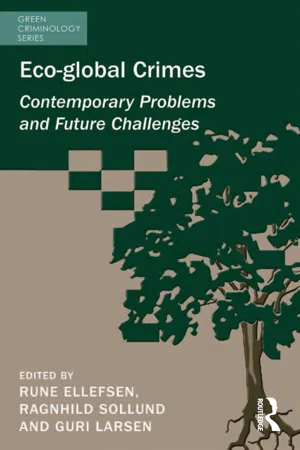
Eco-global Crimes
Contemporary Problems and Future Challenges
- 332 pages
- English
- ePUB (mobile friendly)
- Available on iOS & Android
eBook - ePub
About this book
Building on knowledge within the fields of green and eco-global criminology, this book uses empirical and theoretical arguments to discuss the multi-dimensional character of eco-global crime. It provides an overview of eco-global crimes and discusses them from a justice perspective. The persistence of animal abuse and speciesism are also examined together with policies aimed at controlling the natural world and plant species. Pollution by large corporations, rights of indigenous peoples and the damage caused by the mineral extraction are also considered. Providing new ideas and insights which will be relevant on a global scale, this book is an interesting and useful study of the exploitation of nature and other species. It will be invaluable for students and scholars globally, working within or connected to the field of green and eco-global criminology. The book will also be important for the participants of various social movements, especially the environmental and animal advocacy movements.
Information
Part I Introduction to Eco-global Criminology
DOI: 10.4324/9781315578651-1
Chapter 1 Introduction
DOI: 10.4324/9781315578651-2
Over the past three decades there has been a growing body of literature within what is known as green criminology (Lynch 1990, South and Beirne 2006, Beirne and South 2009) and eco-global criminology (White 2008, 2009, 2011). The present book seeks to build knowledge within this field, by both empirical examples and theoretical discussions. The goal of this book is to illustrate the scope of environmental crime, and how local environmental problems are also transnational in their effects.
This is a reason for the title: Eco-global Crimes: Contemporary Problems and Future Challenges. In Chapter 2 of this book, Rob White defines eco-global criminology as the following: ‘Eco-global criminology refers to a framework of analysis where the emphasis is on the ecological, the transnational and questions of justice. The substantive focus of eco-global criminology is transgressions against ecosystems, humans and animals’. Eco-global crimes are often transnationally organized, with damage being caused by legal transnational corporations, such as British Petroleum in the Gulf of Mexico, and the destruction of the soil and forest in the Ecuadorian Amazon caused by Chevron and Texaco.
The topics addressed by eco-global criminologists are many and various; relating to air, water and space-pollution (Walters 2007), toxic waste (White 2011), legal and illegal deforestation (Boekhout van Solinge 2008a, b) and legal and illegal animal abuse (Beirne 1995, 1995, 1999, 2009; see also White this volume). Because of the multivariate character of problems relating to eco-global crimes, it is necessary to expand the boundaries of criminology as a discipline, and thus also the perspective of what crime is and what should be perceived as a crime, as well as the notions of harm and justice. For example, moral and utilitarian philosophy (Regan 1988, Singer 1977) have been important points of departure for non-speciesist criminologists (Beirne 1999, Cazaux 1999 and Sollund 2008), and observations and fieldwork done by biologists and ornithologists have been important in providing an empirical basis for discussions of crime prevention regarding the illegal parrot trade (Pires and Clark 2010).
The concept of crime relates to that which is a breach of law, yet eco-global harms, such as those committed by states and corporations, often eclipse the scope and reach of criminal law (South 2008, O’Brien 2008, Sollund 2008, White 2011). This book seeks to broaden the perspectives of the research topics falling within the fields of eco-global criminology and assumes that these issues must be addressed with the same theoretical weight found in, for example, the study of deviance and other more traditional criminological topics. One example is an examination of how laws and regulations which actually uphold and legitimize intolerable exploitation of non-human animals and of nature are passed by means of the legislation processes supported by capitalist and consumerist interests, despite the increasing importance of environmental issues in modern contexts.
To do so, interdisciplinary approaches are required, as different disciplines have different epistemologies which all have something to offer. Empirical knowledge from, for example, biologists, botanists and oceanographers can provide a basis for ‘building a case’ relevant to an eco-global criminological analysis, while a theoretical contribution may come from humanistic sciences such as ethics and philosophy. Interdisciplinary thought may help create a firm theoretical and empirical ground from which to develop convincing arguments and effective strategies for altering the present course of exploitation which endangers so many people, plants and animals, both now and in the future.
Building on and including interdisciplinary contributions, however, does not mean that critical criminology should be ignored, since its tradition of speaking for the weak and pointing to structural injustice is a central issue addressed in eco-global criminology. Critically speaking, perspectives relating to the prevention of crime/harm and victimology may be useful, while the principle of precaution directs attention to what lies beyond the horizon (White 2011).
In addition, related criminology concepts such as those related to globalization and migration (crimmigration, Aas 2011), a phenomenon closely related to structural differences between the north and the south, may prove useful. For instance, partly as a consequence of the effects of climate change, migration will increase in the decades to come, unless we manage to remedy the situation. These migration patterns have important criminological implications such as exclusion and criminalization of the ‘deviant other – the asylum seeker’– whereby refugees are put in detention centers, or are forced to live ‘undocumented’ and deprived of basic human rights (Engbersen et al. 1999).
The establishment of green/eco-global criminology followed broader the green and animal liberation movements four decades ago, and owes much to those traditions. Prior to this, criminologists showed little interested in studying for example the pollution caused by the coal industry during the industrial revolution, though the damage caused by pollution then became evident. While the early animal welfare movements that were connected to feminist movement in the UK emerged (Donovan 1993), criminologists studied human deviance. Environmental problems and animal abuse thus existed long before green/eco-global criminology emerged. Nevertheless, these environmental problems, though studied across various disciplines, have criminological implications.
The effects of the exploitation of nature – the senseless polluting of the seas, of fresh water and of the earth, and the pollution of the air which has led to global warming, have become common knowledge – they are not, strictly speaking, the results of criminological research. In addition, we are constantly made aware of the rapid decline of other species because they are regarded as legitimate objects for human consumption of some kind – as trophies, food, medicine, or clothing. These harms are now obviously caused by the expansion of the human species, which is in turn bound up with the globalization of the economy and the capitalist system. The present-day actions of humans against nature and other species may not be fundamentally different from the way humans have always taken advantage of their superior position vis-à-vis nature and other species in an historical sense. However, new historical conditions such as advanced technologies produced an imaginative capacity to develop innumerable new ways of exploiting natural resources and other species, multiplying the effects of humans on the environment so that now these effects appear catastrophic.
Many human cultures have been anthropocentric (Sollund 2008), though native Americans, for example, appeared to regard all creatures as sacred and entitled to fundamental respect (Donovan 1993: 181–192). In the present day we are seeing the large-scale consequences of the anthropocentric world view. This goes parallel to an increased knowledge of, and conscience about, non-human species which seriously questions the ‘right’ humans have previously accorded themselves to use other species as they please. So far, however, this knowledge has not had any general impact on people’s daily practices, which to a large extent are colored by denial, whether with regard to the relationship between global warming and human carbon emissions, or the systemic and widespread physical and psychological abuse of non-human animals. A driving force behind the abuse of the world around us is the belief that human welfare can only be achieved by increased consumption, which has been increasingly fueled by global capitalism and neo-liberalism. According to this logic, the only way to bring about ‘justice’ between the peoples of the south and north is to increase consumption for those living in underdeveloped regions. This view, however, overlooks the volume of waste and pollution this form of ‘justice’ creates. This logic may in a sense seem fair to the extent that the countries of the south are those which suffer most from the consumption of the western world with respect to, for example, climate change and electronic waste, but the consequences of consumptive justice are fatal. Humans, it seems, generally behave like the three wise monkeys;2 Mizaru, Mikazaru, and Mazaru, refusing to see, hear or speak evil, but forgetting the fourth, the monkey who by crossing his/her arms, does no evil. Indeed, we refuse to see, refuse to listen, remain silent, and therefore see no reason why we should not proceed with our actions. The rejection of facts is caused by denial Cohen (2000). Consumption has been encouraged by political leaders, who, typically, saw no other answer to the global financial crisis than to increase consumption, to ‘make the wheels run faster’.
As a counterblast to this view we seek with this book to direct attention towards eco-global crimes and the abuse of non-human species, and to look at the causes of these behaviors and the challenges they present now and in the future. The fact that the book is being published may point to a more positive trend, exemplified also by the afore-mentioned growing body of literature in the field. By expanding the agenda for criminology in this way, and by not leaving eco-global problems to environmental and animal rights movements alone, we also seek to give these issues further academic weight, and consequently to increase the impact of this kind of research and these ideas.
As the topics which need to be addressed in order to secure the health of Tellus and its inhabitants are challenging, we can in this book only point to some crucial immediate issues. In this we share in building knowledge, stone by stone, which hopefully will inspire other social scientists, and also influence social movements, politicians and decision-makers.
Outline of the Book
The book is divided into three parts. This said, it is important to add that themes may overlap, and be treated from different perspectives in the different sections. The first part of the book – Introduction to Eco-global Criminology – is theoretical, starting with Rob White’s chapter, The Foundations of Eco-global Criminology, in which he provides an overview of the different kinds of crimes/harms which can be encompassed within the field of eco-global criminology. In this he shows precisely the transnational, global character of eco-global crimes/harms, and how an action in one local context may impact other places and people far from where the harm was initiated. In demonstrating the multiversity of eco-global crimes, White also emphasizes the urgency with which these problems must be met. He provides us with the theoretical tools to discuss eco-global crimes through a justice perspective by using the terms ecological justice, environmental justice and species justice. These are important concepts which need to be further developed by means of empirical examples, and to be absorbed deeper into the theoretical basis of eco-global criminology through discussion and amplification.
The latter is illustrated by Guri Larsen in Chapter 3, The Most Serious Crime: Eco-genocide, in which she critically scrutinizes the inherent meaning of the different concepts used in the field, such as the concepts of harm, green criminology, and eco-global criminology, and provides arguments for why the concept eco-global criminology is better equipped to address eco-crimes than the previously more established concept green criminology. In her discussion Larsen also makes the point that ecological justice includes an emphasis on environmental and species justice. Ecological justice reflects the interdependence between all kinds of life on the planet, whether life is part of nature or culture. She distinguishes between ecocrime as a legal category, and ecocide as a moral category. However, as legal acts may be even more destructive, she introduces a new concept: eco-genocide, which she sees as a unifying category for both illegal and legal damage that cause harm to nature-culture unit, that is, to the environment, animals, the climate and to humans and human societies.
In Chapter 4, Constructing a Meta-history of Eco-global Criminology – On Brute Criminologists, Mortified Bunnies, Nature and its Discontent, Per Jørgen Ystehede traces the historical and theoretical roots of eco-global criminology, by creating a genealogy of eco-global criminological research spanning 150 years. He suggests that the history of eco-global criminology, especially the part encompassing the human–animal–nature relationship, may be divided into three main intellectual historical developments, or stages, which can be seen as partly shadowing the history of the science of criminology in general. In the first stages animals, as being nature, were regarded as criminal agents. This view was heavily influenced by the tendency of 18th century men of letters value comparisons between moral temperament, and the physic...
Table of contents
- Cover Page
- Half-Title Page
- Dedication
- Title Page
- Copyright Page
- Table of Contents
- List of Figures and Tables
- List of Contributors
- Preface and Acknowledgements
- Part I Introduction to Eco-Global Criminology
- Part II Speciesism, Animal Abuse and Social Movements
- Part III Biodiversity, Environmental and Species Justice
- Index
Trusted by 375,005 students
Access to over 1.5 million titles for a fair monthly price.
Study more efficiently using our study tools.
Frequently asked questions
Yes, you can cancel anytime from the Subscription tab in your account settings on the Perlego website. Your subscription will stay active until the end of your current billing period. Learn how to cancel your subscription
No, books cannot be downloaded as external files, such as PDFs, for use outside of Perlego. However, you can download books within the Perlego app for offline reading on mobile or tablet. Learn how to download books offline
Perlego offers two plans: Essential and Complete
- Essential is ideal for learners and professionals who enjoy exploring a wide range of subjects. Access the Essential Library with 800,000+ trusted titles and best-sellers across business, personal growth, and the humanities. Includes unlimited reading time and Standard Read Aloud voice.
- Complete: Perfect for advanced learners and researchers needing full, unrestricted access. Unlock 1.5M+ books across hundreds of subjects, including academic and specialized titles. The Complete Plan also includes advanced features like Premium Read Aloud and Research Assistant.
We are an online textbook subscription service, where you can get access to an entire online library for less than the price of a single book per month. With over 1.5 million books across 990+ topics, we’ve got you covered! Learn about our mission
Look out for the read-aloud symbol on your next book to see if you can listen to it. The read-aloud tool reads text aloud for you, highlighting the text as it is being read. You can pause it, speed it up and slow it down. Learn more about Read Aloud
Yes! You can use the Perlego app on both iOS and Android devices to read anytime, anywhere — even offline. Perfect for commutes or when you’re on the go.
Please note we cannot support devices running on iOS 13 and Android 7 or earlier. Learn more about using the app
Please note we cannot support devices running on iOS 13 and Android 7 or earlier. Learn more about using the app
Yes, you can access Eco-global Crimes by Ragnhild Sollund, Rune Ellefsen in PDF and/or ePUB format, as well as other popular books in Diritto & Diritto ambientale. We have over 1.5 million books available in our catalogue for you to explore.