- 196 pages
- English
- ePUB (mobile friendly)
- Available on iOS & Android
eBook - ePub
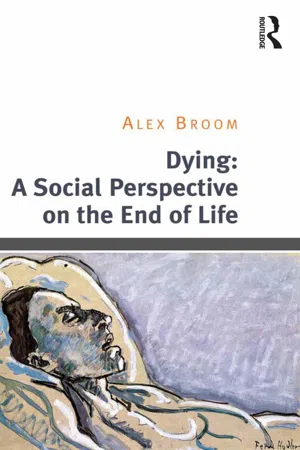
Dying: A Social Perspective on the End of Life
About this book
An inevitable and universal experience, dying is experienced by individuals in different ways, often related to the character of our relationships, family structures, gender identities, cultural backgrounds, and economic means. Drawing on extensive qualitative fieldwork with patients, carers and health professionals in Australia and the United Kingdom, Dying: A Social Perspective on the End of Life provides a critical examination of the different spheres of dying, in social and cultural context. Exploring complex issues such as the politics of assisted dying, negotiating medical futility, gender and dying, the desire for redemption, the moralities of 'the good fight' and the lived experience of bodily disintegration, this book links novel theoretical ideas within sociology to cutting-edge empirical data collected in palliative and end-of-life care contexts. A theoretically engaged understanding of the social mediation of the end of life, Dying: A Social Perspective on the End of Life also sheds light on the manner in which the end of life can be shaped by major economic, cultural and socio-cultural shifts including neo-liberalism, individualisation, medicalisation, professionalisation and detraditionalisation. As such, it will appeal to social science, health and medical researchers interested in the end of life, as well as those working in palliative and end-of-life care settings.
Information
1 Introduction
DOI: 10.4324/9781315578293-1
The usual response from colleagues when I mentioned I was writing a book on dying was to hurry the conversation on to another matter. Who could blame them? To say dying is not a sexy issue in the West is an understatement, especially dying of a disease like cancer. In writing this book, I discovered that dying continues to be shunned as a legitimate topic in polite circles, despite its ubiquity. If it is mentioned, then it is all too easily dispensed with, with a joke perhaps. No doubt for most of us death conjures up strong feelings at some level. We project all kinds of fears onto it. After all, the topic of death can trigger strong feelings of grief, sympathy and introspection. However, there are cracks in this story. For instance, ‘heroic’ deaths (Seale 1995) might receive sustained media attention, dinner party chatter and prolonged memorialisation that ‘everyday’ varieties of death and dying do not. While there has been some erosion of cultural taboos around death and dying in recent years (Lee 2008; Sayer 2010; Willmott 2000), dying is still often resisted, ignored, stigmatised, laughed away, pushed aside or otherwise cloaked in shadows. I venture that these perceptions and responses position dying as a pivotal moment for contemporary sociological inquiry.
Dying conjures up the most difficult and confronting of all experiences we can imagine in the West. With this in mind, it is entirely understandable that death has received relatively limited attention in the public sphere or indeed within the scholarly literature prior to mid-to-late twentieth century (e.g. Faunce and Fulton 1958; Glaser and Strauss 1968). It represents the end of our embodied connection with the world. Death is the final democratic process we enter, and we all eventually experience it, involving as it surely must, the fracture of our remaining social ties. This critical social occasion, not only affects the dying but also profoundly impacts on their loved ones (Broom and Kirby 2013). The many challenges posed by dying in turn reflect core discontents of modernity and contemporary social life. Giddens articulated this well in suggesting that a feature of modernity was that it purchas[ed] ontological security through institutions and routines that protect us from such things as criminality, madness … and death’ (Giddens 1991; see also Willmott 2000, p. 649 for further discussion). With his words, we can begin to grasp how modernity can function to exclude questions that raise uncomfortable moral dilemmas, of which dying is a prime example (Willmott 2000: 649).
Dying is deeply unsettling to most. It poses uncomfortable questions around the purpose of our everyday lives, the importance of the ‘self’, as well as the legitimacy and even integrity of the structure of social organisation (Lee 2008; Willmott 2000). As Giddens and others since have outlined, dying is thus prone to being sequestered and, arguably, this process has been enhanced in the context of (late) modernity. Social life more broadly has become increasingly separated from existential concerns – including dilemmas around our mortality and the advent of death. Here, our cultural practices and institutions can be viewed as creative players in developing a ‘protective’ layer against the dread of the meaning of life particularly when put side-by-side with the inevitability of death.
As I have already alluded to, despite the (recent) historical tendency to sideline death and dying, there have been major shifts in recent years in terms of community awareness of, and the cultural visibility of, dying. Significant public debates and nuances in ways of understanding dying have developed (Walter 1999; Willmott 2000; Lee 2008). This has been facilitated by scholarly research revealing, among other things, the social circumstances of dying (for example, Clark 1993; Glaser and Strauss 1968; Kellehear 1990, 2008; Kubler-Ross 1969; Howarth 2007b; Lawton 2000; Seale 1998; Strauss 1970), and research exploring how experiences and perceptions of dying have shifted with the expansion and mainstreaming of palliative, hospice and end-of-life care (for example, James and Field 1992; Lawton 1998, 2000; McNamara 2001, 2004). Yet, despite this valuable scholarly contribution, and distinct improvements in the mainstreaming of the field, the dying process still conjures up stigma and despair, impacting at the very core of individual identities and our relationships with others. Moreover, how dying is increasingly being done in hospitals and hospices is challenging the traditional role of the family (for example, Broom and Kirby 2013; Kirby et al. 2014a) and the church (for example Bradshaw 1996; Brown 2009; Broom 2012a) in the dying process. This raises important questions about the expanding role of professions, institutions and the state in shaping experiences of death and dying (for example, Clark 2007; Hibbert et al. 2003; Stanley and Wise 2011). In turn, how and where people die is heavily shaped by ingrained forms of inequality and widening economic polarisation (for example, see Broom 2012a; House 2002). While Mark Twain considered death to be ‘the great leveller’, dying is certainly not, with class, gender and place, among other social dynamics, heavily influencing a person’s ‘ending’, as well as their previous life chances up until death (Howarth 2007c; Broom 2012b). This raises broader questions around our agency, rights, forms of disadvantage, as well as the meaning and purpose of our everyday lives. In this way, I argue in this book that a critical sociological examination of dying must reflect as much on how we live as it does on how we die.
Why a Social Perspective on Dying?
There is no one superior approach to analysing and interpreting the character and experience of dying within contemporary societies. Dying is investigated fruitfully in various fields like anthropology, ethics, philosophy, history, medicine and cultural studies among others. All of these fields have important contributions to make, which are vast and beyond the scope of this book. However, a sociological approach can uniquely get behind our cultural veneer in specific ways, for example, by highlighting the shared experience of dying, or by uncovering the ideological underpinnings of particular ways of dying. Moreover, a sociological approach reveals how dying involves unexpected twists and turns in the personal journey, the role of expertise, competing knowledges, varying moral framings and religious beliefs, on top of rapidly changing ways of organising death (Broom 2012a; Broom et al. 2013a, 2014b). To elucidate these social issues means treating dying as a meeting point between our social practices, institutions (for example, health care, family) and our individual biographies. Particularly, in the context of the interpretative traditions in sociology – which largely utilise qualitative and ethnographic methodologies – a sociological approach to dying can hold together multiple truths concurrently, treating professional, patient and family experiences as equally important, revealing and worthy of considered examination. As I hope to show in the following chapters, whether about doctors stubbornly holding onto hope, patients suffering in silence, nurses feeling unable to intervene in care, or families not acknowledging medical futility, a sociology of dying is about entertaining the whole messy picture to ask important questions like: Why do such dynamics flourish? and, What are the implications for care practices and the various actors involved?
One might argue that this is a well-trodden path with a significant amount of sociological and social science research and commentary exploring the area of death and dying already (some examples include Clark 1993; Glaser and Strauss 1968; Hockey 1990; Howarth 2007b; Kellehear 1984, 1990, 2008; Lawton 2000; Seale 1998). And yet, the interpersonal, community and organisational circumstances within which people are dying are rapidly changing, necessitating a reassessment of the social, economic and political contexts of dying across communities and cultures. As I explore in the following chapters, there are new and rising organisational and professional influences on the end of life, and these are continually remodelling (often imperceptibly at the individual level) the landscapes of dying in our communities and hospitals (see Broom and Cavenagh 2010; Broom et al. 2011, 2013a, 2013b, 2014a, 2014b). Moreover, there are evolving social expectations and reductive mindsets at play among professionals, and normative pressures on those who are nearing the end of their lives, with important consequences for the experience of dying and, indeed, the capacity for a ‘good enough’ death (see Broom 2009a; McClean 2005). Thus, a key contribution of this book is to highlight dying as inter-subjective, and that pathways towards, and choices at, the end of life involve multiple and negotiated subject positions, whether acknowledged by all actors or not (Broom et al. 2014b; MacArtney et al. 2014; Kirby et al. 2014a). In this way, stories of hope, acceptance, injustice and, importantly, experiences of suffering, peace and comfort at the end of life are necessarily co-written and co-starred in by a cast of patients, families, carers and professionals, and played out within the constraints and opportunities of the particular stage set for dying. Each player, as will become clear in the following chapters, participates in a complex social production of dying.
I should emphasise here that the following chapters utilise a critical sociological approach, but in a targeted fashion, exploring specific social dynamics and moments in care (often in formalised care settings). I do not seek to cover all spheres of dying or speak to experiences across all communities or cultural contexts. I focus almost exclusively on relations manifest in the context of illness and disease in Australia and at times the United Kingdom. So, for example, I do not seek to develop an understanding of the social dynamics of traumatic deaths (see Chapple and Ziebland 2015, for an excellent discussion), or other important sites of dying (like death in war, suicide, sudden deaths by road accident and so on). Instead I focus on dying from life-limiting illnesses, and caring for others in this particular situation. In gathering multi-stakeholder accounts of the dying process, I seek to explore what the implications are of dying in particular ways, in particular locations, surrounded by particular stakeholders, and supported by particular forms of expertise and governing rules. When taken together, the accounts that I have gathered and interpreted in this book tell us much about the evolving meanings of dying, and their implications for how we go about dying in modern Western societies.
Situating Dying in Recent Historical and Social Context
Throughout the following chapters I focus on analysing experiences of dying – and caring for the dying – as relationally experienced, morally bound, and located in a cultural and historical context. It is perhaps useful then to provide a potted (albeit brief) historical account of dying in modern societies. There is considerable literature around the cultural reception of death and dying (for example, Beilin 1981; Becker 1973; Rousseau 2003; Zimmermann 2007), providing as it does a helpful scholarly and historical context to the chapters that follow. For instance, some scholars argued that death and dying created significant ‘no go’ areas in our social lives – coined the death taboo. The argument is that such dynamics have essentially come to frame the way we relate to death and dying. Denying our ‘physical and symbolic mortality’ became a core motivator of human conduct in modern societies (see Willmott 2000), including in the areas of sex and ageing. The death taboo thesis captured social anxieties around the inevitability of dying, connecting discontents around death with an emerging anomie and loss of meaning in modern societies (Lee 2008: 747). This dovetails nicely with Giddens’s (1991) aforementioned argument around our deep needs to retain an ontological security in late modernity. As such, dying has become increasingly alarming in the context of modernity, especially given the (arguably) lack of meaningful and ritualistic structures surrounding it (Mellor and Shilling 1993; see also Lee 2008). The development of taboos around death and dying became an effective way of delineating between that which is prioritised in the West (self/life) and that which is not to be considered in everyday life (death/dying) (see Lee 2008: 650). The death taboo thus represents a crisis of meaning in modernity (Becker 1973; Lee 2008), instituting and protecting the boundary between living and dying (Giddens 1991: 156). I return to this debate around the death taboo, and questions around its contemporary relevance shortly. Before I do, it is useful to first consider a range of other economic, organisational and political influences that were important in framing understandings of, and approaches to, dying in the twentieth and now twenty-first centuries. The emergent anxieties of modernity around human mortality intertwined with, and were produced within, the context of various developments within the professional, institutional and political realms.
Improvements in Life Expectancy, Biomedical Development and Mastery of Disease
The many biomedical and public health developments that functioned to dramatically extend the human life span heavily informed perceptions of dying in the twentieth century. Most babies born in 1900 did not live past age 50. Extraordinarily, in a little over a hundred years, life expectancy has been extended to over 80 years in a number of OECD countries (NIH 2011). Populations in early pre-industrial societies faced high risks of death with few people making it into what we would now consider ‘old age’. The twentieth century’s dramatic extension of life expectancy in the developed world, fuelled by biomedical responses to significant population killers (for example, smallpox, polio and measles), improvements in nutrition and public health and increasing social prosperity, contributed to a cultural mindset of mastery over disease (at least in theory) and an historic resiliency in the face of death (in practice). What emerged was an unprecedented shift toward delaying death (see also Kellehear 1984 on the ‘death denying’ society). It was increasingly assumed that each generation would, and could, live for longer and longer (Baltes and Smith 2003; Laslett 1991; Lubitz et al. 2003), with an emphasis on living and quality of life, rather than death and its qualities.
The surge in public confidence in scientific and biomedical development of the twentieth century coincided with, and contributed to a (partial and varied) secularisation of death and dying (Bradshaw 1996). While there are those who posit a recent ‘re-enchantment’ of death and dying (for example, Lee 2008), it remains the case that there is much work to do in any re-appropriation of spirituality in the ‘treatment’ of death and dying metaphysically (cf. Bradshaw 1996). Essentially, dying from illness was gradually transformed over the course of the twentieth century into a medical challenge not just an existential moment (Emanuel and Emanuel 1998; Kubler-Ross 1969; Smith 2000; James and Field 1992; see also Cobb 2001). Increasingly medicalised, dying was drawn into various institutions and viewed as a site of medical expertise and professional skill (Clark 2002, 2007). While many individuals and groups within modern societies continued to espouse death-as-transition and dying-as-existential, scientific development and the medicalisation of everyday life encouraged an emphasis on the mastery of life and the body and a relation of resistance to death (Kellehear 1984; Zimmermann 2007).
Such socio-historical shifts were spurred on by political, medical and consumer developments that sought to ‘conquer disease’, and slow down the ageing process and bodily disintegration. This trajectory toward delaying ageing, mastering the body’s unruly activities, and enhanced management of our ‘lifestyles’ to improve longevity, was furthered by the meteoric rise of biomedicine. Specific developments, including the discovery of antibiotics, blood transfusions, organ transplants, chemotherapeutic responses to cancer, and so forth, drove public faith in the potential for biomedical solutions to our bodily limits (Brenner 2002). The twentieth century was thus very much a century – until the later parts – centred on the seeming limitlessness of biomedicine in securing our existence, or at very least, significantly delaying death.
The dramatic rise in life expectancy in turn shifted the...
Table of contents
- Cover
- Half Title Page
- dedication
- Title Page
- Copyright Page
- Contents
- List of Abbreviations
- Acknowledgements
- 1 Introduction
- 2 Time to Die? Breaking the News of Futility and the End of Life
- 3 A Place for Dying
- 4 The Moralities and Politics of Dying in a Hospice
- 5 Families and Dyin
- 6 Nursing the Dying
- 7 Dying, Healing and Survivorship
- 8 Gender and the Moralities of Dying
- 9 The Dying Body
- 10 Conclusion
- References
- Index
Trusted by 375,005 students
Access to over 1.5 million titles for a fair monthly price.
Study more efficiently using our study tools.
Frequently asked questions
Yes, you can cancel anytime from the Subscription tab in your account settings on the Perlego website. Your subscription will stay active until the end of your current billing period. Learn how to cancel your subscription
No, books cannot be downloaded as external files, such as PDFs, for use outside of Perlego. However, you can download books within the Perlego app for offline reading on mobile or tablet. Learn how to download books offline
Perlego offers two plans: Essential and Complete
- Essential is ideal for learners and professionals who enjoy exploring a wide range of subjects. Access the Essential Library with 800,000+ trusted titles and best-sellers across business, personal growth, and the humanities. Includes unlimited reading time and Standard Read Aloud voice.
- Complete: Perfect for advanced learners and researchers needing full, unrestricted access. Unlock 1.5M+ books across hundreds of subjects, including academic and specialized titles. The Complete Plan also includes advanced features like Premium Read Aloud and Research Assistant.
We are an online textbook subscription service, where you can get access to an entire online library for less than the price of a single book per month. With over 1.5 million books across 990+ topics, we’ve got you covered! Learn about our mission
Look out for the read-aloud symbol on your next book to see if you can listen to it. The read-aloud tool reads text aloud for you, highlighting the text as it is being read. You can pause it, speed it up and slow it down. Learn more about Read Aloud
Yes! You can use the Perlego app on both iOS and Android devices to read anytime, anywhere — even offline. Perfect for commutes or when you’re on the go.
Please note we cannot support devices running on iOS 13 and Android 7 or earlier. Learn more about using the app
Please note we cannot support devices running on iOS 13 and Android 7 or earlier. Learn more about using the app
Yes, you can access Dying: A Social Perspective on the End of Life by Alex Broom in PDF and/or ePUB format, as well as other popular books in Social Sciences & Health Policy. We have over 1.5 million books available in our catalogue for you to explore.