- 280 pages
- English
- ePUB (mobile friendly)
- Available on iOS & Android
eBook - ePub
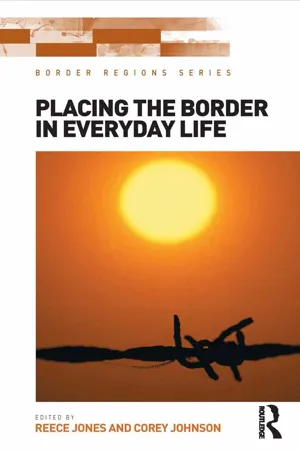
Placing the Border in Everyday Life
About this book
Bordering no longer happens only at the borderline separating two sovereign states, but rather through a wide range of practices and decisions that occur in multiple locations within and beyond the state's territory. Nevertheless, it is too simplistic to suggest that borders are everywhere, since this view fails to acknowledge that particular sites are significant nodes where border work is done. Similarly, border work is more likely to be done by particular people than others. This book investigates the diffusion of bordering narratives and practices by asking 'who borders and how?' Placing the Border in Everyday Life complicates the connection between borders and sovereign states by identifying the individuals and organizations that engage in border work at a range of scales and places. This edited volume includes contributions from major international scholars in the field of border studies and allied disciplines who analyze where and why border work is done. By combining a new theorization of border work beyond the state with rich empirical case studies, this book makes a ground-breaking contribution to the study of borders and the state in the era of globalization.
Chapter 1
Where is the Border?
The busiest land crossing into the European Union is at a remote place called Kapitan Andreevo, near the tripoint where Bulgaria, Turkey, and Greece meet. It is a typical hectic border crossing scene, a place where dozens of trucks and a steady lineup of cars and people on foot back up on either side of the border. The trucks, loaded with Turkish tomatoes and consumer goods, and cars full of tourists and migrants, await the mundane, technocratic processing so familiar to contemporary border crossers.
The region around Kapitan Andreevo is a good place to study the past and present of borders. At 100-years-old, this border is young by European standards, but makes up for its relative youth in its prominent position in the annals of regional and national folklore. Unnoticed by most border crossers is a statue of Captain Andreev—the namesake for the crossing—who was killed during the First Balkan War (1912–13) and through his martyrdom helped to secure a victory for Bulgaria over the mighty Ottoman Empire. Nearby towns and villages embody Billig’s (1995) “banal nationalism” with public art celebrating border guards’ service to the nation. In a 1980 census, one county had 13 stone statues depicting border guards, with six in a single village (Scarboro 2007).
Bulgaria is not alone in mythologizing its border agents. States around the world elevate the bravery of those who protect the Motherland from unwanted incursions, which keeps the home pure and protects the sanctity of sovereign borders between states. Romanticized statues of armed border guards, often accompanied by a canine companion, dot the borderscapes in many parts of the world, and serve as reminders of the vaunted place in national mythologizing reserved for these agents in the past.
During the Cold War in Europe, the tragic human stories of the Berlin Wall took their toll on this mythology—the heroes became not the lone sentry with his trusty dog, but the illicit border crossers themselves. The memory of these heroes is enshrined in countless indelible black and white photographs of escapees as they sought freedom on the other side of die Todesstreife (the death strip). All too often, of course, their treks ended in tragedy at the hands of border guards, who were not perceived as protectors of the Motherland, but instead symbolized in the public consciousness the cruelty of restricted human movement. The Berlin Wall came to symbolize the violence and exclusion of the East German state and the images of its fall in 1989 signified the collapse of the entire system.
These anecdotes of historical bordering, in spite of their key differences, share two things in common. First, in each case the geographical location of the border was explicit. The border was materially marked and cartographically mapped. It was patrolled by agents of the state who sought to control or prevent movement across the line, and those agents’ jurisdictions typically were limited to the zone immediately adjacent to the border. The human experience with borders coincided with an encounter with the borderline itself, or the “razor’s edge,” across which travel was difficult but the promise of unimpeded movement once on the other side an ample reward (Schofield and Blake 2002, Cox 2008). Second, for the vast majority of people the experience was atypical; border crossing was an exceptional, not an everyday, experience. Humans were less mobile over long distances than they are today, a fact that globalization has changed for a substantial percentage of the world’s population. The state viewed the political border as the key site to protect its sovereignty and thus the primary place where entry and egress was controlled.
State borders were never as strictly patrolled as these romanticized stories suggest. In many places borders were only firmly under the control of the state at the crossing points and the vast stretches between them were unguarded or lightly patrolled. The US–Mexico border, for example, was established in 1848 but the Border Patrol was not created until 1924 (Hernández 2010). Even then it was a small and underfunded force tasked with patrolling a 1969-mile border through rough, arid terrain. As late as 1990, the US–Mexico border did not have any fencing and the Border Patrol had just over 3,000 agents (Jones 2012). In 2013, there are over 21,000 agents and 670 miles of fence. Despite the mythologizing of a past golden era of borders, it is nevertheless true that in previous eras the vast majority of border work happened at the borderline and was carried out by the officers of the state.
Contrast these historical experiences of the border with a third anecdote from November 2011 in the United States. In the town of Vance, Alabama, a traffic cop made a routine stop because the license plate on a vehicle was not visible. The vehicle was driven by Detlev Hager, a German Mercedes-Benz executive visiting a factory in the town. In addition to checking the vehicle’s license plate, the officer was also obligated to check the immigration status of the driver who had a foreign accent. Hager did not have his passport with him and was arrested and taken to jail on an immigration violation. A few weeks later a Japanese Honda executive was similarly arrested at a temporary police checkpoint in Alabama.
These stories about the auto executives made the news because the detained individuals were part of the supposedly borderless world of global commerce, but their experiences demonstrate a substantive shift in who does border work and where they do it. Whereas encounters with an international border were once exceedingly rare, today they are for many a daily occurrence, and increasingly not at the actual borderline. Contemporary borders, and by consequence the study of them, are decentered; the act of bordering happens far away from the border itself, as well as beyond the traditional realm of securing territory from unwanted incursions. In addition, more actors are called upon—or see it as their calling—to be the agents of the state in making the border. Indeed, the Alabama law and traffic checkpoints are specifically designed to identify and detain undocumented Latino workers in the state. The border checkpoint, in essence, briefly materializes thousands of miles from the actual line on a road in rural Alabama and is manned not by a federal agent but a local police officer. The border does appear to be everywhere (Balibar 2004).
However, the contributions to this book demonstrate that Balibar’s assertion is only half right. There is no doubt that border work is now done at many new sites and by many new people but the fact that the arrest of the auto executives was newsworthy also demonstrates that these new borders are not designed to ensnare everyone, everywhere. Instead, the arrests were remarkable specifically because there is an assumption that there should not be a border for these wealthy executives. The implication is that there indeed is, and should be, a border in Alabama for poor undocumented workers. In this volume, we delineate precisely where these new borders are implemented, who is doing the new border work, and who specifically they are meant to locate.
The Everyday of Bordering: Conceptual and Theoretical Background
This book delves into the more recent geographies of border work, and it suggests that the previous reality of bordering—although it was never as tidy as it was represented or remembered—has nevertheless been both geographically displaced and partially supplanted by a new, more variegated reality. For every dramatic, hair-raising scramble across a wall or fence, there are multiple, mundane encounters with the border and its agents. Contemporary border work is technocratic, bureaucratic, and political—anything but romantic (though still sometimes romanticized). Border work is directed not only at transgressions of borders in the narrow sense of preventing a human from violating territorial sovereignty by crossing a line at the margins of a state’s sovereignty, but also at border crossing by particular undesirable categories of goods and services, specific types of information, certain classes of humans, and nature. Yet even if the actual site of the border is less in focus than it was in pre-war Bulgaria or 1960s Berlin, for most people borders have become a more, not less, prominent feature of everyday life. This is true not only for the labor migrant or refugee, but also for the tourist, prisoner, protester, or auto executive on the way to a factory. For border scholars, this presents a host of new methodological and conceptual challenges: not only where do we go to find the border at work, but how does the concept maintain any sense of coherence once it is decentered.
This book offers some insights on these questions, but we acknowledge that much border work is still done by agents of the state at the border. Fences, walls, and even the lonely stone marker on an otherwise featureless landscape continue to serve their function in demarcating sovereign states’ territorial limits and impeding free movements, but globalization and other structural changes altered the dynamic in notable ways (Johnson 2009, Newman 2001). Since the end of the cold war, the dominant way of conceptualizing borders has been as a dialectical relationship between the breaking down of borders and their increasing permeability on the one hand, and the maintenance and even fortification of borders on the other (Jones 2009, Newman 2006). Initially, the end of the cold war and emergence of the process of globalization were thought to be creating an increasingly borderless world where the dominance of liberal democracies and advances in transportation and communication technologies would connect distant places economically, culturally, and politically (Fukuyama 1992). The fall of the Berlin Wall, the removal of border checkpoints within the EU, and the creation of regional trade zones such as NAFTA all appeared to herald the possibility of a borderless world (Ohmae 1995, 1990).
Many other scholars disputed the claim of a borderless world by demonstrating that globalization was producing uneven boundary effects in which some movements were facilitated while others were restricted (Newman 1999, Ó Tuathail 2000, Sparke 2006). These seemingly opposing processes are in fact intricately interrelated: Some borders are opened to the movement of goods, capital, and certain desirable classes of humans while other boundaries are erected specifically to restrict undesirable classes of humans (“illegal immigrants,” terrorists, etc.) (Geddes 2003, Häkli 2007, Mountz 2004). Much like other changes brought about by globalization, the shifting nature of political borders have both global as well as local significance. It is no coincidence, for example, that the European Commission calls their action plan on protecting its borders a “Global Approach to Migration: Priority Actions in Africa and the Mediterranean.” The US Homeland Security strategy, meanwhile, advocates an extraterritorial approach to border security by “pushing borders out” beyond US sovereign territory (Hobbing and Koslowski 2009). Other scholars have also identified an inward gaze as boundary work that reinforces the border—from creating identity documents to raids to arrest undocumented immigrants—increasingly occurs away from the border itself within a sovereign state’s territory (Amoore 2006, Appadurai 2006, Coleman 2005, 2009).
In the past 10 years the stigma associated with fortifying political borders disappeared and at least 23 security barriers were initiated or expanded worldwide, or more than double the number that were built during the entire Cold War (Hassner and Wittenberg 2009, Jones 2012). These include well-known projects in the United States (Nevins 2010) and Israel (Weizman 2007) but also in countries as diverse as Botswana, Thailand, Saudi Arabia, and Uzbekistan. Many more borders were hardened through the deployment of new security practices from increased patrols to new surveillance systems. In 2013, we estimate approximately 20,000 km (12,400 miles) of the world’s borders are now marked with walls or barriers (Foucher 2007). An additional 18,000 km are “hardened” but unfenced boundaries (Rosière and Jones 2012). Contrary to expectations at the end of the Cold War, the current era of globalization has resulted in the most intensive and extensive period of bordering in the history of the world. These examples demonstrate that the process of globalization is accompanied by the rise of governance strategies, which are designed to cope with the risks inherent to the increasing mobility of humans and goods by patrolling beyond and within the territorial boundaries of the state (cf. Beck 1999).
While border security at the line is an important aspect of the everyday of bordering, we argue that sovereign bordering must be understood in a much broader context. The geographies of borders are more expansive, and as a result the conceptual tools we use to understand them must be expanded. This book, therefore, builds on recent work in geography and allied disciplines that has examined realignments in the relationship between concepts of territory, borders, and sovereignty (Brown 2010, Elden 2010) and on governmentality and security (Walters 2006, Bigo 2011). With the immigration reform debate in the US still unresolved and comparable discussions occurring in countries across the globe, border security is a topic of pressing concern in policy and academic communities alike. At the heart of these discussions is not only a debate about whether strategies by states to restrict access to its territory through barriers and expanded security practices are effective, but also ethical and philosophical questions about how, where, why, and by whom it is being done.
Non-traditional Actors and Locations for Border Work
The book makes three central arguments. The first is to identify the rescaling and expansion of border enforcement away from a top-down model of agents at border lines to border work by multiple local actors within the state’s territory. “The implosion of border enforcement,” as Mat Coleman and Angela Stuesse term it in their contribution to this volume, makes it clear that, not only are many non-state actors involved in the process of defining the boundaries of the group, but in many countries the work of patrolling the border often happens at sites away from the line. This process is evident in the post-9/11 refrain of “if you see something, say something,” which deputizes every citizen to be the eyes and ears of the state (Vaughan-Williams 2008). More formally, in the US, the federal government is training local police officials in immigration enforcement which gives them the authority to inquire about immigration status and check documents. Previously this was solely the duty of the federal government but these new “secure communities” agreements move this authority to other non-federal actors at a variety of scales. This volume will analyze how and why sovereign states are expanding the power to enforce immigration laws to local law enforcement officials and the consequences this has for the lives of people within state territory.
In addition to the expansion of state border enforcement practices to interior locations, there is a growing number of state, quasi-state, and non-state actors doing the work of border making and enforcement at a range of locations that were not previously associated with the border. We theorize a shift away from the state itself to the position that a range of non-traditional actors have an interest in making borders and enforcing restrictions on movement both at the border and within the territory of the state (Parker and Vaughan-Williams 2009). The underlying argument is that borders are not just lines on the ground, but rather that they form an important part of our political imaginary that is predicated on an idea that a territory exists, that states inhabit it, and that people are bounded by it. As such, these borders in our minds are a fiction that shapes our conception of the world, our place in it, and our relationship to other humans (Castells 2010). In so doing, this fiction becomes a very powerful fact for the large numbers of people who encounter borders in their multiple locations in their daily lives. At the core of this book is the contested and often contradictory relationship between the narratives and practices of bordering the nation-state—the creation of inside and outside—on the one hand, and the real-life physical encounters with bordering practices on the other.
When the border is seen this way, as not simply a state artifact but a potent symbol that is firmly in the hands of individuals and organizations engaged in group making, it opens up a whole new range of actors who do border work every day for a variety of purposes (Walters 2006). These non-traditional border workers often have divergent goals that result in what Anthony Cooper, Chris Perkins, and Chris Rumford call, in a contribution to this volume, “the vernacularization of borders.” Examples of this type of border work abound: right-wing organizations that want to protect a particular version of the cultural identity of the state; corporations involved in funding border security that rely on a narrative of insecurity and threat; and, in the US, state level legislation such as Arizona’s SB 1070 or Alabama’s HB 56 that complicate the lives of undocumented workers and result in a much broader definition of who does not belong. In the case of both pieces of anti-immigration legislation, one individual—a law professor, consultant, and later the Secretary of State of Kansas named Kris Kobach—played a central role in drafting the laws, himself becoming a border worker from his home in Kansas, as far from the US border as one can be. Other acts of everyday bordering are evident in the controversies over the construction of mosques in the US both near the World Trade Center site in New York, but also in places like rural Tennessee where the site of a proposed Islamic co...
Table of contents
- Cover Page
- Title Page
- Copyright Page
- Contents
- List of Figures
- List of Tables
- Notes on Contributors
- Acknowledgments
- 1 Where is the Border?
- SECTION I THEORIZING THE BORDER IN EVERYDAY LIFE
- SECTION II BORDER WORK BY NON-TRADITIONAL ACTORS NEAR THE BORDER
- SECTION III BORDER WORK BY NON-TRADITIONAL ACTORS AWAY FROM THE BORDER
- Index
Trusted by 375,005 students
Access to over 1.5 million titles for a fair monthly price.
Study more efficiently using our study tools.
Frequently asked questions
Yes, you can cancel anytime from the Subscription tab in your account settings on the Perlego website. Your subscription will stay active until the end of your current billing period. Learn how to cancel your subscription
No, books cannot be downloaded as external files, such as PDFs, for use outside of Perlego. However, you can download books within the Perlego app for offline reading on mobile or tablet. Learn how to download books offline
Perlego offers two plans: Essential and Complete
- Essential is ideal for learners and professionals who enjoy exploring a wide range of subjects. Access the Essential Library with 800,000+ trusted titles and best-sellers across business, personal growth, and the humanities. Includes unlimited reading time and Standard Read Aloud voice.
- Complete: Perfect for advanced learners and researchers needing full, unrestricted access. Unlock 1.5M+ books across hundreds of subjects, including academic and specialized titles. The Complete Plan also includes advanced features like Premium Read Aloud and Research Assistant.
We are an online textbook subscription service, where you can get access to an entire online library for less than the price of a single book per month. With over 1.5 million books across 990+ topics, we’ve got you covered! Learn about our mission
Look out for the read-aloud symbol on your next book to see if you can listen to it. The read-aloud tool reads text aloud for you, highlighting the text as it is being read. You can pause it, speed it up and slow it down. Learn more about Read Aloud
Yes! You can use the Perlego app on both iOS and Android devices to read anytime, anywhere — even offline. Perfect for commutes or when you’re on the go.
Please note we cannot support devices running on iOS 13 and Android 7 or earlier. Learn more about using the app
Please note we cannot support devices running on iOS 13 and Android 7 or earlier. Learn more about using the app
Yes, you can access Placing the Border in Everyday Life by Reece Jones,Corey Johnson in PDF and/or ePUB format, as well as other popular books in Physical Sciences & Geography. We have over 1.5 million books available in our catalogue for you to explore.