eBook - ePub
Taxi! Urban Economies and the Social and Transport Impacts of the Taxicab
- 208 pages
- English
- ePUB (mobile friendly)
- Available on iOS & Android
eBook - ePub
Taxi! Urban Economies and the Social and Transport Impacts of the Taxicab
About this book
The taxicab makes a significant contribution to the accessibility of a city, and provides a wide range of services across many different social groups and urban environments. This study considers the roles and functions of the taxi from its origins as the first licensed form of public transport, to the current variations of vehicle type and operation, to predictions for its future development. Also addressed here is the impact which this ubiquitous form of transport has on contemporary urban life, and the analytical tools being used and developed for its licensing and control.
Information
Chapter 1
Historical Development of the Taxi
INTRODUCTION
The taxicab, in various incarnations, remains one of the oldest licensed and most recognizable forms of public transport still in use today. This is not to say that other forms of transport have not existed in parallel with the taxi, but rather that the history of the taxi is significant and impacts on our current understandings of the mode and its operation.
1.1 HISTORICAL DEVELOPMENT
The modern taxi owes its design and the nature of current operations to its significant history. There is no doubt that the concept of a shared vehicle operated for reward has been in existence from the very earliest origins of vehicles themselves. The distinct emergence of a taxi is traceable to vehicles for hire in Paris from about 16401. The first recognizable taxi service in the UK can also be traced to the seventeenth century, and is exampled in the 1654 Ordnance for the Regulation of Hackney Coachmen, a regulation designed to ensure a level of service in the provision of horse drawn taxis. The 1654 ordnance predates motorized transport and relates to “Hackney Carriages”, named after the French word “Haquenée” a cart pulling horse2. The term Hackney Carriage (Hack, Black Hack) has stuck and remains in use today together with the more common term “taxi” which is suggested to originate from the German “Taxemeter” – literally the meter designed to measure tax (fare), invented in 1891 by Wilhelm Bruhn.
Although the term “taxi” can be applied to across the entire gambit of vehicle types, further distinctions exist. The most common of which is between Hackney Carriages – itself a legal definition of a vehicle available for hire on street; and Private Hire Vehicles (PHVs), vehicles restricted to pre-booked (dispatch) journeys. Hackney and PHV taxis represent the majority of all “taxi” journeys, the existence of both forms of taxi within a single authority area often being referred to as a “dual system” of supply. Some variation of these terms exists, with the US referring to pre-booked vehicles as “livery taxis” named after the livery or appearance of the vehicle, while in Ireland, and somewhat confusingly, the term “Hackney” is applied to PHVs. The diminutive term “Hacks” is widely applied particularly in the trade and can refer to most forms of taxi dependant on local precedent, see Table 1.1.
The two further forms of taxi operation, taxibus and limousine, are less widespread than their dual system counterparts, but play a significant role in distinct market segments. Taxibuses in particular have emerged as a recent development in Western locations and owe much of their history to a lack of more formalized transport. The taxibus is typified by Jitney operations in developing countries, shared Camionetas amongst immigrant populations in the USA, and “Black Taxi” shared buses in some UK cities.
Table 1.1 Taxonomy of names used to describe taxis
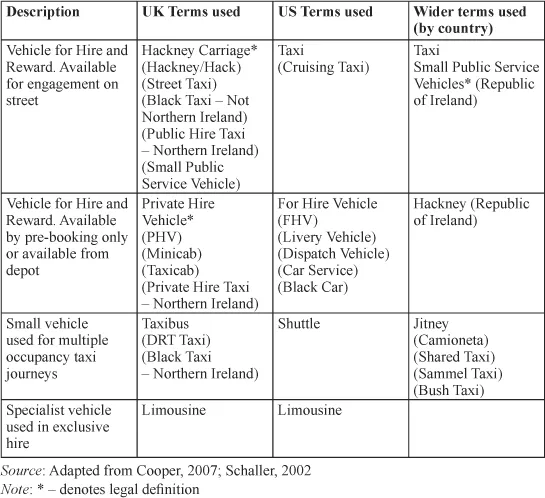
Schaller (2002) provides a good description of distinctions within the US “For Hire Vehicle” market, with specific reference to New York, including a description of car service vehicles, which are formally defined in the USA within the FHV market, but vary distinctly within the group.
While some differences in terminology are common and understandable, the general purpose of the taxi remains consistent. The taxi offers, across a number of forms, personal carriage for an individual or small group for hire and reward. This pattern is repeated worldwide and continues to date following remarkably similar patterns regardless of location.
1.2 FROM HORSES TO MOTORIZED VEHICLES
In the period from the early seventeenth century to the end of the nineteenth, the horse drawn Hackney Carriage became a recognized part of city life in many parts of the world. Horse drawn vehicles of varying designs can be seen in historical accounts in most cities with a significant advance in design coming with the Hansom Cab, a horse drawn carriage patented in 1834 by Joseph Hansom, originally built in Leicestershire and adopted widely in London.
The Hansom cab differed in design from previous horse drawn carriages in that the vehicle ran on two wheels connected by a single horizontal axle, with the driver seated above and viewing over the passenger seat. The vehicle was light and thus quick in comparison to earlier carriages, and offered a degree of maneuverability not possible in the more rigid twin axle carriages it replaced. The design was popular in many cities including those in America, the Hansom Cab Company, founded in 1869, offering similar vehicles in New York. Irish and Scottish versions included the “Noddy”, a small two-wheeled carriage slung behind a single horse.
The first motorized taxis appeared from 1890, initially as electric vehicles powered by battery, followed by a rapidly expanding market for petrol and diesel vehicles, the mainstay of the current industry. Examples of electric taxis include the “Hummingbird”, a battery powered taxi properly called the “Bersey”, entering mainstream service 18973. The Bersey taxi is recorded as being the first self-propelled taxi licensed for use in London, with a fleet of such vehicles operated by the London Electrical Cab Company. The Bersey taxi was limited to a range of 30 miles between charges, highlighting a difficulty in use of electric vehicles, which remains to this day. Modern equivalents of the electric taxi include the Zero Emissions Vehicle being developed and tested in the UK market by Allied Vehicles (an electric taxi based on the company’s E7 London Taxi design). The Bersey taxi suffered from poor reliability4 and was replaced with the emergence of petrol vehicles.
The first petrol-powered taxi was produced by the French manufacturer Prunel, and introduced to Paris and London fleets from 1903. The Prunel taxi was followed, in the UK, by a wide range of taxi designs from other manufacturers. The wide range of differing designs led, in London, to the Metropolitan Conditions of Fitness (MCF), introduced in 1906. The MCF regulations set standards for vehicle design including the requirement for a taxi to be able to make a complete U turn within a 25-foot roadway. These requirements effectively discounted a number of vehicle designs from taxi use restricting the available vehicle types to specific taxis, which have since become known as a “London taxi” type. Metropolitan Conditions remain to this day and continue to prove controversial, particularly with the strict application of a tight turning circle effectively ruling out some production vehicle types. A number of UK cities, in addition to London, have chosen to adopt MCF conditions as a control on the design of vehicles in use with varying strictness, particularly in terms of turning circle requirements. Licensing Authorities in Liverpool upholding, in 2008, the strict need to adhere to a turning circle requirement; while other UK cities, which apply MCF principles, have dropped this requirement, including Edinburgh in 2007.
The fitting of taximeters became a requirement of the London fleet in 1907 predicating the widespread use of the term taxi (after the taximeter) for all such vehicles.
The current Black London Taxi design emerged in 1948 with the development of the Austin Carbodies FX3, the forerunner of today’s dominant London vehicles. The FX3 and its replacement FX4, from 1958, defined a standard purpose-built taxi flexible to the extent that engine and drive train parts could vary while external appearance remained constant. The final version production FX4, the Fairway, ceased production in 1997 following a run of over 75,000 such vehicles. London Taxis International, the successor to Carbodies, continues to this day to produce purpose-built London taxis, currently marketing the TX4 model (2007-present).
UK taxi design differs significantly outside London. In most metropolitan cities a form of consistency is applied, based on a number of interpretations of the MCF approach adapted from London, ranging from strict controls, as applied in Liverpool, to more generous interpretations in Glasgow, Edinburgh etc. The latter have a greater flexibility in the range of vehicles available and allow the Allied Vehicles E7, ostensibly a London Taxi, but unable to perform the turning circle requirements set in the stricter interpretation of the MCF. Smaller cities in the UK split between those requiring London styles of taxis, and those permitting saloon (sedan) vehicle types. Current discussion focuses around the relative merits of one vehicle type over another for the types of journey made by location. The argument is further complicated by a desire, of some authorities, to provide accessible vehicles, and legislated requirements requiring, but not defining technical standards for, accessible vehicles. It is significant to underline the importance of the taxi to wheelchair users, as a commonly available form of transport, and this is further underlined, as described in Chapter 8, by the range of regulatory requirements and analysis techniques available specific to vehicle type.
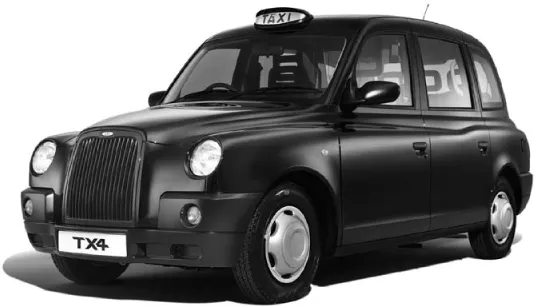
Figure 1.1 TX4 model built by London Taxi International
Source: © LTI Limited reproduced with permission. Fairway and TX shape is a registered design. Fairway™, TX ™, the LTI device, the LTI logo and the London Taxis International logo are all trademarks of LTI Limited.
In North America Hackney Carriages (Hacks) were a popular form of transport in the early nineteenth century. Waves of immigrant incomers adopted the trade as a method of gaining employment, leading to ethnic succession from indigenous to immigrant dominance. Not all such successions were peaceful, with hack drivers earning a poor reputation for aggressive solicitation and anti-competitive practices.
Hansom Cabs became popular with the founding, in 1869, of the Hansom Cab Company in Brooklyn, New York. Electric vehicles made a brief appearance including a fleet of electric hansom cabs introduced in 1897 by the Electric Carriage and Wagon Company.
In 1907 a New York entrepreneur, Harry N. Allen, introduced a fleet of petrol taxis imported from the French manufacturer Darracq (Hodges, 2007), operating a fleet of 65 vehicles employing contracted drivers each required to wear a uniform “designed to emulate a West Point cadet”. Allen’s business model introduced a level of control to the supply of taxis in the city and included the requirement for uniformed drivers and specified distance based fares, determined using pre-set taximeters reducing the opportunities for price abuse (US: price gouging). Allen’s taxis are also reported as the first taxis to be painted yellow, reportedly as a result of yellow being the color most easily seen from a distance. Problems emerged a year later, in October 1908, with the onset of labour disputes, between drivers and Allen’s company in a dispute seeking union representation and higher salaries (see Schaller, 2006).
Standardization of vehicles followed, with the development, from 1910, of the Yellowcab, a design manufactured by John Hertz who both built the vehicle and operated a taxi business, using excess vehicle production to form a car rental business (initially called “Yellow Drive-Ur-Self”, and latterly Hertz Rental Car).
Morris Markin, who both manufactured and operated taxis under the name Checkercabs, and was to take over the Yellow taxicab company in 1929, adopted a similar approach. The 1956 Checker A8/Marathon became the most popular taxi vehicle in the USA, continuing in production until 1982 and forming the basis for subsequent standard taxi designs, and informing the current dominance of the Ford Crown Victoria and Lincoln in taxi use, Lincoln using a taxi derivative of the production “Town Car”. In 1960 the City of New York legislated that all vehicles be coloured Yellow, although this differs in other cities, and does not cover all taxi types in New York.
In 1964 the State of New York filed antitrust charges against Markin highlighting the anti-competitive position of Checker Cab having dominance in manufacture and operation of taxis.
Similar patterns of development are observable in other countries, while some locations offer distinctive and distinctly different forms of taxi. Differences arise from the form of licensing adopted, this being adherence to a dual system of taxis and PHVs; alternative licence forms including taxibus and limousines; but will also relate to the market forms, typically the dominant methods by which taxis are engaged.
1.3 MARKET FORM
The split between licensing types highlights the fact that taxis provide services for different constituencies. The two most popular taxi categories, Hackney Carriage and PHV actually provide services to three market segments, hailed journeys, journeys engaged at taxi rank, and taxi journeys booked in advance (by prior arrangement). In locations that distinguish between Hackney and PHVs, the latter may be restricted to pick up by prior arrangement only, while some concessions exist allowing PHVs to operate on demand from specified depots.
Hailed journeys, as with journeys starting at a taxi rank (UK: Taxi Stance/Taxi Stand; US: Cabstand) are based on immediate engagement of a vehicle, and both rely on the supplier offering to supply services, typically at points of high demand. Licensing authorities have a role in determining the location of taxi ranks and in their maintenance, often with direct input from taxi operators and companies, and in discussion with local planning and roads authorities. The balance between stands and hailed traffic remains a local choice and will often affect the dominant forms of taxi operating patterns in a city. Most UK cities favour the identification and maintenance of taxi stands and there are over 500 taxi ranks in London at the time of writing. Taxi stands may also provide a focus for particular uses such as providing a safe location for taxi engagement at night. The Glasgow Nitezone is an example of marshalled policed taxi stances introduced in 2005 and highly popular with both passengers and drivers alike.
Pre-booked (US: dispatched) taxis represent a third method of engaging taxis and are often dominated by PHVs, vehicles only licensed to operate by prior arrangement. The pre-booked market has developed significantly in recent years with the advent and widespread use of mobile phones allowing for faster bookings, removing many of the barriers associated with pre-booked vehicles particularly in reducing delay.
The third and fourth licence types, taxibus and limousine represent a smaller market than for Hackney Carriages and PHVs, but have significant roles to play. The taxibus (Jitney/Shared Taxi) has developed as a relatively new form of service in the UK, and has become established (CflT, 2008) as a part of a market for Flexible Transport Service (FTS) with particular benefits in rural communities. The idea of a shared small vehicle, however, owes much to the Jitney and Camionetas (Bush Taxi) frequently providing collective transport in developing countries.
The Shared Taxibus (Jitney) is an intermediate form offering journeys to individuals and small groups in multiple occupancy, often using traditional taxi vehicles. Traditional taxi licensing authorities and operators in developed countries have tended to avoid permitting such operations, in part due to the additional difficulties of determining multiple fares in a single journey compared to sole vehicle hire. The taxibus does, however, play a significant role in transport in developing countries and in locations where more traditional modes are inadequate to need.
The Jitney owes its name (Hodges, 2006) to a practice arising in Los Angeles, in the 1914 economic downturn, to offer rides for 5 cents (US slang: a Jitney). The practice led, in a number of US cities by the development of public transit authorities responsible for planning for local public bus services. Valenzuela et al. (2005) describe “Camionetas” (Lit: Mexican: minivans) as privately operated jitney services operated by and for immigrant populations, partially as a response to a lack of public buses, but also as a response to US limitation to incoming populations to obtain driving licences. Although many such services operate they are, in the main, illegal. Cervero (1998) argues that the informal privately operated Jitneys offer a complementary service to operate alongside existing public transit, citing Mexican examples of legalized “colectivo” a community-based jitney service, as offering potential for development in the USA.
1.3.1 Taxi Ranks
The primary objective of the taxi rank is to define a location at which prospective passengers may engage a taxi. The rank may be...
Table of contents
- Cover
- Half Title
- Title Page
- Copyright Page
- Table of Contents
- List of Figures
- List of Tables
- About the Authors
- Preface
- Acknowledgements
- 1 Historical Development of the Taxi
- 2 The Development of a Licensing Structure
- 3 Fundamentals of Taxi Analysis
- 4 Taxi Analysis – Application and Interpretation
- 5 The Role of Technology in Taxi Operations
- 6 The Role of the Taxi in Night-time Economies
- 7 The Role of Airport Taxis in Airport Ground Transportation
- 8 The Role of the Taxi in Specialist Transport Services
- 9 The Use of Taxis in a Community and Developmental Role
- 10 Barriers to Development
- 11 Taxi Transport: Toward a Future Direction
- References
- Index
Trusted by 375,005 students
Access to over 1.5 million titles for a fair monthly price.
Study more efficiently using our study tools.
Frequently asked questions
Yes, you can cancel anytime from the Subscription tab in your account settings on the Perlego website. Your subscription will stay active until the end of your current billing period. Learn how to cancel your subscription
No, books cannot be downloaded as external files, such as PDFs, for use outside of Perlego. However, you can download books within the Perlego app for offline reading on mobile or tablet. Learn how to download books offline
Perlego offers two plans: Essential and Complete
- Essential is ideal for learners and professionals who enjoy exploring a wide range of subjects. Access the Essential Library with 800,000+ trusted titles and best-sellers across business, personal growth, and the humanities. Includes unlimited reading time and Standard Read Aloud voice.
- Complete: Perfect for advanced learners and researchers needing full, unrestricted access. Unlock 1.5M+ books across hundreds of subjects, including academic and specialized titles. The Complete Plan also includes advanced features like Premium Read Aloud and Research Assistant.
We are an online textbook subscription service, where you can get access to an entire online library for less than the price of a single book per month. With over 1.5 million books across 990+ topics, we’ve got you covered! Learn about our mission
Look out for the read-aloud symbol on your next book to see if you can listen to it. The read-aloud tool reads text aloud for you, highlighting the text as it is being read. You can pause it, speed it up and slow it down. Learn more about Read Aloud
Yes! You can use the Perlego app on both iOS and Android devices to read anytime, anywhere — even offline. Perfect for commutes or when you’re on the go.
Please note we cannot support devices running on iOS 13 and Android 7 or earlier. Learn more about using the app
Please note we cannot support devices running on iOS 13 and Android 7 or earlier. Learn more about using the app
Yes, you can access Taxi! Urban Economies and the Social and Transport Impacts of the Taxicab by James Cooper,Ray Mundy in PDF and/or ePUB format, as well as other popular books in Politics & International Relations & Local & Regional Planning Public Policy. We have over 1.5 million books available in our catalogue for you to explore.