- 490 pages
- English
- ePUB (mobile friendly)
- Available on iOS & Android
eBook - ePub
About this book
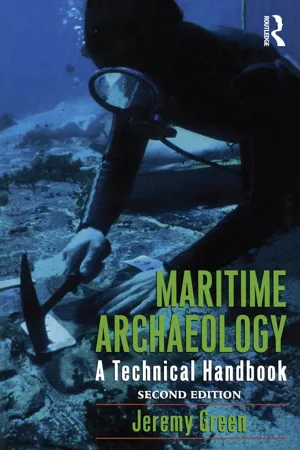
Jeremy Green's systematic overview of maritime archaeology offers a step-by-step description of this fast-growing field. With new information about the use of computers and Global Positioning Systems, the second edition of this handbook shows how to extract as much information as possible from a site, how to record and document the data, and how to act ethically and responsibly with the artifacts. Treating underwater archaeology as a discipline, the book demonstrates how archaeologists, "looters," academics, and governments interact and how the market for archaeological artifacts creates obstacles and opportunities for these groups. Well illustrated and comprehensive in its approach to the subject, this book provides an essential foundation for everybody interested in underwater environments, submerged land structures, and conditions created by sea level changes.
Information
Chapter 1
1Introduction to Maritime Archaeology
Much has changed since I wrote the first edition of Maritime Archaeology: A Technical Handbook in 1989. Possibly the greatest change, at the technical level, has been the advance in the use of computers and their introduction to mainstream maritime archaeology. The development of the Internet, the amazing power of the computer, and the advent of reliable, cheap, and extremely accurate position fixing systems like the Global Positioning System (GPS) have provided opportunities that would have been unthinkable in 1980s. Now, with a small hand-held GPS, a position can be obtained anywhere on the surface of the Earth accurate to about a couple of meters. Although much has changed, surprisingly, a lot of things have not. So in revising the handbook there will be changes in some areas and very little in others. I have decided to omit the chapter on conservation as this subject is now well covered in the literature and there are several handbooks that can be used as references. Over the past ten years, maritime archaeology as a subject has become increasingly involved in cultural resource management, so I have introduced a new chapter dealing with this issue. In addition, the plethora of computer packages which are currently available now make it impossible to deal with each in detail. As a result, I have illustrated the general application with a program with which I am experienced. This is not to say there are better programs, or that the one discussed is the best, it is simply that I have used it and know how it works and know its limitations. Readers are encouraged to investigate other systems, particularly as there are always new systems being produced, that may well be better or more sophisticated.
When Maritime Archaeology: A Technical Handbook was first published there were few books that dealt with the practical application of maritime 2archaeology with Wilkes (1971) being the only notable work. Soon after the publication of Maritime Archaeology: A Technical Handbook, Dean (1992) published Archaeology Underwater: The NAS Guide to Principles and Practice, an excellent guide to maritime archaeology, particularly as it related to the very important Nautical Archaeology Society (NAS) courses developed in the UK.
In the first sentence of the first edition, I asked the question: “What is maritime archaeology?” The answer is still the same. There have been a number of attempts to define a term to describe all aspects of the field. Terms such as marine, nautical, and underwater all have slightly different meanings, and there is no one word that is really adequate. In 1978 Muckelroy (1978) defined a meaning of the various terms, but generally it has been accepted that the most suitable adjective is “maritime” (McGrail, 1984, 1987), and that it is possibly irrelevant to attempt to determine if, for example, a shipwreck found on reclaimed land is nautical, maritime, or marine archaeology. It is clearly not under water. Recently, Werz (1999) revisited this question and quoting Bass (1983) “archaeology under water, of course, should be called simply archaeology.” This handbook deals with aspects of archaeology and the techniques that are used to conduct archaeology in an underwater environment. Although shipwrecks are particularly featured here, the techniques described can be applied just as readily to submerged land structures and research associated with sea level changes. See, for example, Blackman (1982) and Flemming (1971, 1978). The overall archaeological process is in fact no different from the process that takes place on land. It is therefore essential to understand that archaeology which is done under water requires the same elements and the same procedures as any other form of archaeology.
Because maritime archaeology is a relatively new discipline it has in the past at times suffered, understandably, from a lack of proper methodology. This was partially due to the fact that the procedures were not clearly understood then; this is no longer the case. A series of major and pioneering excavations demonstrated that even under the most difficult conditions, the highest archaeological standards can be maintained. Previously it was often difficult to determine what was proper archaeology. There was (and there still is) a lot of excavation work masquerading as maritime archaeology, when it was in reality simply treasure hunting carried out by individuals claiming to be maritime archaeologists who were driven by a profit motive or simply souvenir hunting. These factors were detrimental to the proper development of maritime archaeology in the early phases and resulted in some people, including professional archaeologists, to argue that maritime archaeology was not a discipline but merely an extension of treasure hunting. This is no longer true and many of these prejudices are long 3gone. There is, however, a new problem beginning to arise. Whereas in the 1970s and 1980s maritime archaeological excavations were quite common, this is no longer the case. Remarkably few excavation reports are seen today in the literature. This stems from the fact that there are limited funds and a philosophical approach to the whole issue of excavation that tends to eschew the process. Consequently, there are less and less maritime archaeologists with excavation experience. This whole subject will be dealt with later in Chapter 14, “Cultural Resource Management.” But it is worth noting here that as a result of this, most recovery work being done today is by treasure hunters.
An early criticism of maritime archaeology involved questions related to the study of relatively modern sites such as shipwrecks from the post-medieval or later periods. This has led professional archaeologists and historians to suggest that this type of study is “an expensive way of telling us what we already know” (Sawyer’s remark quoted by McGrail, 1984). Others maintained that maritime archaeology was a valid part of archaeology and that it had made important contributions to history, art, archaeology, the history of technology, and many other traditional areas of study. Today, this criticism is largely irrelevant. The advances over the past decade in post-medieval and modern maritime archaeology have been enormous. Both the Columbus centenary and the remarkable historical reconstructions that were initiated in Lelystad, The Netherlands by Willem Vos, starting with the Batavia, have lead to a series of other historical reconstructions. These have all had immense impact on the understanding of the construction and sailing of ships of this period and have stimulated archaeological, historical, and archival research. The development of iron and steam maritime archaeology has also created new areas of research, particularly the development of corrosion science and understanding of the disintegration process of iron shipwrecks.
It is also obvious that maritime archaeology is no longer purely an archaeological matter concerned with archaeological issues of excavation and research. There is a growing awareness that maritime archaeology is related to management of sites and that sites do not necessarily “belong” to archaeologists, but instead are a cultural resource that belongs to everyone. This does not necessarily mean that a site has to be defined as an ancient monument in order to involve maritime archaeologists, nor does it mean that if it is declared a monument it precludes archaeological excavation. It could, for example, be a recreational facility in a national park or a site used to train archaeologists. The management of sites also concerns legislation and procedures and decisions required to define sites in accordance with the legislation—all of which have archaeological assessment issues. These issues will be discussed in greater depth in Chapter 16.
4Steffy (1994) published a groundbreaking work, Wooden Ship Building and the Interpretation of Shipwrecks, in which he discusses how shipwreck sites should be investigated and that “each wreck must be analyzed as accurately and as extensively as possible by means of a controlled discipline; we have come to know this discipline as ship reconstruction.” Steffy’s approach was to take the basic ship-related information from archaeological shipwreck sites and attempt to extrapolate from the evidence a reconstruction of the ship. This is a particularly important and scholarly work and possibly one of the most important theoretical contributions to the field in the last decade.
From an archaeological point of view the study of maritime sites and artifacts has opened up new fields of study. In part these have complemented existing fields of study, but in many cases the area of study is totally new. The hulls of ancient ships and their contents, apart from one or two examples, have not previously been available for study. The material from shipwrecks is unusual for several reasons including that the circumstances of the loss of a vessel in one instant of time often leaves a large quantity of material, much of which can be recovered or reconstructed. This may be contrasted with objects that survive today in museums and collections, which do so because they were rare or valuable and were therefore to be kept and collected. Thus, if one’s view of the past is based solely on museum collections, there tends to be a bias toward luxury and there is often little of the mundane, day-to-day items that would have been found in the houses of the masses. This view has changed within the last decade as archaeology has opened up fields of study that relate to these issues. The Jorvik Viking Centre in York is a good example of this; a place where everyday life of the Vikings is shown. Another example of this shift in perspective is with the Egyptian excavations. Here the archaeology is probably driven by the fact that there are few remaining Pharaonic tombs to be found, but there is now a considerable emphasis on discovering who the builders of the pyramids were and what the life of the ordinary person was like in Egypt during the time of the Pharaohs.
There is a difference too in the nature of maritime archaeological sites. The material from terrestrial archaeological sites usually represents occupation over a period of time, often centuries, and the artifacts that survive do so in a complex pattern demanding great skill on the part of the archaeologist to understand and interpret. Often terrestrial sites have had a continual history of interference, both human and natural, and the continued occupation of sites make understanding them as a series of events extremely complicated. Underwater sites, on the other hand, particularly shipwreck sites, tend to be single events in time. Shipwreck sites usually contain all the material that was on board the ship at the moment of sinking, 5almost like a tomb on land (naturally some things tend to disappear). The artifacts, however, are usually simple domestic wares belonging to the common seaman, trade goods destined for the markets of the world, and the fittings of the vessel itself. As a result the collections provide new and different types of information through which we can study the past. The consequent disintegration of the site and the natural effects of the sea are thus the primary vectors that the archaeologist have to interpret.
The advent of underwater breathing equipment and early salvage work starting essentially in the 16th century had a minor effect on the archaeological record, but the advent of the aqualung had a major impact on underwater sites. More and more sites are being looted by treasure hunters so that the archaeological record, like that on land, is now slowly disappearing. These issues have been of concern to archaeologists and legislators, and there has been a long and bitter battle with the treasure-hunting community over this issue. The United Nations Educational, Scientific and Cultural Organization (UNESCO) Convention on the Protection of the Underwater Cultural Heritage was adopted in November 2001 by the Plenary session of the 31st General Conference thus becoming UNESCO’s fourth heritage convention. This convention is a starting point in dealing with issues relating to sites that lie in international waters, but it also requires that countries abide by its principles. The conference underlines an international desire that underwater cultural heritage should be protected.
Underwater archaeology as a discipline had its beginnings in the 19th century when salvors, working on the then modern shipwrecks, and sponge divers seeking sponges occasionally came across ancient material. This attracted archaeological interest, however, the work that was undertaken was limited at best to an archaeologist directing divers from the surface (Frost, 1965; Taylor, 1965; Throckmorton, 1964). The advent of scuba equipment and the birth of sport diving rapidly altered this situation. The 1950s marked the start of two separate developments that were to affect the future of maritime archaeology: the diving archaeologist and, for want of a better word, the “looter”. The former included a small number of archaeologists who learned to dive, and a large number of divers who became involved and interested in doing archaeology under water, many of whom (like myself) went on to become archaeologists. The looters were sports divers, who, in the Mediterranean, found that Greek and Roman amphora commanded high prices on the antiquities market. Even if there was no commercial motive, these artifacts from the sea made excellent souvenirs. In the United States, the seeds of a far greater problem were being sown. The discovery of the shipwrecks of the Spanish fleets that sailed from Central America to Spain, bringing the treasures of the Americas, attracted the growing interest of underwater treasure hunters. The treasure hunter 6operates differently from the looter, who usually finds sites by chance. The treasure hunter actively searches for sites as an occupation using sophisticated electronic search equipment, is motivated by profit, and usually works totally within the law. This was a time when the word gold was on every treasure hunter’s lips. There is an apocryphal story that treasure hunters in their search for gold were ignoring sites that had just silver on board. The literature abounds with accounts of treasure-hunting groups that set up companies to search for famous treasure ships. Nearly all went bust, possibly some never had the intention to search for sites in the first place, and others were inept. Yet, even today the gullible investors sign up their hard-earned cash with the dream of gaining huge fortunes—most are sadly disappointed.
Once again the wheel turned and in 1983 Michael Hatcher started looking for the Verenigde Oostindische Compagnie (VOC) shipwreck Geldermalsen off the Riau Archipelago in Indonesia. His search started with the discovery of another wreck site, the so-called Transitional Wreck. This was a Chinese junk, dating from the mid-17th century, possibly in the employment of the VOC. There was no silver or gold on this site, but a remarkable collection of Chinese porcelain of the Transitional Period. The collection was sold at Christie’s in Amsterdam, and made Hatcher a small fortune (Christie’s Amsterdam, 1984, 1985; Sheaf and Kilburn, 1988). He went on and eventually found the Geldermalsen which contained a huge cargo of Nanking porcelain (Christie’s Amsterdam, 1986; Jorg, 1986; Sheaf and Kilburn, 1988). There has never been an event quite like the sale of the Nanking cargo which was comprised of over 160,000 ceramic items and 126 gold ingots and sold for about £10 million. Indeed the Geldermalsen sale by itself exceeded in almost every conceivable way anything that Christie’s had done before. For example: Lot 5105 included one thousand similar tea bowls and saucers, circa 1750 at £21,000-32,000 and Lots 5059-5066 included one thousand (each lot) tea bowls and saucers at £26,000-40,000. It was staggering. The sheer quantity must have created a nightmare in marketing for Christie’s. Clearly, their approach was unconventional and successful. First, by selling off large lots it was possible for dealers to the resell, allowing for a financial speculation. The catch phrase was “Nanking for everyone.” Even if is was mediocre quality, the buyers came in droves and bought at prices well above the expected or “suggested” price. Additionally, it was essential for Christie’s to ensure that the sale did not cause a loss in confidence of people who use the antiquity market for investment purposes. Who wants to buy something for £1000 today and find tomorrow, because a wreck has been found with thousands of what were once unique items, that one’s investment is worthless? This has happened with numismatic collections consisting of rare silver coins, which in the catalogs are 7worth a large amount, have often fooled the unwary treasure hunter (working on the theory that the numismatic value of a coin is say, £200, so because I have 10,000, this means I have £2,000,000). In the same way, the investor who has a coin worth £100,000, because there are only four in the world, is faced with the danger of a hitherto unknown wreck site which is found to have 10,000 of these coins. Christie’s also sold dinner services as lots:
A magnificent dinner service ... four tureens and covers, 25.5 cm diameter. Four dishes, 42 cm diameter. Eight dishes, 39 cm diameter. Four deep dishes, 38 cm diameter. Six dishes, 35.5 cm diameter. Sixteen dishes, 32 cm diameter. Eighteen dishes, 29 cm diameter. Twelve saucer dishes, 26 cm diameter. Eight jars and covers, 11.5 cm wide. Twelve salt cellars, 8.5 cm wide. One hundred and forty-four soup plates, 23 cm diameter. One hundred and forty-four plates, 23 cm diameter £100,000 to 15,000.
There were about 17 dinner services auctioned, mostly smaller than those illustrated above. The suggested price in the catalog was generally far exceeded at the time of the auction, often by up to ten times. The auction was the second highest total for a Christie’s sale and no doubt, for them, a very profitable operation. From this moment on, shipwreck treasure hunting was not just looking for gold and silver.
The whole problem of course started much earlier. It must be remembered that this started at a time when governments, academics, and archaeologists had no real interest in, or concept of, the extent of the underwater heritage. As a result, the looters made rapid inroads into shallow water sites (up to 40m). By the mid-1960s, there were growing reports of sites in the Mediterranean being extensively looted. Countries bordering the eastern and western Mediterranean (France, Greece, and Turkey) started to take steps to protect these sites by enacting legislation. These countries, particularly Greece and Turkey, had suffered in the 19th century from terrestrial collectors. Because the underwater looters were more often than not visiting tourists (who could afford not only the holiday, but also the expensive diving equipment), the enactment of legislation came easily and was widely accepted by the local people who generally did not have access to this equipment, did not benefit from the process and, more significantly, had a growing interest and pride in their cultural heritage. The treasure hunters in the Caribbean were beginning to run out of really valuable sites and were running into more and more bureaucratic opposition to the process. This opposition gradually extended outside the United States, as international organizations such as UNESCO and the International Council on Monuments and Sites (ICOMOS) became concerned that valuable underwater heritage was being lost to a small, elite group of commercial operators. Naturally, the Geldermalsen opened up a huge new opportunity, particularly 8in Asia, where countries had little interest or ability in dealing with underwater cultural heritage. Additionally, as many of the sites belonged to their post-colonial masters there was an even greater lack of interest. The fact that these sites that had little to do with their indigenous heritage but had promised opportunities of access to a share of the fortunes, often resulted in arrangements where sites were salvaged for their financial resource, the material cataloged and then sold at auction, and the country taking a percentage of the proceeds, occasionally in artifacts, but often in straight cash. Even today Malaysia, Viet Nam, the Philippines, Indonesia, and other Southeast Asian countries make deals with treasure hunters. They license them to search and share in the proceeds. This is often against the wishes of the heritage managers, but the decisions are driven by the finance departments and the politicians. It is quite legitimate, a country has every right to decide how it wishes to dispose of its heritage. It is unfortunate that these decisions have short-term benefits and rarely result in a positive outcome. The UNESCO Convention will make this process more difficult.
In the past four decades, great developments have been seen in the maritime archaeological field. Pioneering this was the raising of the 17th century Swedish warship Wasa in Stockholm Harbor in 1961 (Franzen, 1961). This was a landmark for maritime archaeology. For the first time, an almost complete ship was brought to the surface, not for salvage, but for archaeology. This immense project brought home the impact of the past in that dramatic moment when the vessel first broke surface and floated into the dry dock. The raising of the Mary Rose in 1982 was also a landmark in maritime archaeology. However, strangely, neither projects have become springboards for advancement in the field. Admittedly both projects have stupendous displays, but between the Wasa and the Mary Rose there has been no more than a handful of academic papers, a fact that has to be deplored.
The work in the Mediterranean, popularized in the 1950s and 1960s by Jacques Cousteau, and later developed into a scientific discipline by George Bass (and other organizations in the Mediterranean), also stimulated the popular imagination. Here, it was not really the material, but more the great age of the sites. The fact that they dated from pre-Christian times amazed many and brought home the closeness of the past.
However, in the United States there was a different situation. First, the sites involved were relatively modern. It was therefore argued that they came under salvage laws and that the question of antiquities was irrelevant. Secondly, as mentioned above, there was little interest (in the beginning), either from government, academics, or institutions. Everyone, generally, either tried to avoi...
Table of contents
- Cover Page
- Title Page
- Copyright Page
- Table of Contents
- Acknowledgments
- Preface
- 1 Introduction to Maritime Archaeology
- 2 Research
- 3 Search and Survey
- 4 Conventional Survey
- 5 Subsurface Survey
- 6 Photogrammetric Techniques
- 7 Site Plans and Geographical Information Systems
- 8 Field Photography
- 9 Excavation
- 10 Recording
- 11 Artifact Drawing
- 12 Artifact Photography
- 13 Post-Excavation Research
- 14 Cultural Resource Management
- 15 Reports and Publications
- 16 Legislation
- 17 Conclusions
- References
- Index
Trusted by 375,005 students
Access to over 1.5 million titles for a fair monthly price.
Study more efficiently using our study tools.
Frequently asked questions
Yes, you can cancel anytime from the Subscription tab in your account settings on the Perlego website. Your subscription will stay active until the end of your current billing period. Learn how to cancel your subscription
No, books cannot be downloaded as external files, such as PDFs, for use outside of Perlego. However, you can download books within the Perlego app for offline reading on mobile or tablet. Learn how to download books offline
Perlego offers two plans: Essential and Complete
- Essential is ideal for learners and professionals who enjoy exploring a wide range of subjects. Access the Essential Library with 800,000+ trusted titles and best-sellers across business, personal growth, and the humanities. Includes unlimited reading time and Standard Read Aloud voice.
- Complete: Perfect for advanced learners and researchers needing full, unrestricted access. Unlock 1.5M+ books across hundreds of subjects, including academic and specialized titles. The Complete Plan also includes advanced features like Premium Read Aloud and Research Assistant.
We are an online textbook subscription service, where you can get access to an entire online library for less than the price of a single book per month. With over 1.5 million books across 990+ topics, we’ve got you covered! Learn about our mission
Look out for the read-aloud symbol on your next book to see if you can listen to it. The read-aloud tool reads text aloud for you, highlighting the text as it is being read. You can pause it, speed it up and slow it down. Learn more about Read Aloud
Yes! You can use the Perlego app on both iOS and Android devices to read anytime, anywhere — even offline. Perfect for commutes or when you’re on the go.
Please note we cannot support devices running on iOS 13 and Android 7 or earlier. Learn more about using the app
Please note we cannot support devices running on iOS 13 and Android 7 or earlier. Learn more about using the app
Yes, you can access Maritime Archaeology by Jeremy Green in PDF and/or ePUB format, as well as other popular books in Social Sciences & Archaeology. We have over 1.5 million books available in our catalogue for you to explore.