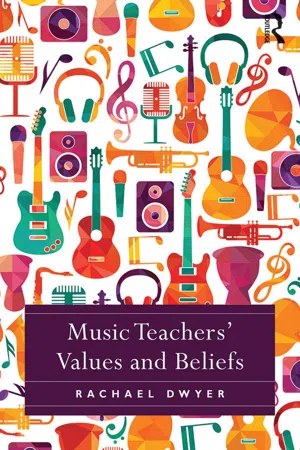
In Music Teachers' Values and Beliefs, Dwyer investigates the relationships between teachers, learners and music in music classrooms. Using Bourdieu's concepts of habitus and doxa as an interpretive lens, the book explores the values and beliefs of four music teachers, depicted in richly detailed narratives. The narratives are contextualised through the examination of traditions of music and contemporary approaches. In the past, music education has been shaped by elitist tendencies regarding the types of music worthy of study, the ways in which music should be learnt, and the purpose of such learning. Contemporary approaches to music education have enacted significant change in some regions and systems, while others have been slower to leave behind deeply entrenched values, beliefs and practices. These approaches have been blamed for low rates of participation and engagement in school music education, despite the fact that the majority of young people listen to and enjoy music outside of school. This innovative book provides music education researchers and practitioners with a new understanding of the impact of teachers' personal values, beliefs and experiences of music and music education on classroom practice, and the impact this has on students' experiences of music education.
- 156 pages
- English
- ePUB (mobile friendly)
- Available on iOS & Android
eBook - ePub
Music Teachers' Values and Beliefs
About this book
Information
1 Introduction
DOI: 10.4324/9781315596839-1
This book is about school music teachers’ values and beliefs, and how these shape students’ experiences of music education. It explores how music teachers’ values and beliefs are shaped by their own experiences of education and their interactions in musical fields, which, in turn, shape the way music curricula are interpreted and enacted. The book explores the way values, beliefs, dispositions and assumptions are socially and culturally acquired. They shape the way we see the world, and are shaped by our early upbringing, our participation in particular social groups and communities.
One of the reasons this is particularly important for school music education is because music teachers invariably have a different experience of music education from that of the majority of the students they teach. Those pursuing tertiary study in a music-related field will have experienced some level of success in music learning, and in schooling more broadly. As is the case with other specialist disciplines, music teachers develop strong beliefs about what musical knowledge and skills are valuable to their students (Richardson, 1996), most often aligning with what was emphasised in their own music education. This, of course, leads to tensions when the students’ desires for musical learning differ from the teachers’.
The existing literature on music teachers’ values and beliefs, and the ways in which they are enacted in practice, seems to suggest three basic premises about music teachers. First, that music teachers’ values and beliefs are shaped by their musical socialisation, which is most often within the sphere of Western art music. Second, that this contributes to a propensity for music teachers to treat their students as if they are preparing them for tertiary music studies, teaching them as if they were future professional musicians. Third, that these values, beliefs and practices are exclusionary and inappropriate. These ideas will be discussed in turn, before describing the ways that they shaped the research study on which this book is based.
Talent, elitism and hierarchy in Western music making
Music making in Western societies is informed by the belief that participating in music is reserved for those with innate talent1 (Merriam, 1964; Messenger, 1958; Nettl, 1989; Small, 1977, 1998). This is a deeply ingrained social belief that is rarely questioned (Koza, 2001); despite the fact that research has shown that expert performance is a result of deliberate practice (Ericsson, 2006; Lehmann and Ericsson, 1997). Further, ethnomusicological research has shown that all-inclusive, communal music making is the norm in many non-Western cultures (Blacking, 1973, Merriam, 1964, 1967). The majority of adults in Western countries label themselves as ‘unmusical’, convinced that their relationship with music should be as a consumer. As Small (1998) says, ‘our powers of making music for ourselves have been hijacked … while a few stars, and their handlers, grow rich and famous through selling us what we have been led to believe we lack’ (p. 8). This has led to a shift in the way music is conceptualised within Western cultures to that of a consumable, something to be bought and sold rather than something that people do (Small, 1998). Possession of talent is a means of hierarchisation of participation in music making, with those who are ‘able’ to sing or play being applauded, and those who compose, revered.
In addition to a hierarchy of activities, there exists a hierarchy of musical styles, based on ways in which value systems of individual musical styles intersect with broader values about art and cultural production. As will be explained more fully in Chapters 2 and 3, each musical style has knowledge, skills and attributes that are considered valuable, along with guiding principles about what the music is for. If we compare Western art music and jazz (speaking in broad generalisations), there are differences between the importance placed on the musicianship skills of reading notation and improvising. However, there are similarities between the two styles in terms of the emphasis placed on economic gain, with artistry most often prioritised over financial success. Those who invert these two priorities are branded ‘sell-outs’. If we compare these two styles with commercial popular music, musicianship and artistry are often secondary to the economic motivations.
Music teachers' socialisation
Music teacher candidates most often have a background in Western art music (Bouij, 2004, Bowman, 2007, Hargreaves et al., 2007, Regelski, 1997, Ross, 1995); as Philpott (2010) identifies, it is difficult for people without such training to become music teachers at all. It makes sense that teachers who are immersed in this musical culture take the ideas with them into the music classroom. Their identity as a music teacher is formed within it, and it is inevitable that the views they inherit will shape their work as teachers (Hargreaves et al., 2007).
In particular, the literature identifies a number of values with roots in the Western art music tradition that influence music teachers’ practice. The reverence for ‘the canon’ and, by association, dead, white, male composers (Bradley, 2007; 2012; Gould, 2012) presents particular ideas about who music education, particularly composing, is for. Pedagogy has been shaped by conservatism, which has stifled innovation (Philpott, 2010), as has the development of methods and curricula that seek to control (Benedict, 2009). Efforts to challenge or displace these ideas in music teacher education have typically involved the ‘bolting-on’ of additional experiences (Philpott, 2010) in popular musics, non-Western musics and informal pedagogies, which, unsurprisingly, have not resulted in widespread change. As research in teacher education more broadly has found, values and beliefs are highly durable, with change being difficult (Tillema and Knoll, 1997) and, where it does occur, usually superficial and/or temporary (Cochran-Smith, 1991; Mills 2012).
Music education as elitist and exclusionary
As many have identified, there is potential for music teachers’ values and beliefs about music, based on their own experiences of music and music education, to lead to exclusionary practices (Koza, 2001; Regelski, 1997, 2012). Music in secondary schools has a low uptake rate among students at the senior level when compared with other arts forms (Bray, 2009; Lamont, Hargreaves, Marshall, and Tarrant, 2003; Lamont and Maton, 2010; Mills, 1996). School music is considered, at best, to fail to connect music making at school with students’ out-of-school musical worlds (Allsup, 2010; Lamont et al., 2003), and, at worst, to tacitly or overtly exclude students with limited knowledge, skill, experience and interest in the teachers’ favoured styles of music (Mills, 1996; Regelski, 2012; Ross, 1995).
As Green (2008) identifies, both the content – the knowledge and skills, and the repertoire used to teach them – and the pedagogy of music education have held to longstanding traditions. Western art music is positioned as a superior style in some music education programmes, not only through its prominent place in the curriculum, but through the replication of its values and practices in the classroom. This may lead to students seeing music education as ‘not for the likes of me’, even in the absence of an explicit indication that this is the case.
There are signs that the landscape of music education is changing, or at the very least, recognition of the ways in which music education needs to change in order to become more inclusive and more relevant to the lives of young people. There are a number of authors critiquing the ways in which practices of music education promote ideas of exclusivity, and suggesting ways that things might be done differently (Bernard, 2004, Bowman, 2007a, 2007b; Bradley, 2006, 2007; Regelski, 1998; Schmidt, 2005; Väkevä, 2006; Väkevä and Westerlund, 2007; Vaugeois, 2007; Westerlund, 2006; Wright, 2008). While further work still needs to be done, the increasing interest in informal music learning (Green, 2002, 2008; Karlsen and Väkevä, 2012) provides examples of how music education might deviate from traditional pathways, providing experiences that are inclusive and responsive to students’ needs.
Conducting the research
In response to the issues identified in the literature, this study sought to investigate secondary classroom music teachers’ values and beliefs. Three overarching questions guided the inquiry:
- What values and beliefs do music teachers hold about music, music-making and music teaching and learning?
- How are these values and beliefs shaped by institutions and traditions of music, music education and schooling?
- How are these values and beliefs enacted in pedagogy and curriculum?
In order to interrogate these ideas, the study took the form of a narrative inquiry with four music teacher participants in different schools.2 In each school site, the data generation included formal interviews with the teacher, school principal and a small number of students, informal conversations, classroom observations and artefact analysis. The fieldwork was completed in Queensland, Australia between March 2009 and November 2010, with ethical clearance granted by The University of Queensland, School of Music.
Semi-structured and open-ended interviews were used. The interview schedules were used as a guide rather than a script for the interviewer. The actual questions and the order in which they were asked varied between participants. Each of the student participants and school principals was interviewed once. Each of the teachers was interviewed twice: once prior to or early in the observations and once following the observations. The follow-up questions in the post-observation interview allowed for expansion, elaboration and revision of the views and opinions expressed in the initial interview, and these interviews were much more open-ended in structure.
In addition to the interviews, observations were conducted as a way of enriching the data. The data gathered during the observations in the classroom and school settings provided a context for the interview data, but also drew attention to examples of tensions between the teachers’ values, beliefs and practices that could not have been explored through interview alone. The equivalent of four to five days was spent in each school, although this was in most cases a series of partial days spread over two to three weeks in order to maximise the observation of the teacher working in the classroom. Each visit was documented with field notes, which varied from a list of the activities in a particular lesson, to drafts of narrative vignettes recording the classroom happenings. The observations were largely unstructured in nature: I entered each field setting with no predetermined list of events and behaviours to observe that were any more specific than the phenomena embedded in the research questions.
Narrative inquiry
Narrative inquiry is an epistemological approach to research through which the knowledge of people's lived experience is explored and interrogated. (Clandinin and Connelly 2000; Connelly and Clandinin, 2006) suggest that ‘narrative inquiry comes out of a view of human experience in which humans, individually and socially, lead storied lives’ (Connelly and Clandinin, 2006, p. 477). Pinnegar and Daynes (2007) claim that narrative inquiry is characterised by a shift away from the traditional relationship between the researcher and the researched. Clandinin and Connelly (Clandinin, 2010; Clandinin and Connelly, 2000; Connelly and Clandinin, 2006) claim that this is what distinguishes narrative inquiry from other forms of research.
By coming alongside, over time and in relationship, we are able to name, to show, to talk about, to dwell in the tensionality and to learn from the experiences of dwelling within.(Clandinin, 2010, p. 9)
As Barrett and Stauffer (2009) identify, living alongside participants and drawing upon that experience of living as a source of data is a deeply relational research process, resulting in a co-construction of the research data. Opportunities to revisit the data – to relive and retell, and to discuss the events in more depth – allow for deeper levels of negotiation and interpretation of the data. This process of negotiation is central to narrative inquiry, casting the participants in a more collaborative role in the research process. Ollerenshaw and Creswell (2002) suggest that ‘collaboration involves negotiating the relationships between the researcher and the participant to lessen the potential gap between the narrative told and the narrative reported’ (p....
Table of contents
- Cover Page
- Half-Title Page
- Title Page
- Copyright Page
- Dedication
- Table of Contents
- 1 Introduction
- Interlude: narrative beginnings
- Part I Framing the narratives
- Part II The narratives
- Part III Narratives illuminated
- References
- Index
Trusted by 375,005 students
Access to over 1.5 million titles for a fair monthly price.
Study more efficiently using our study tools.
Frequently asked questions
Yes, you can cancel anytime from the Subscription tab in your account settings on the Perlego website. Your subscription will stay active until the end of your current billing period. Learn how to cancel your subscription
No, books cannot be downloaded as external files, such as PDFs, for use outside of Perlego. However, you can download books within the Perlego app for offline reading on mobile or tablet. Learn how to download books offline
We are an online textbook subscription service, where you can get access to an entire online library for less than the price of a single book per month. With over 1.5 million books across 990+ topics, we’ve got you covered! Learn about our mission
Look out for the read-aloud symbol on your next book to see if you can listen to it. The read-aloud tool reads text aloud for you, highlighting the text as it is being read. You can pause it, speed it up and slow it down. Learn more about Read Aloud
Yes! You can use the Perlego app on both iOS and Android devices to read anytime, anywhere — even offline. Perfect for commutes or when you’re on the go.
Please note we cannot support devices running on iOS 13 and Android 7 or earlier. Learn more about using the app
Please note we cannot support devices running on iOS 13 and Android 7 or earlier. Learn more about using the app
Yes, you can access Music Teachers' Values and Beliefs by Rachael Dwyer in PDF and/or ePUB format, as well as other popular books in Media & Performing Arts & Professional Development. We have over 1.5 million books available in our catalogue for you to explore.