- 192 pages
- English
- ePUB (mobile friendly)
- Available on iOS & Android
eBook - ePub
About this book
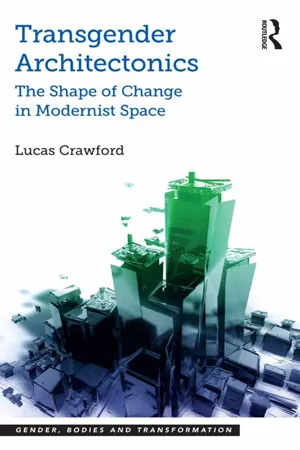
Combining transgender studies with the 'neomodernist' architectures of the internationally renowned firm, Diller Scofidio + Renfro (DS+R) and with modernist writers (Samuel Beckett and Virginia Woolf) whose work anticipates that of transgender studies, this book challenges the implicit 'spatial models' of popular narratives of transgender - interiority, ownership, sovereignty, structure, stability, and domesticity - to advance a novel theorization of transgender as a matter of exteriority, groundlessness, ornamentation, and movement. With case studies spanning the US and UK, Transgender Architectonics examines the ways in which modernist architecture can contribute to our understanding of how it is that humans are able to transform, shedding light on the manner in which architecture, space, and the spatial metaphors of gender can play significant - if often unrealized - potential roles in body and gender transformation. By remedying both the absence of actual architecture in queer theory's discussions of space and also architectural theory's marginal treatment of transgender, this volume constitutes a serious intervention in the field of 'queer space'. It draws on modernist literature in order to reckon with and rebuild the architectural ideas that already implicitly structure common understandings of the queer and transgender self. As such, it will appeal to scholars with interests in queer theory, the body and transformation, gender and sexuality, modernist writing and architectural theory.
Information
Chapter 1
Introduction1, 2
In Chris Vargas’s short film, “Have You Ever Seen a Transsexual Before?” (2010), the filmmaker poses with various American landmarks, from the Mormon world headquarters to the Las Vegas Strip. Vargas flashes his surgically altered chest to each scene and a path of faded scars – traces of a bilateral mastectomy, a procedure often pursued by FTM (female-to-male) trans people – crawls across Vargas’s chest with a beauty and singularity that is sorely missing from most public scenes of flashing. As Vargas stages these spectacular acts of transsexual disclosure, he cheekily asks the film’s titular question to each space. For instance, emphasizing and drawing out the word “transsexual” just a bit longer than seems possible, he proclaims: “Hello, Death Valley, have you ever seen a transsexual before?” The tone is one of camp and mock solemnity. Yet, the fun and adventurous tone of the piece changes after Vargas flashes Las Vegas. At that point, we see him flop onto his hotel bed, seemingly distraught. Viewers realize for the first time that the conversation of the film has been one-sided; no responses are forthcoming from these landmarks. Abruptly, the film shifts location and takes us on a wondrous trip through an animated dream world in which Vargas plays with beach balls and watches birds while jaunty music plays. In this world, each ball and each bird bears the same scars as does Vargas. The viewer is therefore caught between 1) a series of potentially transsexual spaces and 2) a fantastical cartoon trans utopia. Positioned between these worlds – one designed as a whimsically trans alternate-reality, and the other as a series of often silent spatial interlocutors to whom we reveal ourselves – Vargas gives us the opportunity to ask anew: what ought a transgender space to do?
One obvious answer is that transgender space in general may be defined simply by transgender spaces in particular – by those spaces that we visit and must navigate on a daily basis. Following such a definition, transgender studies has produced a keen field of texts that begins to pay attention to the role played by architecture and geography in the continued struggles (and of course pleasures) experienced by many trans people. Trans studies scholars have, for instance, made compelling cases for gender-neutral space and accessibility, such as Sheila Cavanagh’s Queering Bathrooms: Gender, Sexuality, and the Hygienic Imagination (2010). We have also told stories about the spatial confinement and exclusion that meet trans people who face multiple forms of discrimination, such as those told in Eric A. Stanley and Nat Smith’s Captive Genders: Trans Embodiment and the Prison Industrial Complex (2011). This kind of work, which commits itself to the local and specific spaces through which various trans people move, allows us not only to see that the demarcation of spatial boundaries plays out disproportionately on transgender people and others, but also to witness that we have fashioned many of our own ways of short-circuiting the spatial systems that would exclude us.
However, Vargas’s film does something different: it insists on the vitality of trans-imaginative worlds, on the creation of trans spaces of our own design, and the importance of stretching the definition of just what a transgender space would even be. The ending of the short film implies that rather than seek to “fit in” to pre-existing structures and spaces, the spaces of the transgender imagination are where we live, at least to an extent. This reminds us that while there are crucial reasons that trans studies has sometimes focused on the agency, experiences and resistances of human actors, this must not come at the cost of equally important aesthetic inquiry and the generation of new – even if impossibly utopian – possibilities for transgender.
That said, imagining transgender architecture is no easy task, given that transgender and architecture have an uneasy – often closeted – relationship. On the surface, the two could not seem less alike. Architecture stands firm; transgender is at heart an ethos of change. Transgender is a type of identity; architecture is an aesthetic production. Architecture excludes and divides; transgender encompasses, includes, and bends boundaries and binaries. Transgender demands a voice, agency, and subject; architecture is usually anonymous, institutional, and seemingly without agency. These dissimilarities – generative, one might assume, of trans troubles such as washroom violence, exclusion from institutions, and danger faced in public – seemed the stuff of a clear, feasible argument for this book: that the relative fluidity of the trans body could serve as a model for a renovation of the stark modernist lines, aesthetics, and exclusions of architectures – that we could queer modernist space with postmodern bodies. Like most well laid plans, the blueprints for that book met their end at the bottom of a wastebasket. There were two reasons for this. The first was a shift in my perception of what kind of work is most relevant for trans people of my ilk, who want new ways to navigate gender and not celebrations of existing ways (crucial though the latter may be for some situations). I become more and more uneasy with the tendency to elevate trans and queer to heroic catchall terms that seem to resist critique, alternatives, or extensions. What, I began to ask, might transgender become if we were dissatisfied not only by the dictates of normative culture, but with our own models of self-understanding and subjectivity? I began to ask instead: despite queer theory and trans studies’ excellent histories of reworking the norms of sexuality and gender, have we accidentally and implicitly consented to troubling – and gender-charged – norms of spatiality?
Secondly, that the book described above was not written is also due, in large part, to my encounter with the New York City architectural firm diller scofidio + renfro (DS+R), known as much for their art projects and performances as for their high-profile building contracts (which include New York City’s High Line Park, renovations at Lincoln Centre, museums in Rio de Janeiro, Oslo, the Netherlands, and so on). The specific DS+R project that instigated the book that has been written is called the Blur Building, which nabbed a coveted spot at the Swiss Expo 2002.
With a playfulness that recalls Chris Vargas’ video, the Blur Building appears to be, simply, a cloud. An observer could not help but wonder, how are they doing that? The Blur Building consists of a lightweight tensegrity structure that, in shape, lies somewhere between spaceship and boat. (Appropriately, the building appears to float above water – above Lake Neuchâtel, Switzerland) As Anthony Pugh explains in his text, An Introduction to Tensegrity, the word is “a contraction of tensional integrity” (3). The integrity of the Blur Building and other tensegral structures is, to put it plainly, a result of 1) beams on the inside pushing outwards and 2) a tight thin façade pressing inwards. (More precisely, tensegrity structures are a result of the equilibrium of these contrary forces.)3 The resultant ‘building’ is, then, very light and mobile, given that it stands up without the usual, immovable foundation in the earth. Embedded in the Blur Building’s hollow light structure is a complex weather system: a series of tools and gauges that measures the shifting climate of the surrounding environment. Upon absorbing and computing this information, the 35,000 high-pressure nozzles built into the Blur Building emit a fine mist. The result is an ephemeral performance of structure that is, literally, a blur – or, as DS+R put it, “an architecture of atmosphere” (diller scofidio + renfro, “Blur”). If architecture is about stability and transgender is, at least sometimes, about change, then here we have a piece of architecture built out of movement. The illusion of its stability – that is, its form – is made only of the human incapacity to see the infinite movements of steam, air, water, and light that make up the Blur Building. The shape and consistency of the Blur Building is a direct intelligent response to the conditions of its ever-changing surroundings; it listens, reacts, and builds in concert with its space. Visitors to the Blur Building do not simply inhabit the building as they do other spaces: instead, visitors feel the architecture condensing upon them as dew; visitors walk through the deep “walls” of the building itself; and, visitors’ bodies must adapt quickly and continuously to the changing conditions. Subverting the usual celebratory and nationalist tone of World Expo architecture, DS+R provide an experience for the senses, or, rather, an experiment in blurring the senses. The Blur Building is not merely a liminal space. In fact, while this book could have been about the relationship between transgender and architecture, the Blur Building places under erasure the very distance and sovereignty implied by this “between”. After all, visitors could even taste the architecture. (As DS+R note, “the public can drink the building” [“Blur”].) The Blur Building reminds us that space and self are never so distinct.
This may seem interesting enough, but how does the Blur Building incite a new conception of transgender architecture for this book? There are five main answers, which will, in turn, become the five shifts that this book motivates for transgender:
1. The Blur Building has an activated, dynamic temporality, insofar as it is always changing in response to multiple factors. In this sense, the Blur Building disposes with the notion of any normal, natural, default, or ideal state. The very “state” of the Blur Building is change. So too, this book will argue, the very “state” of gender is change. If this is true, then transgender is simply a particularly strong and valuable event of gender – not an exception or aberration to the rule of otherwise static genders.
2. Since the nozzles respond to the current climate of the lake, the Blur Building’s changes are produced collaboratively with its unpredictable surroundings. The Building does not present itself as a sovereign body rising and isolating itself from its milieu. In the most blunt sense, the Blur Building is its milieu. So too do our experiences and ideas of transgender take their shape from the shapes through which we move – be it our adoption of spatial metaphors of being ‘at home’ in the body or our tendency to locate our genders in privileged and inaccessible interiors (such as the mind, psyche, or spirit).
3. Visitors to the Blur Building are welcomed not just inside the building but inside of the architecture itself. In fact, the architecture does away with the idea of a clear inside and outside altogether. This book argues that the interior/exterior spatial binary – which institutes other spatial binaries, such as self/other and sex/gender – needs to be questioned. Doing so is necessary, if we are to pursue the difficult, vulnerable, but important task of not knowing precisely where, and how, the gendered self lives – and, in turn, allowing it to live in new ways.
4. With mist, immersive music, the pulsing of the nozzles, the feeling of dew and fog on the skin, and of course highly reduced visibility, the Blur Building disorients the visitor. This is in direct contradiction to most public buildings, which are presented as fully-mapped, fully-legible spaces to be masterfully navigated by human subjects. As a result, visitors do not walk about in strictly visual awe of the majesty of the building. Rather, they hazily explore the space and in so doing confront (and, by necessity, change) their own bodily habits and comportment. Can a less mapped-out model of gender also invite a fuller bodily experience of others and of one’s self?
5. The Blur Building has a minimal “light” structure that, against the high modernist convention of revealing and valorizing “pure” structure, is hidden away by the excessive and anti-functional fog that it creates. This design radically minimizes the amount of unchangeable material required to constantly create new shapes and experiences. The building’s seeming stability is, then, not premised of immovability; rather, its stability relies entirely on its ability to change relatively quickly! What would a transgender be that one experiences as both livable and coherent in the moment and as dynamic and unknowable in each future moment?
These five characteristics will, across the length of this book, be further translated into five correlative shifts in how we think about transgender feeling and narrative. The facts that the Blur Building was 1) a temporary structure that 2) consisted of always-changing material 3) that could be packed up and moved quickly is central to its ability to model a new type of transgender that is alive to change. As much as these characteristics are obviously spatial, so too are they temporal. If a place is a set of material conditions that endures, then space and time cannot be regarded as discrete categories. This, as we shall see below, is precisely how Derrida and others urge us to rethink the figure of the archive – as a figure that suspends the distinction between time and space, as a space that attempts to hold all times, and, as a timekeeper that needs spatial figuring. By way of describing the theoretical ‘foundations’ for this book, I show below that the same is true for transgender; I argue that the transgender body, like the ‘stable’ movement of Blur or Vargas’ temporal ‘series’ of spaces, ought to be regarded as a particular kind of archive.
An Archive of Forgetfulness: A Methodology of Transgender Architecture
I argue that, in order to consider the transgender body as an archive, two modes of analysis are required: first, self-critical remembrance (so as to not dissimulate and cover over one’s pasts, thereby feigning stability) and, secondly, a forward-looking bodily forgetfulness (so as to be able to change – to detach from one’s present feelings or self). First, I discuss briefly why and how architecture in particular may be understood as an archive in this book. Throughout this introduction and book, architecture will be discussed as normalizing and dissimulating – as engaged in problematic abjections of femininity, fashion, and ornamentation. It will also, however, be discussed as a potential site for change – as an aesthetic production that can disorient the body and provide models for new architectonics of the body. Taking these two modes of architecture together, it is fair to say that in this book architecture is seen to both record and preserve the past by building ideologies and conventions into lasting forms and also to build for an unknown future, placing new (sometimes experimental) forms into our environments. In these seemingly contradictory functions, architecture functions in much the same way as Derrida’s archive. In his text Archive Fever: A Freudian Impression, Derrida insists that “every archive … is at once institutive and conservative. Revolutionary and traditional” (7). This book’s architectural hermeneutic adopts Derrida’s seemingly paradoxical characterization of the archive; I read architecture (and architectural models of narrative/self – that is, architectonics) as invested both in maintaining and instituting a space (and a subject) and also in providing the means for spaces and subjects to change or exceed themselves. In Chapter 3, it will become clear that architecture functions specifically as an archive of the body: for instance, the aesthetic convention of the smooth white porcelain of washrooms will be shown to be a relic both of late nineteenth-century anxieties about visuality, the germ theory, and contagion and also of early modernist interests in effacing the past. This is one simple way in which architecture is an archive: it is the relic matter as which a cultural idea enjoys its afterlife. Transgender theorist Susan Stryker interprets architecture in precisely this way. As she sees it, the old San Francisco National Guard Armory is an archive: it “occupies an intermediate timespace framed and inflected by these maximal and minimal fixed points in temporal distance within the present built environment; it is the materialized remnant of its own distinctive meshwork of force relations” (“Dungeon” 37).
For Derrida, however, treating architecture like an archive would be somewhat of a recursive definition, as the archive is already a space. It is crucial to note that Derrida specifically links the traditional function of the archive to the spatial economy with which we associate (institutions of) cultural memory. Below, he traces out the architecturally-figured origins of the word:
the Greek arkeion: initially a house, a domicile, an address, the residence of the superior magistrate; the archons, those who commanded … They do not only ensure the physical security of what is deposited and of the substrate. They are also accorded the hermeneutic right and competence. They have the power to interpret the archives. (2)
Central to this book’s critique of the transgender body-as-a-home narrative architectonic, Derrida locates this conservatism – a conservatism of hermeneutic authority, clearly demarcated interiors, and ownership – in the architectural form of the house. The theoretical propositions forwarded earlier aim, then, to release the “house arrest” of the gendered psyche. Crucially, Derrida reminds us that the notion of “archive” contains at its kernel the very promise of its control and institutionalization in space – of the necessity of “archons” who not only control access to the archive but who also determine the intellectual means through which the archive will be interpreted. Such “house arrest” is indeed a mode of disciplining memory: the literal placement of the archive for Derrida takes the form of “consignation”, a word that refers not only to ‘assigning place’ but also to the “gathering together [of] signs” (3) into a coherent whole. If, to occupy a proper place, the archive is consigned in order “to coordinate a single corpus, in a system of synchrony in which all the elements articulate the unity of an ideal configuration” (3), then the very authority that bars access to the archive for those on the “outside” is also what sets the conservative means of interpretation for those archons within it. As we will see in the Chapter 5 analysis of Woolf’s Orlando: A Biography (which features a gender-changing protagonist who lives – and accumulates, or, archives – across the centuries), an implicit theory of the body as an archive underlies many conceptions of the gendered body as a home. That is, for the body to feel and function as a wholly “right” home, the subject must be installed, like an “archon”, as the sovereign and sole interpreter of one’s self and of one’s history. The archon-subject’s interpretation of their own gendered history may then be shared with others as the correct interpretive key. This is often necessary, in order to function in the world. However, to me, this way of doing things is uninteresting (because I wish for relationships between people that 1) are not based on pre-assembled systems of right and wrong behaviour, and 2) include the possibility of being undone and remade by and with each other) and impossible (because, as literary scholars know, interpretation and interpretive authority are never so simple – for which I am thankful.)
Indeed, trans...
Table of contents
- Cover Page
- Title Page
- Copyright Page
- Contents
- Acknowledgements
- 1 Introduction
- 2 Foundations and Ruins: Why Don’t Transgender and Architecture Get Along?
- 3 How to Beat a Straight Flush: DS+R’s Brasserie and the Rhetoric of Transgender “Plumbing”
- 4 “The Ladies Lavatory:” Woolf and the Transgender Biographical Imperative
- 5 Woolf’s Einfühlung: An Alternative Theory of Transgender Affect, Space, and Time
- 6 “I’ll call him Mahood instead, I prefer that, I’m queer”: Samuel Beckett’s Spatial Aesthetic of Name Change
- 7 Against Transgender Integrity: Beckett’s Grey Matter
- 8 Epilogue: A Transgender Poetics of the High Line Park
- Works Cited
- Index
Trusted by 375,005 students
Access to over 1.5 million titles for a fair monthly price.
Study more efficiently using our study tools.
Frequently asked questions
Yes, you can cancel anytime from the Subscription tab in your account settings on the Perlego website. Your subscription will stay active until the end of your current billing period. Learn how to cancel your subscription
No, books cannot be downloaded as external files, such as PDFs, for use outside of Perlego. However, you can download books within the Perlego app for offline reading on mobile or tablet. Learn how to download books offline
Perlego offers two plans: Essential and Complete
- Essential is ideal for learners and professionals who enjoy exploring a wide range of subjects. Access the Essential Library with 800,000+ trusted titles and best-sellers across business, personal growth, and the humanities. Includes unlimited reading time and Standard Read Aloud voice.
- Complete: Perfect for advanced learners and researchers needing full, unrestricted access. Unlock 1.5M+ books across hundreds of subjects, including academic and specialized titles. The Complete Plan also includes advanced features like Premium Read Aloud and Research Assistant.
We are an online textbook subscription service, where you can get access to an entire online library for less than the price of a single book per month. With over 1.5 million books across 990+ topics, we’ve got you covered! Learn about our mission
Look out for the read-aloud symbol on your next book to see if you can listen to it. The read-aloud tool reads text aloud for you, highlighting the text as it is being read. You can pause it, speed it up and slow it down. Learn more about Read Aloud
Yes! You can use the Perlego app on both iOS and Android devices to read anytime, anywhere — even offline. Perfect for commutes or when you’re on the go.
Please note we cannot support devices running on iOS 13 and Android 7 or earlier. Learn more about using the app
Please note we cannot support devices running on iOS 13 and Android 7 or earlier. Learn more about using the app
Yes, you can access Transgender Architectonics by Lucas Crawford in PDF and/or ePUB format, as well as other popular books in Social Sciences & Architecture Criticism. We have over 1.5 million books available in our catalogue for you to explore.