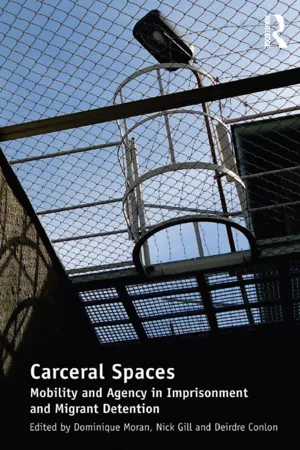
eBook - ePub
Carceral Spaces
Mobility and Agency in Imprisonment and Migrant Detention
- 262 pages
- English
- ePUB (mobile friendly)
- Available on iOS & Android
eBook - ePub
About this book
This book draws together the work of a new community of scholars with a growing interest in carceral geography: the geographical study of practices of imprisonment and detention. It combines work by geographers on 'mainstream' penal establishments where people are incarcerated by the prevailing legal system, with geographers' recent work on migrant detention centres, where irregular migrants and 'refused' asylum seekers are detained, ostensibly pending decisions on admittance or repatriation. Working in these contexts, the book's contributors investigate the geographical location and spatialities of institutions, the nature of spaces of incarceration and detention and experiences inside them, governmentality and prisoner agency, cultural geographies of penal spaces, and mobility in the carceral context. In dialogue with emergent and topical agendas in geography around mobility, space and agency, and in relation to international policy challenges such as the (dis)functionality of imprisonment and the search for alternatives to detention, this book presents a timely addition to emergent interdisciplinary scholarship that will prompt dialogue among those working in geography, criminology and prison sociology.
Chapter 1
Introduction
Dominique Moran, Deirdre Conlon and Nick Gill
This edited book defines a new field in geographical research, drawing together the work of a new community of scholars and a growing body of work in ‘carceral geography’, a term we use to describe the geographical engagement with the practices of imprisonment and migrant detention.
In theory these practices are separate, in that ‘mainstream’ imprisonment incarcerates ‘criminals’ for custodial sentences imposed by the prevailing legal system, whilst migrant detention confines irregular or non-status migrants pending decisions on admittance or removal. Migration detention is defined as an administrative, non-punitive measure to facilitate expulsion, across the European Union and in the United States (Leerkes and Broeders 2010). However, in practice these spheres increasingly overlap, in complex and intriguing ways, both in terms of the discourses applied to them, the functionality of their institutions, and the experiences of detained individuals. Just as ‘mainstream’ prison populations have expanded over the past 25 years, there has also been a veritable explosion in the use of detention for irregular migrants. Migrants are increasingly scrutinized as criminals, so much so that scholars and activists now refer to this nexus as ‘crimmigration’ (Stumpf 2006). Migrant detention centres increasingly resemble prisons in terms of their regimes and security arrangements. Individual migrants are frequently detained in ‘mainstream’ prisons and subjected to the same ‘corrective’ regimes as sentenced prisoners, and in both cases citizenship rights are constrained, either through the disenfranchisement of many prisoners, or the disputed identities of some failed asylum seekers in detention (Griffiths 2012). Bosworth (2012) also writes of the ‘dual confinement’ of foreign national offenders who serve time both in prison and then in migrant detention whilst awaiting deportation.
Despite the similarities between these systems, the distinctions between them have meant that within the academy more broadly, researchers have tended to define themselves by the context in which they work – either imprisonment or migrant detention. Rarely are the two considered in parallel, but as Martin and Mitchelson (2009: 459) point out, both ‘hold human beings without consent by other human beings’. We argue here that human geography is well placed to integrate study of the various practices of holding human beings without consent, focusing as it does on the similarities and commonalities between them, through an inherent and integrative focus on the spatial practices of confinement. This book therefore brings together scholars whose work engages practices of imprisonment and migrant detention, and opens a space within geography and related interdisciplinary fields such as critical prison studies, criminology and prison sociology, for conversation and dialogue across these ever more intertwined spheres. In this volume, we seek for the first time to synthesize these related but previously separate strands to create new insights, in dialogue with emergent and topical agendas in geography around mobility, space and agency, and in relation to international policy challenges such as the functionality of imprisonment, and responses to population migration. The broad conceptual focus and wide geographic net is deliberate and consistent with the goals of sparking insight, dialogue and new connections across ordinarily distinct areas.
Imprisonment and Migrant Detention
Changing political, economic and social relations in this globalized era have yielded increased pressure – and propensity, for some – toward greater mobility across state borders. Coinciding with this trend, and contrasting with the free flow of traded goods and consumer services that are frequently connected to neoliberal ideology and practice, migrants meet with ever expanding efforts to immobilize, exclude and excise. There is a wide swath of techniques employed by state governments to these ends including border securitization measures (Hall 2012, Loyd et al. 2012), interdiction and ‘push back’ policies (Flynn and Cannon 2009), neo-refoulement (Hyndman and Mountz 2008), devolution (Coleman 2009, Lahav 1998) and immigrant detention. Each of these practices entails complex questions dealing with issues of space, territory, geo-politics, agency and (im)mobility, and in recent years there has been a burgeoning of scholarly attention to these matters among geographers.
Of particular concern to critical human geographers is migration-related detention, which refers to ‘the practice of detaining – typically on administrative as opposed to criminal grounds – asylum seekers and irregular migrants until they can be deported, their identities established, or their claims adjudicated’ (Global Detention Project 2007). This practice is now more or less de rigueur as part of states’ immigration enforcement strategies in the global North. Moreover, as established immigrant receiving states move to externalize immigration enforcement and processing to peripheral and offshore locations, more detention takes place in transit-states and more and more regions have become entangled in a global detention ‘enforcement archipelago’ (see Mountz 2011). Alongside these trends there has been a massive increase, over a short time span, in numbers of detained immigrants and the US serves as a striking exemplar. As with its prison population, immigrant detention in the US has expanded rapidly and the state now detains the largest number of immigrants on a global scale. In the 10-year period from 1999 to 2009, the yearly rate of immigrant detention more than doubled from 146,760 to 369,483. In 2010, Immigration and Customs Enforcement (ICE) detained approximately 363,000 immigrants. This represents an increase in daily detention rates from under 7,000 individuals in 1994 to roughly 33,000 individuals in 2010 (DHS 2011, Detention Watch Network n.d.). It also means that non-citizens now represent the fastest growing segment of the prison population in the US (No More Deaths n.d.). While overall numbers are lower in other countries, trends in immigrant detention are similar. For example, in the UK, which has the largest detention estate in Europe, the government detained approximately 27,000 individuals in 2011 (Silverman and Hajela 2012), and the detention estate has increased from a daily capacity for 250 individuals in 1993 to 3,500 in 2011.
These developments warrant critical attention by human geographers in their own right, but for scholars of carceral spaces they also highlight the resonances between imprisonment and migrant detention, in at least four ways. First, as noted above, the growth in numbers of individuals being held in immigrant detention facilities parallels increases in mainstream prison populations in the US as well as many other regions since the 1970s (see Aebi and Delgrande 2009). Second, as the privatization of prisons has proceeded, immigrant detention has also become a corporate, for-profit venture. As Flynn and Cannon (2009: 15) observe, ‘one of the more notable patterns is how frequently immigration privatization precedes efforts to privatize prisons’. The resonances between prison and immigration industrial complexes (see Fernandez 2007) demand critically informed, theoretically and empirically rich, cross-cutting analyses, such as those offered by contributors to this volume.
Another resonance concerns criminality. For instance, in both the US and the UK, knowingly entering the state using falsified documents now carries both immigration penalties – such as deportation and exclusion from re-entry to the country in the future – and criminal penalties. This is so even when circumstances render these practices unavoidable, such as when individuals flee persecution. The convergence between immigration law and criminal law enforcement does not stop at borders and points of entry however. In the US, once again, over the past two decades ‘crimmigration’ has expanded and taken root in the interior and has transformed ever greater numbers of irregular immigrants into ‘permanent criminals’ (Kanstroom 2004, see also Coleman 2007). Immigrants confront the contraction of secure everyday domestic, labour and community spaces, so much so that participation in civil society is fraught with precarity as the threat of being picked up by state authorities – of all stripes – and detained or deported looms as an ever-present possibility. These developments compel scholars to take up questions of space and agency for immigrants as an urgent matter. Contributors to this volume extend this work by examining how detention and spaces in ‘civil’ society seep into one another (Hiemstra, Martin), by probing how biopolitics and technologies of government operate within detention and prison facilities alike (Gill, de Dardel), and by theorizing possibilities and understandings of autonomy in sites where liberty and agency seem to implode (Conlon, Michalon, McWatters).
With these circumstances, it seems clear that conditions confronted by individuals who are incarcerated within mainstream prisons and detained immigrants overlap in numerous ways. This, then, is a fourth reason for this volume’s combined focus from migration and incarceration studies scholars. Significant areas of overlap include attention to the physical design of prisons (Milhaud and Moran), an issue to which migration support advocates and policy makers have become increasingly attuned. In examining movements into, out of, and around sites of detention (Hiemstra) and incarceration (Moran et al., Mitchelson), authors raise critical policy-oriented questions about the ability to access networks of support as well as offering practical and conceptual insights into the perpetual production of ‘ontological insecurity’ (Katz 2008), concerns that chime equally in migration and prison studies. Finally, there is much that scholars of carceral spaces can learn from the analysis of popular cultural discourses about prison life that often serve to bolster stereotyped views of incarcerated individuals (Turner). All-in-all, then, these contributions not only advance scholarship in migration and prison studies in their own right, in addition, they propel critical cross-cutting perspectives on all carceral spaces.
Structure
The book emerges out of a series of themed sessions at the conferences of the Association of American Geographers and the Royal Geographical Society with the Institute of British Geographers, and both reflects and extends the current scholarship in the field of carceral geography, and its dialogue and synergy with contemporary critical human geography. The book is arranged in two main sections, themed around Mobility, and Space and Agency, each prefaced by a short introduction by influential scholars in the field – Alison Mountz and Yvonne Jewkes.
Mobility
The first main section, prefaced by Alison Mountz, a leading feminist political geographer who has examined migration and (im)mobility across a wide range of international settings, engages with the notion of mobility, and challenges the assumptions both that confinement necessitates immobility, and that mobility is inherently connected with freedom and autonomy. In so doing, the chapters build upon the recent expansion of literature on the actual or virtual movements of people through space (Cresswell 1999, 2010, Sheller and Urry 2006, Silvey 2004, Urry 2007), including attention to both human and non-human elements (such as waste) and emphasize a deconstructed, post-humanist self, any aspects of which may be mobile or migrate in relative independence (whereas migration scholarship has tended to adopt a more structuralist approach in relation to human agency). The tendency within the mobilities literature has been to understand mobility as a reflection of and a means of reinforcing power (Skeggs 2004); a resource to which not all have equal access, rather than to see it as an instrument of power, which can be used or experienced punitively. Geographers working on imprisonment and migrant detention (e.g. Moran et al. 2012, Gill 2009) have critiqued these understandings of mobility, and point out the forced or punitive mobility which characterizes much of the movement within carceral estates.
In the chapters in this section, these ideas of punitive, governmental or disciplined mobility are taken up and developed further, as authors engage with the mobilities paradigm within a variety of carceral contexts. Nick Gill considers the punitive uses of movement within and outside carceral environments; Bénédicte Michalon analyses mobility and power in relation to migration and asylum policies in the new EU state of Romania; Nancy Hiemstra discusses the ‘chaotic’ geographies of mobility for US migrant detainees from Ecuador; Matthew Mitchelson engages with imprisonment as a form of migration in relation to the counting of prisoners in the US census; Kelsey Nowakowski considers the intersection between ‘immobile’ prison labour and the flows of toxic waste through the US penal system; and Dominique Moran, Laura Piacentini and Judith Pallot discuss the forced mobility of prison transport in Russia as a liminal space between ‘freedom’ and incarceration.
Through this focus on mobility, these chapters make clear the potential for carceral geography to make constructive contributions to contemporary theorizations in critical human geography, and by foregrounding the experience of the confined individual in each of these cases, they open the way for the second section of the book, which takes as its thematic focus agency within carceral space.
Space and Agency
The second section, prefaced by criminologist Yvonne Jewkes whose work is at the forefront of research into prison architecture and design, considers agency within carceral space. Despite an understanding that prison spaces enable actual or perceived constant surveillance, and that this has a direct effect on prisoner behaviour and control (Foucault 1979, Alford 2000), the literature on the built environment of prisons has until recently (Jewkes and Johnston 2007, Fiddler 2010, Hancock and Jewkes 2011) been one of the more underdeveloped areas of penal research (Marshall 2000, Fairweather and McConville 2000). Human geographers interested in secured and carceral spaces recognize space as more than the surface where social practices take place (Gregory and Urry 1985, Lefebvre 1991, Massey 1994); it is understood instead as simultaneously the medium and the outcome not only of political or macro-economic practices, but also of everyday social relations across all spatial scales (Soja 1985). As Adey (2008: 440) argues, ‘specific spatial structures… can work to organize affect to have certain effects upon motion and emotion’. Designers of spaces consider ‘seductive spatiality’ (Rose et al. 2010: 347) or ‘ambient power’ (Allen 2006: 445) which shape human behaviour within these spaces (Allen 2006, Adey 2008, Thrift 2004). Jones et al. (2010: 492) observe the ‘spatialities of behaviour change’ in that the design of spaces affects the kinds of decisions that individuals make, both in terms of the macro-scale re-engineering of spatial environments, and the micro-scale recalibration of the fabric of everyday spaces, which ‘encourage the normalization of certain patterns of conduct’. In a context in which spaces of confinement are commonly assumed, in the context of Foucauldian panopticism and biopower, to create ‘docile’ bodies, or Agambenian ‘bare life’, the chapters in this section of the book engage directly with the notion of agency in carceral space, identifying both ways in which confined individuals are denied rights, and ways in which they contest regimes of confinement and deploy spatial strategies, at different scales and in different settings.
Deirdre Conlon opens this section by discussing the practice of hunger strikes by asylum seekers in Ireland in the context of Foucault’s writings on governmentality, arguing that rather than single acts of resistance to ‘bare life’, they can instead be understood as counter-conduct, a practice that enacts a right to question how subjects are governed. Julie de Dardel considers individual and collective agency of prisoners within a Colombian prison system absorbing a New Prison Culture inspired by the US prison system. Olivier Milhaud and Dominique Moran present findings on prisoner agency and privacy in French and Russian prisons, identifying the ways in which prisoners in these contexts consciously negotiate tactical spatial manoeuvres to find solitude in crowded prison spaces. Lauren Martin discusses the complex carceral and legal geographies of immigrant detention in the US, in which noncitizens’ rights are limited and the federal government’s discretion to detain is extended in and through immigra...
Table of contents
- Cover Page
- Half Title Page
- Title Page
- Copyright Page
- Contents
- List of Figures and Tables
- Notes on Contributors
- 1 Introduction
- Part I Mobility
- Part II Space and Agency
- Index
Trusted by 375,005 students
Access to over 1.5 million titles for a fair monthly price.
Study more efficiently using our study tools.
Frequently asked questions
Yes, you can cancel anytime from the Subscription tab in your account settings on the Perlego website. Your subscription will stay active until the end of your current billing period. Learn how to cancel your subscription
No, books cannot be downloaded as external files, such as PDFs, for use outside of Perlego. However, you can download books within the Perlego app for offline reading on mobile or tablet. Learn how to download books offline
Perlego offers two plans: Essential and Complete
- Essential is ideal for learners and professionals who enjoy exploring a wide range of subjects. Access the Essential Library with 800,000+ trusted titles and best-sellers across business, personal growth, and the humanities. Includes unlimited reading time and Standard Read Aloud voice.
- Complete: Perfect for advanced learners and researchers needing full, unrestricted access. Unlock 1.5M+ books across hundreds of subjects, including academic and specialized titles. The Complete Plan also includes advanced features like Premium Read Aloud and Research Assistant.
We are an online textbook subscription service, where you can get access to an entire online library for less than the price of a single book per month. With over 1.5 million books across 990+ topics, we’ve got you covered! Learn about our mission
Look out for the read-aloud symbol on your next book to see if you can listen to it. The read-aloud tool reads text aloud for you, highlighting the text as it is being read. You can pause it, speed it up and slow it down. Learn more about Read Aloud
Yes! You can use the Perlego app on both iOS and Android devices to read anytime, anywhere — even offline. Perfect for commutes or when you’re on the go.
Please note we cannot support devices running on iOS 13 and Android 7 or earlier. Learn more about using the app
Please note we cannot support devices running on iOS 13 and Android 7 or earlier. Learn more about using the app
Yes, you can access Carceral Spaces by Nick Gill, Dominique Moran in PDF and/or ePUB format, as well as other popular books in Physical Sciences & Geography. We have over 1.5 million books available in our catalogue for you to explore.