![]()
Part I
Producing and identifying Sufism
![]()
1 Sufis, dervishes and Alevi-Bektaşis
Interfaces of heterodox Islam and nationalist politics from the Balkans, Turkey and India1
Robert M. Hayden
I am grateful to the editors for letting me move rather far past the boundaries of probably anyone’s definition of ‘South Asia’. Though I have worked on the changing identities of a Hindu/Muslim saint and his shrine in central India intermittently since 1992 (Hayden 2002; Hayden and Valenzuela 2014), for the past 30 years most of my professional work has focused on the Balkans. As the historian Maria Todorova has argued convincingly (Todorova 1996), the concept of ‘the Balkans’ itself is a heritage of the centuries of Ottoman rule in Southeastern Europe, Balkan being Turkish for ‘mountain’, and the Balkans are certainly that, mountainous. However, various cultural and linguistic connections can be easily seen in the region roughly defined as between Bosnia in the west, and Bengal in the east, Bijapur in the south, this last as a surrogate for all of the Muslim kingdoms of the Deccan. These connections reflect the centuries in which Muslim polities ruled most of this vast expanse. All of this territory was and is outside the Arabic-speaking world, and in all of it, Muslims of various definitions have lived intermingled with non-Muslims: Roman Catholics, eastern Christians (also known as Orthodox Christians), Hindus of varying communities, Sikhs, Buddhists, to name only a few. That there was a sense of a common cultural and religious world among Muslims in this vast region can be seen in the continuities in the architectural, artistic and literary traditions of the larger area. Of course, speakers of Serbo-Croatian, Bulgarian, Albanian and Greek who go to South Asia are struck by the cognates in those languages and in Hindi-Urdu, derived from Persian, Turkish and Arabic, words from this last often as mediated by one or both of the other two. Indeed, if one looks at the continuities in this larger range of Muslim polities from Bengal to Bosnia until the nineteenth century, the utility of the concepts of ‘South Asia’ on the one hand, ‘the Balkans’ on the other, becomes suspect, diverting attention from the cultural similarities by the presumption of inherent difference.
For the purposes of this volume, what is interesting about all of this is that some of the Sufi traditions of the formerly Ottoman world (though generally known as dervish, or some variation on that term instead of Sufi),2 have been the focus both of political pressures as ‘anti-national’ and of other political and academic imagery as ‘syncretic’ and thereby linking various communities. Thus looking at the formerly Ottoman region offers another take on the politics of belonging in what is sometimes a bit unhappily labeled ‘heterodox Islam’ (unfortunate in seeming to acknowledge Sunni Islam as defining orthodoxy), but involving quite different players and histories in constructions of politics and dominance.
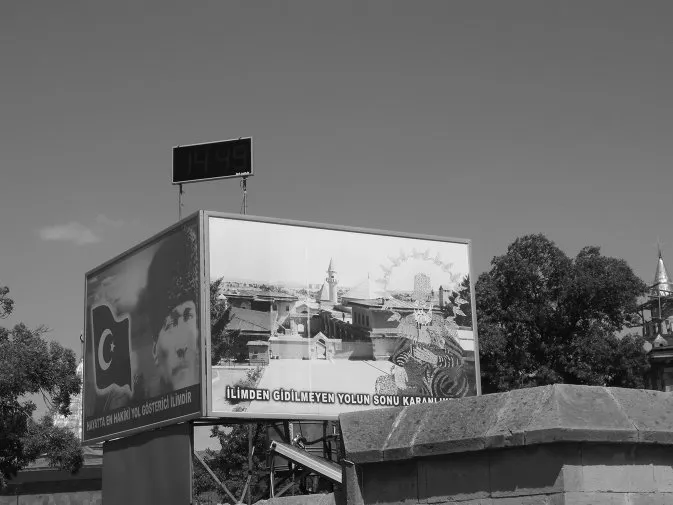
Let me start in central Anatolia, in a town called Hacibektaş after the saint of the same name. Haci Bektaş Veli, the saint, is said to have founded his order (tarikat) in the thirteenth century, and it became one of the most powerful dervish orders in the Ottoman Empire. The complex contains his tomb (türbe), the lodge (tekke) housing his followers, the house for the subsequent leaders, the tombs of leaders and devotees, plus various courtyards, fountains, storerooms, kitchens and the other structures required for the main complex of a major religious order. In 2008, when I visited the place, in front of the complex was a statue of Atatürk – no surprise – and billboards equating a saying by Haci Bektaş (The road that does not pass through science will lead you to darkness) with one by Atatürk (Science is the truest path illuminator in life), which is more surprising, for reasons explained below (Figure 1.1). A plaque in Turkish and English states that:
Figure 1.1 Billboards in front of the tomb/lodge complex of Haci Bektaş Veli, a thirteenthcentury saint, in the town named after him, Hacibektaş, Turkey, June 2008. The left billboard (in red) has an image of Atatürk, founder of the modern Turkish state, and his saying that science is the truest path illuminator in life. The right billboard has an image of Haci Bektaş and his saying that the road that does not pass through science will lead you to darkness. The twentieth-century politician thus appropriated the thirteenth-century saint
(Translations by Tugğba Tanyeri-Erdemir. Photo courtesy Robert M. Hayden)
the system of his [Haci Bektaş’s] thought is based: [on] tolerance, peace, love and equality still illuminates the humanity [sic]. His social ideologies have been applied to everyday’s [sic] life 600 years later by Kemal Atatürk the creator of modern Republic of Turkey. His thoughts shared the same point of view with the universal human rights declaration which is announced in [sic] December 10 1948.
As for those thoughts, a plaque in the complex states them succinctly, if not necessarily always quite grammatically, in English:
Search and find.
Educate the women.
Even if you are hurt, don’t hurt.
Sages are pure sometimes purifiers.
First stage of attainment is modesty.
Whatever you look for, search in you.
Don’t forget even your enemy is human.
Control your hand, your word, your lust.
Beauty of human is in the beauty of his words.
Prophets and saints are God’s gift to humanity.
Road that doesn’t go through science is perilous.
Don’t try to find faults neither in nation nor individual.
How nice to ones who put light in the darkness of thought.
Don’t do anything to anyone if you don’t want it to be done to you.
Peace be with you!
(Huu dost!)
The linkage of Haci Bektaş with Atatürk and the republic seems a clear indication that Bektaşism is viewed as ‘bringing about national integration, fostering humanism and syncretism’ as per the aims of this volume, and certainly the references to educating women, to science and self-control are congruent with Atatürk’s modernization program. Yet the same Atatürk who is said to have implemented Haci Bektaş’s social ideologies actually closed down this complex, among others, banning all of the dervish orders including the Bektaşis, in 1925, two years after proclaiming the Republic of Turkey out of part of the ruins of the Ottoman Empire, following the empire’s collapse after World War I. The closure of the dervish orders was part of Atatürk’s effort to destroy the power of the Ottoman religious establishment – he had, after all, abolished the Caliphate in 1922 – whose members had opposed him and his plans to build a new, modern Turkey (Stirling 1958), in part by imposing secularism.
In fact, the Bektaşi complex in the town of Hacibektaş is not the home of the Bektaşi order, but rather a museum, opened in 1964 – after 39 years in which the complex had been closed and inaccessible to the followers of Haci Bektaş. At present, while the saint’s followers can visit the museum, they have to pay to do so; the way in which the complex is now structured hinders Alevi-Bektaşi forms of worship while facilitating Sunni practices (see Harmanşah et al. 2014), and the main form of Alevi worship, the cem ceremony, is prohibited entirely in the complex. Other dervish complexes have similarly been turned into museums, with the Mevlana museum in Konya the greatest in international prominence due to the popularity in the West of the works of ‘Rumi’, the founder (Jalāl ad-Dīn Muhammad Rūmī, Mevlana), but also structured now to obstruct the worship practices of Alevis/Mevlevis while facilitating those of Sunni Islam (ibid.).3
The site closure and ban of the order in 1925, however, was not the first such challenge to the Bektaşis. The order was also banned by Sultan Mahmud II in 1826, and its properties given to the Nekşibendis, a Sunni order. By the early twentieth century, some Bektaşi sites were also being claimed by Christians (Hasluck 1973 [1929]). If we look at the situation of the Bektaşis over nearly the past two centuries, it seems that their order has faced challenges, and its sites have been subject to appropriation by other religious communities, for the entire period. Neither were the Bektaşis the only dervish order to face such challenges in the late Ottoman Empire and the post-Ottoman states. To put the matter succinctly, in parts of the post-Ottoman Balkans and Anatolia in which Islam is the dominant religion of heritage, if not always of practice, the Sufi or dervish versions have been under strong pressure, even repression, even in avowedly secular states. Where Christians have come to rule, the Sufi/dervish orders have suffered less outright repression (at least after 1878), yet have also seen their major shrines and other sites become absorbed into Christian religioscapes, many ultimately losing their identities as Muslim sites. Sometimes, as explained below, this Christianization of a dervish site has had the approval of Sunni authorities, whose hostility to saints seems to lead them to think it better that a saint be seen as Christian than as Muslim, even when (or maybe because) it is mainly Muslims who go to pray at the site.
If we think about the politics of belonging in the post-Ottoman nation-states, the dervish orders in the Balkans and Anatolia have had mixed receptions depending on whether the polities were predominantly Christian or predominantly Muslim. In the former case, the presumption has always been that Muslims, even when citizens, are outside the national corpus, but the non-Sunni Muslims have not been matters of separate concern to governments, which has allowed freedom to the dervish orders to continue their distinctive practices – unless and until Christians decide that a dervish site is ‘really’ Christian and appropriate it. In Sunni-dominated polities, on the other hand, adherents of the dervish orders were also seen as outside the national corpus, and their major sites were often subject to appropriation by Sunnis.
Another way to look at the position of the dervish orders is provided by the model of ‘antagonistic tolerance’ (Hayden 2002; Hayden and Walker 2013), which assumes that major ethno-religious groups that live intermingled (though rarely intermarrying) will do so in a condition of competitive sharing of space, marked by competition over central and/or prominent religious sites. Such antagonistic tolerance is common in colonial polities, and also in nation-states in which the majority nation (natio, das Volk, narod), an ethnic group in American terms, is defined by a primary religious criterion. In such polities, citizens of another religious heritage may be excluded conceptually from the sovereign nation, even when the state proclaims itself to be a democracy (Hayden 1992). The post-Ottoman Balkans and Anatolia provide good comparison with South Asia because they manifest post-imperial nation-state formations in which, in each case, one ethno-religious group was seen as the titular, sovereign nation in the new state, even when the state was proclaimed to be secular.
This chapter considers indicators of belonging/exclusion by dervish groups in the post-Ottoman Balkans and Anatolia/Turkey, as well as practices by the latter that cope with this situation. Various dervishes arrived in the region with the Ottoman conquests of the fourteenth-fifteenth centuries, but did not organize into orders until late in the fifteenth century (Clayer 2011). These orders were closely tied to centers in Istanbul or elsewhere in Ottoman Anatolia, such as Ankara (the Bayrami), Konya (the Mevlevi) and Hacibektaş (the Bektaşi). These last were not Sunni but rather are increasingly known as Alevis, probably lumping them together on the basis of their non-Sunni practices. The Ottoman Empire’s ‘Sunnitification’ is generally seen as having developed during the sixteenth century (see Terzioğlu 2013), but the non-Sunni tarikatlar were generally able to function in at least some parts of the empire until its end in 1922. In any event, the Nekşibendis were very much a Sunni order, a point of some importance in light of what happened to the non-Sunni orders in the nineteenth and twentieth centuries.
As for the non-Sunni orders, each had, by definition, its own devotional practices. Among the non-Sunni orders in the Ottoman imperial space, some practices were so unorthodox from a Sunni perspective as to seem to Sunnis to be non-Islamic. The Bektaşis provide a good example: they do not pray in mosques, or normally even visit them, but rather hold their own communal cem ceremonies in buildings dedicated to that purpose (cemevi), and consume wine in the course of some rituals. These customs are not unique to the dervish orders, but are found among a larger population in the region known in Turkish as Alevis (see Sözer 2014: 3–4). While Alevis claim to be a community of birth (one must be born an Alevi), the dervish orders are communities of adherence; however, Alevis and some of the dervish orders, especially the Bektaşis, share many beliefs and practices. Alevi-Bektaşis do not observe Ramadan but rather Muharram. Alevi and Bektaşi women do not veil or cover their heads, and take part in cem ceremonies. It has long been suggested that some Alevi-Bektaşi beliefs and practices (e.g. belief in a form of trinity [albeit God, Mohammed and Ali], utilization of wine or other alcohol in ritual, identification of the 12 imams with the disciples of Christ) are either derived in part from those of Christianity or at least served as an attractive alternative belief for Christians (Birge 1965: 215–218), and Hasluck (1973 [1929]: 456 ff.) documented considerable sharing of religious sites between Bektaşi and Christians in the very late Ottoman Empire. An example of a tekke/türbe complex (külliye) built on the site of a church or monastery is that of Battal Gazi, in Seyitgazi, Eskişehir (Yürekli 2012).
What the dervish/Sufi orders of the Ottoman Empire certainly shared with local forms of Orthodox Christianity was a belief in the efficacy of appealing to saints for assistance and benefits. These saints could be the founder of an order, or one of the deceased former heads of a local tekke. For the Christians, saints could be Biblical, both from the Old and New Testaments, or more local. The non-Sunni Muslims could also venerate Old Testament figures, such as St Ilija/Ilya/Ilyas. As discussed below, there are shrines in the Balkans to this saint that are still visited by both Muslims and Christians, as there are other shrines in which the saint may have both a Muslim and a Christian identity. The British archaeologist and ethnologist F.W. Hasluck noted nearly a century ago that Christians visited the Haci Bektaş tekke and that some also claimed that the founder’s tomb there was really that of a Christian saint (Hasluck 1973 [1929]: 109–110). Such stories of the single saint having ‘really’ been a Muslim on the one hand and a Christian on the other, so similar to the dual identities of some Sufi saints and Nāth saints in central India (see e.g., Bouiller and Khan 2009; Deák 2010), is still found today, as discussed further below.
Comparing imperial withdrawals and their consequences
Despite their many differences, South Asia, Anatolia and the Balkans share some parallel historical developments. In both cases, Muslim conquerors took control over large territories starting in the eleventh century. In both cases, there were conversions from the indigenous religions,4 sparking similar political discourses in later years about conversion as a tactic of conquest. In both cases, a Muslim religioscape came into existence, in some places displacing the structures of the indigenous religions. In both cases, the withdrawal of the imperial structures that had enforced stability led to partitions on ethno-religious grounds, along with the processes now called ethnic cleansing: the Partition of India in 1947 was preceded by the expulsion of Turks and the Muslims from the newly independent Greece and Serbia in the nineteenth century, the multiple forced movements of populations with the partition of Macedonia in 1912–13, the mass killings of Armenians in Anatolia in 1915, and the compulsory ‘population exchange’ between Greece and Turkey in 1923 that displaced almost all of the Orthodox Christians from Turkey and Muslims from Greece (Clark 2006; Gingeras 2009).
The well-known accounts of the violence that took place during the Partition of Punjab are matched by accounts of similar violence in Macedonia (see Brown 2013; Yosmaoğlu 2014), among other places. On the other hand, analyses of the supposedly peaceful, pre-national pasts in both cases are also common (compare Doumanis 2013; Pandey 2001). There were also, of course, differences. In South Asia the last empire was a European colonial one that withdrew, leaving domestic political regimes in charge of new states, while in almost all of the Balkans, the imperial regime was itself less colonial5 and collapsed, with different outcomes in the Turkish-speaking heartland of Anatolia and eastern Thrace from in the peripheries. In the European parts of the empire, everywhere but Bosnia and Cyprus,6 Ottoman rule was succeeded by domestic political regimes, but in Anatolia and eastern Thrace, Ottoman rule was succeeded by the republic regime proclaimed by Atatürk in 1923. Thus in the new Republic of T...