This book is about a single image - the frontispiece to Thomas Sprat's History of the Royal-Society of London (1667). Designed by John Evelyn, and etched by Wenceslaus Hollar, it is arguably the best-known representation of seventeenth-century English science. The use of such plates to celebrate and legitimise the 'new' science of the period falls into a tradition that was well-established both in Britain and in Europe more generally, and which has increasingly attract attention from historians. Nevertheless, there are many questions to be asked about it and how it came into being. Was it an original composition by Evelyn, or is it based on earlier exemplars? Can all the scientific instruments, books and other objects that appear in it be identified, and what significance should be attached to their inclusion? Above all, how did the plate come to be designed in the first place, and what is its true relationship with Sprat's book? In order to assess such issues, this study provides a full analysis of Evelyn's image in its Royal Society setting and the wider world of early-modern science. The book first considers the overall iconography of the image and its message concerning Evelyn's conception of the society's role, before moving on to examine the myriad of details included in the plate and their significance. It concludes by considering the print's history after publication, including the extent to which Evelyn used copies to exemplify the combination of technological and artistic accomplishment to which he believed the society should aspire.

eBook - ePub
The Image of Restoration Science
The Frontispiece to Thomas Sprat’s History of the Royal Society (1667)
- 150 pages
- English
- ePUB (mobile friendly)
- Available on iOS & Android
eBook - ePub
The Image of Restoration Science
The Frontispiece to Thomas Sprat’s History of the Royal Society (1667)
1
Introduction
This book is a study of a single image – though arguably one of the best known that has come down to us from seventeenth-century science. This is the plate that was published as the frontispiece to Thomas Sprat’s History of the Royal Society of London (1667). It was designed by the virtuoso and diarist, John Evelyn, and etched by Wenceslaus Hollar, the Bohemian artist long domiciled in England.1 Within an architectural setting surmounted by the Royal Society’s coat of arms and festooned with scientifically significant books and objects, it shows a bust of King Charles II, the society’s founder and patron, placed on a pedestal and being crowned with a wreath by the goddess Fame. The column on which Charles’s bust stands is flanked to the right by the society’s first President, William, Viscount Brouncker, and to the left by Francis Bacon, Lord Verulam, the figure from the early seventeenth century who more than anyone else was the society’s intellectual inspiration. Bacon provided a mandate for the complete reformulation of knowledge about the natural world, not least through the collection of a great inductive ‘natural history’, and he also emphasised the desirability of the application of science to practical use. Here, he is shown in his robes as Lord Chancellor.
In seeking to encapsulate the message of a book in a prefatory image, the print that precedes Sprat’s History falls into a tradition of providing frontis-pieces and engraved title-pages that by the late seventeenth century was well established both in Britain and in Europe more generally.2 Indeed, the use of such plates to celebrate and legitimise the ‘new’ science of the period has recently begun to attract attention from historians.3 In the words of the Jesuit astronomer, Christoph Scheiner, ‘a small image teaches what many written words cannot say,’ and this was a point that was not lost on authors like Galileo, whose works were embellished with striking illustrations, as with the title-page that Stefano Della Bella designed for the Dialogue concerning the Two Chief World Systems (1632), which powerfully evokes the message of Galileo’s book (Fig. 1.1).4
Indeed, through such images, astronomers like Tycho Brahe and Andrea Argoli sought to establish their lineage from Atlas and Hercules and to raise the status of their discipline accordingly, while a succession of authors used

Figure 1.1 Stefano Della Bella’s etched title-page for Galileo’s Dialogue concerning the Two Chief World Systems (1632), showing Aristotle, Ptolemy and Copernicus.
elaborate designs – often including personifications based on biblical and classical imagery – as a means to dignify the pursuits in which they were engaged. By comparison, the Sprat frontispiece might seem rather artful and understated in the way in which it puts across its message, but it has nevertheless been reproduced very frequently. This is largely because it is the most striking image relating to the early Royal Society that we have, encapsulating the society’s ethos in significant ways that will be explored in the course of this study.5 Indeed, no book on the early Royal Society and its context seems complete without a reproduction of it.
It is also worth noting the context of Sprat’s History of the Royal Society itself in terms of self-promoting publications by the new institutions devoted to natural philosophy of which the Royal Society was one. Thus the Accademia del Cimento, founded under the auspices of the Medici family at Florence in 1657, brought out a volume of Saggi di Naturali Esperienze which, though not actually published until 1667, had been in preparation since the start of the decade.6 Equally notable were the publications of the Académie des Sciences founded in Paris in 1666, including the grandiose volumes devoted to L’Histoire des Animaux, originally published in 1671, and L’Histoire des Plantes, published in 1676, elephant folios that were distributed under the auspices of the French monarchy.7 Both the volumes just mentioned feature lavish etchings by Sébastien Leclerc which provide a profuse pictorial record of the academy’s members and patrons, and of its apparatus, activities and milieu (Figs. 1.2, 5.21).8 We entirely lack an English equivalent to this mouth-watering visual resource, and it is perhaps partly for this reason that the Evelyn/Hollar image has come to acquire such prominence in relation to the seventeenth-century Royal Society.
Nevertheless, there are many questions to be asked about it and how it came into being. Was it an original composition by Evelyn, or is it based on earlier exemplars? Can one identify all the instruments, books and other objects that appear in it, and what significance should be attached to their inclusion? Perhaps above all, how did the plate come to be designed in the first place, and what is its true relationship with Sprat’s book? The latter question is a pressing one, since the status of the print in relation to the volume is problematic. Facing the title-page of the book, on the verso of the half-title, is a depiction of the society’s coat of arms (see Fig. 2.1); in copies of the book in which the etched image is to be found, it is often inserted rather uncomfortably between that and the title-page. In addition, many copies of the book lack the Evelyn/Hollar plate, although these are often in contemporary bindings and there is no sign that it has been removed. In any case, the print is larger in size than the format of normal copies of the book, which means that, insofar as it appears in these, it has had to be cropped or folded to make it fit. It is of just about an appropriate size for the choice copies of the book that were printed on large paper, and it has sometimes been claimed that it must have been produced for inclusion in these: but this seems to be a retrospective rationalisation.9 Instead, there is a clear reason for the
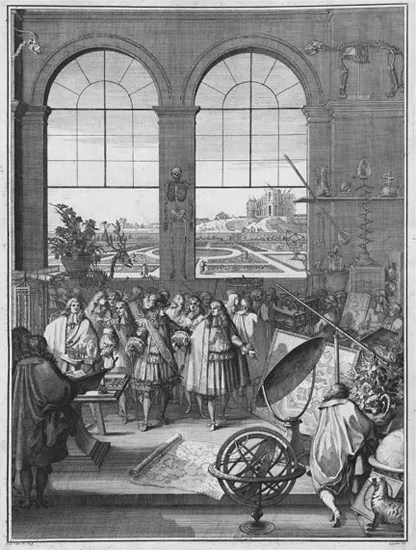
Figure 1.2 Sébastien Leclerc’s etching of Louis XIV’s (imagined) visit to the Académie des Sciences in Paris, from Mémoires pour Servir à l’Histoire Naturelle des Animaux (1671).
anomalous status of the plate, which was first divulged in 1981 and will be recapitulated here. This is that it was not originally intended for Sprat’s work at all. In fact, it was designed for a completely different book, a defence of the Royal Society devised by the Somerset virtuoso, John Beale, and it was re-routed to Sprat’s volume only when Beale’s project proved abortive.10
This book will therefore begin by giving an account of Beale’s scheme and its context, prior to providing a full analysis of Evelyn’s image in its Royal Society setting. This will comprise three parts. First, we will consider the overall iconography of the image and its – in some respects surprising – message concerning Evelyn’s conception of the society’s role. We will then examine the myriad of details included in the plate and their significance, looking first particularly at the portraits and books included in it and the trappings of the society’s institutional status. A further chapter will then give minute attention to the various instruments that are depicted. Such scrutiny of the print’s details raises questions about its design process, including the relative contribution of designer and etcher, and these are addressed in the context of seventeenth-century print production more generally. In a final chapter, we will consider the print’s history after its publication, including the extent to which Evelyn seems to have used copies of it to exemplify the combination of technological and artistic accomplishment to which he believed the Royal Society should aspire.
Notes
1 The print is described and briefly commented on in virtually all modern accounts of Hollar and of Evelyn, as follows: Howard C. Levis, Extracts from the Diaries and Correspondence of John Evelyn and Samuel Pepys Relating to Engraving (London, 1915), pp. 140–2; F. G. Grossmann, Wenceslaus Hollar 1607–77: Drawings, Paintings and Etchings (Manchester, 1963), no. E19; Keynes, John Evelyn, pp. 283–4; Katherine S. van Eerde, Wenceslaus Hollar: Delineator of His Time (Charlottesville, 1970), pp. 80–1; Graham Parry, Hollar’s England: A Mid-Seventeenth-Century View (Salisbury, 1980), p. 29 and plate 107; Penning-ton, Hollar, no. 459; Antony Griffiths and Gabriela Kesnerová, Wenceslaus Hollar: Prints and Drawings (London, 1983), no. 110 (p. 69); Richard T. Godfrey, Wenceslaus Hollar: A Bohemian Artist in England (New Haven and London, 1994), p. 22; Frances Harris and Michael Hunter (eds), John Evelyn and His Milieu (London, 2003), p. 16; Anne Thackray, Caterpillars and Cathedrals: The Art of Wenceslaus Hollar (Toronto, 2010), pp. 90–1; New Hollstein, no. 1966; Douglas D. C. Chambers and David Galbraith (eds), The Letterbooks of John Evelyn (2 vols., Toronto, 2014), vol. 1, p. 438. Where not purely descriptive, most accounts of the print are positive, but for an exception see Gillian Darley, John Evelyn: Living for Ingenuity (New Haven and London, 2006), p. 186, who speaks of ‘the dull image which Evelyn and Beale designed’ (see also p. 212). Two further useful works on Hollar which do not, however, mention the Sprat frontispiece are Jacqueline Burgers, Wenceslaus Hollar: Seventeenth-Century Prints from the Museum Boymans-van Beuningen, Rotterdam (Alexandria, VA, 1994), and Rachel Doggett, Julie L. Biggs and Carol Brobeck, Impressions of Wenceslaus Hollar (Washington, DC, 1996).
2 For English examples see Margery Corbett and Ronald Lightbown, The Comely Frontispiece: The Emblematic Title-Page in England 1550–1660 (London, 1979) and A. F. Johnson, A Catalogue of Engraved and Etched English Title-Pages Down to the Death of William Faithorne, 1691 (London, 1934). For continental examples see next note.
3 See esp. Volker R. Remmert, Picturing the Scientific Revolution (Philadelphia, 2011), translated by Ben Kern from Remmert, Widmung, Welterklärung und Wissenschaftslegitimierung (Wiesbaden, 2005).
4 Ibid., pp. 57, 59–60, 212.
5 For engraved title-pages associated with the society, see that to Richard Waller’s translation of the Saggi of the Accademia del Cimento (London, 1684) and that to Francis Willughby’s Historia Piscium (Oxford, 1686). These are more typically allegorical in the tradition studied by Remmert. It is perhaps revealing that the latter was the most expensive plate in the book, costing £4, far more than the others. See Sachiko Kusukawa, ‘The Historia Piscium (1686)’, Notes & Records, 54 (2000), 179–97, esp. p. 191. See also her ‘Picturing Knowledge in the Early Royal Society: The Examples of Richard Waller and Henry Hunt’, Notes & Records, 65 (2011), 273–94 (where the Saggi title-page is reproduced and discussed), and Johnson, Catalogue, pp. 53, 77.
6 See W. E. Knowles Middleton, The Experimenters. A Study of the Accademia del Cimento (Baltimore, 1971), pp. 65ff. and passim, and Alfonso Mirto, ‘Genesis of the Saggi and Its Publishing Success in the Seventeenth through Nineteenth Centuries’, in Marco Beretta, Antonio Clericuzio and Lawrence M. Principe (eds), The Accademia del Cimento and Its European Context (Sagamore Beach, 2009), pp. 135–49.
7 Anita Guerrini, ‘The King’s Animals and the King’s Books: The Illustrations for the Paris Academy’s Histoire des Animaux’, Annals of Science, 67 (2010), 383–404. See also Roger Hahn, The Anatomy of a Scientific Institution: The Paris Academy of Sciences, 1666–1803 (Berkeley and Los Angeles, 1971), Alice Stroup, A Company of Scientists: Botany, Patronage and Community in the Seventeenth-Century Parisian Royal Academy of Sciences (Berkeley and Los Angeles, 1990) and Eric Brian and Christiane Demeulenaere-Douyère (eds), Histoire et Mémoire de l’Académie des Sciences (Paris, 1996), esp. pp. 107ff.
8 See E. C. Watson, ‘The Early Days of the Académie des Sciences as Portrayed in the Engravings of Sébastien Le Clerc’, Osiris, 7 (1939), 556–87, and Maxime Préaud, ‘“L’Académie des Sciences et des Beaux-arts”: Le Testament Graphique de Sébastien Leclerc’, RACAR: Revue d’Art Canadienne, 10 (1983), 73–81. The most striking of th...
Table of contents
- Cover
- Title
- Copyright
- Dedication
- Contents
- List of illustrations
- Acknowledgements
- Abbreviations
- 1 Introduction
- 2 John Beale, ‘Lord Bacon’s Elogyes’ and the fortunes of Sprat’s History
- 3 The overall design of the frontispiece: sources and significance
- 4 Details: the portraits, books and institutional accoutrements of the Royal Society
- 5 The instruments
- 6 The publication and dissemination of the print
- 7 Conclusion
- Index
Trusted by 375,005 students
Access to over 1.5 million titles for a fair monthly price.
Study more efficiently using our study tools.
Frequently asked questions
Yes, you can cancel anytime from the Subscription tab in your account settings on the Perlego website. Your subscription will stay active until the end of your current billing period. Learn how to cancel your subscription
No, books cannot be downloaded as external files, such as PDFs, for use outside of Perlego. However, you can download books within the Perlego app for offline reading on mobile or tablet. Learn how to download books offline
Perlego offers two plans: Essential and Complete
- Essential is ideal for learners and professionals who enjoy exploring a wide range of subjects. Access the Essential Library with 800,000+ trusted titles and best-sellers across business, personal growth, and the humanities. Includes unlimited reading time and Standard Read Aloud voice.
- Complete: Perfect for advanced learners and researchers needing full, unrestricted access. Unlock 1.5M+ books across hundreds of subjects, including academic and specialized titles. The Complete Plan also includes advanced features like Premium Read Aloud and Research Assistant.
We are an online textbook subscription service, where you can get access to an entire online library for less than the price of a single book per month. With over 1.5 million books across 990+ topics, we’ve got you covered! Learn about our mission
Look out for the read-aloud symbol on your next book to see if you can listen to it. The read-aloud tool reads text aloud for you, highlighting the text as it is being read. You can pause it, speed it up and slow it down. Learn more about Read Aloud
Yes! You can use the Perlego app on both iOS and Android devices to read anytime, anywhere — even offline. Perfect for commutes or when you’re on the go.
Please note we cannot support devices running on iOS 13 and Android 7 or earlier. Learn more about using the app
Please note we cannot support devices running on iOS 13 and Android 7 or earlier. Learn more about using the app
Yes, you can access The Image of Restoration Science by Michael Hunter in PDF and/or ePUB format, as well as other popular books in History & European Renaissance History. We have over 1.5 million books available in our catalogue for you to explore.