eBook - ePub
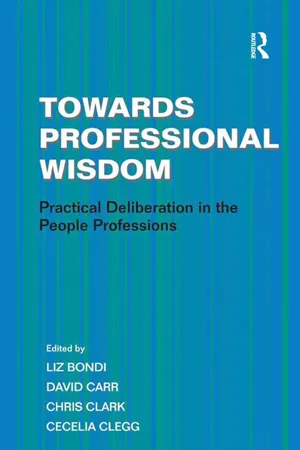
Towards Professional Wisdom
Practical Deliberation in the People Professions
- 272 pages
- English
- ePUB (mobile friendly)
- Available on iOS & Android
eBook - ePub
About this book
People professions - such as social work, teaching, nursing, ministry and counselling - are at heart ethical or moral enterprises. Much recent theorizing has been concerned to show that effective professional deliberation and judgement cannot be reduced either to technical rationality or to simple obedience to general occupational procedures or prescriptions. Professional judgement would seem to require the development of a distinctive mode of practical (ethical) reflection or 'wisdom' - perhaps along the lines of Aristotle's 'phronesis' or practical wisdom. Reflection is required to address such key professional concerns as: What is the impact of official prescription and regulation on professional judgement? How should conflicts of professional judgement and public/political accountability be resolved? How might one reconcile tensions between universal justice and equality and particular client need? What is the role of emotion and/or affect in 'people professional' practice? This ground-breaking work addresses, in a thoroughly multidisciplinary way, the central question of the nature of professional judgement and deliberation that has recently come to the fore in the academic literature of profession and professionalism. It proposes a marked shift - in theory, practice and policy-making - away from technical-rational approaches to professional decision-making in favour of reflection and deliberation informed by responsible moral judgement. This reflects a significant progressive trend in this literature by taking practical wisdom, rather than technical rationality, to lie at the heart of professional judgement. It is unique in bringing together key authors from different professional fields to address the issue of professional wisdom in a cross-professional and multidisciplinary way.
Information
Practical Wisdom and Professional Deliberation
1 ‘Professional Wisdom’ in ‘Practice’1
The claims of any profession or would-be profession, in terms of its authority with clients, the esteem it enjoys in the wider society, the exclusivity of its members’ mandate to practise – and, not least, the scale of remuneration it commands – are closely tied to the kind of knowledge it embodies. In this chapter, I will focus on a particular kind of knowledge, much valorised in the wider culture of modernity, that has increasingly been called on to inform expert activity and to ground claims to professional status in many diverse fields. My analysis will show how this kind of knowledge, assembled according to the norms of what may be called ‘technical rationality’, negates wisdom as a capacity for engaged understanding and discerning judgement. And my main purpose will be to offer an account of wisdom – largely by contrast with technical reason – and to argue that, all pressures to the contrary notwithstanding, it remains indispensable in those domains of activity designated in this book as the ‘people professions’ – or at least that this is the case if the essential fabric of these domains is to be respected and they are to realise, without distortion, their own proper ends.
Practices and their Internal Goods
I begin by replacing ‘profession’ with ‘practice’, a concept I borrow mainly from Alasdair MacIntyre (1984 [1981]) and Aristotle’s Nicomachean Ethics (Book 6, trans. Thompson, 1976); I do so in the belief, to be substantiated in the subsequent analysis and argument, that anything worth defending in the concept of profession is already included in the concept of practice – and that anything not so included is best jettisoned anyhow. By a practice, I mean a more or less coherent and complex set of activities that has evolved co-operatively and cumulatively over time, and that exists most significantly in the community of those who are its practitioners – so long as they are committed to sustaining and developing its internal goods and its proper standards of excellence. ‘Internal goods’ here includes the desirable outcomes characteristically aimed at through a practice, for example patients restored to good health, well-educated students, and clients’ achievement of greater resourcefulness in dealing with emotional conflict – in the cases, respectively, of medical practice, teaching and psychotherapy. What all these examples show are the characteristic end-results of a practice, the attainment of which is its essential end or telos as a practice. And these are the first kind of what I call internal goods of a practice.
Internal goods of a second kind reside in practitioners themselves: capabilities or qualities acquired and exercised by them through their apprenticeship into the practice, their answerability to its standards of excellence, and their submission to the demands of striving to achieve, regularly and reliably, its characteristic ends (in the sense of the first kind of internal good). These qualities are themselves of two kinds: competencies proper to each practice, and virtues of character that transcend any particular practice, though they may receive a unique modulation in the context of some particular practice. The former are technical proficiencies (for example, in making an accurate assessment of a patient’s or a student’s state of immediate need or readiness); but to exercise these proficiencies in striving to realise the proper ends of the practice, one may need virtues such as patience, temperance, courage, honesty or humility. Together, these qualities focus and direct one’s energy and attention, disciplining one’s desires, putting one at the disposal, so to speak, of what needs to be accomplished in each situation where the ends of the practice are at stake, and joining one in non-rivalrous partnership with others similarly disposed.
Internal goods are at the constitutive core of a practice, definitive of it as the quite specific practice that it is. But there are also external goods – chiefly, rewards in terms of pay, recognition and status. And also, somewhat external (though necessary if a practice is to survive with more than a fugitive presence in the world) is an institutional framework: a set of structures that mediates between it and wider social, economic and political agencies – in the case of the type of practices to be considered here, for example, securing and managing adequate resources, formulating and invigilating codes of practice, devising regulatory procedures, determining entry requirements or credentialising aspirant practitioners. At their best, these institutional structures serve the achievement of the practice’s internal goods. But they can also, and often do, compromise this achievement, leading to greater or lesser distortions and corruptions of practice – distortions and corruptions that can be identified and addressed only in the light of a clear recognition and understanding of the internal goods defined and pursued at what I am calling the practice’s constitutive core.
This MacIntyrean (1984 [1981]) conception of practice, sufficiently generic to include a wide variety of specific domains and even kinds of domain – for example, performance arts (dancing, flute-playing), productive professions and crafts (architecture, weaving), theoretical pursuits (physics, history) and games (soccer, chess) – differs from Aristotle’s original concept of praxis. For the latter was not domain-specific, but rather designated the open set of activities through which one strove to live a worthwhile life in the light of some conception of the overall human good, or of flourishing as the ultimate goal of all one’s living; and one did this precisely not as an expert in any particular field – and, if in any role, simply as a citizen of the polis. Now the practices to which this book is devoted might be said to instantiate both of these senses of practice: on the one hand, they are enclaves of specialised competency and concern, while on the other – since their ends lie in significant changes to the human beings whose needs are addressed by their specific forms of interaction – they are unavoidably implicated in basic, and of course always contestable, issues concerning human well-being.
Technical Rationality and the Drive Towards ‘Professionalisation’
My concern here is not singly with any one of these latter practice-domains, but rather with all of them as sharing, so I shall claim, an internal feature that is essential to their integrity as practices. Returning us to the theme broached at the outset, this feature has to do with the kind of knowledge that they embody, a kind that I shall designate as ‘practical’. I shall return presently to analyse the nature of this knowledge, whose kinship with wisdom will, I hope, become manifest. But I turn now to consider that other kind of knowledge which, by its growing dominance, has threatened to eclipse it – while at the same time driving the movement in many areas towards more assertive forms of professionalism.
This latter form of knowledge has been intimately linked to the great esteem placed in modernity on rationality, or rather, a specific mode of rationality that has established an epistemic hegemony, so that only knowledge assembled within its frame is recognised as properly rigorous, and only activity organised according to its dictates is recognised as properly efficacious – claims for the efficacy of the activity being grounded in prior claims for the rigour of the knowledge. This mode is often and understandably related to modern science (though it needs to be recognised that, as practices of inquiry, the sciences do not actually follow it). And it also has deep roots in Western philosophy, being traceable back to the Platonic valorisation of techne which provides the etymological basis for its designation as technical rationality.
Within the frame of technical rationality, the context-dependence of first-person experience is suppressed in favour of the detachment of third-person procedures. These procedures give a privileged role to a kind of observation and experimentation that is standardised and measurable, to modes of testing that specify precisely what can count as counter-evidence, to findings or outcomes that are clearly formulated and replicable, and to a language-in-use that is maximally freed from possibilities of misinterpretation by its being maximally purged of the need for interpretation itself. Within this frame, a subject can disengage from her or his environing milieu and take an objectifying and instrumental stance towards it. This stance promises enormous mastery: everything in the environment is potentially a means to be controlled in achieving pre-designed ends. And with mastery there is also maximisation: optimal effectiveness in achieving ends and optimal efficiency in achieving them with the least – or most economical – input of means.
It is in control over matter that technical rationality has achieved the spectacular success now so evident in our built environment and vast array of technological devices. What concerns me here, however, is the persistent attempt to organise and regulate according to its dictates the kind of human action and interaction involved in the people-centred practices considered in this book. Its prestige has grown to the point where it is no longer seen as a form of rationality, with its own limited sphere of validity, but as coincident with rationality as such. Knowledge of any kind that does not accord with it is deemed to be non-rational, and hence to be incapable of delivering progress in an area of practice – or, as is now easily assumed, of underwriting its claims as a profession. Any area of practice that does not rationalise itself according to its standards – that persists in giving a strong function to other modes of knowledge – is under pressure to adopt its procedures and accommodate to its norms. This pressure has long been exerted in practices strongly linked to natural science, such as medicine and dentistry, and in recent decades has also been very evident in practices such as education, law and nursing, or in newer practices (such as psychotherapy or social work) keen to assert their ‘professional’ status.
To technicise a practice is to make it over in such a way that control over its key operations is maximally assured by a method whose implementation can be monitored systematically. This will involve devising new procedures or extracting from established ones a rational core that can be made transparent and replicable. Typically, this entails disembedding the knowledge implicit in the skilful performance of the characteristic tasks of the practice from the immediacy and idiosyncrasy of the particular situations in which it is deployed, and from the background of experience and character in the practitioners in whom it resides. Through this disembedding, it is supposed that what is essential in the knowledge and skill can be abstracted for encapsulation in explicit, generalisable formulae, procedures or rules – which can in turn be applied to the various situations and circumstances that arise in the practice in order to meet the problems that they present. These problems are assumed to contain nothing significant that has not been anticipated in the analysis which yielded the general formulae, and hence to be soluble by a straightforward application of the formulae without need for any new insight or discernment in the actual situation itself. Control, efficiency and proper ‘accountability’ seem to be assured because the system is minimally dependent on the discretion or judgement of individual practitioners, with all the hazard and lack of standardisation that this might entail. The ideal to which technical rationality aspires, one might say, is a practitioner-proof mode of practice.
Wisdom in Practice
My articulation of the nature of technical rationality has just brought out its inherent opposition to practitioners’ knowledge, or its drive to supplant what might be called an alternative mode of practical rationality. How, then, is this alternative mode of rationality to be characterised? It is here that wisdom re-enters the discussion. In the Aristotelian tradition, the answer will rely heavily on the notion of phronesis elaborated, somewhat sketchily, in Book 6 of the Nicomachean Ethics and usually translated as ‘practical wisdom’ (or good ‘judgement’ as the capability to make good judgement-calls reliably). I will outline here a few key, inter-related features of phronesis: its role as an action-orientating form of knowledge; its irreducibly experiential nature; its entanglement (beyond mere knowledge) with character; its non-confinement to generalised propositional knowledge; its need to embrace the particulars of relevant action-situations within its grasp of universals, and its ability to engage in the kind of deliberative process that can yield concrete, context-sensitive judgements (see Dunne, 2009).
To have phronesis (to be practically wise or a person of good judgement) is to be able to recognise situations, cases or problems as perhaps standard or typical – that is to say, of a type that has been met previously and for which there is an already established and well-rehearsed rule, recipe or formula – or as deviating from the standard and conventional, and in either case, to be capable of dealing with them adequately and appropriately. One respects the particularity of the case – and thus does not rigidly impose on it an ill-fitting application of the general rule. At the same time, one tries to find a way of bringing this particularity into some relationship, albeit one yet to be determined, with the body of general knowledge codified in rules and formulae. It is not that one disregards this general knowledge, but rather that it is available to one, like the measuring rule used by builders at Lesbos, which Aristotle (trans. Thompson, 1976) approved because, being made of lead, it was pliable enough to measure the surfaces of irregularly shaped stones (unlike, for example, a wooden rule). One’s adeptness as a person of judgement, then, lies neither in the knowledge of the general as such nor in an entirely unprincipled dealing with particulars. Rather, it lies precisely in the mediation between general and particular, in the ability to bring both into illuminating connection with each other. This requires perceptiveness in reading particular situations as much as flexibility in one’s way of possessing, being informed by, and ‘applying’ general knowledge.
Practical wisdom is more than the possession of general knowledge just because it is the ability to actuate this knowledge with relevance, appropriateness, or sensitivity to context. In every fresh actuation there is an element of creative insight through which it makes itself equal to the demands of a new situation. Because of this element of ‘excess’, beyond what has already been formulated, which it proves itself recurrently capable of generating, judgement is at home with the implicit – a fact closely related to its experiential character. One thinks here of how the past experience of ‘experienced’ people is at their disposal, informing in intimate detail their way of meeting and interpreting what is now appearing within their experience here. What comes up here and now, what challenges one in a new situation, may not be comfortably encompassed by one’s previous experience, but rather may require that experience be reconstructed; and this reconstruction (a key motif of Dewey’s philosophy; see, for example, Dewey, 1997 [1938]) is what we mean by significant learning. It may be, of course, that there are many situations in or from which we need to, but do not, learn, so that our experience settles into stale routine; it is sometimes said of teachers, for example, that although they may have been teaching for ten years, they have only one year’s experience – their first year in practice, more or less repeated thereafter.
The kind of openness that allows one’s experience to be quickened by new learning so that one develops finely discriminating judgement can be characterised as cognitive; but it also brings into play some of those virtues of character mentioned earlier. There is, for example, patience in sticking with a problem, or in waiting with a person until she or he has found a way to tell a story; or courage in entertaining an unpopular or unwelcome thought, or in trying to deal with rather than avoid a risky situation, or in confronting a person whom one may have good reason to fear (perhaps because of some power the person can wield over one), or temperateness so that one is not too easily swayed by first impression or by impulse or irritation, and can thus keep one’s attention on what is salient in dealing with a problematic situation. Receptivity to the problem is called for, rather than keenness to master it with a solution. This receptivity may call for a high level of imaginative and emotional engagement by the self; but it does not gratify the ‘fat relentless ego’ (Murdoch, 1970, 52). One might therefore be tempted to speak of it as ‘impersonal’; but the springs of judgement are deeply recessed in one’s mind, character and being, and therefore are expressive of the kind of person – as well as, or rather in and through, the kind of practitioner – that one has become.
The kind of attentive receptivity that I have just invoked may seem to draw us too uncomfortably close to the ‘mystical’ or to states of mind whose cultivation is sought through ‘spiritual’ disciplines. However, our ordinary linguistic usage already registers the need for – indeed, the very fact of – receptivity: we speak of a question arising or an insight coming (as sleep comes or tears come). Language here points us to the fact that what we need is not always under our control in the sense of being at our command; it is a matter, rather, of our not obstructing, but allowing – or being available to – what needs to happen or to emerge. I introduce these intimations of ordinary language because their very ordinariness may seem more reassuringly legitimate than any recourse to the ‘mystical’. But there can in fact be a fruitful porosity between the practices under consideration in this book and some spiritual disciplines that are also sometimes called ‘practices’. Various practices of meditation, for example, aim at a stilling of the over-active mind or the distracting ego (though ‘aim at’ contains a paradox to be resolved only in the very practice). ‘Mindfulness’...
Table of contents
- Cover
- Half Title
- Title Page
- Copyright Page
- Table of Contents
- List of Tables
- Acknowledgements
- Notes on Contributors
- Introduction: Towards Professional Wisdom
- Part I Practical Wisdom and Professional Deliberation
- Part II The Personal and Affective Dimension of Professional Engagement
- Part III Legislation, Regulation and Professional Judgement
- Index
Trusted by 375,005 students
Access to over 1.5 million titles for a fair monthly price.
Study more efficiently using our study tools.
Frequently asked questions
Yes, you can cancel anytime from the Subscription tab in your account settings on the Perlego website. Your subscription will stay active until the end of your current billing period. Learn how to cancel your subscription
No, books cannot be downloaded as external files, such as PDFs, for use outside of Perlego. However, you can download books within the Perlego app for offline reading on mobile or tablet. Learn how to download books offline
Perlego offers two plans: Essential and Complete
- Essential is ideal for learners and professionals who enjoy exploring a wide range of subjects. Access the Essential Library with 800,000+ trusted titles and best-sellers across business, personal growth, and the humanities. Includes unlimited reading time and Standard Read Aloud voice.
- Complete: Perfect for advanced learners and researchers needing full, unrestricted access. Unlock 1.5M+ books across hundreds of subjects, including academic and specialized titles. The Complete Plan also includes advanced features like Premium Read Aloud and Research Assistant.
We are an online textbook subscription service, where you can get access to an entire online library for less than the price of a single book per month. With over 1.5 million books across 990+ topics, we’ve got you covered! Learn about our mission
Look out for the read-aloud symbol on your next book to see if you can listen to it. The read-aloud tool reads text aloud for you, highlighting the text as it is being read. You can pause it, speed it up and slow it down. Learn more about Read Aloud
Yes! You can use the Perlego app on both iOS and Android devices to read anytime, anywhere — even offline. Perfect for commutes or when you’re on the go.
Please note we cannot support devices running on iOS 13 and Android 7 or earlier. Learn more about using the app
Please note we cannot support devices running on iOS 13 and Android 7 or earlier. Learn more about using the app
Yes, you can access Towards Professional Wisdom by Cecelia Clegg in PDF and/or ePUB format, as well as other popular books in Social Sciences & Social Work. We have over 1.5 million books available in our catalogue for you to explore.