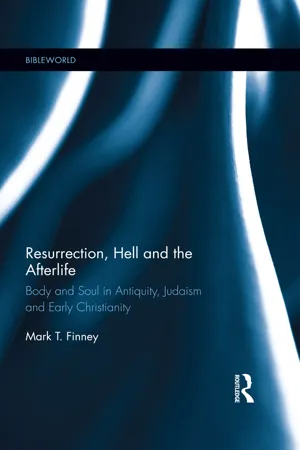
This book begins by arguing that early Greek reflection on the afterlife and immortality insisted on the importance of the physical body whereas a wealth of Jewish texts from the Hebrew Bible, Second Temple Judaism and early (Pauline) Christianity understood post-mortem existence to be that of the soul alone. Changes begin to appear in the later New Testament where the importance of the afterlife of the physical body became essential, and such thoughts continued into the period of the early Church where the significance of the physical body in post-mortem existence became a point of theological orthodoxy. This book will assert that the influx of Greco-Romans into the early Church changed the direction of Christian thought towards one which included the body. At the same time, the ideological and polemical thrust of an eternal tortuous afterlife for the wicked became essential.
eBook - ePub
Resurrection, Hell and the Afterlife
Body and Soul in Antiquity, Judaism and Early Christianity
- 204 pages
- English
- ePUB (mobile friendly)
- Available on iOS & Android
eBook - ePub
Resurrection, Hell and the Afterlife
Body and Soul in Antiquity, Judaism and Early Christianity
About this book
Information
1 Afterlife in Antiquity
Post-Mortem Existence in its Greco-Roman Context
DOI: 10.4324/9781315626888-2
Average life expectancy in the ancient Greco-Roman world was very low. Statistics from tombstones show that death occurred around the age of twenty-three years for men and twenty years for women; just forty percent reached that age and only fifty percent of children survived to their tenth birthday (Horsley 1983; Wiedermann 1989: 15). General illness was the primary cause of this (Bolt 1998: 59). So, the average ancient Greek or Roman died young and ill, and death was a ubiquitous feature of Greco-Roman life. Walter Burkert notes that such a social environment led to considered reflection on the afterlife in all periods of antiquity and that there are three significant stages in the development of the afterlife amongst the ancient Greeks: the archaic period, the age of Homer, and the later Hellenistic period influenced by Plato (Bernstein 1993; Burkert 1985).1
Firstly, in archaic Greek thought, the dead were considered to exist as wispy, smoke-like shadows either in their tombs or under their homes and were a force to be reckoned with for the living: positive if kept content, but destructive otherwise.2 As such they had to be placated with offerings of food and drink for, on the one hand, they were thought to be able to take vengeance on others, and yet on the other, they had the ability to heal the sick or even resurrect the dead.3 The ancestor cult was particularly important in this regard, for a dead ancestor buried under a home remained part of the extended family and could protect both home and family, or one buried in a field was thought to have the power to guard that field during its fallow year (Hallote 2001: 29–35). The reason for their influence was their liminal ‘power’ as they existed, in some senses, between the worlds of the dead and the living. Yet, in archaic Greek thought the ψνχή4 (psyche), the soul or ‘life’ of a person, was also considered a form of material substance and may have been thought of in a comparable way to air or aether, but which was still in some way ‘material.’ As Gregory Riley notes, “No concept of immateriality yet existed in Greece, even the gods had bodies and could, for example, engage in sexual relations with humans or be wounded in battle” (Riley 1995: 28, citing Hom. Il. 5.330–62; and see Renehan 1979).
The second stage in the development of thoughts on the afterlife is that dominated by Homer who remained of supreme influence well into the Roman period. His significance in later Greco-Roman life and culture is adequately summed up by Moses Finley (1977: 15):
No other poet, no other literary figure in all history for that matter, occupied a place in the life of his people such as Homer’s. He was their pre-eminent symbol of nationhood, the unimpeachable authority on their earliest history, and a decisive figure in the creation of their pantheon, as well as their most beloved and most widely quoted poet. Plato (Republic 606E) tells us that there were Greeks who firmly believed that Homer ‘educated Hellas and that he deserves to be taken up as an instructor in the management and culture of human affairs, and that a man ought to regulate the whole of his life by following this poet.’5
For Homer, the departed soul leaves the body sometimes from a mortal wound or more often simply by being breathed out of the mouth near death, whereupon it departs for the miserable and shadowy world of Hades. Here, it exists as an ‘image’ (εἴδωλον) and Hades is the destination for the souls of all people (almost without exception), and from which there is no return. Here, souls simply “flit about like shadows” (Od. 10.495). That said, in Homeric thought, and comparable with earlier reflection, it is the ‘material’ attributes of the soul that are of some import, for the ψνχή was an image of the person to the extent that it moved and spoke like the living being (Bremmer 1983: 73). It was also the life force of the body, for on the departure of the ψνχή the physical body died. Some key relevant Homeric texts include the statement of Achilles to his friends, “The soul of a man does not return again, neither by being carried off nor seized, after it has crossed the barrier of his teeth” (Il. 9.408–409); or when Achilles speaks to Priam after the death of his son Hector, “for there is nothing to be gained from grief for your son; you will never bring him back” (Il. 24.550).6 On Hector’s own death, Homer confirms that his ψνχή had departed to Hades: “Even as he thus spake the end of death enfolded him and his soul fleeting from his limbs was gone to Hades, bewailing her fate, leaving manliness and youth” (Il. 22.362).7
In Hades, life of a sort persists, and memory too, much to the chagrin of the departed.8 In the Odyssey, Odysseus is permitted to descend into Hades to speak with Achilles and attempts to encourage the departed hero: “Formerly, in your lifetime, we Argives used to honour you equally with the gods, and now that you are here you exercise great power over the dead. Do not grieve about it, Achilles, now that you are dead.” The reply of Achilles is illuminating: “Do not make light of death to me, noble Odysseus. I would rather be on earth a serf to a landless man, with small enough living for himself, than act as king over all these dead men who have perished” (Od. 11.484–91).9 The Greeks may have at times employed the concept of the dead rising up, but for the vast majority this was only a rhetorical absurdity—the dead remained in Hades.10 Only for a very select few was there a place of peace and blessing after death in such places as the Elysium fields or the Isles of the Blessed. The Greek king Menelaus was said to dwell in Elysium (Od. 4.565), and the heroes of Thebes and Troy dwelt on the Isles of the Blessed (Hesiod, Opera et Dies 166). And yet, there are some elements of ambiguity in Homeric thought, for while Odysseus can meet the shade (εἴδωλον) of Hercules on his journey to the underworld, the ‘real’ Hercules is at the same time feasting with the immortal gods (Od. 11.601–27).11
Within a Homeric perspective the transition of the ψνχή to Hades takes place only after the proper funerary rites have taken place and the soul remains in a liminal state before this is completed, often near the body (Bremmer 1983: 123).12 Patroclus, for example, begs Achilles to perform the burial ritual for him so that he can cross the boundary river into the underworld:
You sleep, Achilleus; you have forgotten me; but you were not careless of me when I lived, but only in death. Bury me quickly as may be, let me pass through the gates of Hades. The souls, the images of dead men, hold me at a distance, and will not let me cross the river and mingle among them, but I wander as I am by Hades’ house of the wide gates. And I call upon you in sorrow, give me your hand; no longer shall I come back from death, once you give me the rite of burning. [Achilles] with his own arms reached for him but could not take him, but the spirit went underground like vapour, with a thin cry. [Achilles laments] Oh, Wonder! Even in the house of Hades there is left something, a soul and an image, but there is no real heart of life in it.(Il. 23.65–107)
On the death of Achilles, the bones of the two friends would share a common grave and the soul of Achilles, too, would descend into the dismal and murky darkness of Hades (Il. 23.83). On Odysseus’ descent to the underworld, the first person to speak with him is his friend Elpenor, whose body was still unburied at the time, due to which he still belonged to the special category of the abnormal dead (Od. 11.38–41). Elpenor urges Odysseus to bury his body for failure to do so could bode ill for Odysseus: “Leave me not behind thee unwept and unburied as thou goest thence, and turn not away from me, lest haply I bring the wrath of the gods upon thee” (Il. 11.71–74).
Yet, within the broader literature of the period there is another post-mortem scenario for a very select few: those superlative Greek heroes who became immortalized like the Olympians, and what is assumed in such cases is that the ψνχή never actually left the body (Collins 1997: 92). As Stephen Bedard notes, this elevation to immortal life among the gods after his/her death, “was an important theme in Greek literature,” and although the original earthly physical body need not itself be relocated to heaven, if not, the newly apotheosized individual dwelt in some form of a god-like body (2008: 181).13 Vigdis Songe-Møller articulates this well:
The Greeks were familiar with the conception that eternal existence includes bodily existence. Or perhaps rather: that there are bodies which live forever […] namely the bodies belonging to gods and to very special humans, whom the gods decided to give the status of immortals. A transformation of mortals into immortals actually required a bodily transformation, a transformation from a mortal human body to an immortal divine body.(2009: 114, italics his)
He goes on to note that the philosophical or anthropological dualism between body and soul found in later Platonic thought is absent from earlier Greek mythological thinking, and rather, the only dualism that exists is the distinction of two kinds of bodies: human and divine. Likewise, Stanley Porter argues that the Greeks had a “significant tradition of bodily resurrection that has been neglected in discussion of the resurrection in the New Testament […] there is a strong tradition of contemplation of the soul’s destiny in the afterlife, along with examples of bodily resurrection” (1999: 53, 68).
The Influence of Plato
Burkert’s third and final stage in Greek thought on the afterlife is the period dominated by Plato which includes a progression towards astral immortality and a generally more positive experience of life after death for most. The changes in Greek reflection, towards a framework of thought that moderns are more familiar with, begin in the writings of Pythagoras (Davies 1999: 135),14 Pindar,15 Orphism,16 Socrates, and culminate in the work of Plato, in which the soul was considered to be both immaterial and in some senses the true vehicle for human identity (Riley 1995: 32).17 Platonic philosophy considered the soul to originate in the heavenly realm and to be trapped or imprisoned in an earthly body where the two were in tension to the point of being enemies. Plato writes:
When the soul and the body are joined together, nature directs the one to serve and be ruled, and the other to rule and be master. The divine is by nature fitted to rule and lead, and the mortal to obey and serve […] the soul is most like the divine and immortal and intellectual and uniform and indissoluble and ever unchanging, and the body, on the contrary, most like the human and mortal and multiform and unintellectual and dissoluble and ever changing.(Ph...
Table of contents
- Cover Page
- Halftitle Page
- Series Page
- Title Page
- Copyright Page
- Table Of Contents
- Abbreviations
- Introduction
- 1 Afterlife in Antiquity: Post-Mortem Existence in its Greco-Roman Context
- 2 Biblical Beginnings: Death and Afterlife in the Hebrew Bible
- 3 The Priority of the Soul: Constructions of Afterlife in Second Temple Judaism
- 4 Life after Death in Additional Jewish Literature: The Dead Sea Scrolls and Later Rabbinic Thought
- 5 New Testament Beginnings: Afterlife in the Thought of the Apostle Paul
- 6 The Priority of the Body: Post-Mortem Existence in the Later New Testament
- 7 The Rise of Gehenna: Afterlife in Early Christianity
- 8 What the …? Developments of Hell in its Jewish and Christian Contexts
- Conclusion
- Ancient Sources Index
- Author Index
Trusted by 375,005 students
Access to over 1.5 million titles for a fair monthly price.
Study more efficiently using our study tools.
Frequently asked questions
Yes, you can cancel anytime from the Subscription tab in your account settings on the Perlego website. Your subscription will stay active until the end of your current billing period. Learn how to cancel your subscription
No, books cannot be downloaded as external files, such as PDFs, for use outside of Perlego. However, you can download books within the Perlego app for offline reading on mobile or tablet. Learn how to download books offline
Perlego offers two plans: Essential and Complete
- Essential is ideal for learners and professionals who enjoy exploring a wide range of subjects. Access the Essential Library with 800,000+ trusted titles and best-sellers across business, personal growth, and the humanities. Includes unlimited reading time and Standard Read Aloud voice.
- Complete: Perfect for advanced learners and researchers needing full, unrestricted access. Unlock 1.5M+ books across hundreds of subjects, including academic and specialized titles. The Complete Plan also includes advanced features like Premium Read Aloud and Research Assistant.
We are an online textbook subscription service, where you can get access to an entire online library for less than the price of a single book per month. With over 1.5 million books across 990+ topics, we’ve got you covered! Learn about our mission
Look out for the read-aloud symbol on your next book to see if you can listen to it. The read-aloud tool reads text aloud for you, highlighting the text as it is being read. You can pause it, speed it up and slow it down. Learn more about Read Aloud
Yes! You can use the Perlego app on both iOS and Android devices to read anytime, anywhere — even offline. Perfect for commutes or when you’re on the go.
Please note we cannot support devices running on iOS 13 and Android 7 or earlier. Learn more about using the app
Please note we cannot support devices running on iOS 13 and Android 7 or earlier. Learn more about using the app
Yes, you can access Resurrection, Hell and the Afterlife by Mark Finney in PDF and/or ePUB format, as well as other popular books in Theology & Religion & Biblical Criticism & Interpretation. We have over 1.5 million books available in our catalogue for you to explore.