- 294 pages
- English
- ePUB (mobile friendly)
- Available on iOS & Android
eBook - ePub
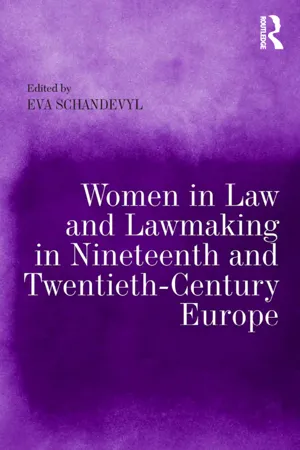
Women in Law and Lawmaking in Nineteenth and Twentieth-Century Europe
About this book
Exploring the relationship between gender and law in Europe from the nineteenth century to present, this collection examines the recent feminisation of justice, its historical beginnings and the impact of gendered constructions on jurisprudence. It looks at what influenced the breakthrough of women in the judicial world and what gender factors determine the position of women at the various levels of the legal system. Every chapter in this book addresses these issues either from the point of view of women's legal history, or from that of gendered legal cultures. With contributions from scholars with expertise in the major regions of Europe, this book demonstrates a commitment to a methodological framework that is sensitive to the intersection of gender theory, legal studies and public policy, and that is based on historical methodologies. As such the collection offers a valuable contribution both to women's history research, and the wider development of European legal history.
History of Women in the Legal Profession
Chapter 1
From Philanthropists to Juvenile Judges: Women Dealing with Juvenile Delinquency. International Debates and Local Practices in Belgium (1890–1960)
On 15 May 1912, after several years of harsh debate, members of the Belgian Parliament enacted the country’s first law on child protection.1 This law notably established juvenile courts, which concretized a wish inherited from the previous century: to withdraw delinquent minors from the penal law. From that point on, children were no longer to be judged as adults but by one single specialized judge. Despite its humanitarian tone, the actual intentions of this legislation entailed further ramifications. The law of 1912 was the first great form of the realization of the so-called défense sociale doctrine.2 It was focused on children who were victims, delinquents or just ‘difficult’, in the sense of generating a social risk. The law provided for interventions that would affect families directly, some preventive and some curative, involving placement of ‘children at risk’ in institutions.
This shift from the penal field to the social (but still judicial) field went together with the emergence of new parties concerned: the juvenile judge and the délégué(e) à la protection de l’enfance, a function which was claimed to be inspired by probation officers in the United States.3 These probation officers led enquiries into the families in preparing the judge’s decision and supervising children who were to stay with their family following a judge’s decision.
Their mission was twofold: proceed to a social investigation into the minor and his family in order to supply the judge with information on the possible fate to be reserved for the child appearing before him; supervise the child should he or she be placed under the mode of release on probation, by submitting a report to the judge on the child’s schooling, work, frequentations, behaviour and so on.
Throughout the debates in parliament, extending over two decades, the emphasis was placed on the success of the methods used in the US, and particularly the positive repercussions of the officers’ work, in terms of relapse for example.4 Some of these foreign institutions (Chicago, New York and Canadian municipal courts), the names of which regularly came up in the debates, often employed women as probation officers or even magistrates. Indeed, at the international level, child protection was one of the first fields where women were socially, politically and professionally involved. At the end of the nineteenth century, a reflection emerged about the part they could play in specialized courts dealing with children, which were created all around Europe. As Seth Koven and Sonya Michel mentioned, the rise of women’s social action movements is connected to the emergence of state welfare policies, and women succeeded in ‘shaping one particular area of state policy: child welfare. It was in this area, closely linked to the traditional female sphere, that women first claimed new roles for themselves and transformed their emphasis on motherhood into public policy’.5
The foreign (mainly American) innovative institutions, regularly quoted in Belgian debates for their exemplary ways of working, influenced Belgian lawmakers. The institutions employed female officers with real professional training in juvenile delinquency management, under various statuses and conditions. They were either full-fledged civil servants or employees paid thanks to private fundraising.6 Their salaries were often quite low, but nonetheless regarded as a stable career employment.
In conceiving the 1912 law, Belgian members of parliament were aware of foreign experiences linking women to child protection. Therefore, it seemed justified to women to benefit from the opportunity that the creation of a new judicial territory related to child protection in Belgium might represent for them. It should be immediately specified that the choices made by members of parliament, led by the Catholic minister Carton de Wiart, quickly restricted professionalization opportunities in the field as well as the opening of these positions to women. The opening of the juvenile judge position to women was not even discussed, since it was decided to recruit these new judges among magistrates in office, who at that time were all men (women did not have access to the magistracy until 1948).
Probation officers, juvenile judges, women doctors, female police officers … Although women’s commitment in child protection was large and varied, every function or duty involving women had to be negotiated, and the specificity – or even the legitimacy – of women’s official participation in the field of child protection was debated with sometimes considerable vigour. How did women appear as privileged auxiliaries of justice or the police with regard to juvenile delinquency treatment? How did their commitment, often presented as ‘natural’ in some discourses, materialize in practical experiences? Was their integration really that evident? And, finally, how was their work received, evaluated or criticized?
This chapter aims to explore these issues, from the early parliamentary debates in 1890 when the first law project on child protection was elaborated, up to achievement after World War II, when women succeeded in their efforts to be integrated into child protection programmes and institutions as real professionals. Sources for exploring these questions are numerous and rich. We used parliamentary debates records (annales parlementaires); specialized literature in the field of child protection – journals or practitioners’ reports; and writings of Belgian feminists engaged at the national or international level (League of Nations). The analysis of these ideological debates was complemented by a study of the juvenile courts’ archives, which inform us on the practices of child protection services and workers.
The Délégué(e) à la Protection de l’Enfance (1912–1935): A Charitable Model
Let us now discuss the role of the délégué(e) à la protection de l’enfance for which Belgian parliament members opted, yet with a quite different approach than that of the American success stories they at first claimed to have been inspired by. It is true that Carton de Wiart directly advocated the ‘recruitment’ of women as probation officers (we will deal with this issue later). However, he ruled out all the arguments that favoured a professionalization of the position, turning down the amendment proposed by the socialists presented by the deputy, Hector Denis, according to which probation officers were to be appointed by the government instead of the judges. The Catholic minister replied that his objective was ‘to foster dedication rather than to create job opportunities’.7 He opposed any form of professionalization of the probation officers, and wished the position to be given to volunteers rather than to civil servants.8 Thus, the délégué(e)’s mission fitted into the purest paternalistic tradition inherited from the nineteenth century, with a recruitment of its lifeblood from philanthropic organizations and local social actors: ‘visitors to the poor, teachers, members of the Saint Vincent de Paul Society and the Sisters of Mercy.’9
According to this model based on charity, financial compensation, one of the most obvious characteristics of professionalization, would allegedly alter the pureness of the actions and the quality of the interventions within families. The charity model favoured the selfless interventions of philanthropists rather than the intrusion of beggars (quémandeurs, as Carton de Wiart termed them) looking for a small salary at the state’s expense.
The Catholics used as their main argument that it was advisable for women to intervene in the noble cause of child protection so as to rule out the idea of financial compensation. Indeed, paying the délégué(e)s à la protection de l’enfance would result in philanthropic women and women from the upper middle-class involved in charity disengaging themselves, their social rank being incompatible with the notion of salary. ‘We should avoid ruling out any contribution due to conditions that might scare people with very delicate sensibilities away’, as Carton de Wiart put it.10
The délégué(e)s à la protection de l’enfance had to be filled with devotion, and as such, the task had to be performed by volunteers. Volunteering was seen as favouring the participation of women already involved in the field. Their presence was strongly encouraged through maternalist arguments, praising the typical qualities of the intervention of women in dealing with delinquent children and their families. Carton de Wiart explained:
Women’s cleverness, when used to do good, contains an infinite diversity and energy. As they are more in touch with the small details of everyday life, and are more intimate confidants of hidden woes, women will often be better able to soothe the former and discreetly show interest in the latter.11
This opening of the delegate position to women illustrates this will to build a truly protective model around delinquent children. Protecting rather than punishing, ‘depenalizing’ without ‘dejudicializing’ are all leitmotivs justifying the setting up of systems around children reminiscent of a harmonious family structure, with a sensitive and understanding mother-like probation officer on the one hand, and a paternalistic and protective judge on the other hand.
Indeed, debates in the Belgian Parliament heavily insisted on this notion of the paternalistic figure of the judge, therefore notably ruling out collegiality – preferring a single judge instead of a collegial exercise of jurisdiction – and stressing the necessity of recruiting experimented and stable magistrates for these positions. Some deputies went further, as did the socialist politician Georges Hubin, who pleaded for restricting access to this function to family men:
I do not consider a bachelor as able to properly judge children. (…) In order to be able to judge a child (…) one has to have children of his own, to have felt the sufferings that are incurred in bringing them up. One needs the experience of their education and of their souls.12
We should add that this kind of argument was only used for men. The experience of motherhood as an ultimate skill was never required for women. This illustrates once more how these qualities were perceived as innate and natural, rather than personal: there was no necessity, for women, to experience motherhood in order to be recognized as experts in the field. Maternalist discourses, aiming at promoting women’s involvement in the field of child welfare, exalted women’s capacities as mothers, and extended to society as a whole their values of care, nurturance and morality.13
In the end, parliament members agreed on hiring volunteers. There was only one exception: some paid permanent probation officers were hired in ...
Table of contents
- Cover Page
- Title Page
- Copyright Page
- Contents
- List of Tables
- Notes on Contributors
- Acknowledgements
- An Introduction to Women in Law and Lawmaking in Nineteenth- and Twentieth-century Europe
- PART I HISTORY OF WOMEN IN THE LEGAL PROFESSION
- PART II GENDER CONSTRUCTIONS AND THEIR IMPACT ON JURISPRUDENCE
- PART III GENDERED LEGAL CULTURES IN GLOBAL PERSPECTIVE
- Index
Trusted by 375,005 students
Access to over 1.5 million titles for a fair monthly price.
Study more efficiently using our study tools.
Frequently asked questions
Yes, you can cancel anytime from the Subscription tab in your account settings on the Perlego website. Your subscription will stay active until the end of your current billing period. Learn how to cancel your subscription
No, books cannot be downloaded as external files, such as PDFs, for use outside of Perlego. However, you can download books within the Perlego app for offline reading on mobile or tablet. Learn how to download books offline
Perlego offers two plans: Essential and Complete
- Essential is ideal for learners and professionals who enjoy exploring a wide range of subjects. Access the Essential Library with 800,000+ trusted titles and best-sellers across business, personal growth, and the humanities. Includes unlimited reading time and Standard Read Aloud voice.
- Complete: Perfect for advanced learners and researchers needing full, unrestricted access. Unlock 1.5M+ books across hundreds of subjects, including academic and specialized titles. The Complete Plan also includes advanced features like Premium Read Aloud and Research Assistant.
We are an online textbook subscription service, where you can get access to an entire online library for less than the price of a single book per month. With over 1.5 million books across 990+ topics, we’ve got you covered! Learn about our mission
Look out for the read-aloud symbol on your next book to see if you can listen to it. The read-aloud tool reads text aloud for you, highlighting the text as it is being read. You can pause it, speed it up and slow it down. Learn more about Read Aloud
Yes! You can use the Perlego app on both iOS and Android devices to read anytime, anywhere — even offline. Perfect for commutes or when you’re on the go.
Please note we cannot support devices running on iOS 13 and Android 7 or earlier. Learn more about using the app
Please note we cannot support devices running on iOS 13 and Android 7 or earlier. Learn more about using the app
Yes, you can access Women in Law and Lawmaking in Nineteenth and Twentieth-Century Europe by Eva Schandevyl in PDF and/or ePUB format, as well as other popular books in History & 19th Century History. We have over 1.5 million books available in our catalogue for you to explore.