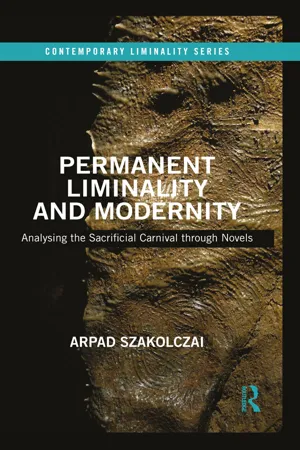
This book offers a comprehensive sociological study of the nature and dynamics of the modern world, through the use of a series of anthropological concepts, including the trickster, schismogenesis, imitation and liminality. Developing the view that with the theatre playing a central role, the modern world is conditioned as much by cultural processes as it is by economic, technological or scientific ones, the author contends the world is, to a considerable extent, theatrical - a phenomenon experienced as inauthenticity or a loss of direction and meaning. As such the novel is revealed as a means for studying our theatricalised reality, not simply because novels can be understood to be likening the world to theatre, but because they effectively capture and present the reality of a world that has been thoroughly 'theatricalised' - and they do so more effectively than the main instruments usually employed to analyse reality: philosophy and sociology. With analyses of some of the most important novelists and novels of modern culture, including Rilke, Hofmannsthal, Kafka, Mann, Blixen, Broch and Bulgakov, and focusing on fin-de-siècle Vienna as a crucial 'threshold' chronotope of modernity, Permanent Liminality and Modernity demonstrates that all seek to investigate and unmask the theatricalisation of modern life, with its progressive loss of meaning and our deteriorating capacity to distinguish between what is meaningful and what is artificial. Drawing on the work of Nietzsche, Bakhtin and Girard to examine the ways in which novels explore the reduction of human existence to a state of permanent liminality, in the form of a sacrificial carnival, this book will appeal to scholars of social, anthropological and literary theory.
eBook - ePub
Permanent Liminality and Modernity
Analysing the Sacrificial Carnival through Novels
- 272 pages
- English
- ePUB (mobile friendly)
- Available on iOS & Android
eBook - ePub
Permanent Liminality and Modernity
Analysing the Sacrificial Carnival through Novels
About this book
Information
Part I
Before World War I
Waiting for the storm
1
Empires and their collapse
Fin-de-siècle Vienna in context
Following hints from Bakhtin (1981), Novels and the Sociology of the Contemporary presented the rise of the modern novel as a progress across certain ‘chronotopes’, or concrete times and places central for the rise of modernity which at the same time were birthplaces of the modern novel, through the intermediary of the theatre, as – here following hints from Agnew (1986) – the theatre was considered as not simply ‘reflecting’ such changes, rather a crucial operator in them as a social practice. The rise of the hypermodern novel is also connected to a new chronotope, and a particularly intriguing one, given that Austria never before or after played a major role in modern or European culture, except for the music of Beethoven, Mozart and Haydn at the end of the eighteenth century,1 while in the few decades before World War I it suddenly catapulted itself into the incubator of modernism.
Every single element of this crucial chronotope is profoundly shrouded in paradoxes and ambivalence. It starts at the most elementary level, its name. As it has been emphasised by two of its most famous writers, Robert Musil and Joseph Roth, a unique feature of the Habsburg Empire was that it ‘had no accepted name!’ (sic.; Janik and Toulmin 1973: 36–7). The political entity is usually called ‘Austro-Hungarian’ Empire, but Hungary had little to do with its features, entering the name as Pilate entered the credo, the only reason for the name being to please Hungarians who wanted to be outside the Empire. Even the expression ‘fin-de-siècle Vienna’ is misleading, as Prague was not simply part of the Empire, but played a major role both in its political and cultural life, much more than Budapest. Several of the most famous figures of the period were formed in Prague, like Mach, Husserl, Rilke or Kafka. In his speech delivered on the occasion of his Noble prize Elias Canetti described Kafka as an Austrian (Janik 2001: 1, 247), while Prague was often considered as the true capital of Austria.
Taking paradoxes further, members of the Vienna/Prague cultural elite were certainly self-conscious about being in the vanguard, while also keenly aware that such leadership position implied to be ahead of the others in terms of losing sense and direction, a fading of values and a growing sense of vagueness (Francis 1985: 1–2). The presumed vanguard status of Vienna was also combined with a keen sense of imitativity: Vienna followed London in economic terms, while Paris in culture: the famed theatre, poetry, opera, operetta, coffee-house and cabaret cultures of Vienna each imitated Paris models. Thus, far from being an independent centre of cultural flourishing, Vienna was rather the ‘seismograph’ or ‘weather station’ of Europe which ‘registered inexorably the signs, even the most imperceptible ones, of the catastrophe’ (according to Karl Kraus; see Magris 1986: 21), the ‘crucible’ of modernity (Steinberg 1984: 3); using the remarkable expression of Hermann Broch, it was ‘the centre of the European void of values [Wert-Vakuum]’ (Broch 1974: 47). Even further, this void soon assumed apocalyptic proportions, with the Viennese literary avant-garde, these vagabonds of the coffee tables even offering apologies for an apocalypse (Magris 1986: 21). Yet, in another striking expression of Broch, this apocalypse seemed, at least to some, even ‘joyful’ (Die fröhliche Apokalypse, title of section 4 of the first essay, a clear allusion to Nietzsche’s ‘gay science’, Die Fröhliche Wissenschaft).
Yet, again, a joyful apocalypse – meaning not the Second Coming but a genuine collapse and end-of-the-world-as-we-know-it – is simply absurd and unreal, and such unreality was indeed a central feature of fin-de-siècle Vienna. The great Viennese culture of the period only unmasked the ‘increasing abstraction and unreality of life’, which was ‘ever more absorbed by mechanisms of collective information and transformed by its own mise en scène’, the reality of the world perceived as being ‘identical to the spectacle it gave about it’ (Magris 1986: 21). Masks and unmasking assumed each other, producing a permanent game of illusion, where existence became inseparable from its images that were reproduced in innumerable copies; where everything was artificial, and therefore staged representation captured the true untruth of reality, with masks hiding not reality but the void. It is in this sense that the representative forms of art in fin-de-siècle Vienna literally represented, and in every possible sense, the void, and in an ever-increasing scale and magnitude. The flagship venue of Vienna was theatre, most closely related to Vienna modernism, a modernism ‘officially’ inaugurated by the Ibsen week of April 1891 (Yates 1992: 1–2). Theatre again offered a perfect ‘representation’ of Vienna modernism, where ‘in the truest sense of the term, or rather in its double sense, theatre represented the misery of the epoch masqueraded as wealth’ (Broch 1974: 16). Due to the centrality of its theatre, the world in Vienna genuinely felt as a stage (Yates 1992: 66); though, at the same time, already by the 1880s, recalling mid-eighteenth century England, theatrical life reached the nadir of intellectual vacuity, though – or, again, rather because of it – theatre remained the heart of Vienna (Ibid.: 68, 72). Still, an even more representative genre of the epoch was opera, which managed to transform the ‘non-style’ of the epoch itself into style (Broch used the term ‘non-style’ in the title of his first chapter), to be superseded by the operetta, which was a genuine decoration of the void (Vakuum-Dekoration; Broch 1974: 47).
Such decorated void as lying at the heart of the Empire had an unsurpassable symbol, the empty box seat of the Emperor vacated at every single theatrical show of the Empire, waiting for the Emperor to arrive, an event that never took place, and taken by Broch as the true image of Austria (Magris 1986: 24). The theatre expressed this not only representatively but endlessly, staging a prolonged repetition of the apocalypse (Ibid.: 21–2), captured by Hofmannsthal in the Rosenkavalier, another representative work of art at the point of intersection between theatre, opera and operetta, where at its end the protagonist, the Marschallin – another par excellent Viennese hero, not a military general but his wife – just cannot ever end saying her goodbyes.
Vienna suddenly came to play a representative role in European culture at the end of the nineteenth century because this was a period of decadence, decay, void and nihilism, and this had a certain affinity with the kind of spirit that was evidently already present in Austria. It was this specific kind of (nihilist) spirit that Viennese modernism managed to stamp on Europe, and so, with a bit of rhetorical excess, evoking Shakespeare it can be claimed that ‘We are the stuff of Viennese dreams, we moderns’ (Whalen 2007: 1).
Yet, it was not simply the spirit of decay, but the decay of a very specific kind of spirit. We need now to reconstruct this ‘Austrian’ spirit, starting from its sources, and focusing especially on its affinities with the ‘Byzantine spirit’, a spirit particularly present in the unique and quite non-Prussian bureaucracy of the ‘Monarchy’.2
The Austrian spirit
In trying to capture this spirit the first problem we encounter is that it is difficult even to pin down its name. The spirit of what? This spirit is not of Vienna, a city, and certainly not of Austria as a nation state, but of the monarchy, or rather the Empire, connected to the Habsburgs as a dynasty – each element playing its role, yet none identifying the entity. Opting for the adjective ‘Austrian’ was guided ot so much by the contemporary country name, rather its etymological origin: ‘Austrian’ means Eastern, originally designating the Eastern part of the Carolingian Empire. The ‘Eastern’, even ‘Asiatic’ character of Vienna was much bemoaned by visitors even before World War I (Whalen 2007: 148), while Rilke loathed Vienna even more than Paris (Pizer 2003: 117). Such adjectives have their precise meaning, connected to terms like ‘Byzantine’ and ‘Ottoman’, whose links to the Austrian court bureaucracy are evident – and which was also connected by Kafka to the Chinese imperial court, stressing further the fruitfulness of such metaphors. The most important link, however, concerns the ‘Byzantine spirit’.
The central feature of fin-de-siècle Vienna is decadence (Borkenau 1938: 155).3 Vienna in its Golden Age (1890–1918) was certainly decadent, and in an extreme manner, which immediately raises some question marks about the value and meaning of such a ‘golden age’, in contrast to similar periods in Athens or Florence, which certainly were not decadent – at least, until the end. The term also evokes the Paris of Baudelaire and the thinking of Nietzsche, much influenced by Baudelaire’s vision of modern decadence. But the ‘Austrian spirit’ can be traced before fin-de-siècle decadence – and here parallels with the Byzantine Empire become particularly close. This is because a central feature of this spirit was its paradoxical, dualistic, even schismatic character – thus directly recalling the similar Byzantine spirit (Szakolczai 2013a, Chapter 4).
Beyond mere analogy, the connections are historical.
The rise of the Habsburg Empire: a genealogical sketch of its spirit
By coincidence, if not by direct succession, the rise of the Habsburgs followed upon the demise of the Byzantium. While the 1437–38 Ferrara-Florence council marks the last, ultimately unsuccessful attempt to unify the Eastern and Western Churches, and 1453 the sack of Constantinople and the collapse of the Empire, it was in 1437–38 that the Habsburgs finally managed to get hold of the Holy Roman Empire, with its seat shifting from Prague to Vienna, while in 1453 Frederick III was crowned as Holy Emperor in Rome. Within half a century, through successful marriages – just when Henry VIII and Matthias Corvinus had no success with their Aragonian wives to secure an heir – the Habsburgs inherited first Burgundy (1477) and then Spain (1507). The Burgundy court for centuries had close connection with the Byzantine world, while the Eastern connections of Spain, through centuries of Islamic presence, thus an indirect link to the Byzantium are well known.
Growth based not on inner strength, rather clever goal-oriented strategic thinking follows a long Habsburg tradition. The central instance in the growth of the Habsburgs from merely local potentates towards major power players was provided by a forgery, the forging of the Privilegium Maius (1358/59), to promote the claims of Rudolf IV. The forgery was immediately recognised, and by none other than Petrarch, central figure of the Italian Renaissance, yet it eventually became used to support the increasing Habsburg claims for legitimate rule, and in the sixteenth–seventeenth centuries the Habsburgs formally ruled over most of Europe, excepting England, France, small sections of Italy and Poland.
An Empire gained by such means, without any clear human qualities and driving forces, could not be effective, and it wasn’t. The Habsburgs lived under the shadow of the Holy Roman Empire, since long little more than a name; and yet, such names and titles mattered much in a Europe increasingly oriented towards theatrical representativeness. In the late eighteenth century Vienna was little more than a medieval city, with effective rule being divided with Prague.
As a result, and especially with the rise of Prussia, challenging the supremacy of Habsburg Austria in the German-speaking areas, the question of ‘reform’ – the big slogan of all Enlightenments – was increasingly on the agenda. It had two aspects marking the stamp Habsburg Austria would leave through its fin-desiècle decadence on the modern world: the build-up of imperial bureaucracy and the reconstruction of Vienna. Both turned out to produce extremely paradoxical results, culminating in the schismatic ‘Austrian spirit’, caught between rigid formalism and decadent sensualism.
Bureaucracy
The emergence of modern bureaucracy is usually identified with the rise of Prussia, closely related to the modern military, legal and industrial machines, and even the modern university system, with consequences that – due to the smokescreen exerted by the World Wars – are still not fully visible. Austria for long lagged behind in following this road of ‘progress’, so the imitation of the Prussian model was central for the reforms started by Joseph II, shortly after acceding to the throne in 1780. However, Joseph died in 1790, his heir Leopold in 1792, and then the throne was inherited by the extremely conservative Francis, the last Holy Roman Emperor, who – indirectly, through Metternich, until 1848, scared by the developments of the French Revolution and the loss of the Holy Roman Empire – inaugurated an extremely reactionary mode of government.
This modality of reactionary conservatism had two major paradoxes. To begin with, in contrast to England or France, or practically any other European countries, there was no real tradition to preserve. The Habsburg Empire was an artificial construct, gained by tricks and ruse, not by any significant valour or merit, and so it could only survive by mimicking values, including local traditions and Catholicism. While such traditions merited to be preserved, the Habsburg Empire as a political centre never had sufficient inner strength to care for them genuinely; it could only fake. The second, just as glaring paradox is that the main instrument of such reaction came to be the very bureaucracy that was put into place in the service of reform. The Austrian Empire thus ended up with a unique and particularly repulsive combination of Byzantine and Prussian bureaucracy, rendered even more lethal by the importance of Austria as a South-German Catholic stronghold, helping to justify the unjustifiable as bulwark against both the North (Protestantism) and the East (barbarism).4
Modernising Vienna
After 1848 changes delayed for long decades started to be implemented, resulting in feverish construction and a quick population explosion in the city. The crucial moment, with evident symbolic significance, was the 1857 demolition of medieval city walls, replaced by Paris-style boulevards, the Ringstrasse. These were the years of Manchester liberalism, and a largely speculative economic boom was particularly rampant in Austria, helped by the fact that the previous government even opposed the setting up of railways. Due to such feverish economic activity the period is called Gründerzeit, or time of (economic) foundations, when it was possible to make a fortune almost overnight, prompting even Jacob Burckhardt to say that soon Vienna will overshadow Paris (Riedl 2005: 25).
Faithful to the long tradition of make-believe central to Habsburg rule, developments in the entertainment industry were even more spectacular. The first major building completed on the Ringstrasse was the Opera house, and the constructions represented an enormous boom for the theatre world, with the launching of a series of private theatrical companies as well as the new, mixed genres of operettas and then cabarets (Springer 2006a: 309; Traubner 2003), taken over from Paris but developed with even more energy. As a result, the new main street of the city became ‘ “a theater of costumes and masks, an art of façade” ’ (Ann Tizia Leitich, as quoted in Whalen 2007). An overheated economic boom in tandem with a similarly escalated entertainment scene in an Empire historically obsessed with representation and maintaining a reality check only through endemic ruse and behind the scene manipulation was recipe for disaster – and indeed became the incubator of hypermodernism.
This again happened in the most appropriate, at once real and symbolic manner, with the Vienna World Fair, scheduled to open on 1 May 1873. As feverish construction in the city was much sparked by the experiences of the Austrian delegation at the 1851 first World Fair in London, many expected to reap the benefits of their investment through this crowning event. Due to spiralling expectations the economic situation became precarious even before the start of the Fair, with hopes that a success of the event would redeem matters. However, hit by bad weather and general overpricing the Fair turned out to be an economic disaster, generating one of the biggest stock-market disasters, the crash of 1873. This event, together with the Franco-Prussian war of 1870–1 cast the shadow under which fin-de-siècle decadence, breeding ground of hypermodernism, was urtured – not only in Vienna, but particularly virulent there.
Features of the schismatic spirit
In the title of a central chapter in their classic Wittgenstein’s Vienna Allan Janik and Stephen Toulmin (1973: 33) characterise ‘Habsburg Vienna’ as a ‘city of paradoxes’.5 Before World War I Vienna was a city full of radically contradictory qualities. It was the city of glamour, to sa...
Table of contents
- Cover
- Title
- Copyright
- Contents
- Preface
- Introduction
- PART I Before World War I: waiting for the storm
- PART II Suspended in the In-Between: Franz Kafka
- PART III After World War I: hypermodernity as sacrificial carnival
- Conclusion
- Bibliography
- Name index
- Subject index
Trusted by 375,005 students
Access to over 1.5 million titles for a fair monthly price.
Study more efficiently using our study tools.
Frequently asked questions
Yes, you can cancel anytime from the Subscription tab in your account settings on the Perlego website. Your subscription will stay active until the end of your current billing period. Learn how to cancel your subscription
No, books cannot be downloaded as external files, such as PDFs, for use outside of Perlego. However, you can download books within the Perlego app for offline reading on mobile or tablet. Learn how to download books offline
Perlego offers two plans: Essential and Complete
- Essential is ideal for learners and professionals who enjoy exploring a wide range of subjects. Access the Essential Library with 800,000+ trusted titles and best-sellers across business, personal growth, and the humanities. Includes unlimited reading time and Standard Read Aloud voice.
- Complete: Perfect for advanced learners and researchers needing full, unrestricted access. Unlock 1.5M+ books across hundreds of subjects, including academic and specialized titles. The Complete Plan also includes advanced features like Premium Read Aloud and Research Assistant.
We are an online textbook subscription service, where you can get access to an entire online library for less than the price of a single book per month. With over 1.5 million books across 990+ topics, we’ve got you covered! Learn about our mission
Look out for the read-aloud symbol on your next book to see if you can listen to it. The read-aloud tool reads text aloud for you, highlighting the text as it is being read. You can pause it, speed it up and slow it down. Learn more about Read Aloud
Yes! You can use the Perlego app on both iOS and Android devices to read anytime, anywhere — even offline. Perfect for commutes or when you’re on the go.
Please note we cannot support devices running on iOS 13 and Android 7 or earlier. Learn more about using the app
Please note we cannot support devices running on iOS 13 and Android 7 or earlier. Learn more about using the app
Yes, you can access Permanent Liminality and Modernity by Arpad Szakolczai in PDF and/or ePUB format, as well as other popular books in Social Sciences & Sociology. We have over 1.5 million books available in our catalogue for you to explore.