- 224 pages
- English
- ePUB (mobile friendly)
- Available on iOS & Android
eBook - ePub
About this book
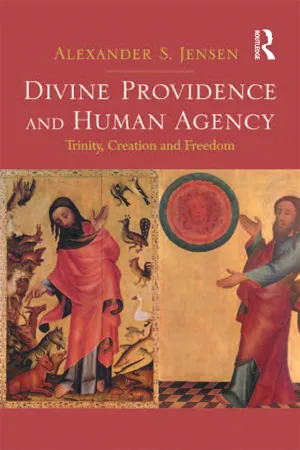
Divine Providence and Human Agency develops an understanding of God and God's relation to creation that perceives God as sovereign over creation while, at the same time, allowing for a meaningful notion of human freedom. This book provides a bridge between contemporary approaches that emphasise human freedom, such as process theology and those influenced by it, and traditional theologies that stress divine omnipotence.This book argues that it is essential for Christian theology to maintain that God is ultimately in charge of history: otherwise there would be no solid grounds for Christian hope. Yet, the modern human self-understanding as free agent within certain limitations must be taken seriously. Jensen approaches this apparent contradiction from within a consistently trinitarian framework. Jensen argues that a Christian understanding of God must be based on the experience of the saving presence of Christ in the Church, leading to an apophatic and consistently trinitarian theology. This serves as the framework for the discussion of divine omnipotence and human freedom. On the basis of the theological foundation established in this book, it is possible to frame the problem in a way that makes it possible to live within this tension. Building on this foundation, Jensen develops an understanding of history as the unfolding of the divine purpose and as an expression of God's very being, which is self-giving love and desire for communion. This book offers an important contribution to the debate of the doctrine of God in the context of an evolutionary universe.
Information
Chapter 1
Introduction
The notion that God is active in creation has become problematic in modern times. This is, I suppose, for two reasons. First, we commonly view the world as autonomous. Natural occurrences within the world can be explained perfectly well in terms of natural causes according to the laws of physics. If there is anything that classical physics, astrophysics and quantum physics cannot explain, then there is a good chance that this gap in our knowledge will be closed in due course. So there is not much space left for God to act – unless we assume that God miraculously interferes with the created order from time to time. Second, we also experience ourselves as free agents (with some obvious limitations). As a result, God’s agency and our agency appear to be in conflict. If God is omnipotent and ruling the universe, then there is no space for human freedom and agency. If we are free agents, then classical notions of divine providence and omnipotence are problematic. In this study, I shall approach the question of divine activity in creation primarily through the lens of this second set of issues. As part of these discussions, I shall also touch on the relation between God and the laws of physics – after all, these are created as well. I shall argue that, if we recover elements of the classical understanding of divine transcendence and approach the question in a consistently Trinitarian manner, then divine agency does not contradict human agency or the natural causal nexus. On the contrary, they work together in harmony in the realisation of the divine plan. This, obviously, needs some more explanation.
The common argument goes that if God is active in creation in a continuous way, i.e. that God is governing and directing events in creation according to God’s providence, then this must be at the expense of human freedom and agency. Conversely, if humans are free (with some limitation granted) and have genuine agency, then God cannot foreknow what they will do or determine the way in which they will behave. This can be understood in terms of the autonomy of the world from God, i.e. that God has withdrawn from creation and allows it to go in whatever direction it goes. If Christians want to hold on to divine activity within this autonomous world, then they need to assume that God interferes with the otherwise free course of nature in order to achieve God’s aims or to answer prayer. In this case, God acts from the outside, as it were, suspending the laws of nature or human freedom in order to change the course of the world. Alternatively, it can be understood in terms of God being present in creation, immanent in the world, but not controlling it. According to this view, God can only persuade and lure with a vision of goodness, truth and beauty. Humans, as free agents, are able to resist this divine lure. At the same time, the immanent God is affected by creaturely actions and takes into God’s own self the joy and sadness as well as the flourishing and suffering of all creatures. But, ultimately, this God is not able to realise the vision of goodness, truth and beauty without human co-operation.
The underlying issue is that human freedom and agency on the one hand and divine providence and omnipotence on the other seem to be in conflict. This conflict can be described as a zero-sum game: whatever one party gains the other party loses. So if God is omnipotent and governs the universe by God’s providence, then humans are mere puppets in God’s stage show. Alternatively, if humans are free and have true agency, then divine providence and omnipotence must be limited or entirely absent. God’s power can be seen as limited either because God cannot be coercively omnipotent, as in process theology, or that God has chosen to limit God’s own power in order to grant creatures their freedom and agency, as other theologians suggest. In this present study I seek to challenge the underlying assumption that divine agency and creaturely agency, and divine providence and creaturely freedom, are in this kind of conflict. Instead, I am going to argue that these can actually work harmoniously in the fulfilment of the divine purposes. This was the view of the Church Fathers and of the mediaeval theologians, but, due to intellectual developments in the late Middle Ages, this view became implausible. It is the task of this study to recover this plausibility, not by turning back the clock and repristinating a supposedly better past, but by exploring resources in modern theology that help us to overcome the problems in the perception of divine and creaturely activity.
The key to my argument is the recovery of a ‘strong’ notion of divine transcendence – not in the sense that God is extremely remote from the world, or that God is simply beyond time and space, but that God is utterly ineffable, beyond being, and, at the same time, immanent in and present to the world. Or, in other words, God is not a being among beings, but the source of all being. This is not a new insight. It is based on the classical view, which we can find in Augustine and Thomas Aquinas. More recently, Wolfhart Pannenberg argued in the late 1960s that if God is merely thought of as an existent being, then divine omnipotence and human freedom will be in irreconcilable conflict.1 In the 1980s, Kathryn Tanner suggested that it became implausible to speak about God as active in creation because two basic linguistic rules for discourse about God were not adhered to. These are that God must be spoken of as ‘transcendent beyond necessary relation of identity of difference with the non-divine’, which is similar to what I am going to call divine transcendence in the ‘strong’ sense. The other rule is God’s agency must be described ‘as immediate and universally extensive’, or, in other words, that divine causality is fundamentally different from creaturely causality.2 The shift from what I call a strong view of divine transcendence took place in the late Middle Ages, beginning shortly after the death of Thomas Aquinas, and being completed in the theology of the via moderna of William of Ockham and his followers. This shift has been identified and critiqued by many, among them John Milbank and Catherine Pickstock, who suggest that the loss of the neo-Platonic/Augustinian participation theory of being in the late Middle Ages is the source of all ills of modernity.3
Unlike Milbank and Pickstock I am not advocating a return to Augustinianism and neo-Platonism, however postmodern and critical, but seek to identify and make use of resources within modern theology to overcome the conundrums caused by the loss of the strong view of divine transcendence, of which, if one looks carefully, there are many. Tanner, for example, singles out Karl Barth and Karl Rahner as two twentieth-century theologians whose theology adhered to her rules of discourse and who therefore are able to speak of divine omnipotence and creaturely freedom meaningfully.4 And we can identify many more: in the context of this study, I shall refer to Friedrich Schleiermacher, who, in my opinion, recovered the strong notion of divine transcendence for modern theology, as well as to Rudolf Bultmann, Karl Barth, Wolfhart Pannenberg and, occasionally, John Macquarrie. Despite their diversity and disagreement on many issues they all come together on one key point: divine agency and human agency, divine providence and human freedom are not in conflict. All five share one fundamental assumption: they understand divine transcendence in what I call a ‘strong sense’ and divine agency as utterly different from creaturely agency, even if this is not always made explicit. In discussion with these authors, I shall draw out the strong notion of divine transcendence and explore its implications.
This provides the starting point for my discussion of the question of divine providence and human freedom, of divine activity in creation and human agency as well as of the existence of evil and the goodness of God. These four interrelated topics together will give an account of how we can speak meaningfully of God being active in creation. Each of these topics will be discussed from a historical perspective, beginning with biblical motifs and patristic insights and continuing with Augustine of Hippo and Thomas Aquinas. Then the change of the approach to the question in the late Middle Ages will be explored, and to the modern conundrums to which this led. In response to these, I shall embark on a discussion of Schleiermacher’s approach to the question, followed by an appreciation of Karl Barth or Rudolf Bultmann’s contribution, and of that of Wolfhart Pannenberg. Other authors, both classical and modern, will be drawn upon as appropriate. In interaction with these authors I shall develop my own thought on the questions.
It lies in the nature of the approach proposed in this study that it is impossible to give a straightforward answer to the question how God interacts with the world. Approaches that work on the basis of a ‘weak’ understanding of eternity are forced to find a causal joint through which God can work, for example at the quantum level by influencing quantum events, or at the macro level through emergent properties of complex systems. Alternately, if one holds a very strong view of divine omnipotence, one can claim that God has created the entire causal nexus of the whole world and its history in the act of creation, which would then, as we shall see, exclude any meaningful notion of human freedom and agency. Yet others, usually of a more conservative attitude, may think of God’s action in terms of the suspension of the natural laws in particular situations. In the course of this study, I shall critique each of these approaches as insufficient. In contrast, I shall build my thinking in the strong notion of divine transcendence, of God as utterly ineffable, the source of being, time and space, as well as of creaturely freedom and agency. Such an approach denies the very possibility of a causal joint through which God may work, because God works in, with and through every inner worldly event, and creatures participate in divine activity and freedom. Every attempt to explain the mechanics of divine action is bound to fail, because it denies the ineffability of God. As Augustine suggested, ‘if you can grasp it, it isn’t God’.5 We can apply this to divine action: precisely because God is ineffable, the way in which God works within the world is incomprehensible. If it were comprehensible, it would not be God at work.
The question remains how we can meaningfully speak of God and God’s activity in the world. As I shall develop later in this chapter, theological language properly understood does not make the incomprehensible comprehensible, but it describes and safeguards the fundamental Christian experience of the liturgy, and draws conclusions about what God is like in order for God to be experienced in the way in which God is experienced within the Christian community at worship and in its loving life. With regard to the topic at hand, this means that I will have to restrict myself to offering parameters within which one can make sense of divine providence at work in creation, our scientific knowledge and human freedom. I shall also critically interact with the obstacles which we encounter if we want to understand the world as God’s creation, in which God’s purposes are acted out, but in which we humans (and possibly other creatures, but that is another discussion) exercise our free will. This will lay the foundation for my own argument that God works in creation through God’s one eternal act of w...
Table of contents
- Cover Page
- Title Page
- Copyright Page
- Contents
- Acknowledgements
- 1 Introduction
- 2 God’s Transcendence and Eternity
- 3 Divine Omnipotence and Human Freedom
- 4 Divine Activity in Creation
- 5 A Cruciform Universe
- 6 Conclusion
- Bibliography
- Index
Trusted by 375,005 students
Access to over 1.5 million titles for a fair monthly price.
Study more efficiently using our study tools.
Frequently asked questions
Yes, you can cancel anytime from the Subscription tab in your account settings on the Perlego website. Your subscription will stay active until the end of your current billing period. Learn how to cancel your subscription
No, books cannot be downloaded as external files, such as PDFs, for use outside of Perlego. However, you can download books within the Perlego app for offline reading on mobile or tablet. Learn how to download books offline
Perlego offers two plans: Essential and Complete
- Essential is ideal for learners and professionals who enjoy exploring a wide range of subjects. Access the Essential Library with 800,000+ trusted titles and best-sellers across business, personal growth, and the humanities. Includes unlimited reading time and Standard Read Aloud voice.
- Complete: Perfect for advanced learners and researchers needing full, unrestricted access. Unlock 1.5M+ books across hundreds of subjects, including academic and specialized titles. The Complete Plan also includes advanced features like Premium Read Aloud and Research Assistant.
We are an online textbook subscription service, where you can get access to an entire online library for less than the price of a single book per month. With over 1.5 million books across 990+ topics, we’ve got you covered! Learn about our mission
Look out for the read-aloud symbol on your next book to see if you can listen to it. The read-aloud tool reads text aloud for you, highlighting the text as it is being read. You can pause it, speed it up and slow it down. Learn more about Read Aloud
Yes! You can use the Perlego app on both iOS and Android devices to read anytime, anywhere — even offline. Perfect for commutes or when you’re on the go.
Please note we cannot support devices running on iOS 13 and Android 7 or earlier. Learn more about using the app
Please note we cannot support devices running on iOS 13 and Android 7 or earlier. Learn more about using the app
Yes, you can access Divine Providence and Human Agency by Alexander S. Jensen in PDF and/or ePUB format, as well as other popular books in Theology & Religion & Religion. We have over 1.5 million books available in our catalogue for you to explore.