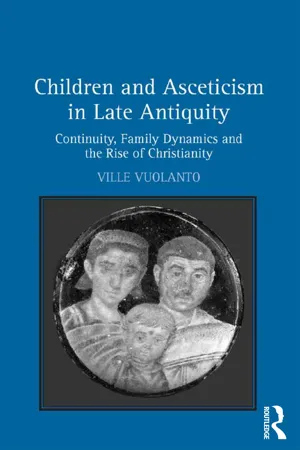
In Late Antiquity the emergence of Christian asceticism challenged the traditional Greco-Roman views and practices of family life. The resulting discussions on the right way to live a good Christian life provide us with a variety of information on both ideological statements and living experiences of late Roman childhood. This is the first book to scrutinise the interplay between family, children and asceticism in the rise of Christianity. Drawing on texts of Christian authors of the late fourth and early fifth centuries the volume approaches the study of family dynamics and childhood from both ideological and social historical perspectives. It examines the place of children in the family in Christian ideology and explores how families in the late Roman world adapted these ideals in practice. Offering fresh viewpoints to current scholarship Ville Vuolanto demonstrates that there were many continuities in Roman ways of thinking about children and, despite the rise of Christianity, the old traditions remained deeply embedded in the culture. Moreover, the discussions about family and children are shown to have been intimately linked to worries about the continuity of family lineage and of the self, and to the changing understanding of what constituted a meaningful life.
Does not an industrious peasant plant trees the fruit of which he will never see? Does not a great man found laws, institutions and society itself? What does the procreation of children mean, what the cares to continue our names, what the adoption of children, what the diligence in drawing up wills, what even the inscriptions on monuments and panegyrics, but that our thoughts run on the future, too?1
Asceticism became a widespread phenomenon in the Christian world of Late Antiquity, although it had been almost unknown to the mainstream of Greco-Roman culture. At first sight, asceticism was in opposition to traditional family life and its goals of promoting the familial line for coming generations; to remain unmarried was not an option before the rise of Christianity and there was no room for voluntary bachelors and spinsters. This shift was already noted by contemporary authors: as Gregory of Nyssa remarked, motherhood had been seen as a public duty among the Romans, something which he saw as at variance with ascetic Christian values.2 Indeed, by the end of the fourth century CE, asceticism had found its way into the everyday lives of families and households3 throughout the Roman world, and the whole idea of married life and family was questioned by celibate sons and daughters. Married couples took vows of abstinence and widows and widowers refused to remarry. How was it possible for this change in attitudes and behaviour to be propagated and how did it affect actual family relationships, especially between children and their parents?
The beginning of the period covered in my study, the last quarter of the fourth century and the first half of the fifth century, belonged to the wealthy and comparatively peaceful world of Late Antiquity. However, the accumulation of external and internal crises from the 360s onward was quickly gathering pace, especially in the western part of the Roman world, culminating in the Sack of Rome in 410 by Alarik and the Visigoths. If the eastern part of the Empire was able to retain much of its economic and cultural impetus despite constant warfare, for the western Empire, the Vandals taking of Roman Africa in the 430s ushered in the beginning of the final general crisis and impoverishment. Simultaneously there was another change taking place: the Christianization of the society and culture. Christianity became the only legally accepted religion in the Roman Empire at the beginning of the 390s, but there were heated theological debates going on between different Christian groups, such as the Origenist controversies, and disputes between the ‘Catholics’ and groups like Donatists in North Africa, Pelagians especially in Gaul and North Italy, and Arians in the northern and eastern parts of the Roman Empire.
The different Christianities argued not only over dogma, but also over what was a proper Christian lifestyle and identity, that is, over the essential questions of social and cultural enculturation and differentiation.4 Asceticism in particular challenged the traditional norms and practices of family life, and the proper place and worth of sexuality, marriage and family for Christian life became an issue of debate. There was a legion of minor groups with strictly dualistic and encratic overtones that highlighted the value of celibacy and shunning marriage. On the other hand, more moderate forms of asceticism gained support among the intellectuals of mainstream ecclesiastical circles in the fourth century, causing disagreements on the proper relationship between Christianity and the traditional social order. There arose an urgent need to define the limits for the ‘orthodox’ position. Thus, the ecclesiastical writers5 were led to discuss and to evaluate the traditional forms of thought and practices which in the writings of their predecessors and of non-Christian authors were thought to be self-evident and not worthy of mention, let alone lengthy comment. This is shown clearly, for example, in the Jovinianist controversy in Rome of the 380s and 390s over the status of asceticism in the Christian way of life. For the winning side, asceticism represented a higher form of Christianity.6 For them, the only acceptable reason for sex was to produce offspring; therefore, the discussions of the role of sex and marriage inevitably concerned the ‘worth’ of children for Christians and for human communities. However, these discussions were by no means begun only by the end of the fourth century and they were neither limited to the western part of the Empire nor to singular polemics.7 This expansion of the public discourse on the families, real and imagined, even transcended the limits of mainstream Christianities.8
It is in these kinds of situations, in times of cultural change and the clash of values, that the former commonplaces had to be re-assessed. In this process, the dominating cultural values, discourses and structures become visible. In the context of Late Antiquity, the collision of two seemingly opposing lifestyles – the ascetic career and family life – offers a perfect case for the testing of a theoretical framework of continuity strategies and for studying the interplay of the early Christian ideology of asceticism and its practical solutions within families.
The world that appears in my study is the world of honestiores – not necessarily of senators and the super-rich aristocracy (although some of them will make appearances), or of the more well-off landowners, but rather those who had at least been able to rise above the masses. These elites formed the backbone of the Roman Empire and held public authority, legal privileges and a view of the universal Roman-ness of the Empire as a whole. Among them also lived those men, deeply engaged with the Greco-Roman paideia, cultural heritage and urban way of life, who became the leading figures for late fourth- and early fifth-century Christianities, and who wrote the texts used in this study as my sources.9 I concentrate on the western parts of the Empire, mainly Italy and Northern Africa, but Eastern sources especially from Roman Cappadocia and Syria, as well as texts from southern Gaul will be extensively discussed as comparative material.
The Task and Older Scholarship
This is the first book-length study to analyse the interplay of asceticism, family life and children in early Christian ideology, and also the first to scrutinise in depth the role of children in the actual family dynamics of the Roman world. By studying the family imagery and family dynamics of the elites, I am looking for new interpretations for the success of ascetic discourse and ascetic practices. However, contributing to the scholarship on asceticism of the Christian mainstream in Late Antiquity is only a secondary aim for my study: asceticism is used here as a way to study family history of the late Roman world and, more generally, strategies of continuity. Analysis of the patterns of thought in the rhetoric of asceticism and its adaptation in the actual circumstances of family life enables the study of values in connection with everyday life, and of the possible changes due to the Christianizing process of Late Antiquity.
As one of the principal tasks of this study is to scrutinize the different ways of aspiring to continuity in the late Roman world, as a starting point, and a hypothesis to be tested, I have developed a theory of continuity strategies to serve as the theoretical basis, or ‘a mental tool’.10 This theory is the main conceptual apparatus for the interpretation of the discourses and processes taking place within asceticism and family life. The focus is on family dynamism and human strategic behaviour in comparative and long-term perspectives in the context of social history, social anthropology and sociology. The importance of the different aspects of the ambition for continuity – connected to children, patrimony, reputation, commemoration and afterlife – is systematically analysed.
By the term ‘asceticism’, I mean a physically and mentally disciplined life, based on practices (or ‘exercise’,
) aiming to contribute to the contemplative life, the control of the passions, abstinence from physical comforts and pleasures, and the renunciation of worldly power and wealth. I am aware that this definition cannot be a universal one,11 but it is well suited to the forms of asceticism described in the sources I have used. I am primarily interested in asceticism as a form of social behaviour and, more specifically, in those aspects of asceticism leading to celibacy and potentially to the renunciation of kinship ties. It should be noted that during the period under scrutiny, the monastic communities with specific rules were only just taking shape, and the discussions analysed in this study constituted an essential part of this very formation process. For example, especially in the western part of the Empire, by the end of the fourth century, the majority of women ascetics seem to have lived not as anchorites or coenobites, but were connected with ordinary households (home-asceticism).12 This made the link between families and asceticism even more substantial than could be deduced from the later, or present-day, forms of Christian monasticism.
This volume has three interlinked goals: to study family ideology, the role of children and elite family dynamics in the late Roman world; to contribute to the study of Christian asceticism in Late Antiquity; and to develop a theory about continuity strategies. These issues are scrutinized by analysing the role of children during the transformation of Greco-Roman culture in the period of the rise of Christianity to its culturally dominant place during the late fourth and early fifth centuries CE. This process is approached from both ideological and social-historical perspectives: what was the place reserved for children in the emerging Christian family ideology? What was the place for children in actual family dynamics and life course? And what were the limits of children’s own actions? From an ideological perspective, the focus is on Christian family rhetoric: it will be shown that evading death and striving for continuity through family life were conceived as basic components of a good life in the late Roman world. The social-historical part of the study deals with family-level adaptations of the ideals: how did asceticism fit into the elite culture and mentality, and how was it put into practice at the family level in the lives of children? These processes are informative in showing how the late Roman elite families functioned and what the role of children was in the contemporary culture.
To tackle these questions, it is necessary to combine discussions of different research fields: research on early Christian asceticism, on the Roman family and childhood, and on more modern family and continuity strategies must be integrated with studies of Late Antiquity.
In the past 30 years early Christian asceticism, and especially women ascetics, have received much attention in scholarly work. Most recently, the research has concentrated on questions of body and gender, and the secular, political and spiritual power of the ascetics, whereas the older social historical questions on the impact of ascetic women in the process of the Christianization of the late Roman world have been left aside.13 Searching for the origins or motivation for asceticism, which was once a common approach in studies, has lately been of less interest to scholars too.14 My aim, however, is to take the issues of gender, rhetoric and relations of power back to the questions of motivation. The difference from the previous research is that I have no intention of searching for the origin (of the cultural idea) of Christian asceticism. What interests me is how the benefits of the unmarried state were propagated to the individual would-be ascetics and their relatives, and how these arguments were accepted in family contexts. What kind of reasons and what kind of motivation led individuals and their relatives to take the ascetic vow seriously?
In dealing with questions of shared values, collective ethos and worldview – in a word, mentality15 – the discourses are a part of the reality in which people live. The culturally dominant discourses neither precondition actual choices of the people, in some way reflecting their mentality, nor do they constitute a separate sphere of life on their own without any connection to the actual family-level behaviour. To avoid the temptation of drawing conclusions which go to extremes in either direction, it is necessary not to concentrate only on the family rhetoric of asceticism, but to pay attention also to the interaction of asceticism and actual family life. For what goals was asceticism (and the ideas and discourse on asceticism) used in the context of family life? What kind of influence did asceticism have in the family dyna...
Table of contents
Cover Page
Title Page
Copyright Page
Contents
Preface
1 Approaches and Strategies
2 Family, Kin and the Right Way of Living as a Christian
3 Ascetics and the Family of Christ: Metaphors, Family Dynamics and Continuity
4 Chastity as Immortality
5 Choosing Asceticism: Demography and Decision Making in the Domestic Sphere
6 Family Economy and the Profits of Asceticism
7 Progeny, Reputation and Memory
8 Children, Strategies and Continuity
9 Not All of Me Will Die: Conclusions
Bibliography
Index
Trusted by 375,005 students
Access to over 1.5 million titles for a fair monthly price.
Study more efficiently using our study tools.
Frequently asked questions
Yes, you can cancel anytime from the Subscription tab in your account settings on the Perlego website. Your subscription will stay active until the end of your current billing period. Learn how to cancel your subscription
No, books cannot be downloaded as external files, such as PDFs, for use outside of Perlego. However, you can download books within the Perlego app for offline reading on mobile or tablet. Learn how to download books offline
We are an online textbook subscription service, where you can get access to an entire online library for less than the price of a single book per month. With over 1.5 million books across 990+ topics, we’ve got you covered! Learn about our mission
Look out for the read-aloud symbol on your next book to see if you can listen to it. The read-aloud tool reads text aloud for you, highlighting the text as it is being read. You can pause it, speed it up and slow it down. Learn more about Read Aloud
Yes! You can use the Perlego app on both iOS and Android devices to read anytime, anywhere — even offline. Perfect for commutes or when you’re on the go. Please note we cannot support devices running on iOS 13 and Android 7 or earlier. Learn more about using the app
Yes, you can access Children and Asceticism in Late Antiquity by Ville Vuolanto in PDF and/or ePUB format, as well as other popular books in History & Ancient History. We have over 1.5 million books available in our catalogue for you to explore.