- 270 pages
- English
- ePUB (mobile friendly)
- Available on iOS & Android
eBook - ePub
About this book
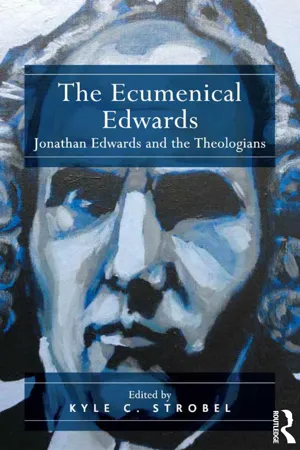
Jonathan Edwards is considered by many to be America's greatest theologian. Many have lauded him as one of the great theologians in church history. This book brings together major Catholic, Orthodox, and Protestant theologians to assess Edwards's theological acumen. Each chapter places Edwards in conversation with a thinker or a tradition over a specific theological issue.
Information
Comparison and Assessment
Chapter 1
Seeking Salvation: Jonathan Edwards and Nicholas Cabasilas on Life in Christ
Introduction
Bringing the theology of Jonathan Edwards into conversation with the Eastern Orthodox tradition is not a straightforward task. If one were to approach the question head on and examine Edwards’s own assessment of Eastern Orthodoxy and vice versa, material would be both sparse and polemically charged. Although a little attention will be paid to this side of the topic below, the chief concern here, as throughout this collection, is more constructive: the goal is to engage the theology of Edwards in a meaningful dialogue with Eastern Orthodoxy. Others have proved that performing such a task without polemic is both desirable and possible,2 but it remains a delicate task, since in order for the dialogue to be meaningful we must find common ground across radically different cultures, traditions, and theological frameworks, all the while resisting the temptation to collapse distinctiveness or contradiction where they exist.
Faced with this dilemma, I turned to Edwards (who is not in my area of expertise) looking for a thread that could serve as a fitting reference point for dialogue. The themes of light, trinitarian dogma, and aesthetics, all key to both Edwards’s thought and the Christian East, had already drawn the attention of others.3 But reading his work, something else jumped out at me, a phrase I had not expected to find yet one that appeared time and again, namely, “seeking salvation.”4 As someone whose field of study is Byzantine theology (especially ascetic theology), this phrase and the concept behind it felt like familiar territory. Given the importance of Edwards for his championing of popular Protestant spirituality (or “awakening”), it seemed only natural to explore his notion of “seeking salvation” in relation to the theology of one of the great exponents of popular Byzantine spirituality, Nicholas Cabasilas (ca. 1319–ca. 1392).
In what follows, we will begin with a brief look at Edwards’s views of Eastern Christianity and how these should or should not affect our broader enquiry. Next we will examine the phrase “seeking salvation” in Edwards’s theology, unpacking both its positive and negative sense and relating it to the question of grace, works, and justification in his thought. Having laid this foundation, the theology of salvation in the thought of Nicholas Cabasilas will be introduced under three interrelated headings: christological, sacramental, and ascetic. Having looked at each theologian on his own terms, points of contact and conflict will be noted. It will be emphasized that while certain radical differences cannot be ignored, there is a shared sense that, while the salvation wrought by Christ is a free gift freely given, it is nevertheless to be sought with the utmost urgency and as life’s most pressing care.
Jonathan Edwards on Eastern Orthodoxy
Sharing the views common to his time and place, Edwards considered the “Greek Church” to be a degenerate entity rife with superstition. One of his few references to Eastern Christianity comes during a sketch of Christian history in which he charts the rise of Islam and the Muslim conquests in the East. He mentions “the remains of the Christians that are in those parts of the world, which are mostly of the Greek church” and describes their plight: they “are in miserable slavery under [the Muslims], and treated with a great deal of barbarity and cruelty, and are become mostly very ignorant and superstitious.”5
Edwards’s intellectual engagement with Eastern Christianity was limited, of course, but not non-existent. Paul Rycaut/Ricaut’s 1679 work The Present State of the Greek and Armenian Churches appears twice in Catalogues of Books, and Thomas Smith’s 1680 volume An Account of the Greek Church is also mentioned.6 Edwards also paid attention to Christian developments in the East as they were relayed through newspapers and periodicals. One development that interested him greatly was Peter the Great’s Church reform policy in Russia, which he hailed as a victory for the Protestant world at large. His comments to this effect (written in 1739) appear in the context of a discussion surrounding the discernibility of the gospel’s success in his day. One of the three chief markers for success in this area, he argues, is “reformation in doctrine and worship in countries that are called Christian.” His great example of such a phenomenon is Russia, and the passage is worth citing at length:
As to … a reformation in doctrine, the most considerable success of the gospel that has been of late of this kind has been in the empire of Muscovy, which is a country of vast extent. The people of this country, so many of them as call themselves Christians, professed to be of the Greek church, but were barbarously ignorant and very superstitious till of late years their last emperor, Peter Alexander [the Great], who reigned till within these twenty years, set himself to reform the people of his dominion and took great pains to bring ’em out of their darkness and to have ’em instructed in religion. And to that end he set up schools of learning, and ordered the Bible to be printed in the language of the country, and made it a law that every family should keep the holy Scriptures in their houses, and that every person should be able to read the same, and that no persons should be allowed to marry till they were able to read the Scriptures. And he also reformed the churches of his country of many of their superstitions—whereby the religion professed and practiced as in Muscovy is much nearer that of the Protestants than formerly it used to be. This emperor gave great encouragement to the exercise of the Protestant religion in his dominions. And since that Muscovy is become a land of light in comparison of what it used to be before; wonderful alterations have been brought about in the face of religion for the better within this fifty years past.7
Aside from Edwards’s exaggerated (or misinformed) description of some of the particulars of Peter the Great’s reforms, the general sense is clear: Christianity in Russia is a hopeful subject precisely because of its Protestantizing tendencies. From a contemporary perspective, we may be tempted to skip over this instance of a not-so-ecumenical Edwards. But it is a reality that I do not think should be ignored: Edwards himself could view Eastern Christianity positively only insofar as it conformed to “Protestant religion.” In the absence of such a tendency, it was a religion full of darkness and delusion.
This does not mean, as mentioned above, that the quest for a theological rapprochement between Edwards and Orthodoxy is necessarily and unavoidably futile, but it does help us frame our subject. On the one hand, the paucity of available material on Eastern Christianity at the time goes some way toward explaining Edwards’s sparse and overall negative assessment. On the other hand, it is evident that Edwards had little concrete interest in Eastern Christianity beyond instances that might attest to the illumination of the barbarous and superstitious Easterners by the pure light of Protestantism. I think it is important to underline this at the outset for the simple reason that this is historically what we can deduce regarding Edwards’s position on Eastern Orthodoxy. There is a distinct benefit to be had, I believe, from bearing this in mind as we proceed. Being aware of Edwards’s historical position on Eastern Christianity prevents us from doing him a disservice, the kind of disservice often done in the name of ecumenism, namely, that of hastily collapsing differing (even opposing) theologies one into the other without a close or deep regard for these differing theologies or their proponents. With this caveat explored, we can now turn to a more constructive appraisal of the theology of Jonathan Edwards in the context of Eastern Orthodox thought.
Jonathan Edwards on “Seeking Salvation”
This is not the place to attempt a thorough analysis of Jonathan Edwards’s soteriological vision, nor can I hope to deal adequately with such momentous, intertwined theological issues as faith, freedom, will, grace, works, or divine sovereignty, all of which Edwards treats in an intricate and sophisticated way. Each of these issues is also, incidentally, a matter of debate among Edwardsian scholars themselves. For instance, although popularly known as the fiery, uncompromising Calvinist preacher of the Great Awakening, his concept of faith as “qualification” and “work” of salvation has drawn scholarly criticism as contradictory to strict Reformed doctrine. Thomas A. Schafer could go so far as to make comparisons on this point between Edwards and Tridentine Roman Catholicism,8 and George Hunsinger laments that “by defining faith as a meritorious virtue … he had moved closer to Thomas [Aquinas] than to the Reformation.”9
From an Eastern Orthodox perspective—for whom the utter negation of any sense of “active” participation in the salvation wrought by Christ is inadmissible—Edwards could here be providing a positive ground for ecumenical discussion. This possibility will be considered below, but first Edwards’s sense of an active faith, often expressed in his writings in terms of “seeking salvation,” needs to be investigated. This will be done first by attempting to get behind the meanings (negative as well as positive) of the idea of “seeking salvation” in Edwards’s thought and how it leads us to an unmistakably ascetic vision. This sense of ascetic struggle will in turn be set against Edwards’s unstinting commitment to the absolute sovereignty of God and his “arbitrary disposition” in matters of salvation, and a brief examination will be made of how Edwards envisages holding these two themes together. From there, attention will turn to Nicholas Cabasilas.
The very idea of “seeking salvation” might seem counterintuitive in the broader context of Calvinist theology, yet it appears in Edwards’s works with great frequency. It generally arises, unsurprisingly, in sermons or discussions of Christian practice. He uses it as a kind of all-encompassing term for the concrete Christian life, and, just as Christian life could proceed in both fortunate and unfortunate ways, so too could salvation-seeking. An emblematic use can found in his discourse titled Pressing into the Kingdom of God, where he encourages his audience thus:
By all means be thorough now! Make but one work of seeking salvation! Make thorough work of it the first time! There are vast disadvantages that they bring themselves under, that have several turns of seeking with great intermissions: by such a course persons exceedingly wound their own souls, and entangle themselves in many snares … press right forward, from henceforth, and make but one work of seeking converting and pardoning grace, however great, and difficult, and long a work that may be.10
These lines betray Edwards’s interest in the doctrine of perseverance, here framed in terms of pursuing the “work” of seeking salvation. Elsewhere, he refers to “that great work of seeking salvation.”11 But the act of seeking salvation was not necessarily, according to Edwards, done aright (and as we shall see later, in one sense never could be). He refers more than once to a “slack and dull way of seeking” that has little hope of success. When discussing the Great Awakening, he speaks of the awakened as those who “before this wonderful time, had been something religious and concerned for their salvation, [and] have ...
Table of contents
- Cover Page
- Dedication
- Title Page
- Copyright Page
- Contents
- List of Contributors
- Acknowledgments
- Abbreviations
- Introduction
- PART I: COMPARISON AND ASSESSMENT
- PART II: CONSTRUCTIVE ENGAGEMENT FOR CURRENT CONVERSATIONS
- Bibliography
- Index
Trusted by 375,005 students
Access to over 1.5 million titles for a fair monthly price.
Study more efficiently using our study tools.
Frequently asked questions
Yes, you can cancel anytime from the Subscription tab in your account settings on the Perlego website. Your subscription will stay active until the end of your current billing period. Learn how to cancel your subscription
No, books cannot be downloaded as external files, such as PDFs, for use outside of Perlego. However, you can download books within the Perlego app for offline reading on mobile or tablet. Learn how to download books offline
Perlego offers two plans: Essential and Complete
- Essential is ideal for learners and professionals who enjoy exploring a wide range of subjects. Access the Essential Library with 800,000+ trusted titles and best-sellers across business, personal growth, and the humanities. Includes unlimited reading time and Standard Read Aloud voice.
- Complete: Perfect for advanced learners and researchers needing full, unrestricted access. Unlock 1.5M+ books across hundreds of subjects, including academic and specialized titles. The Complete Plan also includes advanced features like Premium Read Aloud and Research Assistant.
We are an online textbook subscription service, where you can get access to an entire online library for less than the price of a single book per month. With over 1.5 million books across 990+ topics, we’ve got you covered! Learn about our mission
Look out for the read-aloud symbol on your next book to see if you can listen to it. The read-aloud tool reads text aloud for you, highlighting the text as it is being read. You can pause it, speed it up and slow it down. Learn more about Read Aloud
Yes! You can use the Perlego app on both iOS and Android devices to read anytime, anywhere — even offline. Perfect for commutes or when you’re on the go.
Please note we cannot support devices running on iOS 13 and Android 7 or earlier. Learn more about using the app
Please note we cannot support devices running on iOS 13 and Android 7 or earlier. Learn more about using the app
Yes, you can access The Ecumenical Edwards by Kyle C. Strobel in PDF and/or ePUB format, as well as other popular books in Theology & Religion & History of Religion. We have over 1.5 million books available in our catalogue for you to explore.