eBook - ePub
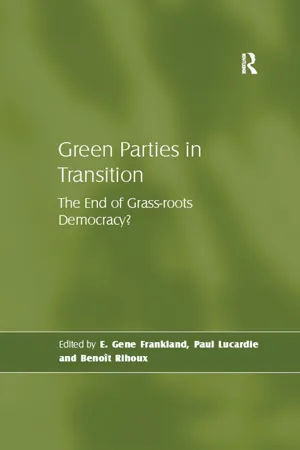
Green Parties in Transition
The End of Grass-roots Democracy?
- 306 pages
- English
- ePUB (mobile friendly)
- Available on iOS & Android
eBook - ePub
About this book
When green parties emerged in the 1980s, not only did they question established ideas about nature and economic growth, they also challenged the 'iron law' of Roberto Michels that all parties inevitably follow a similar path towards informal concentration of power and oligarchy. Grass-roots democracy was both an ideological tenet and an organizational project for practically all green parties. These days the greens have lost their glamour and innocence. They have grown up and even joined governing coalitions in several countries. Did they leave grass-roots democracy by the roadside on the way to power? This book investigates to what extent green parties have remained true to their identity or have been transformed. Country specialists analyze the development of green parties in 14 countries across the world - not only Western Europe but also Australia, Canada, New Zealand and the United States. These analyses also offer clues on broader questions about party types and party change in contemporary democracies.
Information
Part 1
Introduction
Chapter 1
From Amateur-Activist to Professional-Electoral Parties? On the Organizational Transformation of Green Parties in Western Democracies
Why another book about green parties? In the 1980s they were new and exciting, questioning not only established ideas about nature and about economic growth, but also challenging the ‘iron law’ of Roberto Michels about the inevitable oligarchization of political parties. Grass-roots democracy was both an ideological tenet and an organizational project for practically all green parties. What has been said about the new social movements applies to them, too: ‘the new organizational form of contemporary movements is not just instrumental for their goals. It is a goal in itself … The medium, the movement itself as a new medium, is the message.’ (Melucci 1984, 830). Now, more than 20 years later, the greens have lost their glamour and innocence. They have grown up and even played the role of junior partner in governing coalitions in several countries. Did they leave grass-roots democracy by the roadside on the way to power?
Parties in their formative or genetic phase should be more sensitive to external pressures and particularly susceptible to change – especially when they are also fairly small in terms of membership and weakly institutionalized (see Panebianco [1982] 1988). Yet the way green parties are organized concerns the core of their identity and political project. Thus they also challenged (implicitly or explicitly) the predictions of Ostrogorski ([1902] 1964) and Michels ([1911] 1962) that all parties follow inevitably a similar path towards informal concentration of power and oligarchy.
The main purpose of this volume is to find out if or to what extent green parties have remained true to their identity. The main question spawns two or three subquestions. Can we be sure that the Greens applied the principle of grass-roots democracy at least in their first years, or was it a founding myth right from the start? If they did practice what they preached, green parties may have constituted a specific type of party, which would be distinct from other parties, as they themselves have often claimed. If they did differ from established parties at the beginning, but have evolved into a more normal or mainstream type of party, the question arises why and how they changed and under what conditions.
The only way to provide somewhat satisfactory answers to these questions is a comparative analysis of green parties in different countries, under different circumstances, through time. For this purpose we have selected green parties in fourteen countries; parties, which differ in age, size, electoral success and governmental experience. Fortunately, we found sufficient country experts who were willing and able to contribute chapters dealing with our central questions. In order to provide them with a common conceptual framework, in this introductory chapter we will first elaborate how green parties might differ from other types of parties as defined by the literature. Secondly, we will list the forces that might cause the parties to change. The country experts are to look for these benchmarks in their historical analysis of individual green parties.
Do Green Parties Constitute a Distinct Party Type?
A Basic Typology of Party Organizations
When one looks at the literature on party types, it might be exaggerated to refer to a consensus among experts, but one could observe some kind of convergence in terminology and ideas. No doubt this has been encouraged substantially by the international project directed by Richard Katz and Peter Mair (1992). The Dutch political scientist André Krouwel has made a valiant attempt to reduce all known types of party to five clusters, combining different dimensions: origin, electoral appeal, ideology/competition and organization (Krouwel 2006). Here we adopt three of his types, but collapse the two last clusters.
1 elite caucus or cadre parties in the classical work of Duverger ([1951] 1954) were founded by members of parliament who agreed on a few principles and common interests; they are loosely organized as federations of local clubs; their links to civil society are informal and personal: their leaders happen to fulfill leading roles in civil society and the state; most decisions are taken by the local committees, directed by the local member of parliament or his associate; funds are provided by the (usually well-to-do) members.
2 Often in opposition to the elite parties, mass parties of (democratic or totalitarian) integration (the term coined by Neumann 1956, 400–405) were set up, outside parliament, based on a coherent and militant ideology, mobilizing masses and encouraging their participation in the political system; participation can be either (relatively) democratic (‘bottom-up’) or manipulated by the leadership: Neumann’s democratic and totalitarian subtypes. Both subtypes have a formal and centralized organization; links to civil society are strong, even formal and institutionalized, but limited to one particular segment – a pillar (Dutch: zuil), denomination or class, organized in a network of ancillary organizations to cover practically all aspects of daily life: education and schooling, sports and other leisure activities, work and communication.
3 Once integrated in the system, mass parties (as well as surviving cadre parties) developed into electoralist people’s parties – Volksparteien, the term used by Mintzel (1984) and Kaste and Raschke (1977) which we prefer to the term ‘catch-all party’ (Kirchheimer 1966). This type of party is based on a diluted and moderate ideology, organized more or less ‘top-down’; it appeals to the whole people, rather than to particular religious or class segments, even if it maintains sometimes privileged contacts with organizations in particular segments; its links to civil society are negotiated rather than institutionalized. Some may focus only on elections – a parti d’électeurs, in the terminology of Seiler (1993, 93–107); others still foster participation by members and may be more policy-oriented: Seiler’s parti de militants or Koole’s ‘modern cadre party’ (see Koole 1996).
4 In the present era, possibly a new type of party may be emerging: the professional-electoral party (Panebianco [1982] 1988) or parti machine (Seiler 1993, 104), or business firm party (Hopkin and Paolucci 1999), focusing on changing political issues, organized as a professional machine to win elections and/or office, recruiting only members interested in a political career (as far as it still registers members at all); its links to the – individualized, if not atomistic – civil society are haphazard and ephemeral. In some cases it colludes with similar parties in government: the subtype ‘cartel’ parties, discussed by Katz and Mair (1995); in others it keeps competing with similar or different types of parties. Decisions are taken by leaders and their professional staff, funds are provided by the state or by corporations and other sponsors. The ‘cyber party’ of the future, as imagined by Helen Margett, may be another, more competitive and more democratic subtype; it will appeal directly to voters or supporters, who may take part in the selection of candidates through postal or electronic ballots (2006).
Of course, we are dealing with ideal types here, which do not exist in empirical reality. Existing parties may combine characteristics of different types, even if most authors from Duverger to Katz and Mair maintain – implicitly or explicitly – that each period can be characterized by the predominance of this or that type. Even if we assume that the most common type today is the people’s party, we may also observe that characteristics of other types have survived. Communist parties in France, Portugal or Italy could still be classified as mass parties; and so do minor parties based on a religious ideology, such as the Protestant parties in the Netherlands: (see Massink 1993; Lucardie 1991, 126–7). Some French parties like the Centre des Démocrates Sociaux (CDS) which merged into the Union pour la Démocratie Française (UDF) might resemble cadre parties (Van Kemseke 1997); and so do the major Canadian parties, according to Kenneth Carty, even if they share some traits with professional-electoral parties as well (Carty 2002, 376). Examples of a professional-electoral party or business firm party may be Forza Italia and the Uniòn de Centro Democratico in Spain (Hopkin and Paolucci 1999).
The Classification of Green Parties
While many – but not all – major parties may tend to evolve from elite or mass parties into people’s parties, small or minor parties can be expected to deviate more often from prevailing trends – which may incidentally help to explain in some cases why they have remained small. Some may be elite or mass parties which failed to adapt to a changing environment, or people’s parties appealing to the wrong people. Others may be hybrids, combining traits of different types. Yet some may be impossible to classify in this typology and constitute in fact new types, perhaps anticipating the future. Thus we seem to be left with only two options: classifying green parties as hybrids, or constructing a new type which may fit the Greens and similar ‘alternative’ or ‘new politics’ parties. As the first option seems the least satisfactory one from any theoretical perspective, we will first explore the second option. Some pioneering work along this line has already been done, mainly by Poguntke (1987, 1993) and Kitschelt (1989; see also Harmel 2002, 125).
Poguntke regards grass-roots democracy or Basisdemokratie as the core notion of the new type of party. All typical characteristics of Green parties can be derived from this: collective and amateur rather than professional leadership, imperative mandate, separation of party office and parliamentary mandate, rotation, open access to meetings, pre-eminence of the lowest unit and even gender parity for all party offices (Poguntke 1993, 136–48). Though Poguntke has to qualify some of these characteristics in his empirical analysis, the German Greens do seem substantially more participatory than other German parties (1993, 148–70). Yet most power may lay not so much with the simple rank- and-file members but more with the party activists who hold some function at the local or regional level, even if these two categories can be confused easily in practice, given the (relatively) small membership of the Greens.
Thus, one might call the new type the amateur-activist party. Amateur-activist parties are usually founded by activists from new social movements rather than party politicians. Hence, Gunther and Diamond might label them ‘movement parties’, which can be either ‘left-libertarian’ or ‘post-industrial extreme-right’. The former are characterized by a ‘negative consensus’ on ideological questions, a heterogeneous clientele, open membership, a weak centralized organization and loose networks of grass-roots support (Gunther and Diamond 2003, 188–9). Even after the amateur-activist movement party has become an independent organization, it will maintain at least informal ties with the social movements. Sometimes, leaders may switch between organizations of the movement and the party. The background of the activists may have some impact on the ideology of the party: rather than a complete ideology, the party will embrace partial or ‘thin-centred’ ideologies from different movements, such as (a mixture of) ecologism, pacifism or feminism.1 Like most new social movements, amateur-activist parties entertain an ambivalent relationship with the state: they do not refuse state support (subsidies) but distrust involvement with state agencies.
The activists try to create a party organization that allows them a maximum of power – perhaps even at the expense of electoral success and impact on policy-making processes. Thus decisions are taken at the lowest practical level – if not the local branch, then the regional or national party conference, which is firmly in the hands of activist members and often open to all of them. In some cases, members may take a decision by postal vote or referendum. The activists try to control both the party executive and the parliamentary party – through devices like rotation and recall, imperative mandates and separation of the two bodies, according to the old divide and rule principle. For the same reason they prefer collective leadership and oppose professionalization. Even a low member/voter ratio of the party might serve the interest of the activists: thus they do not have to share their power among too many of their kind! Obviously, mass parties cannot offer their millions of members as much power as amateur-activist parties their thousands of members. What the latter lack in membership contributions, they can make up (to some extent) in state subsidies – provided they attract sufficient votes, of course. This is the only catch, and a factor that may explain organizational change, as will be argued below. Another factor, reinforcing organizational change, might be ideological or factional conflict between groups of activists – as analyzed, for example, by Kitschelt (1989) and Kitschelt and Hellemans (1990). Conflicts may be frequent, as members tend to be highly involved, ideologically motivated and well-trained in confrontation techniques rather than in submission to authorities.
The amateur-activist party type can be seen as a dialectical reaction against the prevailing trend towards professional-electoral parties. To this type may correspond not only most Green parties in Western democracies, but also other left-libertarian or Alternative Left parties like the Italian Partito Radicale, the Women’s Party (Samtök um Kvennalista) in Iceland and Democrats 66 in the Netherlands (Panebianco 1988; Styrkarsdottir 1986; Van der L...
Table of contents
- Cover
- Half Title
- Title Page
- Copyright Page
- Table of Contents
- List of Figures and Tables
- Notes on Contributors
- Preface
- PART 1: INTRODUCTION
- PART 2: GREEN PARTIES WITH NATIONAL GOVERNMENTAL EXPERIENCE
- PART 3: GREEN PARTIES WITH NATIONAL PARLIAMENTARY RELEVANCE
- PART 4: GREEN PARTIES WITH LITTLE OR NO NATIONAL PARLIAMENTARY PRESENCE
- PART 5: CONCLUSION
- Index
Trusted by 375,005 students
Access to over 1.5 million titles for a fair monthly price.
Study more efficiently using our study tools.
Frequently asked questions
Yes, you can cancel anytime from the Subscription tab in your account settings on the Perlego website. Your subscription will stay active until the end of your current billing period. Learn how to cancel your subscription
No, books cannot be downloaded as external files, such as PDFs, for use outside of Perlego. However, you can download books within the Perlego app for offline reading on mobile or tablet. Learn how to download books offline
Perlego offers two plans: Essential and Complete
- Essential is ideal for learners and professionals who enjoy exploring a wide range of subjects. Access the Essential Library with 800,000+ trusted titles and best-sellers across business, personal growth, and the humanities. Includes unlimited reading time and Standard Read Aloud voice.
- Complete: Perfect for advanced learners and researchers needing full, unrestricted access. Unlock 1.5M+ books across hundreds of subjects, including academic and specialized titles. The Complete Plan also includes advanced features like Premium Read Aloud and Research Assistant.
We are an online textbook subscription service, where you can get access to an entire online library for less than the price of a single book per month. With over 1.5 million books across 990+ topics, we’ve got you covered! Learn about our mission
Look out for the read-aloud symbol on your next book to see if you can listen to it. The read-aloud tool reads text aloud for you, highlighting the text as it is being read. You can pause it, speed it up and slow it down. Learn more about Read Aloud
Yes! You can use the Perlego app on both iOS and Android devices to read anytime, anywhere — even offline. Perfect for commutes or when you’re on the go.
Please note we cannot support devices running on iOS 13 and Android 7 or earlier. Learn more about using the app
Please note we cannot support devices running on iOS 13 and Android 7 or earlier. Learn more about using the app
Yes, you can access Green Parties in Transition by Paul Lucardie, E. Gene Frankland in PDF and/or ePUB format, as well as other popular books in Politics & International Relations & Politics. We have over 1.5 million books available in our catalogue for you to explore.