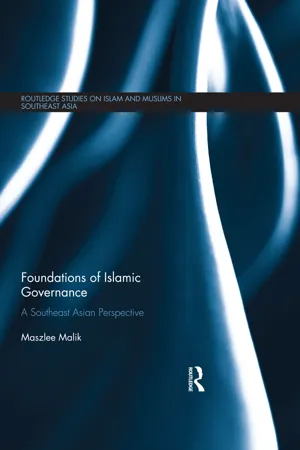
The aim of this book is to explore and analyze the Islamic axioms, foundation principles and values underpinning the field of governance in an attempt to construct the architectonics of a new systemic and dynamic theory and formulate the articulation of 'Islamic governance'. This discursive and abstract, rather than being an empirical exercise, assumes to produce a 'good governance' framework within its own formulation through a value-shaped dynamic model according to maqasid al-Shari'ah (higher objective of Shari'ah) by going beyond the narrow remit of classical and contemporary discussions produced on the topic, which propose a certain institutional model of governance based on the classical juristic (fiqh) method. Through an exclusive analytical discursive approach in this book, readers will find that Islam as one of the major religions in the contemporary world with the claim of promising the underpinning principles and philosophical foundations of worldly affairs and institutions through a micro method of producing homoIslamicus could contribute towards development of societies by establishing a unique model of governance from its explicit ontological worldview through a directed descriptive epistemology.
- 280 pages
- English
- ePUB (mobile friendly)
- Available on iOS & Android
eBook - ePub
About this book
Information
Table of contents
- Cover
- Title
- Copyright
- Contents
- Preface
- Acknowledgements
- List of abbreviations
- Prolegomena
- Introduction
- 1 Governance: definitions and conceptual framework
- 2 Deconstructing the concept of Good Governance
- 3 Religion and governance: a philosophical inquiry
- 4 Ontological and epistemological sources for Islamic governance
- 5 New approach to the texts: epistemological method-related concerns
- 6 Contributions of Muslim scholars in the development of knowledge base for governance
- 7 Architectonics of Islamic governance: locating the axioms, foundational principles and working mechanism
- 8 Articulation of Islamic governance
- Conclusion
- Epilogue
- Bibliography
- Index
Trusted by 375,005 students
Access to over 1.5 million titles for a fair monthly price.
Study more efficiently using our study tools.
Frequently asked questions
Yes, you can cancel anytime from the Subscription tab in your account settings on the Perlego website. Your subscription will stay active until the end of your current billing period. Learn how to cancel your subscription
No, books cannot be downloaded as external files, such as PDFs, for use outside of Perlego. However, you can download books within the Perlego app for offline reading on mobile or tablet. Learn how to download books offline
Perlego offers two plans: Essential and Complete
- Essential is ideal for learners and professionals who enjoy exploring a wide range of subjects. Access the Essential Library with 800,000+ trusted titles and best-sellers across business, personal growth, and the humanities. Includes unlimited reading time and Standard Read Aloud voice.
- Complete: Perfect for advanced learners and researchers needing full, unrestricted access. Unlock 1.5M+ books across hundreds of subjects, including academic and specialized titles. The Complete Plan also includes advanced features like Premium Read Aloud and Research Assistant.
We are an online textbook subscription service, where you can get access to an entire online library for less than the price of a single book per month. With over 1.5 million books across 990+ topics, we’ve got you covered! Learn about our mission
Look out for the read-aloud symbol on your next book to see if you can listen to it. The read-aloud tool reads text aloud for you, highlighting the text as it is being read. You can pause it, speed it up and slow it down. Learn more about Read Aloud
Yes! You can use the Perlego app on both iOS and Android devices to read anytime, anywhere — even offline. Perfect for commutes or when you’re on the go.
Please note we cannot support devices running on iOS 13 and Android 7 or earlier. Learn more about using the app
Please note we cannot support devices running on iOS 13 and Android 7 or earlier. Learn more about using the app
Yes, you can access Foundations of Islamic Governance by Maszlee Malik in PDF and/or ePUB format, as well as other popular books in Politics & International Relations & American Government. We have over 1.5 million books available in our catalogue for you to explore.