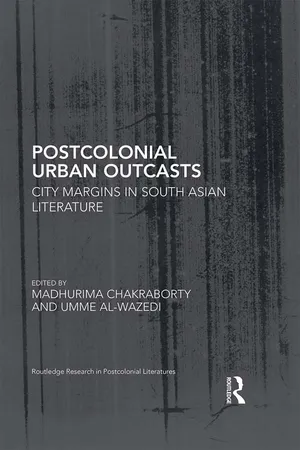
Extending current scholarship on South Asian Urban and Literary Studies, this volume examines the role of the discontents of the South Asian city. The collection investigates how South Asian literature and literature about South Asia attends to urban margins, regardless of whether the definition of margin is spatial, psychological, gendered, or sociopolitical. That cities are a site of profound paradoxes is nowhere clearer than in South Asia, where urban areas simultaneously represent both the frontiers of globalization as well as the deeply troubling social and political inequalities of the global south. Additionally, because South Asian cities are defined by the palimpsestic confluence of, among other things, colonial oppression, anticolonial nationalism, postcolonial governance, and twenty-first century transnational capital, they are sites where the many faces of empowerment and disempowerment are elaborated. The volume brings together essays that emphasize myriad critical approaches—geospatial, urban-theoretical, diasporic, subaltern, and others. United in their critical empathy for urban outcasts, the chapters respond to central questions such as: What is the relationship between the politico-economic narratives of globally emerging South Asian cities and the dispossessed? How do South Asian cities stand in relationship to the nation and, conversely, how might South Asians in diaspora construct these cities within larger narratives of development, globalization, or as sources of authentic ethnic identities? How is the very skeleton—the space, the territory—of South Asian cities marked with and by exclusionary politics? How do the aesthetic and formal choices undertaken by writers determine the potential for and limit to emancipation of urban outcasts from their oppressive circumstances? Considering fiction, nonfiction, comics, and genre fiction from India, Pakistan, Bangladesh, and Sri Lanka; literature from the twentieth and the twenty-first century; and works that are Anglophone and those that are in translation, this book will be valuable to a range of disciplines.
eBook - ePub
Postcolonial Urban Outcasts
City Margins in South Asian Literature
- 282 pages
- English
- ePUB (mobile friendly)
- Available on iOS & Android
eBook - ePub
Postcolonial Urban Outcasts
City Margins in South Asian Literature
About this book
Trusted by 375,005 students
Access to over 1.5 million titles for a fair monthly price.
Study more efficiently using our study tools.
Information
Urban Outcasts, Urban
Subalterns
1 Recasting the Outcast
Hyderabad and Hyderabadi Subjectivities in Two Literary Texts
Introduction: Necessary Orientations1
For many decades now, Anita Desai’s English novel Clear Light of Day (1980) has been a canonical text that has offered possibilities for discussions about Hyderabadi Muslims and urban citizenship and belonging in the long shadow of Partition. However, while the novel helps to bring within the same frame Hyderabad, Partition, and the politics of the city, it also exemplifies classic narratives of lavish Hyderabadi Muslim lifestyles by evoking static Orientalist stereotypes of decadence and excess in its representation of Hyderabadi Muslims. Arguably, it was only in the early 2000s that literary texts in English with more complex Hyderabadi urban subjectivities began to appear. Some of the novels that fictionally engage with the issue of urban outcasts in the context of Hyderabad include Samina Ali’s Madras on Rainy Days (2004), Huma R. Kidwai’s The Hussaini Alam House (2012), and Ian Bedford’s The Last Candles of the Night (2014). Another very important development in this regard has been the revision and reprinting of Zeenuth Futehally’s 1951 novel Zohra in 2004.
In this chapter, I will demonstrate how two of these novels, Bedford’s The Last Candles of the Night and Futehally’s Zohra, establish of what and whom “the city” consists, whom it includes or excludes, whom it humors or harbors, and whom it legitimizes or rejects. In other words, the texts outline the scope of the city’s historical, sociocultural, geographical, political, and imaginative landscapes and boundaries. In doing so, they also interrogate standard, official, mainstream Indian notions about Hyderabad in the troubled last years of the Asaf Jahi dynasty, explicitly and implicitly replacing these notions with a problematized understanding of the politics, society, cultures, and people of Hyderabad. As I argue in this chapter, while these texts are certainly complicit in perpetuating the distorted depiction or invisibility of certain groups, such as the urban working classes, both are distinguished by an important achievement: they restore to memory Hyderabadi subject positions that are neglected or forgotten in canonical, hegemonic narratives of not only the princely state of Hyderabad but also the city after which the state was named.
Furthermore, I show how the subsequent fictional restoration after this hegemonic forgetting is achieved in two ways: first, at the level of metaphor and, second, at a more literal level. I demonstrate how Hyderabad state/city itself and Hyderabadiness as a concept, which were demonized after the turbulent 1940s, are vindicated in the literary texts through a more inclusive and historically located depiction of Hyderabad city and its citizens. And in the literal sense, the texts ensure that urban subject positions which are/were not considered legitimate are restored to the city, offering a fictional counterpoint to an exclusionary historiography. By recasting these urban outcasts—both Hyderabad city itself and different groups and communities as well—in creative writing, the authors of both texts implicitly and explicitly create a platform for readers to question the hegemonic notions of what it is to be Hyderabadi and who is entitled to this citizenship.
In fact, Hyderabad has had a tense history of urban mobility and citizenship, much of which goes back to the politics of Partition. Contrary to earlier notions of southern India not being affected by Partition turmoil, increasingly vocal voices today emphasize how Hyderabad—the largest and wealthiest princely state in India—was in fact completely transformed as a result of Partition-related politics. The players and ideologies that definitively shaped Hyderabadi politics during the 1940s are well known in Hyderabad today: the minority ruling class of feudal and aristocratic Muslims and Hindus, led by the seventh Nizam of Hyderabad, Mir Osman Ali Khan (1886–1967) of the Asaf Jahi dynasty (1720–1948); the peasants, workers, and progressive groups who participated in the Telangana Armed Struggle (1946–1951), an uprising against the feudal, political, and cultural hegemony of the ruling class in Hyderabad; Razakars, a Muslim paramilitary offshoot of the Majlis-e-Ittehad-ul-Muslimeen who terrorized the populace in general and non-Muslims in particular; and the Hyderabad State Congress (HSC), which claimed to represent and align the democratic aspirations of Hyderabadis alongside those of people in British India.
Citing the inequalities of communal representation, the intensifying peasant struggle, and the absence of administrative checks and measures against the Razakars, the Indian National Congress leadership had consistently demanded that the Nizam must unconditionally accede to India. After many difficult negotiations between the two parties, Indo-Hyderabad relations had deteriorated to such an extent that India invaded Hyderabad on September 13, 1948, ignoring the fact that Hyderabad had approached the United Nations Security Council with an urgent appeal to put the matter on its agenda for September 15. Ill-equipped to handle a four-pronged military invasion, Hyderabad surrendered in less than five days. The subsequent crackdowns by the Indian army and police as well as local groups against peasants, workers, and progressive individuals, many of whom were Muslims and/or had participated in the Telangana Armed Struggle (Sunderlal Committee 373; Smith 20–1; Sundarayya 9), are well known in Hyderabad but not elsewhere in the subcontinent. But the discussions of these realities about the situation in Hyderabad during and after the 1940s have arguably increased since the intensification and subsequent realization of the Telangana statehood movement, which created a sense of “openness” and space for conversations on communalism, class/caste, and regional politics. And as I have mentioned above, a direct consequence as well as contributing factor of/for these new/renewed conversations has been the fresh approach that creative writing and reading communities now show in discussions of Hyderabad and questions of citizenship and belonging.
Given the history I have outlined above, a literary analysis of the politics of the city with reference to Hyderabad in the context of Partition needs to address the differentness of Hyderabad and other princely states from British Indian territories. The princely states were not administered directly by the British and were, instead, supported by their own indigenous or hybrid mechanisms of power and patronage; this fact entails that literary texts that revisit this history too have to be approached somewhat differently than the usual course taken by studies of urban or cosmopolitan landscapes and questions of citizenship, boundaries, and belongings.2 As historian Karen Leonard has consistently pointed out in the course of a life-time of work on Hyderabad, the culture, society, politics, and history of the erstwhile princely states must be examined from a framework that is separate from that of British colonialism and standard notions of postcolonialism and postcoloniality.3 Leonard argues that questions and debates about colonialism and postcolonialism do not answer nor address the specific concerns and issues connected to the princely states. In the process, I argue, they also render invisible the historical processes by which urban belongings and affiliations come to be confirmed and legitimized in princely states such as Hyderabad. Keeping this in mind, my situated interpretive approach in this chapter to the two literary texts that depict life in early and mid-twentieth-century Hyderabad takes into account the special circumstances of the princely states. In the process, I privilege historically situated “contrapuntal” (Said 66) readings of literary texts that not only swim against the current of official, mainstream determinations of urban citizenship but also the colonial–postcolonial narrative thrust of much of our contemporary scholarship about the city.
Hyderabad Writes Back/Talks Down: Elite and Subaltern Subjects in Zeenuth Futehally’s Zohra
Although Zohra was published amid some critical recognition in 1951,4 the only focused, serious academic attention it has received has come in the form of Ambreen Hai’s essay “Adultery Behind Purdah and the Politics of Indian Muslim Nationalism in Zeenuth Futehally’s Zohra” (2013). Given the fact that hers is currently the only in-depth study of the novel, it is vital to evaluate the premises on which Hai situates her understanding and interpretation of the depiction of citizenship, culture, and identity in Zohra. For example, she asks important questions about the context in which Zohra was published and why Futehally chooses not to directly address Partition, the position of Muslim minorities, and the integration of Hyderabad into the Indian union.
“[H]ow indeed,” she asks, “does Zohra desire to remember and memorialize Hyderabadi culture and history prior to those years, to offer a different (forgotten) narrative of the 1920s and 1930s and suggest an alternative, more complex reading of at least some of its Muslim intellectuals and their families?” (323)
Hai argues that the poignant absences in Futehally’s text are made meaningful by the text’s foregrounding of an alternative narrative of Indian Muslim nationalism, one that “insists on the right to belonging of such Muslims who fought against the British for a secular India” (324). However, I contend that, in spite of her fine analysis, Hai’s essay does not address how Futehally’s Zohra responds to the particularities of Hyderabad as both a princely city as well as a princely state in British India.
As I have already explained, Leonard cautions scholars against using a generalized, pan-Indian analytical framework to address questions about princely states, such as Hyderabad, because these states were definitively shaped by political and social configurations that were often quite different from the factors that defined urban demographics in other parts of the subcontinent. This is precisely the problem with Hai’s otherwise astute and insightful analysis of Zohra. She conflates Indian Muslims and Hyderabadi Muslims as she discusses Futehally’s representation of “the progressive potential of Indian Muslims” and “a minority community’s right to belong to the nation” (319). Such instances in her analysis reveal a critical lack of informed and contextualized understanding of the discourses surrounding Hyderabad and Hyderabadiness from the contrapuntal perspectives of Hyderabadis and scholars of Hyderabad. Indeed, Hai’s assertion that “the novel also seeks retrospectively to carve a different historical space for Indian Muslims who chose to stay in India as citizens of that nation, claiming belonging based less on heritage than on self-sacrifice and involvement in the independence struggle as well as a history of harmonious coexistence” (318, emphasis mine) risks seriously undermining a long and illustrious heritage of indigenous Hyderabadi progressive, socialist, communist, and yes, nationalist politics. Moreover, Hai’s statement not only undermines the democratic struggles of Hyderabadis of all walks of life against princely rule, but also in fact, undermines the diverse socio-political engagements and cultural syncretism that were the heritage of the small, urban Hyderabadi ruling elite.
Addressing the specific and distinct context of Hyderabad is also something that Futehally distinguishes as the larger aim and broader focus of Zohra, which is, as she writes in the Preface, a record of “that little world of ours, in Hyderabad … for owing to the passage of time it was fast disappearing” (262). Nevertheless, having marked the sense of distinctiveness and value that Hyderabad holds for the author, this statement seems rather unremarkable because, at first glance, Zohra appears to be little more than a mid-twentieth-century reformist novel that questions the institution of purdah, emphasizing higher education and greater agency for young purdahnashin women, and chronicles the disappearing world of the sophisticated, city-based elite of Hyderabad. However, when we read Zohra more carefully and, above all, bear in mind the temporal as well as political climate in which it was written and its plot is implicitly embedded, a more complex text begins to emerge that has considerable significance for the way we approach Hyderabad’s past today.5 As I will show in this section, two aspects of the novel have particular bearing on our present-day reading of this text. These aspects are: the representation of elite Hyderabadis, which goes against the grain of official, mainstream Indian conflations of “Hyderabadi” with “Muslim” and, ultimately, “Razakar”; and the treatment of subaltern characters, which reveals insights about the practice of class among elite Hyderabadis by establishing whose perspectives know and narrate the city and the groups who live in it.
First published in 1951, Futehally’s novel Zohra depicts the life of the eponymous young protagonist from an aristocratic Hyderabadi family. Zohra enjoys her ongoing high-school education in languages and fine arts, but soon finds herself reluctantly agreeing to an arranged marriage to a distinguished, British-trained Hyderabadi physicist. Bashir, her brusque and matter-of-fact husband, does not quite understand nor relate to Zohra, who has an artistic and romantic sensibility. Zohra has three children, whom she adores. However, married to a man whom she respects but cannot love, she falls in love with her brother-in-law Hamid, who reciprocates her feelings. Hamid, a nationalist, leaves Hyderabad to join the Gandhian freedom struggle, motivated both by his political leanings as well as the futility of his love for his sister-in-law. Zohra, who as a young girl had toyed with the idea of participating in the Gandhian struggle, wishes in vain that she could accompany Hamid as he courts arrest during the civil disobedience movement. The sensitive Zohra alternately pines for Hamid and is wracked by guilt for her love. Unable to find a solution to her problems, Zohra falls ill, her health steadily worsens, and she dies.
The political climate to which, I argue, Zohra implicitly responds, was dominated by hyperbolic pronouncements about the Razakars, the paramilitary group that became influential in Hyderabad state from 1946 to 1948. The Razakars vandalized many localities in Hyderabad city as well as parts of the countryside, destroying or seizing property, raping girls and women, and cracking down on anyone—Hindu, Muslim, communist, nationalist—who offered any resistance or gestures of dissent against what they saw as “Muslim rule” in the Deccan. Indeed, the Indian government’s White Paper on Hyderabad (1948) estimated that by 1948 there were seventy thousand armed, well-equipped, and well-funded Razakars (31–2). However, after the invasion of Hyderabad, British newspapers reported from New Delhi that there was “a strong suspicion that the magnitude of [the Razakars’] aggressive acts [before the invasion] ha[d] been grossly exaggerated in order to provide some kind of excuse for an Indian invasion” (Morning Advertiser). Indeed, The Times reported that “not more than 5 percent of their total number (which was also wildly exaggerated) were armed with firearms, mostly old muzzle-loaders, while the remaining 95 per cent carried staves and spears.” Furthermore, the fact that the number of casualties was exponentially larger on the Hyderabadi side placed under scrutiny the rhetorical thrust of Indian press and radio pronouncements about “strong opposition” and “stern resistance” with regard to Hyderabad’s military response (qtd. in The Times). Other sources, such as Osmanabad collector Mohammed Hyder’s nuanced account October Coup: A Memoir of the Struggle for Hyderabad (2012), also corroborate the revelations from journalists, which indicate that India’s step to invade Hyderabad was based on an exaggeration of the capabilities of the Razakars.6
But the damage was done. Not only was the Nizam held responsible in the court of Indian public opinion for the actions of the Razakars, but so were most Hyderabadis who were Muslims and/or communists, as the many instances of individual, collective, and systemic discrimination show.7 Besides completely undermining and misrepresenting the history of the armed struggle, which at its height involved three million people in three thousand villages, such narratives constantly erase the prolonged resistance by students, workers, and other urban groups against the Nizam’s government, the arms of the state, as well as the Razakars. This erasure of specific instances and the particular goals of urban protest also extends to the political mobilization generated by different but connected trade, students’, and women’s organizations. It was also in cities such as Hyderabad, Secunderabad, Warangal, Aurangabad, Nanded, and Gulbarga that the most influential propaganda was released, and practical and ideological mechanisms, such as the formation of unions and execution of strikes, were created (Hyder 145–6; Gour 7). Contemporary communist leader P. Sundarayya concedes that the cadres in Hyderabad, Warangal, and the mining areas were very important because they helped organize underground offices, ...
Table of contents
- Cover
- Half Title
- Title Page
- Copyright Page
- Dedication
- Table of Contents
- List of Figures
- Acknowledgments
- Introduction: Whose City?
- PART I: Urban Outcasts, Urban Subalterns
- PART II: The National, The Global, and the Diaspora
- PART III: The Space of the Margins
- PART IV: Forms of Urban Outcasting
- List of Contributors
- Index
Frequently asked questions
Yes, you can cancel anytime from the Subscription tab in your account settings on the Perlego website. Your subscription will stay active until the end of your current billing period. Learn how to cancel your subscription
No, books cannot be downloaded as external files, such as PDFs, for use outside of Perlego. However, you can download books within the Perlego app for offline reading on mobile or tablet. Learn how to download books offline
Perlego offers two plans: Essential and Complete
- Essential is ideal for learners and professionals who enjoy exploring a wide range of subjects. Access the Essential Library with 800,000+ trusted titles and best-sellers across business, personal growth, and the humanities. Includes unlimited reading time and Standard Read Aloud voice.
- Complete: Perfect for advanced learners and researchers needing full, unrestricted access. Unlock 1.5M+ books across hundreds of subjects, including academic and specialized titles. The Complete Plan also includes advanced features like Premium Read Aloud and Research Assistant.
We are an online textbook subscription service, where you can get access to an entire online library for less than the price of a single book per month. With over 1.5 million books across 990+ topics, we’ve got you covered! Learn about our mission
Look out for the read-aloud symbol on your next book to see if you can listen to it. The read-aloud tool reads text aloud for you, highlighting the text as it is being read. You can pause it, speed it up and slow it down. Learn more about Read Aloud
Yes! You can use the Perlego app on both iOS and Android devices to read anytime, anywhere — even offline. Perfect for commutes or when you’re on the go.
Please note we cannot support devices running on iOS 13 and Android 7 or earlier. Learn more about using the app
Please note we cannot support devices running on iOS 13 and Android 7 or earlier. Learn more about using the app
Yes, you can access Postcolonial Urban Outcasts by Madhurima Chakraborty,Umme Al-wazedi in PDF and/or ePUB format, as well as other popular books in Literature & Literary Criticism. We have over 1.5 million books available in our catalogue for you to explore.