- 216 pages
- English
- ePUB (mobile friendly)
- Available on iOS & Android
eBook - ePub
Women Writing the Home Tour, 1682–1812
About this book
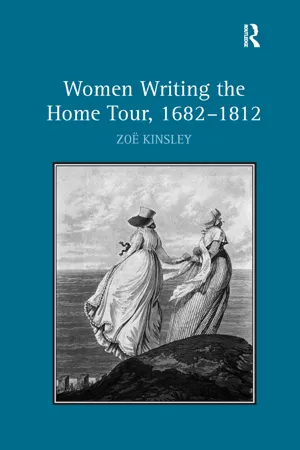
Between the late seventeenth and the early nineteenth century, the possibilities for travelling within Britain became increasingly various owing to improved transport systems and the popularization of numerous tourist spots. Women Writing the Home Tour, 1682-1812 examines women's participation in that burgeoning touristic tradition, considering the ways in which the changing face of British travel and its writing can be traced through the accounts produced by the women who journeyed England, Scotland, and Wales during this important period. This book explores female-authored home tour travel narratives in print, as well as manuscript works that have hitherto been neglected in criticism. Discussing texts produced by authors including Celia Fiennes, Ann Radcliffe and Dorothy Wordsworth alongside the works of lesser-known travellers such as Mary Morgan and Dorothy Richardson, Kinsley considers the construction, and also the destabilization, of gender, class, and national identity through chapters that emphasize the diversity and complexity of this rich body of writings.
Trusted by 375,005 students
Access to over 1.5 million titles for a fair monthly price.
Study more efficiently using our study tools.
Information
PART 1
Travels and Texts: Considering the Travelogue Form
Chapter 1
Pursuing Order: The Organizational Strategies of Women’s Travel Texts
When we … return, it shall not be like other travellers, without being able to give one accurate idea of any thing. We will know where we have gone – we will recollect what we have seen. Lakes, mountains, and rivers shall not be jumbled together in our imaginations;1
Jane Austen, Pride and Prejudice (1813)
When Austen’s heroine Elizabeth Bennett enthusiastically declares her resolve to make sense of the landscapes that she anticipates meeting in the Lake District (a site which her home tour journey fails to actually reach), she voices organizational concerns that are expressed repeatedly in nonfictional travel narratives, and that are paradigmatic of a European tradition of systematization and classification observable in numerous contemporary creative and intellectual projects. Her desire for accuracy, knowledge and precise recollection, and her determination to avoid imaginative chaos, echo the sentiments of many travel writers journeying both at home and abroad. These writers were well aware of the demands and expectations of a reading public who judged travel narratives produced at this time according to their perceived veracity, authenticity, organization and exactitude. Those criteria, by which travel accounts were condemned or condoned, were part of a European Enlightenment zeitgeist which fervently sought to see and know the world, to navigate it, organize it, classify it and record each stage of physical, visual and intellectual cognition for future generations. The organizational impulses captured and playfully satirized by Austen in the words of Lizzie Bennett, which echo so precisely the concerns of women’s home tour travel writing, can only be fully understood within the context of the wider tradition of exploration and writing, classification and organization, of which they are a part. This chapter traces the emergence of that tradition through three of the eighteenth century’s most significant systematizing projects. It then moves on to consider the ways in which the organizational spirit of the age became manifest in the travelling and authorial practices of the women who traversed the island of Great Britain.
Mapping the World: the Enlightenment Quest for Order
The desire to organize and elucidate was common to many areas of intellectual activity in the eighteenth century: people were gaining wider experience of the world and trying to understand and give expression to what they found. The Enlightenment impulse towards organization and standardization can be aligned with the emergence of what Mary Louise Pratt has termed ‘Europe’s “planetary consciousness”’ which was ‘marked by an orientation toward interior exploration and the construction of global scale meaning through the descriptive apparatuses of natural history’. One of the intellectual projects which arguably wrought a sea change in Europeans’ conception of the world and their place within it was the taxonomy established by Carl Linnaeus in his Systema Naturae (1735), which would form the basis for the standard botanical nomenclature that is still in use today. His classificatory system, which organized plants according to their reproductive organs, purported to enable the categorization of ‘all plant forms on the planet, known or unknown to Europeans’, and in the later works which refined his schema he developed a corresponding method by which animals and minerals could be systematized.2The methodizing of nature as it is presented by Linnaeus is concerned with the ordering of a world which, without the intervention of epistemological enquiry, would remain inherently chaotic. The activities of travellers and explorers transported his systematizing agenda to foreign locations, which were familiarized and given meaning through the inscription of his discourse onto that territory. Of the post-Linnaean world it has been said that ‘travel and travel writing would never be the same again’ – travel and the literature it inspired became part of the ‘new knowledge-building project’ of the eighteenth century.3 Yet, for all its claims to ‘transcendent classification’, travel writing was as much a record of a particular individual’s experiences of ‘a given, living space’ as it was a tabulation of measurable geographic and scientific certainties. As Paul Carter has demonstrated in his discussion of European travellers’ contributions to Australia’s ‘spatial history’, for every Joseph Banks wedded to the universalizing system of Linnaean botany, there was a James Cook for whom ‘the gaps were as significant as the discoveries’, and knowledge was ‘indistinguishable from the conditions of knowing’.4 It is in such a relationship, between travellers with fundamentally different outlooks, that we perceive the distinctive features of travel’s organizational imperatives, and through which we realize that the search to understand and depict places and peoples as general, homogenous entities cannot be separated from, and will always be nuanced by, the individual traveller and his or her way of looking at the world.
The ever-increasing trend towards classification is also reflected in two other grand-scale intellectual projects of the eighteenth century: Samuel Johnson’s Dictionary, which occupied him for close to a decade, published in 1755; and Diderot and D’Alembert’s Encyclopédie, published between 1751 and 1772 in 17 volumes. The former, operating at a national level, sought to ‘preserve the purity, and ascertain the meaning of our English idiom’;5 the latter, working towards global criteria, looked to organize all knowledge. Both works exemplify the aspiration to organize and also to standardize, aiming to define and compartmentalize the world and its representation through language, and do so with authority. And in both projects the authors cast themselves as travellers, the matter they organize for the reader as the terrain to be negotiated and mapped out.
Like Linnaeus, Samuel Johnson was perceived to be bringing order to what had originally been chaos. The English language, Lord Chesterfield claimed, was in a ‘state of anarchy’, and was in need of the imposition of ‘order and authority’.6 Johnson figures the pursuance of that order in terms of a lexicographic journey into an unforgiving wilderness, one which he is, nevertheless, determined to cultivate.7 Similarly, for D’Alembert composing the ‘Preliminary Discourse’ to Diderot’s Encyclopédie, ‘the general system of the sciences and arts is a sort of labyrinth, a tortuous road which the intellect enters without quite knowing what direction to take’.8 In the face of such labyrinthine confusion, the contributors to the encyclopedia become cartographers, mapping the terrain of human knowledge in order to provide the reader/traveller with a means of navigation. The Encyclopédie, claims D’Alembert, provides a topographical plan of human knowledge:
It is a kind of world map which is to show the principal countries, their position and their mutual dependence, the road that leads directly from one to the other. This road is often cut by a thousand obstacles, which are known in each country only to the inhabitants or to travellers, and which cannot be represented except in individual, highly detailed maps. These individual maps will be the different articles of the Encyclopedia and the Tree or Systematic Chart will be its world map.9
By using the metaphor of the map in this way, D’Alembert asserts the accuracy and reliability of the Encyclopédie. The eighteenth century has commonly been seen as a revolutionary period in map-making; the increased use of field survey, and the development of triangulation methods, meant that cartography was perceived to be achieving new levels of precision and objectivity. Consequently maps achieved a status of legitimacy as ‘objective bearers of truth’ that was denied to most other forms of expression. A good map would be seen as the ultimate translation of abstract experience into an ordered and manageable form, and it ‘was widely regarded during the eighteenth century as the epitome of encyclopedic knowledge’.10 For that reason it became a potent symbol within the Enlightenment classificatory vocabulary.
However, despite eighteenth-century cartography’s claims to authority and objectivity, its practice and theory reveal powerful patterns of domination and subjugation (it is notable that Chesterfield describes Johnson’s composition of his lexicographic map of the English language as a ‘dictatorship’),11 and, despite its scientific underpinning, can only offer one version of reality, to the exclusion of others. Early maps had made no pretence to a single and absolute representational strategy: ‘in medieval maps and art we find no “objective” representation of space but instead multiple points of view that reflect varied, particular experiences, and social organizations of space’.12 Enlightenment mapping, on the other hand, endeavoured to distance itself from that tradition of polyphonic representation, privileging a single omniscient perspective that supposedly offered the ‘true’ (because mathematically calculated) topography of place. Maps were ‘stripped of all elements of fantasy and religious belief, as well as any sign of the experiences involved in their production’, and became ‘abstract and strictly functional systems for the factual ordering of phenomena in space’. In turn, as a metaphor for the organization of experience and knowledge, the Enlightenment ‘map’ was offered as the symbol of a ‘unitary and stable reality’.13
By adopting the metaphor of the map, then, the encyclopedists take on a model of organization which celebrates rigidity rather than fluidity, similitude instead of variety, principles that seem at variance with the mass and diversity of knowledge that they are working with in the encyclopedic project, and which are also discordant with the notion of an exploratory journey of knowledge accumulation employed elsewhere in D’Alembert’s ‘Preliminary Discourse’. However, the editors of the Encyclopédie are not unaware of the apparent contradictions thrown up by their choice of metaphorical model. Diderot and D’Alembert recognize that the material they attempt to systematize between the pages of the multivolume Encyclopédie is a ‘complex and often chaotic world of factual experience’,14 and they acknowledge that their chosen method of organization only represents one way of looking at the world:
The encyclopedic arrangement of our knowledge … consists of collecting knowledge into the smallest area possible and of placing the philosopher at a vantage point, so to speak, high above this vast labyrinth, whence he can perceive the principal sciences and the arts simultaneously. From there he can see at a glance the objects of their speculations and the operations which can be made on these objects; he can discern the general branches of human knowledge, the points that separate or unite them; and sometimes, he can even glimpse the secrets that relate them to one another.15
The encyclopedist is drawn in the stance of the eighteenth-century disinterested gentleman, viewing from a point of detachment that enables successful cognition.
However, it is also acknowledged that this is not the only view-point that could have been taken:
But as, in the case of the general maps of the globe we inhabit, objects will be near or far and will have different appearances according to the vantage point at which the eye is placed by the geographer constructing the map, likewise the form of the encyclopedic tree will depend on the vantage point one assumes in viewing the universe of letters.16
Although partial, limited, and artificial, the construction of one system of knowledge is more useful than none at all, it is more purposeful than acceptance of chaos: ‘an aberration of the truth of nature’s complexity, but for that reason a partial insight into truth’.17
These organizational concerns being dealt with by cartographers, lexicographers and encyclopedists are also particularly pertinent for travel writers. Narratives of travel are expected to lay bare the truth, and to convey the topographical specificities of place whilst moving beyond local and regional differences in order to compile a general survey of national manners. Whilst travellers are often acutely aware of these demands being made upon them by the literary marketplace, they are frequently as mindful of the intense subjectivity of the activity in which they are engaged. Perhaps inevitably considering the collaborative format in which their works are often marketed to the public, travel writers and cartographers are judged by the same standards of accuracy and rigour. Narratives and maps are offered to readers as partners in the representational project which aims to depict fixed locations at the same time as revealing the movements of individuals between them. For example, the collection of engraved maps entitled Geographia Magnae Britanniae is advertised as the ‘proper edition’ to complement the f...
Table of contents
- Cover
- Half Title
- Title Page
- Copyright Page
- Table of Contents
- List of Figures
- Acknowledgements
- List of Abbreviations
- Introduction: Women on the Home Tour
- Part 1 Travels and Texts: Considering the Travelogue Form
- Part 2 Perspectives on the Landscape: Detachment and Destabilization in Home Tour Writing
- Part 3 Travelling Identities: Travel Theory and the Emergence of British Tourism
- Epilogue
- Bibliography
- Index
Frequently asked questions
Yes, you can cancel anytime from the Subscription tab in your account settings on the Perlego website. Your subscription will stay active until the end of your current billing period. Learn how to cancel your subscription
No, books cannot be downloaded as external files, such as PDFs, for use outside of Perlego. However, you can download books within the Perlego app for offline reading on mobile or tablet. Learn how to download books offline
We are an online textbook subscription service, where you can get access to an entire online library for less than the price of a single book per month. With over 1.5 million books across 990+ topics, we’ve got you covered! Learn about our mission
Look out for the read-aloud symbol on your next book to see if you can listen to it. The read-aloud tool reads text aloud for you, highlighting the text as it is being read. You can pause it, speed it up and slow it down. Learn more about Read Aloud
Yes! You can use the Perlego app on both iOS and Android devices to read anytime, anywhere — even offline. Perfect for commutes or when you’re on the go.
Please note we cannot support devices running on iOS 13 and Android 7 or earlier. Learn more about using the app
Please note we cannot support devices running on iOS 13 and Android 7 or earlier. Learn more about using the app
Yes, you can access Women Writing the Home Tour, 1682–1812 by Zoë Kinsley in PDF and/or ePUB format, as well as other popular books in Literature & Literary Criticism. We have over 1.5 million books available in our catalogue for you to explore.