- 186 pages
- English
- ePUB (mobile friendly)
- Available on iOS & Android
eBook - ePub
About this book
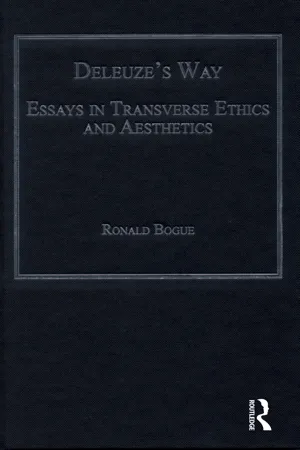
Addressing the essential question of the relationship between ethics and aesthetics in Deleuze's philosophy this book provides clear indications of the practical implications of Deleuze's approach to the arts through detailed analyses of the ethical dimension of artistic activity in literature, music, and film. Bogue examines Deleuze's "transverse way" of interrelating the ethical and the aesthetic, the transverse way being both a mode of thought and a practice of living. Among the issues examined are those of the relationship of music to literature, the political vocation of the arts, violence in popular music, the ethics and aesthetics of education, the use of music and sound in film, the role of the visual in literary invention, the function of the arts in cross cultural interactions, and the future of Deleuzian analysis as a means of forming an open, reciprocally self-constituting, transcultural global culture.
Information
Chapter 1
Immanent Ethics
By the time of his death on November 4, 1995, Deleuze had published twenty-three books touching on subjects as varied as painting, metallurgy, mathematics, geology, anthropology and cinema. As someone who valued the discipline and history of philosophy in his own idiosyncratic way, he had commented on many key figures and prominent issues in the Western philosophical tradition. Seldom, however, did he directly address the topic of ethics, despite its centrality in what is conventionally considered to be “philosophy.” Yet there is a sense in which all of Deleuze’s work is concerned with ethics, in that ethical principles inform his basic conception of thought and what it means to think.
Giorgio Agamben has suggested that we may reconstruct a genealogy of modern French philosophy along two lines of descent, a “line of transcendence” from Kant through Husserl to Levinas and Derrida, and a “line of immanence” from Spinoza through Nietzsche to Deleuze and Foucault, with Heidegger participating in both lines of descent.1 The theme of transcendence is perhaps most strikingly evident in Levinas, whose philosophy focuses on the confrontation with the radical Other. The Other is transcendent in that it is necessarily “otherwise” than Being, and hence for Levinas ethics precedes ontology. The motif of immanence, by contrast, is constant in Deleuze – indeed, he argues in What Is Philosophy? that the entire history of philosophy may be read as an effort to establish a “plane of immanence” (QP 47/46–7). Deleuze regards Spinoza as “the prince of philosophers,” since he is perhaps the sole philosopher to make “no compromise with transcendence” (QP 49/48). For Spinoza, ethics is ontology, a point Deleuze stresses when he observes that Spinoza’s magnum opus of pure ontology is titled Ethics, and when he asserts that Spinoza’s Ethics is really an “ethology,” that is, a science of the species behavior of humans in the natural lifeworld. I believe that for Deleuze, as well as for Spinoza, ethics is ontology, and that for this reason his ethics is best conceived of as an immanent ethics.2
Past, Present, Future
We may first approach the ethics of Deleuze’s thought through three themes, which may somewhat artificially be associated with stances toward the past, present and future: amor fati (the past); vice-diction (the present); and belief in this world (the future).
In his early book Nietzsche and Philosophy (1962), Deleuze argues that Nietzsche’s concept of amor fati, or “love of fate,” provides an ethical principle that may replace Kant’s categorical imperative: whatever you will, also will its eternal return. What Deleuze means by this dictum is made evident in his discussion of chance and the throw of the dice. Most gamblers are bad players who want to control chance. They throw the dice and only affirm the outcome that they like. If they shoot craps, they roll again in an effort to overcome the unlucky roll and erase its consequences. Nietzsche’s good players, by contrast, roll only once, and whatever the result, they affirm that result and will its eternal return. In this way, good players avoid the ressentiment of finding the world guilty of frustrating their desires, and thereby genuinely affirm the play of the world.
This Nietzschean principle of amor fati takes on a specifically Deleuzian cast in The Logic of Sense (1969) when Deleuze relates the concept to a Stoic ethics of the event. Central to Deleuze’s thought is the distinction between the virtual and the actual. The actual consists of the commonsense world of discrete forms, Newtonian space and chronological time. The virtual is a dimension of self-differentiating differences, one that is real without being actual, immanent within the actual without being reducible to it. It is a domain of individuating metamorphic processes, of a disorienting “spatializing” space, and a floating time of a simultaneous before-after. The virtual perpetually passes into the actual, that is, becomes actualized, but it is not thereby exhausted or erased, for it continues to subsist or insist within the actual. The virtual eludes our commonsense understanding, but it impinges on us in moments of vertigo when rational spatiotemporal coordinates are scrambled and a pure “event” emerges.
Consider the growth of a biological organism. The single-celled ovum is traversed by multiple gradients, or zones of potential division, any one of which may be actualized through fertilization. Once cell division is initiated, an individuating process occurs whereby virtual differences become actualized in specific forms (two cells, then four, then eight), but the individuating process of becoming precedes the actually individuated forms, and that process continues throughout the life of the organism as cells are formed, nourished and replaced. The virtual is a kind of structure of self-differentiating differences that unfolds itself into the actual but remains elusively “present” within the actual, hovering over its surface, as it were. The virtual is something like the “problem” of which the actual organism is a specific solution, and at every point in the ongoing emergence of the organism the problem of that structure of self-differentiating differences persists, or insists, as a set of co-present zones of oscillating variation and potential becoming. The virtual organism is a sort of verbal infinitive, “to become dog,” “to become frog,” a differential structuring immanent within the actual dog or frog, passing into the actual in a dynamic becoming at every point of the creature’s emergence, yet persisting as a problematic field of differential vectors.
The world is an egg, says Deleuze (DR 323/251), and everywhere the virtual is passing into the actual while remaining immanent within it. Deleuze’s version of Nietzsche’s amor fati is an ethic of willing the virtual, of willing the virtual “event,” which is immanent within the actual and which impinges on us in moments of disequilibrium and disorientation. The quintessential event, says Deleuze, is the battle, something that hovers over the battlefield like a fog, everywhere being actualized in the bodies of the soldiers, but nowhere specifically present except as a kind of unfolding “problem” of that battle (see LS 122–3/100–101). The event of the battle is an infinitive, a “to battle,” anonymous, elusive, outside conventional time, a floating immanent aura guiding the processes of actualization but becoming manifest only as a kind of secondary emanation from the bodies that actualize it. Deleuze’s ethic is one of being worthy of that which happens, in other words, of willing the event (LS 174–9/148–53). What soldiers should affirm in the battle is not so much any specific outcome as the pure event of the battle, the virtual “to battle” that plays through any of the diverse actualizations of the battle that may take place. To be worthy of what happens is to will the virtual event immanent within one’s ongoing actualization in the world.
In identifying this ethic of the event with amor fati, I am stressing its orientation toward the past. To be worthy of what happens is to will the difference, multiplicity and chance of the virtual and thereby avoid ressentiment and affirm the past events that have shaped one’s present. But one must also act in the present, and Deleuze by no means advocates a passive acceptance of everything that befalls us. One’s orientation toward the present in Deleuzian ethics we might approach through his concept of “vice-diction” (DR 245–7/189–91), as opposed to contra-diction. (In The Logic of Sense [LS 176–8/150–52], the concept goes by the name of contreeffectuation, “counter-actualization.”) Vice-diction is the process whereby one identifies and engages the virtual events immanent within one’s present world, whereby one “counter-actualizes” the virtual. Deleuze divides this process into two complementary movements, “the specification of adjunct fields” and “the condensation of singularities” (DR 245–6/190), which he likens to an Empedoclean expansion and contraction of love and hate. The specification of adjunct fields requires an outward exploration of the virtual networks of multiple connections that come together in each present moment, as well as a critique of our representations of that present moment. The virtual eludes our commonsense representations of the world, and only in moments of disequilibrium and disorientation do we sense the virtual in its passage into the actual. One task of vice-diction is to respond to this moment of disequilibrium, this unsettling “event,” first by undoing conventional representations of our situation, and second by teasing out the proliferating interconnections among self-differentiating differences that are enveloped in this particular moment of disequilibrium. Each unsettling element of a disorienting experience reveals what Deleuze calls variously a “zone of indiscernibility,” a “line of continuous variation,” or a “singularity,” a singular, remarkable difference that generates the regular forms and shapes of the commonsense world. The virtual may be conceived of as an infinite plane of singular points, each point being a zone of indiscernibility or vector of continuous variation. The process of specifying adjunct fields consists of connecting singularities and thereby exploring the expanding surface of that infinite plane. But vice-diction involves a second moment as well: a condensation of singularities whereby one experiments on the real. We might say that vice-diction’s first moment, the specification of adjunct fields, entails an assessment of the configuration of singularities in the grand dice-throw of our present situation, and that vice-diction’s second moment, the condensation of singularities, involves a reconfiguration of singularities as we make of ourselves and our situation a second dice-throw. The object of vice-diction is not simply to comprehend the virtual differences at work in our world but also to transform them, or rather to enter into the play of virtual differences and experiment with them. Such an experimentation is a condensation of singularities in that it is an effort to engage the infinite plane of singular points and contract those points into a single event, an explosive big bang that creates new, unpredictable configurations of singularities. Vice-diction thus entails both a process of exploring and hence constructing connections among differences, and a process of undoing connections in an effort to form new ones.
The concept of amor fati, then, allows us to think of the virtual in terms of an attitude toward the past, an absence of ressentiment and an affirmation of the sequence of virtual events that have come to form the actualized state of the present situation. Vice-diction frames the virtual in terms of the present moment, in which one explores the connections enveloped in the event that impinges on one’s situation and then experimentally induces metamorphic alterations of that situation. Yet implicit as well in this second moment of vice-diction is an attitude toward the future, an affirmation of the possibility of creating something new. One of the controlling themes in Deleuze’s work is that of “thinking otherwise,” of finding ways of inventing new possibilities for life, and such possibilities issue not ex nihilo but from the virtual lines of continuous variation immanent in the real. The creative side of vice-diction, the experimental activation of the disruptive potential of the virtual, implies an orientation toward the future which we may label, in Deleuze’s words, a “belief in this world.”
In Cinema 2: The Time-Image (1985) Deleuze argues that the classic cinema testifies to a bond between humans and the world, whereas the modern cinema does not. “The modern fact,” Deleuze remarks, “is that we no longer believe in this world. We do not even believe in the events which happen to us, love, death, as if they only half concerned us. It is not we who make cinema; it is the world which looks to us like a bad film” (IT 223/171). The “power of modern cinema,” when it ceases to be bad cinema, is to restore “our belief in the world” (IT 223/171), not “another world” or a “transformed world,” but “this world, as it is” (IT 224/172). The world as bad film is the world of clichés, of received opinion (doxa), of that which goes without saying, of static forms and institutions, of intractable facts and inevitable results – in short, a tired world devoid of possibilities. What the great modern directors restore to us is a world within which something new can emerge, and they do so by activating virtual self-differentiating differences immanent within the real. In this activity, cinema directors do as any other artists and as do any other creators – philosophers, scientists, politicians – they experiment on the real, on the virtual’s immanent lines of continuous variation. And when they do so, they affirm the creative potential immanent within the real and thereby exhibit a belief in this world.
Deleuze’s immanent ethics is ultimately an ethics of the virtual, and what I have called amor fati, vice-diction and belief in this world are simply three ways of looking at the virtual. Amor fati is a backward glance that affirms the virtual within the events that have culminated in the present. Vice-diction is a topical survey of proliferating virtual connections and an activation of their potential for reconfiguration through a condensation of singularities. Belief in this world is a view through the present and toward the future, one that envisions nothing specific in that future, but that trusts in the possibilities immanent within the real to produce something genuinely new.
Collectivity
To this point, my focus has been on the ethics of the individual, with little direct reference to the individual’s relationship with others – a decidedly odd emphasis, one might think, given Deleuze’s enduring hostility toward the notion of the autonomous subject and any subject-grounded thought. How, then, might the social implications of an immanent ethics be considered? Three Deleuzian motifs suggest themselves: the body as domain of speeds and affects; the other as disclosure of the possible; and the invention of a people to come.
Throughout his writings, Deleuze returns frequently to a remark by Spinoza that we do not yet know “what a body can and cannot do,” and hence, we do not know the extent of “the body’s capabilities.”3 In Spinoza: Practical Philosophy (1981), Deleuze offers his most succinct explanation of the significance of this remark. Deleuze points out that Spinoza defines the body in two ways: in terms of relations of slowness and speed between an infinite number of particles; and in terms of a body’s capacities for affecting and being affected. By characterizing the body in terms of differential speeds, Spinoza emphasizes the body’s participation in a single “plane of immanence” (S 164/122), a dimension of rhythms, movements, pauses, accelerations and decelerations, in which each body’s form and function emerge as secondary products of kinetic relations among particles. By approaching the body in terms of its capacities, or powers, of affecting and being affected, Spinoza imbues the plane of immanence with a pervasive affectivity generated through interactions among multiple forces.
In this analysis of bodies as affective rhythms, Deleuze finds the theoretical foundations of “what is today called ethology” (S 168/125), the study of animal behavior (a notion that in Deleuze’s usage might better be labeled “ecology”). The tick, for example, has limited capacities for affecting and being affected, its world determined solely by its receptivity to light (as it climbs a stalk or branch), to heat (as it senses an approaching mammal), to butyric acid (the substance excreted from the follicles of mammals), and to limited tactile stimuli (specifically, those provided by the hair and skin of its prey). The tick’s powers select a world, picking out a highly restricted set of relational elements, excluding everything else. The tick combines with its world, taking in certain substances (light, scents, blood), emitting others (anticoagulants, bacteria), connecting with some organisms, defending itself from others, and ignoring the rest. The tick’s relations with its selected world constitute a type of musical counterpoint, its diverse powers forming a point in counterpoint to each of the elements with which it is capable of forming a connection.
Humans, like ticks, select a world and form contrapuntal relations with that world’s elements. In the case of humans, however, the selected world is much wider and fuller than the tick’s, and the elements with which our powers can combine are in large measure unspecified. We do not know what a body can do, what connections the powers of the body make possible. We must therefore experiment with our bodies and seek those relations that increase our capacities. What is important to note is that the ethical imperative in bodily experimentation is not that of an increase in power over a world, but an increase in powers of affecting and being affected, a responsiveness to a selected world and an openness to interaction. As Deleuze insists in his Spinozistic reading of Nietzsche (NP 97/85), will to power manifests itself as a desire for power over others only in the reactive mentality of slaves, of those who seek to restrict others’ powers and to close themselves off from competing forces. The affirmative will to power, by contrast, seeks to extend its capacities through reciprocities of forces that combine in interconnecting affirmations of one another, and this is the will that Deleuze discerns in Spinoza’s ethology of bodies as configurations of speeds and affective intensities.
Deleuze argues that Spinoza’s account of the body calls us not simply to an experimentation with the individual body in its connections with a selected world but also to the formation of more complex collective bodies, social assemblages of differential speeds and affective intensities. Rather than merely testing the relations that augment the powers of individual bodies or threaten their dissolution, we must also determine the powers that may emerge in the generation of compound bodies:
It is no longer a question of utilizations or captures, but of sociabilities and communities. How do individuals enter into composition with one another in order to form a higher individual, ad infinitum? How can a being take another being into its world, but while preserving or respecting the other’s own relations and its world? … It is no longer a question of point to counterpoint, or of the selection of a world, but of a symphony of Nature, of a constitution of an increasingly wide and intense world. [S 169–70/126]
The ethical question for Deleuze is not “what must we do?” but “what can we do?” What assemblages allow the formation of collective bodies that expand their capacities, that open new modes of affecting and being affected? This question is not one of imposing limits from without, but of exploring potential for growth from within. In this sense, ethics is immanent to the creation of worlds, a matter more of mutual affinities and intensities among bodies than of mutual duties and obligations.
Yet is there no duty to the other in an immanent ethics? Not in the sense of a necessary restriction of one’s powers, or of the other’s, but perhaps a form of duty, a certain ethic of responsiveness or attentiveness, may be seen as consistent with Deleuze’s general ethical orientation. In Difference and Repetition (DR 333–5/259–61), Deleuze remarks briefly on the Other as expression of po...
Table of contents
- Cover Page
- Dedication
- Title Page
- Copyright Page
- Contents
- Acknowledgements
- List of Abbreviations
- Introduction The Transverse Way: Du côté de chez Deleuze
- 1 Immanent Ethics
- 2 Minority, Territory, Music
- 3 Violence in Three Shades of Metal: Death, Doom and Black
- 4 Search, Swim and See: Deleuze’s Apprenticeship in Signs and Pedagogy of Images
- 5 Tragedy, Sight and Sound: The Birth of Godard’s Prénom Carmen from the Nietzschean Spirit of Music
- 6 Bergsonian Fabulation and the People to Come
- 7 Re-Viewing Deleuze’s Sacher-Masoch
- 8 Apology for Nomadology
- 9 Nomadism, Globalism and Cultural Studies
- 10 Nomadology’s Trial by Proxy
- Bibliography
- Index
Trusted by 375,005 students
Access to over 1.5 million titles for a fair monthly price.
Study more efficiently using our study tools.
Frequently asked questions
Yes, you can cancel anytime from the Subscription tab in your account settings on the Perlego website. Your subscription will stay active until the end of your current billing period. Learn how to cancel your subscription
No, books cannot be downloaded as external files, such as PDFs, for use outside of Perlego. However, you can download books within the Perlego app for offline reading on mobile or tablet. Learn how to download books offline
Perlego offers two plans: Essential and Complete
- Essential is ideal for learners and professionals who enjoy exploring a wide range of subjects. Access the Essential Library with 800,000+ trusted titles and best-sellers across business, personal growth, and the humanities. Includes unlimited reading time and Standard Read Aloud voice.
- Complete: Perfect for advanced learners and researchers needing full, unrestricted access. Unlock 1.5M+ books across hundreds of subjects, including academic and specialized titles. The Complete Plan also includes advanced features like Premium Read Aloud and Research Assistant.
We are an online textbook subscription service, where you can get access to an entire online library for less than the price of a single book per month. With over 1.5 million books across 990+ topics, we’ve got you covered! Learn about our mission
Look out for the read-aloud symbol on your next book to see if you can listen to it. The read-aloud tool reads text aloud for you, highlighting the text as it is being read. You can pause it, speed it up and slow it down. Learn more about Read Aloud
Yes! You can use the Perlego app on both iOS and Android devices to read anytime, anywhere — even offline. Perfect for commutes or when you’re on the go.
Please note we cannot support devices running on iOS 13 and Android 7 or earlier. Learn more about using the app
Please note we cannot support devices running on iOS 13 and Android 7 or earlier. Learn more about using the app
Yes, you can access Deleuze's Way by Ronald Bogue in PDF and/or ePUB format, as well as other popular books in Philosophy & Philosophy History & Theory. We have over 1.5 million books available in our catalogue for you to explore.