eBook - ePub
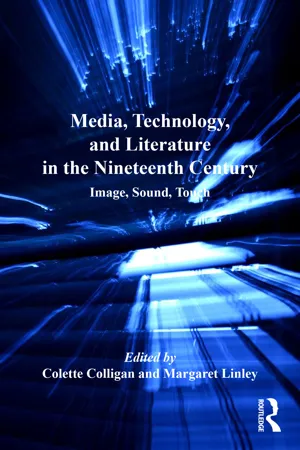
Media, Technology, and Literature in the Nineteenth Century
Image, Sound, Touch
- 316 pages
- English
- ePUB (mobile friendly)
- Available on iOS & Android
eBook - ePub
Media, Technology, and Literature in the Nineteenth Century
Image, Sound, Touch
About this book
Operating at the intersection where new technology meets literature, this collection discovers the relationship among image, sound, and touch in the long nineteenth century. The chapters speak to the special mixed-media properties of literature, while exploring the important interconnections of science, technology, and art at the historical moment when media was being theorized, debated, and scrutinized. Each chapter focuses on a specific visual, acoustic, or haptic dimension of media, while also calling attention to the relationships among the three. Famous works such as Wordsworth's "I wandered lonely as a cloud" and Shelley's Frankenstein are discussed alongside a range of lesser-known literary, scientific, and pornographic writings. Topics include the development of a print culture for the visually impaired; the relationship between photography and narrative; the kaleidoscope and modern urban experience; Christmas gift books; poetry, painting and music as remediated forms; the interface among the piano, telegraph, and typewriter; Ernst Heinrich Weber's model of rationalized tactility; and how the shift from visual to auditory telegraphic instruments amplified anxieties about the place of women in nineteenth-century information networks. Full of surprising insights and connections, the collection offers new impetus for stimulating historical conversations and debates about nineteenth-century media, while also contributing fresh perspectives on new media and (re)mediation today.
Information
Chapter 1
Introduction: The Nineteenth-Century Invention of Media
Media, Technology, Literature
Media, as we understand the word today, is a nineteenth-century invention. Yet what the term media obscures is media history, not only the exponential explosion of print in the nineteenth century but also the massive proliferation of a wide variety of popular mechanical devices, from the kaleidoscope, thaumatrope, phenakistoscope, zoetrope, praxinoscope, and kinetoscope to the stereograph, photograph, telegraph, typewriter, player piano, telephone, phonograph, and early film. This is not to deny the centuries-long history of media machines, but in tandem with unprecedented increases in literacy rates, enlargement of urban spaces and imperial networks, and expansion of industrialization and commodity exchange, the nineteenth century experienced the emergence of media ubiquity.
Together with the destabilization of traditional media hierarchies, whereby the status of the image was increasingly challenged by acoustic and tactile means, new and residual, multi and mixed media exemplified processes of remediation in relations of adaptation, mutation, incorporation, and disruption. The sheer increase in volume and diversity of media was accompanied by an expansion of the scale of information and communications distribution. Throughout this period media and medium could be used interchangeably. However, media would increasingly refer also to specific channels of mass communication, such as advertising, periodicals, newspapers, and educational print. This rapidly transforming environment of media discourse and media machines plugged into media networks contributed significantly to ways of knowing and experiencing the world, simultaneously reflecting, producing and recording alterations of consciousness and extensions of the human sensorium.
After a century of innovative encounters between industrial technology and the communicative imperative, media emerged in the early twentieth century as a modern myth. By the 1920s media had coalesced into an all-encompassing term for the collective means of mass communication, including newspapers, magazines, radio, television, and film, as well as the institutions that own or organize their production, circulation, dissemination and consumption, and the individuals who work for such organizations (OED). More than an umbrella under which to huddle the aggregate means of mass communication, media has come to describe an industry and an ideology.
The moment of consolidation of the nineteenth-century multiplicity of media into a totality of unique singularity in the early twentieth century thus marks the simultaneous appropriation and disavowal of media history, the spatial incorporation of the historical many into the one true media now understood as the first sign of a media matrix. The significance of this double move of spatial appropriation and temporal erasure cannot be understated. When the word that had been used in the particular to refer to specific means of mass communication evolved into the singular term for the heterogeneous plurality of media, history would seem to begin out of nowhere anew. With this apparently immaculate birth, radically cut off from a previous context of use and lexicon of meaning, comes the lament for an absolute irrecoverable past and the opposition to a seemingly monstrously media-saturated present, captured variously in such monumental twentieth-century analytical touchstones as Martin Heiddegger’s enframing, Theodor Adorno and Max Horkheimer’s culture industry, Guy Debord’s society of the spectacle, Harold Innis’s present-mindedness, Jean Baudrillard’s simulation, and Paul Virilio’s information bomb.
If media as a term thus regulates the temporal borders of media studies, historians of particular communications media decry their discipline’s historical amnesia (Brake, Print in Transition xiv; King and Plunkett 1–2) and grand narratives of media progression and supercession (Acland xix). Yet this forgetting is in some sense systemic, for the content of one medium is always another (McLuhan, Understanding Media 8), no medium is ever completely replaced by another (Stafford 1), the representation of one medium is another remediation (Bolter and Grusin 45), and new media is as old as the hills (Mitchell, What do Pictures Want? 211).
Any recovery of the history of media must therefore also historicize media logic: temporal rupture signifies the renunciation that is a precondition for copying on a different register. This is to say that the history of media only confirms the Derridean precept that writing and by extension technics more generally underpin the transcendental logic of Western metaphysics, which is predicated on a disavowal of inscription as the condition of transcendence. The erasure of the complex and multiple media histories from the concept of media is inherent to media logic, indeed is in some senses its culmination, anticipated early in the nineteenth century, as the chapters in this book show, by Mary Shelley’s endlessly replicating media monster Frankenstein, William Wordsworth’s media memory copied from the writing it denies, and Samuel Taylor Coleridge’s secondary imagination understood as the ultimate virtual reality system.
A different logical structure emerges in the context of Heidegger’s critique of technology as a means-ends instrumentality or tool, where media can function as a rejoinder to his reminder of the traditional relationship in Greek thought between techne and poiesis. The association between the technology of the printed book specifically and knowledge was the complex and uneven work of what Roger Chartier calls the second revolution of the book, the age of Gutenberg to the nineteenth century.1 By the nineteenth century, the episteme of technology evinced an ineluctable tension, with machine technology associated with the material tools of emergent industrial forms of production and techne linked not only to the art or print medium, but increasingly to what would become the domain of media, the means of imaginative creation and communications.
As media devices multiplied in the nineteenth century so too did media and art theory on topics ranging from memory and photography to narrative and aesthetics. Never far from the center of nineteenth-century cultural debates, media, now a key term anchoring ways of knowing in a century of wild transformation, was often considered in relation to hierarchies and privilege determined by oppositions between tradition and innovation, fancy and imagination, authentic and machine art, popular and high culture. However, the mutually defining relationship between techne and poiesis in the age of mechanical reproduction ensured a special affinity between literature and media that opened up new possibilities of structures of representation and new genres, confirming Linda Hughes’s apt pronouncement that “the study of literary history is the study of media history,”2 an understanding central to this collection’s interest in the place of literature in the nineteenth-century invention of media.
Media and the Sensorium
What did it mean to see, hear, and touch in this age of media explosions and manifestos? New and complex relationships to the human sensorium developed alongside media’s coming of age, calling for a reconceptualization of the sensing body. Marshall McLuhan’s notion that “all media are extensions of some human faculty—psychic or physical” (Medium 26)—has its foundation in this historical moment when McLuhan’s figure of media as an extension of the body was imagined with surprising variety. Books for the blind became prosthetics for the eye, the pianist’s hands behaved spellingly, and the ear heard more than ever before with the musical/mechanical impressions of the typewriter and the sounding out of the multi-media pages of the Victorian gift book. Decadent writing imagined the social and physiological possibilities of expanded sensory states through concepts of synesthesia and neuresthesia, while recurring tropes of loss and amputation as well as hauntings (Nead, Haunted 3–4) and “communications vampires” (Kittler, Gramophone 225) suggested the concomitant fears about the volatility and integrity of this sensory scaffolding.
The eye, ear, and skin were not just imagined as extended by media devices but were also understood to be incorporated within them. The introduction of the electric telegraph in the middle of the century not only revolutionized communications, it also retuned the ear and retooled the sense of touch. Similarly the introduction of the solo piano recital trained audiences to listen for the sound of the musician’s touch. The nineteenth-century appreciation for the sometimes intimate encounters between body and media, the ways in which the body massaged the medium and the medium massaged the body, anticipated Roland Barthes’s later critical appreciation for the “grain of the voice”—“the body in the voice as it sings, the hand as it writes, the limb as it performs” (188). This incorporation of the body into the period’s mediating structures reveals not only the expansion of the human sensorium, but also shows how the two were enmeshed, creating the possibility for understanding the seeing, hearing, and touching body as a multi-media machine.
The science of perception and the study of physiology grew alongside the marvelously unstable triumvirate of object, organ, and medium. The mechanics of sight, such as the retinal afterimage, were studied by a variety of European scholars in relation to what Jonathan Crary argues in Techniques of the Observer was an increasingly abstract and subjective model of vision based on biological difference. The German scientist, Ernst Heinrich Weber, studied the physiology of touch, mapping the human body’s skin receptors and discovering an atlas of tactile acuity. These studies were part of a larger cultural drive to observe the exciting and unpredictable sensing body as it became a nineteenth-century media phenomenon. Seeing, hearing, and touching were mediated through the instruments of science, measured and objectified for the larger purpose of knowing, educating, and modernizing the senses. This mapping of the senses was also arguably the exercise of sensorship, as demonstrated in Weber’s separation of pain from the tactile system.
Despite this impulse to map and rationalize the senses, to separate them from the screams of the body, they were also understood as irrational and uncharted. They were regularly figured as a haven from technological and metropolitan modernity. Touch, regarded as the least regulated of senses, was frequently appropriated for the purpose of exploring presumably authentic and unmediated human experience. The haptic dimension of the human sensorium allowed for a suspension of perception, a releasing and blending of the senses rather than a concerted modern drive to focus them.3 This romance of touch mounted an important critique of vision and its cultural authority, notably becoming the sensory nook most often associated with femininity and queerness.
With the collapse of the Cartesian separation of physiology from psychology and cognition, the mind as thinking substance could no longer be thought apart from physical location. The new biological sciences redefined thought as the product of an embodied brain, itself an assemblage of parts attached to a nervous system understood as a mediating apparatus integral to a knowledge of the world. Long before the railway “annihilated space by time,” a phrase conventionally attributed to Marx,4 the neurological legacy of Romanticism had radically connected time and space to the deep interiors of the mind. Whether it be Luigi Galvani’s theory of electrical nerve transmission, David Hartley’s associationism and attendant vibration theory, or Erasmus Darwin’s animating principle of matter, thought was measured through the sensory mediations of motion through space, contributing to the development of a new spatial imagination intimately tied to technologies of travel and expressed in such tropes as the “march of intellect.”5
The new biologism notwithstanding, the mind retained its rational capacity to serve as archive and storage bank, but rather than a Cartesian ocular mechanism or a Lockean blank slate for data inscription, the brain envisioned by nineteenth-century physiologists was an active data processor capable of computing time and vitality itself minutely in the mortal motions of the nerves. Spatial charting of physiological networking affected the entire range of cognition, sense perception and memory, revealing complex divisions among conscious, unconscious and automatic processes of thought, heightened consciousness, circumventions of willful control, and unintentional actions.6 The novel sciences of animal magnetism, telepathy, and mesmerism posited the carnally mediated mind as a data bank, housing information in excess of consciousness yet potentially accessible to others capable of virtual or paranormal communications, while medical science pathologized the inconstancies and unpredictability of the body’s medial work.7 Throughout the nineteenth century, the scientific recognition and codification of rapid pulses of neural transmission as data ensured the psyche more than an optical relation to bombardments by new developments in changing technology, communication, and transportation.
Scientific reorganization of mind-body relations together with the novel experiences and new forms of consciousness accompanying technological modernity’s transformations of space and time resulted in changes in forms of representation and mediation, beginning with the structure of the image itself. Word and image contested and vied for supremacy in the mechanically reproduced illustrated book; text inscribed voice to challenge the graphical nature not only of writing, as Friedrich Kittler suggests, but the printed image as well; memory mediated poetry’s virtual immersion in imaginary things; and the hand, as metonym for the creative laborer, became especially fraught in its relationship to moveable type, an ambiguous sign oscillating between alienation and authenticity, disconnection and circumvention. If the book had ordered cognition literally since the Renaissance through a spectrum of bibliographical practices from title pages and chapter divisions right down to the spacing of paragraphs and typesetting, the mass produced multi-media art book of the mid-Victorian parlor permeated domestic space with the touch and smell of the physical artifact, the music of the words on the page, and the dual perspective of reading and gazing at images.
The bifurcated vision and sensory fullness exemplified by th...
Table of contents
- Cover Page
- Title Page
- Copyright Page
- Contents
- List of Figures
- Notes on Contributors
- Acknowledgements
- 1 Introduction: The Nineteenth-Century Invention of Media
- Section 1 Image
- Section 2 Sound
- Section 3 Touch
- Index
Trusted by 375,005 students
Access to over 1.5 million titles for a fair monthly price.
Study more efficiently using our study tools.
Frequently asked questions
Yes, you can cancel anytime from the Subscription tab in your account settings on the Perlego website. Your subscription will stay active until the end of your current billing period. Learn how to cancel your subscription
No, books cannot be downloaded as external files, such as PDFs, for use outside of Perlego. However, you can download books within the Perlego app for offline reading on mobile or tablet. Learn how to download books offline
Perlego offers two plans: Essential and Complete
- Essential is ideal for learners and professionals who enjoy exploring a wide range of subjects. Access the Essential Library with 800,000+ trusted titles and best-sellers across business, personal growth, and the humanities. Includes unlimited reading time and Standard Read Aloud voice.
- Complete: Perfect for advanced learners and researchers needing full, unrestricted access. Unlock 1.5M+ books across hundreds of subjects, including academic and specialized titles. The Complete Plan also includes advanced features like Premium Read Aloud and Research Assistant.
We are an online textbook subscription service, where you can get access to an entire online library for less than the price of a single book per month. With over 1.5 million books across 990+ topics, we’ve got you covered! Learn about our mission
Look out for the read-aloud symbol on your next book to see if you can listen to it. The read-aloud tool reads text aloud for you, highlighting the text as it is being read. You can pause it, speed it up and slow it down. Learn more about Read Aloud
Yes! You can use the Perlego app on both iOS and Android devices to read anytime, anywhere — even offline. Perfect for commutes or when you’re on the go.
Please note we cannot support devices running on iOS 13 and Android 7 or earlier. Learn more about using the app
Please note we cannot support devices running on iOS 13 and Android 7 or earlier. Learn more about using the app
Yes, you can access Media, Technology, and Literature in the Nineteenth Century by Margaret Linley, Colette Colligan in PDF and/or ePUB format, as well as other popular books in Literature & Literary Criticism. We have over 1.5 million books available in our catalogue for you to explore.