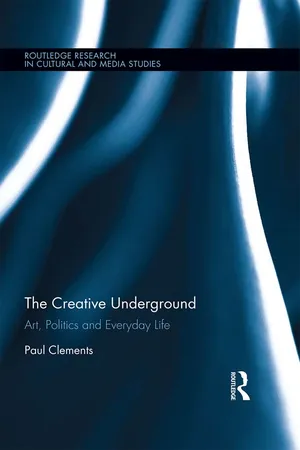
Paul Clements champions the creative underground and expressions of difference through visionary avant-garde and resistant ideas. This is represented by an admixture of utopian literature, manifestos and lifestyles which challenge normality and attempt to reinvent society, as practiced for example, by radicals in bohemian enclaves or youth subcultures. He showcases a range of 'art' and participatory cultural practices that are examined sociopolitically and historically, employing key theoretical ideas which highlight their contribution to aesthetic thinking, political ideology, and public discourse. A reevaluation of the arts and progressive modernism can reinvigorate culture through active leisure and post-work possibilities beyond materialism and its constraints, thereby presenting alternatives to established understandings and everyday cultural processes. The book teases out the difficult relationship between the individual, culture and society especially in relation to autonomy and marginality, while arguing that the creative underground is crucial for a better world, as it offers enchantment, vitality and hope.
- 232 pages
- English
- ePUB (mobile friendly)
- Available on iOS & Android
eBook - ePub
About this book
Trusted by 375,005 students
Access to over 1.5 million titles for a fair monthly price.
Study more efficiently using our study tools.
Information
Topic
ArtSubtopic
Art & Politics1 Introducing the creative underground
A left-wing vision of the world requires you to imagine a future utopia, but one doesn’t have the right to forget the most important thing for every human being is the life they lead now.
(Jose Mujica, President of Uruguay, cited in Tremlett [2014: 32])
In layperson terms, everyone at some time in their lives dreams of a better world with an end to poverty, disease and warfare, but the problem is how to channel this imagination creatively and convert thinking into actuality. Real life appears to manifest itself as a mundane and pragmatic existence that is very different from utopian possibility, although reality may be a necessary benchmark to ground and make conscious the potential scope of such ideas.
This book employs the wide-ranging concept of a ‘creative underground’, to encapsulate cultural resistance through ‘art’ and creative sociocultural practices that oppose hegemony and ‘systems’ to preserve the status quo. It highlights the difficult relationship between culture and society, representation and practice, modernism and postmodernism, legitimate and marginal culture, which often includes a visceral dislike for the abuses of power. There is a selective postmodern ‘pick and mix’ of concepts and material practices that is not a definitive account of the creative underground, but a collection of theoretical and practical takes which retains a wide-angled focus on cultural resistance.
The Situationist International ‘leader’ Guy Debord (1961) over fifty years ago maintained via a prerecorded taped lecture that the role of the artist is to transform everyday life. He questioned the assumptions made about art, especially those presented through the mainstream media, ‘art’ markets and established cultural institutions, and the need to reconfigure culture away from elite to mundane concerns. He was following on from the revolutionary cultural critic Walter Benjamin who suggested in the 1930s that we need to think ‘crudely’ through proverbial, localized and idiomatic everyday language (cited in Arendt 1999: 21) in order to shape a radical ideology for a progressive society. This includes a microscopic focus on the small, often unseen, statements or ideas which a slower, more perceptive lifestyle will encourage us to recognize as meaningful. He argued that the role of the artist is more than just making creative products for (and delivery of cultural services to) the affluent bourgeoisie who can afford them. It is actively to transform the cultural economy and mechanisms of production and consumption into a fairer and equitable system, which cannot be accommodated within a capitalist system and requires revolutionary action (Benjamin 1970 [1934]).
Modernity has altered the role of artists from being determined by rich and powerful patrons to offer degrees of flexibility, aesthetic autonomy and sociopolitical commentary which has challenged canonical control. Nevertheless, society through elite cultural processes selects those few artists deemed worthy of our attention, which leaves the vast majority on the fringes and of little value, surplus to requirements. In contrast, the creative underground is the manifestation of a variety of individuals and movements which have expressed resistance, pluralism and marginality outside established mainstream culture. For example, avant-garde groups and their manifestos have charted the need to challenge and resist acceptable bourgeois culture or peripheral youth subcultures derived from popular culture, which have embodied stylistic nonconformity.
The radical Frankfurt School social psychologist Erich Fromm (1960), again over fifty years ago, suggested that we fear spontaneity, difference and creativity and that this lack of autonomy and ability to express our character corresponds with a feigning to authority. In modern ‘progressive’ society, it is left to the ‘artist’ to explore and enact spontaneity. Unfortunately, one problem with singling out artists for this role is that it is elitist rather than everyday and encourages specific representations of creative individuals in contrast to ‘normal’ people, connoting expressive distinction for the few whilst the general public are deemed to lack creativity reinforcing exclusivity. Fromm (1956) critically maintained that it is society which is at fault and that this disavowal of creativity for everyone goes a long way to explain the need, even compulsion, to consume comforting cultural products as a form of compensation. Consumerism is not accidental; rather, it is orchestrated through capitalism, and today the ideology of neoliberalism stresses the individual but fails to acknowledge that as we become increasingly commodified and pursue values related to having and possessing, this may further alienate us from ourselves and creative processes. Oliver James (2007) re-formatted this notion within a quasi-medical discourse of affluenza, whereby value is embedded in ‘money, possessions, physical and social appearance, and fame’ (2007: 12–13), which consequently creates emotional distress and illness.
In contrast to individualized consumption practices that undergird conformity, the creative underground incorporates those ‘artists’ who conceptualize and construct alterity, often driven by political beliefs and values which oppose the status quo. This includes ‘real’ bohemian spaces manifesting difference rather than wishful thinking. It is a broad notion, associated with authenticity, not ‘selling out’ and a certain degree of self-reflection. The beat writers referred to themselves as ‘subterraneans,’ a term Jack Kerouac used in the title of one of his stories, a characteristic he ascribed to Adam Moorad (aka Allen Ginsberg who created the label; see Charters 1992: 9). Moorad suggested that subterraneans
are hip without being slick … intelligent without being corny … intellectual as hell and know about [Ezra] Pound without being pretentious or talking too much about it, they are very quiet, they are very Christlike.
(Kerouac 2001: 3)
This suggests that being a part of the creative underground requires much cultural capital, style, modesty and a hidden mystique rather than being openly self-promotional, a disposition which may be countercultural but also refers to elitist conceptions, hence the difficulty with terminology.
Within youth culture, subterranean value may refer to the lure of deviancy, which is then reinforced by its labelling in the media. This includes the search for thrills and excitement that then becomes a badge of honour, a narrative exploited by umpteen Hollywood movies.
A glance at the dictionary confirms that the term ‘underground’ refers to the underworld as well as, ‘of, pertaining to, or designating a secret group, movement, or activity, especially one aiming to subvert an established order or ruling power’; also, ‘of or pertaining to a subculture seeking to provide radical alternatives to the socially accepted or established mode; unconventional, experimental’ (Shorter Oxford English Dictionary 2007). As an adverb, it refers to a ‘hidden and obscure manner’ and ‘concealment’; as an adjective, it suggests ‘growing, living or developing underground … dwelling in the underworld or lower regions … not open to public, concealed from general notice’ (Oxford English Dictionary 1970). The word ‘underground’ is entered alphabetically before the word ‘undergrown’, which refers to something not yet fully developed, and also can be applied to it.
There are popular expressions associated, for example, with ‘going underground’ which conjure up notions of hiding away, a term employed to title a pop song by The Jam, which reached number one in the UK charts in 1980. The phrase ‘going to ground’ suggests holing up and escaping, which has criminal associations of lying low after a felony has been committed. The term ‘underground’ connotes resistance to hegemony, whether historically against the military in times of war, colonialism or occupation by dominant powers. The term has a long association with subversive movements and expresses the notion of marginal individuals and social groups gathering secretly in full knowledge that their viewpoints and beliefs may contravene ‘normal’ social practices. The concept of creating religious cells, groups of people meeting and expressing a cosmology which is different to orthodoxy, has a long tradition globally and conjures up imagery of Christian, Jewish and Muslim groups being persecuted for their faith and holding secret worship services. The religious concept of the underground cell has a political manifestation and a need to alter the world corresponding to firmly rooted belief systems inspired by earthly paradise (heaven on earth) and a glorious afterlife, a utopian concept that can take on a number of anti-establishment forms.
It is important to situate creative resistance and underground movements sociopolitically and historically, focusing on those individuals and groups who have challenged common sense which has stimulated free thinking and creative expression in others. For example, the Thracian gladiator Spartacus led a slave rebellion against the might of the Roman Empire (73–71 BC), a movement steeped in presocialist ideals suggesting a better life for those enslaved; Digger groups in seventeenth-century England challenged private ownership influenced by Gerard Winstanley, a preacher of collective agricultural reform (agrarian communism); youthful communards set up the Paris Commune (1871) and struggled for justice, fraternity and equality; Spanish anarchists reconstituted Barcelona during the Civil War (1936–38) as a secular place without hierarchy; youthful counterrevolutionaries in eastern Europe challenged the authoritarianism of the communist regimes in Hungary and Czechoslovakia (the Budapest uprising of 1956 and Prague Spring of 1968), which were unsuccessful in countering Soviet hegemony; protests in Tiananmen Square (1989) encouraged Chinese students to voice their disaffection with the communist regime; and the Arab Spring sparked by the self-immolation of Mohammad Bouazizi in Tunisia (2011) triggered uprisings against authoritarian regimes in Bahrain, Egypt, Libya, Syria and Yemen. These latter uprisings have also included underground religious fundamentalists reacting to the commodification of society and negative effects of capitalism. Recently with regards to Islam, certain militant groups have manufactured terrorism and a ‘utopian’ return to theocracy which may be stridently anticapitalist but far from supporting a democratic public sphere, progress or equality. But this has left an indelible mark both on those countries involved and globally, suggesting that the impossible dream may be possible (or at least alter reality and perceptions), which has inspired subjugated peoples globally and illustrates the power of ideas.
A key issue is forging arguments and practices in support of a democratic public sphere (and media) free from authoritarian regimes and the iniquitous impact of global capitalism (Gilbert 2008). This has become the dominant economic discourse, with its footprint now all-pervasive, and those groups loosely labelled anticapitalist whether global or local in orientation represent a widespread underground resistance. For example, the Zapatistas who have been defending their native rural lifestyle in Central America typify resistant local cultures fighting governments and global corporations whether in the tundra expanses of Siberia, deserts of Australia or rainforests of the Congo. There are renowned ecological movements, including Greenpeace and Friends of the Earth, which preach various degrees of ectopia (ecological utopia). The Slow Movement has combined the need for sustainable agriculture with an attack on fast food and for society to collectively de-stress by living a slower and more three-dimensional lifestyle which critiques speed (Honoré 2004). Mass demonstrations in response to the World Trade Organization meetings (and the G7/8/20 summits) have concerned a variety of global organizations and groups promoting differing blends of anticapitalism over the past twenty-five years or so (Gilbert 2008: 84–86). Underground resistance, aided by on-line technology, has had a new lease of life as realized by the Occupy Movement (in the US and Europe) and the Arab Spring through their use of social network sites to organize and foment disaffection.
One specific notion of the underground in the ‘democratic’ West since the Second World War has referred to symbolic resistance through youth subcultures and the dissenting counterculture of the late 1960s which promoted alternative lifestyles using niche media, popular culture and public events. It dared to mix popular culture with avant-garde ideas and risqué revolutionary sentiment. Timothy Leary summed up this process with his infamous rallying cry for youth to, ‘turn on, tune in and drop out’.
An avenue for the creative underground was folk and rock music which broke free from the commercial constraints of popular culture. Progressive and psychedelic rock musicians utilized prolonged solos and themed ideas, liberated from three-minute pop songs looking to classical, jazz and folk music from around the world for inspiration. Specific venues sprang up expressing this underground in London from the Roundhouse to the UFO club, which became the centres of hippie culture. House bands included Pink Floyd in its early Syd Barrett incarnation of folksy quirkiness, and the jazz-folk inflected Caravan and Soft Machine with the enigmatic Robert Wyatt. These bands employed new sound and lighting technologies creating a specific live ambience, often expressing fantastical utopian narratives.
In contrast to this underground counterculture which was erupting during the 1967 ‘summer of love’, there were specific subcultures of working-class youth groups (in the UK these included Mod, skinhead and biker groups), which were situated on the perimeter of society. The Mods predated this counterculture and congregated in the Flamingo Club in London, taking up pariah outsider roles (encouraged by hooligan labelling in the media). They appropriated bourgeois fashion, Italian scooters, legal drugs (amphetamines) and American rhythm and blues, suggesting that they had an abundance of style and could outcompete the middle class. The ultimate deviant rebel style was encapsulated by punk in the late 1970s, which was an angry and destructive hedonism with attitude and an antibourgeois disposition.
There was dystopian opposition to the hippie counterculture, for example in the US by the Velvet Underground, a band who expressed their alienation influenced by the beat writers. The name was taken from the title of a 1963 paperback by Michael Leigh about sexual corruption, and the co-founder lyricist and guitarist Lou Reed maintained that the band attempted to translate literary texts into music (Hogan 2007). Moreover, John Cale who co-wrote the music and played piano, electric viola and bass, was steeped in avant-garde classical music, and in many ways the band fused avant-gardism with resistant popular culture. Their pessimism and dress code of everything black was in stark contrast to hippie optimism and colouration. Lou Reed portrayed authentic outsider credentials as he underwent electroconvulsive therapy as an adolescent (essentially to rid him of his homosexuality). The music fused experimentalism, folk-induced pop with narratives about heroin addiction, weird sexual dalliances and prostitution. It translated marginalized beat writing of lived experience into song, which process possibly has deeper resonance with deviancy than love and peace mantras.
Hippie thinker Preston Burns defined the underground as groups of subversive activists devoted to improving or overthrowing the established order in the name of progress. He asked:
Who is the underground?
You are if you dream, work and build towards the improvements and changes in your life, your social and personal environments towards the expectations of a better existence.
You are if you dream, work and build towards the improvements and changes in your life, your social and personal environments towards the expectations of a better existence.
(Burns cited in Kornbluth 1968: 210)
Such a definition may appear progressive (and rather self-centred) but it is highly contextual as one person or group’s notion of progress is another’s idea of regress, which suggests a convoluted relationship between culture and counterculture, authenticity and inauthenticity, utopian and dystopian scenarios. Furthermore, if the creative underground concerns counterhegemony, it cannot be ‘high’ art which is academically and culturally respectable, nor mainstream popular culture which supports the capitalist cultural industries and for profit. It is an amalgam of resistant or edgy ‘independent’ popular, participatory and avant-garde cultures, the ‘art’ of those on the margins which reflects degrees of exclusion, creating a hybrid of original or taboo sociocultural practices and left-field ideologies.
In the 1970s, Dick Hebdige (1987 [1979]: 148) from the Birmingham School Centre for Contemporary Cultural Studies, distinguished, possibly unfairly, counterculture from subculture, with the former being a widespread, ‘amalgam of “alternative” middle class youth cultures’ influenced by hippie ideals of peace and love, a ‘flower power’ which was political and in opposition to the dominant culture. The revolt of middle-class youth is both articulate and influential, for these very same individuals are the educated sons and daughters of the ruling establishment who in future may well replace their parents in powerful elite circles. In contrast subculture rises up from beneath, is smaller in scale and refers to those more peripheral young and outsider elements in society. Historically from working-class or minority ethnic backgrounds, these characters are unable to influence the establishment and symbolically resist this to a greater or lesser extent through creativity, lifestyle and taste. There are degrees of infraction and resistance to mainstream thinking represented by the parental generation (1987: 180) and much elasticity in these definitions. Subculture in particular delineates a range of diverse social groups in opposition to mainstream attitudes, values and styles within the wider community, whether bikers, prisoners or bohemians.
An example of the muddy reality were the New Age travellers, a post-hippie and post-punk ‘subculture’ in 1980s UK which grew out of the free festivals of the 1970s. It was a direct reaction to the right-wing neoliberal government at the time and consisted of the disaffected casualties of this ideology, a rump of alternative thinkers living various lifestyles which attracted public opprobrium. Resistance for some was more than merely symbolic style, and many actually lived an alternative rural lifestyle by squatting on land and residing in tepees, converted trucks and buses (like modern-day Diggers). Nonetheless, New Age philosophy was highly individualistic and valorized the autonomous creative individual, thereby sharing similarities with the ideology that it reacted against (Heelas 2006).
The hippie and punk spirit, recuperated by the ideology of neoliberalism, has served to obfuscate the distinction between fantasy and reality, resistance and its saleability. Recent ‘post-subcultural’ groups which have expressed resistance through new youth styles have been intentionally marketed as de rigueur fashion. This has included the children of counterculture expressing themselves by self-consciously competing with the cultural industries within the system of capitalism. These entrepreneurial ‘players’ have reconstituted the realms of work and play through digital technology within a fragmented postmodernity, where at its most extreme leisure is an opportunity to network rather than play. In contrast, an optimistic take recognizes a creative future within a post-capitalist society that is able to focus on leisure time to question and dilute the effects of an overactive and all-pervasive work ethic.
Style in revolt in line with postmodern and post-subcultural thinking places greater emphasis on individualism and lifestyle differences (Muggleton 2000) which recuperates the underground as a tool for marketing the cultural economy. This supermarket of styles (Polhemus 1997) is possibly more about consumer choice than individual difference, determined by market domination of culture and its ideology of liberation (associated with style and its display through consumption). Underground terminology has been replaced by the language of individualism and related ideology which appears all-embracing, The rise of the individual in the US and Europe since the nineteenth century is a complex phenomenon which is the result of various cultural, socioeconomic and ideological factors. Ernest Gellner has maintained that there is a ‘difference between a status society where the individual is subordinate to the community, and a contractual society whereby the community is subordinated to the individual’ (Gellner 1998: 14), although these positions are far from mutually exclusive and vacillate. Today the pendulum appears to have swung to the latter position where, for example, the terms of anarchy have been redefined as an individualistic libertarianism which favours little regulation and minimal government.
In contrast, there is an effervescent understanding of the creative underground compri...
Table of contents
- Cover
- Half Title
- Title Page
- Copyright Page
- Table of Contents
- Acknowledgements
- 1 Introducing the creative underground
- 2 Utopia
- 3 Manifestos
- 4 The avant-garde, autonomy and wider participation
- 5 Creative resistance: counterculture, subculture and counterpublics
- 6 Heterotopia, Bohemia and vignettes of creative underground practices
- 7 Work, play and a post-work scenario
- 8 Everyday life
- 9 Concluding words
- Bibliography
- Index
Frequently asked questions
Yes, you can cancel anytime from the Subscription tab in your account settings on the Perlego website. Your subscription will stay active until the end of your current billing period. Learn how to cancel your subscription
No, books cannot be downloaded as external files, such as PDFs, for use outside of Perlego. However, you can download books within the Perlego app for offline reading on mobile or tablet. Learn how to download books offline
Perlego offers two plans: Essential and Complete
- Essential is ideal for learners and professionals who enjoy exploring a wide range of subjects. Access the Essential Library with 800,000+ trusted titles and best-sellers across business, personal growth, and the humanities. Includes unlimited reading time and Standard Read Aloud voice.
- Complete: Perfect for advanced learners and researchers needing full, unrestricted access. Unlock 1.5M+ books across hundreds of subjects, including academic and specialized titles. The Complete Plan also includes advanced features like Premium Read Aloud and Research Assistant.
We are an online textbook subscription service, where you can get access to an entire online library for less than the price of a single book per month. With over 1.5 million books across 990+ topics, we’ve got you covered! Learn about our mission
Look out for the read-aloud symbol on your next book to see if you can listen to it. The read-aloud tool reads text aloud for you, highlighting the text as it is being read. You can pause it, speed it up and slow it down. Learn more about Read Aloud
Yes! You can use the Perlego app on both iOS and Android devices to read anytime, anywhere — even offline. Perfect for commutes or when you’re on the go.
Please note we cannot support devices running on iOS 13 and Android 7 or earlier. Learn more about using the app
Please note we cannot support devices running on iOS 13 and Android 7 or earlier. Learn more about using the app
Yes, you can access The Creative Underground by Paul Clements in PDF and/or ePUB format, as well as other popular books in Art & Art & Politics. We have over 1.5 million books available in our catalogue for you to explore.