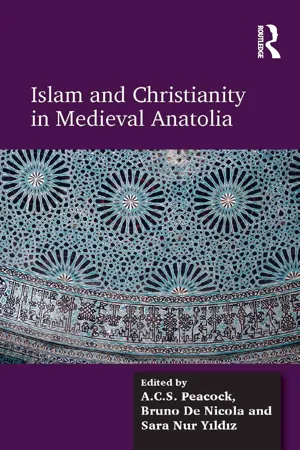
Islam and Christianity in Medieval Anatolia offers a comparative approach to understanding the spread of Islam and Muslim culture in medieval Anatolia. It aims to reassess work in the field since the 1971 classic by Speros Vryonis, The Decline of Hellenism in Asia Minor and the Process of Islamization which treats the process of transformation from a Byzantinist perspective. Since then, research has offered insights into individual aspects of Christian-Muslim relations, but no overview has appeared. Moreover, very few scholars of Islamic studies have examined the problem, meaning evidence in Arabic, Persian and Turkish has been somewhat neglected at the expense of Christian sources, and too little attention has been given to material culture. The essays in this volume examine the interaction between Christianity and Islam in medieval Anatolia through three distinct angles, opening with a substantial introduction by the editors to explain both the research background and the historical problem, making the work accessible to scholars from other fields. The first group of essays examines the Christian experience of living under Muslim rule, comparing their experiences in several of the major Islamic states of Anatolia between the eleventh and fifteenth centuries, especially the Seljuks and the Ottomans. The second set of essays examines encounters between Christianity and Islam in art and intellectual life. They highlight the ways in which some traditions were shared across confessional divides, suggesting the existence of a common artistic and hence cultural vocabulary. The final section focusses on the process of Islamisation, above all as seen from the Arabic, Persian and Turkish textual evidence with special attention to the role of Sufism.
Chapter 1 Christians in the Middle East, 600–1000: Conquest, Competition and Conversion
Philip Wood
For the Christian communities of the Middle East, the Turkish invasions of the eleventh century were the second time that their political order had been overturned by an alien foe. The seventh century had already seen the complete redrawing of the political map of the region, as the Persian and Roman empires were catastrophically defeated by the forces of the nascent caliphate. When the dust had settled, the Persian realms had been entirely absorbed by the new Arab state, and the Roman empire was reduced to an impoverished rump state in Anatolia and the Balkans. Yet Christians continued to live and prosper in the conquered territories. There was no sudden conversion to Islam that accompanied conquest.1
In this chapter I would like to set out some of the evidence for the continuation and transformation of Christian social and political life under Muslim rule. This is significant firstly because it sets the scene for later developments in Anatolia after the battle of Manzikert (1071). But the earlier period also merits investigation because the period of early Islamic rule in the Middle East suggests a number of different models for how the processes of conversion, political accommodation and inter-confessional competition might work in different circumstances.
The religious conversion of the Middle East is a vast subject. I can only really scratch the surface here. But I do wish to emphasise the variety of the Christian experience, whether by confession, by region or by institution. I begin by setting out the confessional diversity of the Middle East as a whole, before discussing the aftermath of the Arab conquests and their different effects in Syria and in northern and southern Mesopotamia.2 Finally, I turn to the elements of Arab-Islamic culture and jurisprudence that might allow us to explain the gradual conversion of parts of the Middle East to a new religion.3
The Sixth Century: Three Christian Confessions
The Roman Middle East that fell to Arab arms in the seventh century was no homogeneous territory. As well as Jews, polytheists and Samaritans, the region played host to numerous different Christian confessions. The Chalcedonians were the most numerous of these. This group, intellectual ancestors of the modern Greek Orthodox, derived their theology from the formulae of the 451 Council of Chalcedon, in particular their emphasis on the independent human and divine natures of Christ (a Dyophysite Christology). This was the faith of the emperor and of the four great patriarchates of the east in Constantinople, Alexandria, Antioch and Jerusalem. It was the only Christian group in the east to enjoy relatively close relations with the Pope in Rome and its adherents were scattered across the eastern Mediterranean. The Chalcedonians of the caliphate are often referred to as Melkites, and I shall use this term here.4
The second major Christian confession were the Miaphysites, those who asserted a single unified nature of Christ. This group is sometimes referred to as the anti-Chalcedonians, because they rejected the Council of Chalcedon and viewed this as their main point of departure from the Melkites. Here I shall use the term ‘Jacobite’, the name they were most commonly given by Arabic authors after the missionary bishop, Jacob Baradeus. Whereas the Melkites had been the direct recipients of imperial patronage, the Jacobites had been subject to periodic persecution throughout the sixth century at the hands of impatient patriarchs of Constantinople. In reaction to this persecution, and to their exclusion from a great deal of imperial patronage, they retreated into the countryside in their main strongholds of Egypt, Mesopotamia and northern Syria. They retained the structures of the Chalcedonian church, however, even if their councils and synods were convened in rural monasteries rather than in cities, and they continued to celebrate the imperial patronage they had received in recent in earlier eras.5
Modern historians have occasionally represented the Syrian Jacobites as a fifth column, eager to welcome the Arab invaders and expel their Chalcedonian persecutors.6 However, these interpretations place rather too much weight on sources written or compiled long after the invasions themselves.7 Sixth-century sources offer a much more nuanced view, in which the Jacobites represent themselves as servants of the emperor and as an ‘orthodoxy in waiting’, until such time as he would restore their exiled bishops to their rightful place.8
The third major confession that I will discuss here is the Church of the East, often referred to as the Nestorian church. This was the Christian church of the Sasanian empire, which adopted a heavily Dyophysite Christology that could occasionally be reconciled with the Council of Chalcedon. Christians in the Sasanian world endured periodic persecution at the hands of the state authorities, but this was interspersed by various experiments by the Sasanian state to give authority to the bishop of Ctesiphon and to try to influence Christian behaviour through institutional structures.9
Relations between all three groups varied substantially across the sixth century. All three could look to important moments of rapprochement or points of conflict in their shared histories, and the sixth century would offer a crucial phase that later historians would look back on, in order to chart contemporary identities. It is, perhaps, ironic, that the closest they came to reconciliation was with the aftermath of the reign of the emperor Heraklios (d. 641). His defeat of the Persian empire in 628 and his representation of the Sasanians as pagan enemies of God offered the possibility of Christian unity.10 Supported by his allies from the Christian Caucasus, the emperor returned the True Cross to Jerusalem after its capture by the Persians and received communion with the Nestorian patriarch Isho
yahb II.11 Where theologians had long failed to get different confessions to cooperate, the field of battle may have offered a more direct indication of God’s will.
Of course, with the hindsight of subsequent events, we know that Heraklios’ plans came to nothing with the Arab invasions of Syria and Iraq. God, it seemed, had other human agents in mind and other theologies to favour. But the fact that Heraklios came so close to establishing compromise should remind us of two things. Firstly, that any theologian conscious of his history would be aware of the real possibility of the union of the churches. And, secondly, that relations between different Christian confessions were also deeply intertwined with secular affairs, and that God’s hand was seen in the deeds of emperors as much as in the internal workings of the church.12
The Effects of the Conquest
Large parts of the Roman Middle East fell to the Arabs very quickly indeed. This was not the long, drawn out struggle that characterised the fall of parts of the Roman West.13 Al-Balādhurī reports that the Greeks fled cities like Homs and Damascus for the safety of Roman Cyprus, and that the Arab conquerors were permitted to live in their houses.14 But the levels of population displacement and the destruction of property during the conquests appear to have been low. The archaeologist Alan Walmsley observes how rare it is to find signs of destruction in the cities of Syria and Palestine.15 The conquest seems to have been swift and relatively tightly controlled.16
For several of the Christian confessions of the Middle East, the seventh century may have represented something of an ‘Indian Summer’, to use Chase Robinson’s term.17 Probably because they simply lacked the administrative manpower to closely monitor the conquered population, the caliphate seems to have allowed many local aristocrats, bishops and monasteries substantial powers to provide justice for their co-religionists18 and relied on them to raise taxes on behalf of the state.19 Numismatists have also suggested that similar groups took on the responsibility of minting imitations of Roman coins, when sufficient coin stock was no longer being imported from elsewhere or being produced by the state.20 In Egypt we see Christian elites exploiting the absence of central government to raise much higher taxes on the agricultural population than had occurred under Roman rule.21 In other words, the ...
Table of contents
Cover Page
Title Page
Copyright Page
Contents
List of Illustrations
Acknowledgements
Note on Transliteration and Place Names
Abbreviations
Notes on Contributors
Introduction
Part I Christian Experiences of Muslim Rule
Part II Artistic and Intellectual Encounters between Islam and Christianity
Part III The Formation of Islamic Society in Anatolia
Bibliography
Index
Trusted by 375,005 students
Access to over 1.5 million titles for a fair monthly price.
Study more efficiently using our study tools.
Frequently asked questions
Yes, you can cancel anytime from the Subscription tab in your account settings on the Perlego website. Your subscription will stay active until the end of your current billing period. Learn how to cancel your subscription
No, books cannot be downloaded as external files, such as PDFs, for use outside of Perlego. However, you can download books within the Perlego app for offline reading on mobile or tablet. Learn how to download books offline
Perlego offers two plans: Essential and Complete
Essential is ideal for learners and professionals who enjoy exploring a wide range of subjects. Access the Essential Library with 800,000+ trusted titles and best-sellers across business, personal growth, and the humanities. Includes unlimited reading time and Standard Read Aloud voice.
Complete: Perfect for advanced learners and researchers needing full, unrestricted access. Unlock 1.5M+ books across hundreds of subjects, including academic and specialized titles. The Complete Plan also includes advanced features like Premium Read Aloud and Research Assistant.
Both plans are available with monthly, semester, or annual billing cycles.
We are an online textbook subscription service, where you can get access to an entire online library for less than the price of a single book per month. With over 1.5 million books across 990+ topics, we’ve got you covered! Learn about our mission
Look out for the read-aloud symbol on your next book to see if you can listen to it. The read-aloud tool reads text aloud for you, highlighting the text as it is being read. You can pause it, speed it up and slow it down. Learn more about Read Aloud
Yes! You can use the Perlego app on both iOS and Android devices to read anytime, anywhere — even offline. Perfect for commutes or when you’re on the go. Please note we cannot support devices running on iOS 13 and Android 7 or earlier. Learn more about using the app
Yes, you can access Islam and Christianity in Medieval Anatolia by A.C.S. Peacock,Bruno De Nicola in PDF and/or ePUB format, as well as other popular books in History & European Medieval History. We have over 1.5 million books available in our catalogue for you to explore.