- 266 pages
- English
- ePUB (mobile friendly)
- Available on iOS & Android
eBook - ePub
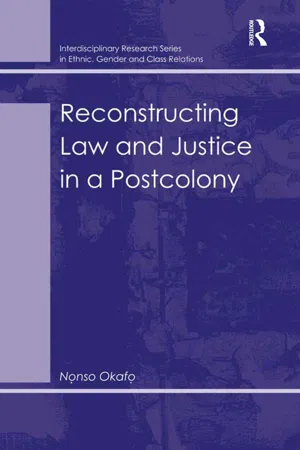
Reconstructing Law and Justice in a Postcolony
About this book
Drawing on data from a cross-section of postcolonial nations across the world and on a detailed case-study of Nigeria, this book examines the experience of recreating law and justice in postcolonial societies. The author's definition of postcolonial societies includes countries that have emerged from external colonial rule, such as Nigeria and India as well as societies that have overcome internal dominations, such as Afghanistan and Iraq. Suggesting that restructuring a system of law and justice must involve a consideration of the traditions, customs and native laws of a society as well as the official, often foreign rules, this volume examines how ethnically complex nations resolve disputes, whether criminal or civil, through a combination of formal and informal social control systems. This book is unique in its concern with how the average citizens of a postcolonial society can play more active parts in their nation's law and justice, and how modern and increasingly urban societies can learn from indigenous peoples and institutions, which are more informal in their approaches to problem-solving. The concluding chapter looks at the possibility of an increased role for civil as opposed to criminal response in the social control system of a postcolonial society.
Information
PART 1 Customary Law Foundations of Modern Law and Justice
1 Are Traditions, Customs, and Native Laws Impotent in the Face of Modernity?1
DOI: 10.4324/9781315604022-1
Introduction
The core object of this chapter is to gauge the utility of customary law in a modern State. Doing so requires me to judge the effectiveness and efficiency of traditions, customs, and native laws in rural and industrial societies. Without doubt, every justice system – past or present – has its limitations (constraining factors) and limits. A justice system is incapable of anticipating and addressing every conflict situation or issue because each system includes factors that compromise its capacity to satisfactorily deal with every situation or subject matter. The justice system of an industrial society, such as the United States of America (USA or US), is widely believed to de-emphasize traditions, customs, and native laws. At this juncture, it seems necessary to clarify the uses of the “traditions,” “customs,” “indigenous,” and “native” concepts. I am aware of the simple, archaic (Hart, 1997, particularly at p. 91), and even racist (Fitzpatrick, 1992) meanings frequently ascribed to those terms in the literature, especially when documenting the relationship between Africa and the West (see Elechi, 2006, particularly Chapter 3). On the strength of immense African contributions to modern social control, those negative connotations are unwarranted and should be discarded. For convenience, those concepts are interchanged throughout this book. The terms are used merely to identify a society’s homegrown system or process vis-à-vis a foreign system or process imposed through colonization, occupation, conquest, etc.
However, this discourse is an opportunity to suggest a way to rise above the negativity of “traditional law (or system) (or process)” in the professional literature, in the same way that it will allow us to escape the disparagement of “customary law (or system) (or process),” as well as “native law (or system) (or process) and “indigenous law (or system) (or process).” While I use the more common concepts (tradition, custom, indigenous, and native) in this book because of the reader’s familiarity with them, I recommend that they be spared condemnatory meanings. Perhaps in the future, where a reader feels unable to look beyond the unjustified negative connotations imposed on the concepts, a new set of terms may be used instead. Thus, as a way out of the unneeded and wasteful intellectual bickering, I propose the use of grounded instead of traditional, customary, indigenous, and native. By this recommendation, “grounded law (or system) (or process)” may be used instead.
The adoption and use of “grounded law (or system) (or process)” will expressly acknowledge that the relevant law, system, or process is based on, and grew out of, the various cultural elements of the relevant society, which elements are rooted mainly in immemorial principles, beliefs, and practices. As such, adopting and using grounded to describe the appropriate law, system, or process of a society will accurately capture the homegrown character of the law, system, or process, as the case may be. Also, using grounded to express the appropriate law, system, or process will do away with the need to assert that such homegrown law, system, or process is not inferior to another imposed by a foreign power. Further, grounded law, system, or process realistically captures the fact that the law, system, or process arose from principles that have been tested through centuries in innumerable grievances, conflicts, and disputes. These tests, many of which are available in the forms of decided cases, attest to the relevant law, principle, or process. Foreign law, system, or process falsely claims a foundation in the society on which it is imposed. On the other hand, grounded law, system, or process sensibly and unpretentiously represents the essence of the society in which it is based. Finally, hopefully, the adoption and use of grounded law, system, or process, as the case may be, will dispense with the war of words in the literature over “native,” “indigenous,” “custom,” and “tradition.”
However, we now return to the issue of the relative strengths of the social control arrangements of an industrial versus rural societies. Predominantly, the system of an industrial society, such as the USA, is often assumed to be more sophisticated, more effective, and more efficient, than the system of a rural society, such as the Igbo (Nigeria) native society. But that is not necessarily correct. The widely acknowledged shortcomings of, and hostility to, the US justice system, by some of its citizens, illustrate the system’s limits and limitations. Numerous justice system scholars and practitioners argue for the USA to return its justice system, at least in part, to the restorative (healing) principles, which derive fundamentally from the world’s indigenous or rural societies and their practices. The fact that the advocacy has grown stronger shows that traditions, customs, and native laws (customary law) remain effective and efficient in rural as well as industrial cultures; it also shows that traditions, customs, and native laws are potent mechanisms for social control in a modern society. The objective of this chapter is to demonstrate that customary law is a strong component of social control in rural as well as industrial societies.
Consistent with the foregoing, the notion that traditions, customs, and native laws (customary law) are inferior to Western law deserves further scrutiny. For instance, Cunneen (2002, pp. 45–46) observes as follows:
The conceptualization of ‘customary law’ adds weight to the preeminence of western legal forms. ‘Custom’ becomes circumscribed within the framework of the ‘formal’ legal system. Custom might be recognized, it might be considered, it might be given a place, but it is always as Other and as inferior. As Findley notes, ‘the trend in post-colonial states has been to reduce custom to the realm of mitigation and sentence within the criminal jurisdiction … this puts custom obligation outside central considerations of liability and legality’ (1999: 209).
The unjustifiable dichotomy between “superior” and “inferior” legal systems need not continue. There is no rational basis or evidence to argue scientifically that Western law is superior to other societies’ customary laws. Moreover, the English common law, which highlights Western law, is based on the English traditions, customs, and native laws, which constitute the same foundation for customary law. However, the claim that customary law is inferior to Western law derives from an inaccurate sense of traditions, customs, and native laws (customary law). The correct position is that customary law is a system of laws based on the indigenous cultures, religion, practices, consensus, aspirations, etc. of a society. The customary law of a postcolony or conquered territory must be distinguished from the system imposed by the colonizing or conquering power. Thus, “customary law” in this book separates a society’s indigenous, home-grown law and justice system from an imposed system.
Without an extensive excursion into rural versus urban criminology, this chapter identifies key distinguishing variables of a rural society and an industrial society. Some of the limits and limitations of a justice system are inherent, while others attach from the environment. Whether they are inborn or acquired, all the variables contribute significantly to the effectiveness and efficiency of the customary law of each society. However, the basic argument here is that, whereas rural and industrial societies differ in their justice characteristics, they may be assessed on effectiveness and efficiency if the assessment is based on what reasonably works for each society (effectiveness) and the cost involved (efficiency). This chapter uses Restorative Justice principles to illustrate traditions, customs, and native laws’ (customary law) contributions to social control, justice, and law in a modern State.
Judging a Justice and Social Control System on Effectiveness and Efficiency
A viable and sustainable justice and social control system must be both effective and efficient. Otherwise, it will be discarded, sooner or later. The credibility of a justice and social control system depends on whether or not its human subjects perceive the system as effective and efficient. A system based on Customary Law, the English Common Law, Constitutionalism, Religious Law, or any other philosophy, has to be effective and efficient to be sustained over a long period of time. I will now illustrate the roles of the twin considerations (effectiveness and efficiency) with a brief consideration of their applications to traditions, customs, and native laws (customary law).
Judging the effectiveness and efficiency of a customary law system can reasonably be reduced to asking and answering these two questions. Question one – effectiveness – does the customary law work reasonably well for the members or most members of its population to help them manage their civil and criminal grievances, conflicts, and disputes? If the answer is “No,” such as where a customary law is generally ignored because of identifiable deficiencies or where the law works for only a few rich and influential members of society, the customary law is ineffective. If the answer is “Yes,” such as where it is widely used successfully to manage grievances, conflicts, and disputes, thus strongly suggesting that it works, the customary law is effective. Question two – efficiency – if the customary law reasonably assists in the management of grievances, conflicts, and disputes, what does it cost to do so? As an example, a customary law system that is effective because a lot of resources (money, equipment, personnel, time, etc.) that would otherwise have been used in other sectors of society are poured into the customary law system is probably too expensive for such a society to maintain. Thus, the customary law is inefficient for that society. A related point should be made here therefore that, irrespective of its indigenous source, a customary or other law system may be effective and/or efficient for one society, but not for another society.
Traditions, Customs, and Native Laws in Rural and Industrial Societies
Relative to an industrial (modern, urban) society, a rural (indigenous, traditional) society is typically small (in physical space and population); it is simple (the common purpose of the society and its leadership is clear to the average member of the society); it is genuine (the common purpose of the society is consistent with most members’ aspirations and the leadership’s procedure for attaining the purpose is honest, reasonable, and for the common good, as opposed to dishonest, unreasonable, and motivated by selfish expectations). Also, a rural society has fewer human alterations of the natural components of the society. The small physical land space and population of a rural society carries substantial advantages. For example, its small size facilitates more and higher quality interaction among the members of the society. It is not uncommon for a member of such a society to know every other member, sometimes by name (first name, or at least last name). The importance of knowing one another well lies in the fact that familiarity with one’s neighbors and other members of a society tends to promote communication, even on sensitive, contentious issues. Such familiarity helps to mollify grievances and prevent their escalation to conflicts and disputes.2 In a dispute situation, familiarity with other members of one’s society helps to smoothen the edges for more cooperative and acceptable resolution of the dispute. The characteristics of simplicity, genuineness, and fewer human alterations of the natural environment also distinguish a rural from an industrial society. However, a big rural society may have some of the enumerated advantages of a rural society if it is simple, genuine, and has a few human interferences with its natural components.
Life in an industrial society differs from life in a rural society in important respects. Unlike a rural society, an industrial society thrives mostly on impersonal existence and relationships. An industrial society typically has high population density. Compared to a rural society, the scale of social change in an industrial society is massive. Moreover, these changes occur relatively quickly and rather frequently. The result is that social life in an industrial society is highly unpredictable when compared to a rural society. Members of an industrial society are detached from one another. Rarely do they know their neighbors, let alone on first name basis. It is common for next-door neighbors to live that close to each other without meeting each other for months, even years. Where they know each other, there is almost a concerted effort to keep each other at arm’s length. Industrial society members tend to feel isolated and unsafe mainly because they generally live among strangers and these members perceive themselves as targets. Also, they are typically unwilling or unable (lack of opportunity) to spend the time to get to know one other better. Kinship relationships, such as family support systems and extended family networks, either do not exist or are fast disappearing.
Conventions and norms of social control constitute critical aspects of lives in rural as well as industrial societies. Every society needs a credible, effective, and efficient social control system to be stable and to thrive. Informal case management and social control techniques are in high use in a rural society. Generally, these techniques serve to promote peace, unity, harmony, sense of common purpose, and progress. As a result of their lifestyle, members of an industrial society, unlike members of a rural society, are unable to exert an informal corrective influence on their fellow members. Thus, minor disagreements that could easily be managed peacefully between friendly neighbors, colleagues, friends, acquaintances, etc. tend to get out of hand quickly leading to formal judicial action in the formal (official) justice system.
Therefore, the absence of the rural society-type close, familial, kinship, and good neighborly relationships from an industrial society leads the industrial society’s members to increase the number and diversity of contentious issues they bring before the official justice system. Consequently, there is an overburdening of the official system of an industrial society. The modern State, embodying the industrial society, is thus expected to intrude more into the (private) lives of the citizens and manage their grievances, conflicts, and disputes. On the contrary, in a rural society, private persons and groups are expected to, and do, manage most of their grievances, conflicts, and disputes, generally free of interventions by the society’s formal structures. One important reason that a rural society’s informal justice process is able to effectively contribute to the social control of the rural environment is that, typically, most members of a rural society consent to their (traditional) informal process. Having thus consented, they are more likely to work hard to ensure that their system works well, even if there is no threat of substantial sanctions (active, rather than passive, penalties) for non-compliance.
On what constitutes a substantial sanction, it may be necessary to explain that a threat of “mere” exclusion (ostracism) from a rural society can be a substantial sanction. The substance of this sanction depends mainly on the availability of other societies, groups, or individuals with whom an ostracized person is able to associate. If an ostracized member of a society can relocate to a neighboring society or community with relative ease, such as where the ostracized person relocates and lives with maternal relatives or in-laws in a neighboring town, the burden of the ostracism should be regarded as not-substantial. On the other hand, having to move to a far off community, where the ostracized person has no blood or close relationship and thus no support base, is a substantial sanction. However, a strong case can be made to restrict substantial sanctions to formal denials of, and restrictions on, fundamental human rights, such as by imprisonment (restriction of the right to movement), fine or seizure and disposal of property (denial of the right to property), and death (denial of the right to life).
The law and justice system of an industrial (modern, urban) society thrives on members’ fears of mainly active, formal, and substantial sanctions for non-compliance with the system’s dictates. In this mode, the system alienates at least some members of the society who may disagree with aspects of the system. Notwithstanding, the official State power, influence, and resources back the system and sustain it. On the c...
Table of contents
- Cover
- Halftitle Page
- Series
- Title Page
- Copyright Page
- Contents
- List of Figures
- Series Editor’s Preface
- Foreword
- Dedication
- Introduction
- PART 1: CUSTOMARY LAW FOUNDATIONS OF MODERN LAW AND JUSTICE
- PART 2: INDIGENOUS VERSUS FOREIGN SOCIAL CONTROLS IN TWELVE SELECTED COUNTRIES
- PART 3: ELEMENTS IN LAW AND JUSTICE RECONSTRUCTION
- PART 4: FOR A FRESH PHILOSOPHY OF JUSTICE
- Appendix A
- Index
Trusted by 375,005 students
Access to over 1.5 million titles for a fair monthly price.
Study more efficiently using our study tools.
Frequently asked questions
Yes, you can cancel anytime from the Subscription tab in your account settings on the Perlego website. Your subscription will stay active until the end of your current billing period. Learn how to cancel your subscription
No, books cannot be downloaded as external files, such as PDFs, for use outside of Perlego. However, you can download books within the Perlego app for offline reading on mobile or tablet. Learn how to download books offline
Perlego offers two plans: Essential and Complete
- Essential is ideal for learners and professionals who enjoy exploring a wide range of subjects. Access the Essential Library with 800,000+ trusted titles and best-sellers across business, personal growth, and the humanities. Includes unlimited reading time and Standard Read Aloud voice.
- Complete: Perfect for advanced learners and researchers needing full, unrestricted access. Unlock 1.5M+ books across hundreds of subjects, including academic and specialized titles. The Complete Plan also includes advanced features like Premium Read Aloud and Research Assistant.
We are an online textbook subscription service, where you can get access to an entire online library for less than the price of a single book per month. With over 1.5 million books across 990+ topics, we’ve got you covered! Learn about our mission
Look out for the read-aloud symbol on your next book to see if you can listen to it. The read-aloud tool reads text aloud for you, highlighting the text as it is being read. You can pause it, speed it up and slow it down. Learn more about Read Aloud
Yes! You can use the Perlego app on both iOS and Android devices to read anytime, anywhere — even offline. Perfect for commutes or when you’re on the go.
Please note we cannot support devices running on iOS 13 and Android 7 or earlier. Learn more about using the app
Please note we cannot support devices running on iOS 13 and Android 7 or earlier. Learn more about using the app
Yes, you can access Reconstructing Law and Justice in a Postcolony by Nonso Okafo in PDF and/or ePUB format, as well as other popular books in Social Sciences & Sociology. We have over 1.5 million books available in our catalogue for you to explore.