eBook - ePub
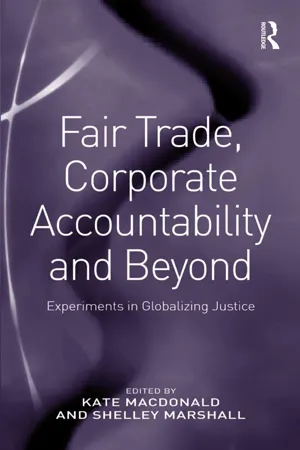
Fair Trade, Corporate Accountability and Beyond
Experiments in Globalizing Justice
- 406 pages
- English
- ePUB (mobile friendly)
- Available on iOS & Android
eBook - ePub
Fair Trade, Corporate Accountability and Beyond
Experiments in Globalizing Justice
About this book
As trade and production have increasingly crossed international boundaries, private bodies and governments alike have sought new ways to regulate labour standards and advance goals of fairness and social justice. Governments are harnessing social and market forces to advance corporate accountability, while private bodies are employing techniques drawn from command and control regulation to shape the behaviour of business. This collection brings together the research and reflections of a diverse international mix of academics, activists and practitioners in the fields of fair trade and corporate accountability, representing perspectives from both the industrialized and developing worlds. Contributors provide detailed case studies of a range of social justice governance initiatives, documenting the evolution of established strategies of advocacy and social mobilization, and evaluating the strengths and limitations of voluntary initiatives compared with legally enforceable instruments.
Individual and Civic Action Through Fair Trade
Chapter 2
Fair Trade at the Centre of Development
Steve Knapp
No single change could make a greater contribution to eliminating poverty than fully opening the markets of prosperous countries to the goods produced by poor ones.
Kofi Annan, Secretary General of the United Nations1
The basic objective is to combine the great benefits of trade to which many defenders of globalisation point, with the overarching need for fairness and equity which motivates a major part of the antiglobalisation protests.
Amartya Sen, Honorary President of Oxfam2
Introduction
Trade is one of the most powerful factors linking our lives and is a source of unprecedented wealth creation. Yet international trade presents a paradox, as the prosperity created coincides with deepening mass poverty and inequality. The rules that govern international trade are not currently structured in a way that respects the needs and interests of the poor. Rather, these rules are largely determined by, and protect the interests of, the wealthy and powerful players in the market. However, it is increasingly being recognized that trade, if structured differently, could have the potential to reduce world poverty dramatically.
In view of these challenges, the aim of this chapter is to identify the multiple levels at which the Fairtrade system supports goals of rural income generation, empowerment, poverty reduction, social development and democratic decision-making, via the creation of a fair system of international trade. The opportunities opened up to poor producers by means of their participation in this system are contrasted to the barriers to development that many marginalized producers face as a result of their integration within the wider system of international trade, in which goals of trade liberalization and goals of development all too often operate at cross-purposes.
In developing this argument, this chapter draws on specific examples from the Asia-Pacific region to illustrate the impact of Fairtrade relationships established between Asia-Pacific producers and consumers in Australia and New Zealand, which have been coordinated by the institutional vehicles of the Fair Trade Association of Australia and New Zealand (FTAANZ) – a member of the International Fair Trade Association (IFAT) (now the World Fair Trade Association) – and Fairtrade Labelling Australia and New Zealand (FLANZ) – a member of Fairtrade Labelling Organizations International (FLO). Analysis of regional developments are situated within a broader evaluation of both the wider international trade and development regimes inside of which these regional systems of trade operate, and the Fairtrade Labelling system’s own structure of international governance.
Trade, Aid and Development: The Failings of the Existing International System
Before exploring some of the major contributions of Fairtrade to developmental goals, this chapter briefly identifies those features of existing arrangements that most directly undermine the potential of the international trading system in its current form to promote goals of poverty reduction and social development.
The Potential of International Trade to Tackle Problems of Global Poverty
Some 1.2 billion people in the world are estimated to live in ‘dollar poverty’, consuming less than one dollar per day (IFAD 2001, 15). With increased and worsening inequality, many poor people and underdeveloped regions are being left behind. In turn, rising inequality slows the rate at which economic growth is converted into poverty reduction. Using a headcount ratio, about two fifths of the population in South Asia was below the poverty line in 1998 (IFAD 2001, 40). Poverty incidence was higher in South Asia than in any other region of the world, except sub-Saharan Africa, and the region accounts for 44 per cent of the total poor (IFAD 2001, 15). Over 70 per cent of the world’s poor, the majority of whom are women, are now rural and projections suggest that this figure will still be over 60 per cent in 2025. In Asia and the Pacific region, poverty is disproportionately concentrated to the extent that 80–90 per cent of the poor live in rural areas in all the major countries of the region (IFAD 2001, 18).
In confronting such problems of global poverty – concentrated particularly in rural populations – the international trading system holds considerable potential to offer pathways towards rural income generation and development. The forces of globalization have driven increases in world trade, and transfers of technology and movement of information have created incredible opportunities for certain sectors of society in both developed and developing countries.
Yet the opportunities offered by an expanding system of international trade are currently being captured disproportionately by rich, industrialized countries. While developed countries export goods worth approximately US$6,000 per capita each year, in developing countries the average is US$330 per capita, and in low-income countries less than US$100 per capita. Least-developed countries (LDCs) – a grouping that includes several Pacific countries – account for less than 3 per cent of world trade, despite comprising 40 per cent of the world’s population (World Bank 2001).
One means by which trade could benefit low income countries would be for those countries to increase their share of earnings from world exports. If developing countries were to increase their share by just 5 per cent, this would generate around US$350 billion in additional income – seven times as much as they receive in aid from the developed world. Regionally if Africa, East Asia, South Asia and Latin America were each to increase their share of world exports by 1 per cent, the resultant gains in income could lift 128 million people out of poverty (a reduction of 12 per cent) (World Bank 2001).
Obstacles to Development Confronting Rural Producers
Despite the potential of international trade to confront problems of global poverty, the framework of the current economic model through which global economic interconnections have been promoted has tended to produce non-inclusive capitalism and economic growth. The advance of globalization has created a range of new opportunities such as: fostering increased linkages between countries; expanded trade, increased financial and information flows; and the rapid development of new technologies, markets, managerial know-how and financial investment capacity. However, some aspects of globalization – such as the organization of the current international trading regime – have compounded associated problems of global poverty and disenfranchisement, implying that globalization as a whole is failing to achieve its promised benefits to the poor. Instead, many marginalized people are experiencing increased insecurity and threatened livelihoods.
The obstacles confronting rural producers within contemporary processes of globalization exist at a number of levels, resulting from features of the local development environment (in producing countries and regions themselves), the international trading system, and international aid and development policy.
At the local level, the shortages of skills and capital experienced by many producers along with a lack of opportunities to add value and diversify production are major problems. As a result, many domestic, particularly rural, producers in developing countries are unable to compete in the globalized market-place in the short term. However, not only are they immediately disadvantaged by the lack of investment capital, business skills and access to markets, but the factors of production that these marginalized producers depend upon are generally non-transferable, having often been the source of livelihood for generations. Hence the prospects for redirecting their productive resources to more efficient economic activities generally do not exist and in many areas of the world this has resulted in rural farmers losing their land assets and being forced to migrate to urban areas.
Producers also face a number of barriers within the international trading system. One major obstacle is instability and price fluctuations in global markets combined with a downward trend in world prices. While all producers of commodity products are exposed to risk from price fluctuations and volatile markets, those in developing countries are more vulnerable, particularly where commodity prices have fallen below their cost of production. Faced with fluctuating and falling world prices they can become ensnared in a cycle of debt, poverty and deteriorating livelihood opportunities, and the lack of access for small farmer producers in developing countries both to markets and to market information contributes further to these difficulties.
Even in a climate of higher and rising commodity prices, small farmer producers do not necessarily receive the benefits of higher price levels. The increase in availability of small farmers’ produce during harvest periods means that farm gate prices tend to remain low. Because farmers lack the capital and market information to take advantage of price movements, it is the traders and middlemen in the supply chain, rather than the farmers themselves, who generally capture the profits from price speculation during periods of high or rising agricultural commodity prices.
As a result of these challenges, poor agricultural producers continue to occupy a highly vulnerable position within the existing system of international trade; these features of the international trading system amplify the significant developmental barriers many such producers already face at the local and national levels.
Intensifying such problems further is the existing lack of policy coherence between those institutions governing the international trading system and those operating in the sphere of international development. Policies designed to further goals of poverty reduction and social development promoted by aid and development agencies are in many ways being undermined by the application of rules that often distort patterns of international production, trade and pricing to the advantage of large transnational companies and to the disadvantage of marginalized producers and workers in the South.
Another major obstacle arising from existing features of the international trading system has been the ongoing implementation of subsidies and protection in the industrialized world. Average agricultural tariffs are in the region of 60 per cent whereas industrial tariffs are rarely greater than 10 per cent (World Bank 2001, 67). Trade barriers imposed by rich countries are especially damaging because they target the goods that the poor produce: labour-intensive agricultural and manufactured products. In contrast, total subsidies to domestic farmers in the EU and United States total more than US$1 billion per day (World Bank 2001). These subsidies accrue to the wealthiest farmers, finance massive environmental damage and generate overproduction that is dumped on world markets to the extent that the agricultural superpowers export at prices that are less than one third of their production cost. This serves to drive down global prices, destroying smallholder agriculture and local economies.
In 2004, a report to the Secretary General of the United Nations by the UN Development Programme stated that the importance of agriculture in reducing poverty creates an urgent need for developing reform initiatives towards the elimination of trade-distorting subsidies which benefit agricultural producers in developed markets (CPSD 2004). The World Bank and other development institutions also acknowledge that many developing countries are still unable to realize their comparative advantage in agricultural production because farm subsidies and agricultural trade policies in industrial countries depress world prices for farm products (DFID et al. 2002). Some of the world’s poorest farmers are, in effect, competing against the world’s richest treasuries. Ironically, this is ultimately financed by taxpayers and consumers in the developed world.
At the same time as international trading rules create multiple barriers to development, the system of international development aid is charged with promoting goals of poverty reduction, capacitybuilding and export promotion. While the development aid system makes some contributions to the advancement of these objectives, its efforts are significantly weakened by its lack of commitment both to the agricultural sector and to goals of producer control and empowerment. They are also undermined in many cases when they fall into conflict with the operation of the international trading system.
In an attempt to address this incoherence in national policies, in December 2005 the World Trade Organization (WTO) Ministerial Declaration in Hong Kong committed to take actions to encourage ‘Aid for Trade’ initiatives. However, there was no clear definition and there remains very little agreement on what ‘Aid for Trade’ actually entails. The New Zealand Agency for International Development (NZAID) is recognized as initiating one of the more progressive ‘Aid for Trade’ programmes and is ranked first out of 22 in the trade component of the Commitment to Development Index 2008 compiled by the Center for Global Development (CGD 2009). As a smaller country with little or no trade barriers, New Zealand’s policy approach perhaps benefits from encountering less pressure from vested commercial interests in the outcomes of trade negotiations that can also benefit trade development than is experienced by other OECD countries.
In its policy statement, ‘Harnessing International Trade for Development’, NZAID acknowledges many of the issues highlighted above and underlines the need for economic and governance factors to be set in place, including policy and regulatory frameworks that ensure the benefits of trade reach those most affected by poverty and disadvantaged by current trade structures. The statement also identifies internal constraints for developing countries, particularly in the Pacific, relating to deficiencies in market information, business skills and domestic infrastructure, and, consequently, to a lack of access to markets that cover small producers’ costs of sustainable production (NZAID 2003).
One major weakness of existing development policies lies in the neglect of the agricultural sector. While agriculture is the primary source of livelihood for the rural poor, international financing for agricultural development declined by nearly 40 per cent from 1987 to 1998 (World Bank 2001). In recent years, only about 3.5 per cent of total overseas development assistance (ODA) has been devoted to agricultural development (World Bank 2007, 41). Additionally, there is considerable evidence that government and ODA has tended to favour the urban areas, the more productive lowlands, export crops, and industrial and manufacturing establishments (World Bank 2007, 40–41). In the process, policies have, often unwittingly, developed inbuilt bias against poor rural households and disadvantaged areas such that their deprivation has been entrenched.
Furthermore, development aid has tended to fund projects on the basis of outside experts deciding what is best for marginalized farmers and imposing predefined agri-business solutions on them. In this way, development engagements with the rural poor often fail to approach them with appropriate respect for their knowledge, beliefs and practices. Such efforts therefore fail to take sufficient account of the fact that a key element of human dignity for any individual as well as of the empowerment of rural communities is for those individuals and communities to retain control over the major decisions that affect their welfare. The lack of emphasis placed on promoting producer empowerment and control over institutional rules and policy priorities is also reflected in the weakness of democratic decision-making within the overarching rule-making institutions that govern prevailing international trade and development regimes.
Even to the exten...
Table of contents
- Cover Page
- Half Title Page
- Title Page
- Copyright Page
- Contents
- List of Figures and Tables
- Notes on Contributors
- Preface
- List of Acronyms
- Introduction
- Part I Individual and Civic Action Through Fair Trade
- Part II Responsible Consumers and Corporations
- Part III Mobilized Workers
- Part IV A Strengthened and Transformed Role for the State
- Conclusion
- Index
Trusted by 375,005 students
Access to over 1.5 million titles for a fair monthly price.
Study more efficiently using our study tools.
Frequently asked questions
Yes, you can cancel anytime from the Subscription tab in your account settings on the Perlego website. Your subscription will stay active until the end of your current billing period. Learn how to cancel your subscription
No, books cannot be downloaded as external files, such as PDFs, for use outside of Perlego. However, you can download books within the Perlego app for offline reading on mobile or tablet. Learn how to download books offline
Perlego offers two plans: Essential and Complete
- Essential is ideal for learners and professionals who enjoy exploring a wide range of subjects. Access the Essential Library with 800,000+ trusted titles and best-sellers across business, personal growth, and the humanities. Includes unlimited reading time and Standard Read Aloud voice.
- Complete: Perfect for advanced learners and researchers needing full, unrestricted access. Unlock 1.5M+ books across hundreds of subjects, including academic and specialized titles. The Complete Plan also includes advanced features like Premium Read Aloud and Research Assistant.
We are an online textbook subscription service, where you can get access to an entire online library for less than the price of a single book per month. With over 1.5 million books across 990+ topics, we’ve got you covered! Learn about our mission
Look out for the read-aloud symbol on your next book to see if you can listen to it. The read-aloud tool reads text aloud for you, highlighting the text as it is being read. You can pause it, speed it up and slow it down. Learn more about Read Aloud
Yes! You can use the Perlego app on both iOS and Android devices to read anytime, anywhere — even offline. Perfect for commutes or when you’re on the go.
Please note we cannot support devices running on iOS 13 and Android 7 or earlier. Learn more about using the app
Please note we cannot support devices running on iOS 13 and Android 7 or earlier. Learn more about using the app
Yes, you can access Fair Trade, Corporate Accountability and Beyond by Shelley Marshall, Kate Macdonald in PDF and/or ePUB format, as well as other popular books in Law & International Law. We have over 1.5 million books available in our catalogue for you to explore.