- 214 pages
- English
- ePUB (mobile friendly)
- Available on iOS & Android
eBook - ePub
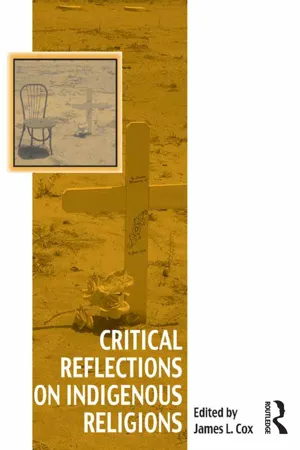
Critical Reflections on Indigenous Religions
About this book
The study of indigenous religions has become an important academic field, particularly since the religious practices of indigenous peoples are being transformed by forces of globalization and transcontinental migration. This book will further our understanding of indigenous religions by first considering key methodological issues related to defining and contextualizing the religious practices of indigenous societies, both historically and in socio-cultural situations. Two further sections of the book analyse cases derived from European contexts, which are often overlooked in discussion of indigenous religions, and in two traditional areas of study: South America and Africa.
Information
Methodological Considerations
Chapter 1
Reflecting Critically on Indigenous Religions
James L. Cox
Background to the Academic Study of Indigenous Religions
This book offers perspectives on the academic study of indigenous religions from scholars who identify, clarify and exemplify important theoretical issues by grounding their discussion in concrete situations ranging from contemporary field studies through historical and literary analyses. In each case, critical reflections on the significance and meaning of studying indigenous religions are suggested, which in turn pose important questions for this emerging field in religious studies.
I call this an emerging field in religious studies, since the academic study of the religious practices of indigenous populations, which began in the latter part of the nineteenth century, initially fell to anthropologists, who applied evolutionary theories to interpret the development of human cultures, beginning with the lowest, most primitive peoples, found in small-scale societies with rudimentary means of production and gradually extending to the highest forms of civilization, exemplified in their minds by European culture. Classic examples are found in E.B. Tylor’s Primitive Culture and J.G. Frazer’s The Golden Bough.1 Other early studies of indigenous religions were found in reports by Christian missionaries, who often gained an intimate knowledge of the languages of the peoples to whom they were delivering the Christian message, but often maintained a somewhat negative attitude towards indigenous religious practices. The different approaches adopted by early anthropologists and missionaries are exemplified in the case of Australia. During the latter part of the nineteenth century Baldwin Spencer, along with his colleague F.J. Gillen, applied evolutionary theories in their analysis of the central desert peoples of Australia, whereas the Lutheran missionary Carl Strehlow, who learned the languages of the central desert peoples and worked among them for nearly thirty years at the Hermannsburg mission, never attended one indigenous ritual and worked hard to discourage his Christian converts from retaining any ties with traditional beliefs and practices.2
Anthropological and missionary writers dominated the study of indigenous religions well into the twentieth century, although later attitudes differed markedly from those expressed initially in these fields. For example, E.E. Evans-Pritchard, who conducted important studies of the Azande and Nuer peoples of southern Sudan, adopted an empathetic approach to the subjects of his study and, unlike many earlier so-called armchair anthropologists, like Tylor and Frazer, actually lived amongst African societies for a number of years. Evans-Pritchard attempted to interpret Azande beliefs in witchcraft for a Western audience by showing how, given the world-view and assumptions of the Azande, beliefs in witchcraft and magic were internally consistent and rational. He suggested that the Azande belief in witchcraft ‘provides them with a natural philosophy by which the relations between men and unfortunate events are explained and a ready and stereotyped means of reacting to such events’.3 In a like manner, missionaries, like Edwin W. Smith, who worked in what is now Zambia, and Geoffrey Parrinder, who served in West Africa conducting research in Dahomey (now Benin), identified the Christian God in the pre-Christian beliefs of the indigenous peoples of Africa and thus sought to reverse the earlier tendency of Christian missionaries to describe indigenous religious practices as pagan and superstitious.4 The offshoot of field studies undertaken by those like Evans-Pritchard was a branch of anthropology, called the anthropology of religion. What followed from Smith and Parrinder, and their African followers like J.S. Mbiti and E.B. Idowu, was a Christian theology of indigenous religions.5 Although Parrinder in particular pioneered a religious studies department in Ibadan in Nigeria, his approach always followed closely a Christian theological scheme outlining the study of Africa’s three religions (Christianity, Islam and African Traditional Religion) in terms of systems, including, and perhaps most importantly for him, belief in a Supreme Being.6
The academic study of indigenous religions as a separate subject within a department of religious studies was initiated in the 1970s by Andrew Walls and Harold Turner at the University of Aberdeen.7 They inherited earlier terminology, which referred to indigenous religions as ‘primitive’, but transformed this into the study of ‘primal’ religions. Turner initially employed the phrase ‘tribal religions’, but soon joined Walls in opting for the nomenclature, ‘primal’.8 The study of primal religions as a distinct tradition in a department of religious studies was in the first instance a practical measure. Both Walls and Turner had worked in West Africa, where they encountered numerous indigenous peoples, some of whom practised variations of traditional rituals, whereas others had adopted missionary forms of Christianity and still others had seemingly blended tradition with Christianity to form new religious movements. This rich field of religious activity could not be covered adequately under the ‘world religions’ rubric and thus called for a specialization in its own right. If students could focus on Buddhism or Hinduism or Islam in departments of religious studies, they ought to be given the opportunity to concentrate their studies on the primal religions of the world, and their interactions with global religious movements. Walls developed the specialized study of primal religions to describe what he called the religions of ‘circumpolar peoples, … various peoples of Africa, the Indian sub-continent, South East Asia, North and South America, Australia and the Pacific’.9 In 1976, a postgraduate course entitled ‘Religion in Primal Societies’ was launched in the Department of Religious Studies in Aberdeen with the stated aim of:
providing instruments for the study of the ‘primal’ (or ‘ethnic’ or ‘traditional’) religions characteristic of many societies in Africa, the Americas, Asia and Oceania, the effects on belief systems, practices and religious institutions of the meeting of these religions with ‘universal’ religions (notably Christianity and Islam) and the new religious movements arising after contact with Western influences.10
The choice of the term ‘primal’ in place of ‘primitive’ or ‘tribal’ on the surface was intended to overcome what Walls called the ‘evolutionistic’ connotations associated with ‘primitive’ and the close connection of ‘tribal’ to what earlier anthropologists had called ‘savage’ peoples.11 Turner rejected the connotations associated with the word ‘primitive’ since, he explained, ‘it is a great mistake to think that because a tribal society is … poor in scientific knowledge, tools or agricultural methods, it must also be primitive mentally and in its thinking about human life’.12 By the mid-1970s, the expression primal religions had even been accepted within the Christian ecumenical movement as a partner in dialogue with Christianity. John B. Taylor, who headed the Unit on Dialogue with People of Living Faiths and Ideologies in the World Council of Churches from the late 1970s to the early 1980s, argued that ‘primal’ should be substituted for a whole series of other less acceptable terms such as ‘pre-literate, primitive, pagan, animistic, primordial, native, ethnic, tribal and traditional’.13
From the Academic Study of Primal Religions to Indigenous Religions
When Andrew Walls moved from his post in Church History in the Faculty of Divinity in the University of Aberdeen in 1970 to found the first Religious Studies Department in Scotland, quite deliberately he situated religious studies not in an ancient Scottish Department of Divinity with its close connections to the Church of Scotland, but in the University of Aberdeen’s Faculty of Arts and Social Sciences. Walls did this to emphasize that the academic study of religion is a field in its own right and should not be reduced either to the social sciences, in the case of primal religions to a field dominated by anthropologists, or to theology. Both Walls and Turner advocated the use of the closely related phenomenological and historical approaches to the study of religion, which they thought were particularly suitable for the study of primal religions.14 While acknowledging that the various disciplines in the humanities and social sciences ‘can be, and must be applied’ to the study of religion, Walls contended that ‘the study of religion is a field in its own right’.15 In line with the phenomenological method, which privileges the believers’ own perspectives as the basis for interpreting religions, Walls explained that ‘religion can best understand religion’ by which he meant that ‘religious commitment’ provides the best ‘entrance gate’ for describing religious practices since it alone leads to understanding from the point of view of adherents.16 It was this specifically ‘religious’ interpretation of religion that Walls applied to the study of primal religions, which he argued provides the key for understanding religions everywhere. The case of Africa is illustrative, since throughout sub-Saharan regions ‘the old religions’ form ‘the sub-structure of African Christianity’. In this sense, Walls believed that the study of primal religions was a precondition for understanding religion in all its forms everywhere.17
By the 1980s, the study of ‘Primal Religions’ as a subject in its own right was making inroads into academic departments internationally. This was due, in part, to the large number of postgraduate students the Aberdeen department attracted from its founding in 1970 and by the international reputation obtained by the Centre for the Study of Christianity in the Non-Western World, which Walls launched at Aberdeen in 1976. Due to severe cuts in the academic programme at the University of Aberdeen in the mid-1980s, in 1986 Walls moved the Centre for the Study of Christianity in the Non-Western World to the University of Edinburgh where he, along with his colleague John Parratt, introduced the study of primal religions into the Edinburgh Religious Studies programme.18 When I arrived in the University of Edinburgh in 1993 from the University of Zimbabwe, I taught the primal religions section in the introductory undergraduate course on world religions and taught sections of the African Primal Religions postgraduate course in the Centre for the Study of Christianity in the Non-Western World. I also worked closely with Kwame Bediako, who was the African Christianity Lecturer in Edinburgh each year for three months from 1993 until 1998, and who was a leading exponent of a theological interpretation of primal religions in Africa.19
In 1996, I published an article in the newly founded Edinburgh journal, Studies in World Christianity, in which I criticized the term ‘primal’ for veiling theological assumptions.20 My reasoning was based on the conviction that, as it was conceived originally by Walls and Turner, ‘primal’ did more than fill an academic gap in religious studies by using a descriptive category phenomenologically and historically; it clearly conveyed an ideological message. Primal religions were presented as antecedent to universal religions and as providing the foundation on which all the world’s religions are based. Turner defined primal as the ‘most basic or fundamental religious forms in the overall history of mankind’ having ‘preceded and contributed to the other great religious systems’.21 Walls argued that ‘primal religions … underlie all other religions’, adding that ‘though we think of ourselves as Christians, Buddhists, Muslims or unbelievers, we are all primalists underneath’.22
The assertion that all religions share an original primordial base has clear connections to the Christian missionary theory of fulfilment. It is but a short leap from the notion that all religions share a common primal base to the Christian idea that Christ sits at the pinnacle of all the world’s religions and fulfils their highest strivings. This is just what Bediako implied when he described Africa as the ‘receptor culture’ for the Christian message. It is a ‘receptor’ in the sense that ‘African pre-Christian religious cultures’ not only provide ‘a valid carriage for the divine revelation’, but they also provide ‘the idiom for Christian apprehension’.23
When I was appointed convener of religious studies in the University of Edinburgh in 1999, I worked to change the nomenclature used in the department from primal religions to indigenous religions. I set up a cluster of courses which enabled undergraduates to study indigenous religions as one of their discrete...
Table of contents
- Cover Page
- Half Title Page
- Series Page
- Title Page
- Copyright Page
- Contents
- List of Figures and Tables
- Notes on Contributors
- Preface and Acknowledgements
- Part I Methodological Considerations
- Part II European Contexts
- Part III South American and African Contexts
- Bibliography
- Index
Trusted by 375,005 students
Access to over 1.5 million titles for a fair monthly price.
Study more efficiently using our study tools.
Frequently asked questions
Yes, you can cancel anytime from the Subscription tab in your account settings on the Perlego website. Your subscription will stay active until the end of your current billing period. Learn how to cancel your subscription
No, books cannot be downloaded as external files, such as PDFs, for use outside of Perlego. However, you can download books within the Perlego app for offline reading on mobile or tablet. Learn how to download books offline
Perlego offers two plans: Essential and Complete
- Essential is ideal for learners and professionals who enjoy exploring a wide range of subjects. Access the Essential Library with 800,000+ trusted titles and best-sellers across business, personal growth, and the humanities. Includes unlimited reading time and Standard Read Aloud voice.
- Complete: Perfect for advanced learners and researchers needing full, unrestricted access. Unlock 1.5M+ books across hundreds of subjects, including academic and specialized titles. The Complete Plan also includes advanced features like Premium Read Aloud and Research Assistant.
We are an online textbook subscription service, where you can get access to an entire online library for less than the price of a single book per month. With over 1.5 million books across 990+ topics, we’ve got you covered! Learn about our mission
Look out for the read-aloud symbol on your next book to see if you can listen to it. The read-aloud tool reads text aloud for you, highlighting the text as it is being read. You can pause it, speed it up and slow it down. Learn more about Read Aloud
Yes! You can use the Perlego app on both iOS and Android devices to read anytime, anywhere — even offline. Perfect for commutes or when you’re on the go.
Please note we cannot support devices running on iOS 13 and Android 7 or earlier. Learn more about using the app
Please note we cannot support devices running on iOS 13 and Android 7 or earlier. Learn more about using the app
Yes, you can access Critical Reflections on Indigenous Religions by James L. Cox in PDF and/or ePUB format, as well as other popular books in Theology & Religion & Comparative Religion. We have over 1.5 million books available in our catalogue for you to explore.