eBook - ePub
Sikhs in Europe
Migration, Identities and Representations
- 360 pages
- English
- ePUB (mobile friendly)
- Available on iOS & Android
eBook - ePub
About this book
Sikhs in Europe are neglected in the study of religions and migrant groups: previous studies have focused on the history, culture and religious practices of Sikhs in North America and the UK, but few have focused on Sikhs in continental Europe. This book fills this gap, presenting new data and analyses of Sikhs in eleven European countries; examining the broader European presence of Sikhs in new and old host countries. Focusing on patterns of migration, transmission of traditions, identity construction and cultural representations from the perspective of local Sikh communities, this book explores important patterns of settlement, institution building and cultural transmission among European Sikhs.
Information
Sikhs in Northern and Eastern Europe
Chapter 1
Institutionalization of Sikhism in Norway: Community Growth and Generational Transfer
Knut A. Jacobsen
The first Sikh to settle in Norway reached the country in 1969, and the next to arrive entered the same year a couple of months later. They were part of a larger immigration from greater Punjab to Norway, of which the largest group was Muslims from Pakistan Punjab. These early Sikh immigrants provided the foundation for the establishment of Sikhism in Norway, and at present around 5,000 Sikhs live in Norway. Finding a job and a place to live were the most important issues for the first settlers and they would come to assist other Sikhs and Punjabis who arrived later.
The most important organization for Indians in Norway in the early years of immigration was the Indian Welfare Society of Norway (IWS), which was established in 1971. The organization assisted those new arrivals by providing contacts and resources and organized social events that focused on Indian culture and tradition.1 The first settlers were all men; women arrived a few years later, when the males had attained some degree of economic security.2 With the establishment of family life, the Indians started the work of rebuilding many aspects of their social and cultural traditions. Family reunions or the establishment of new families led to a resurgence of religious observances which had previously slid into abeyance. Religion and religious identities attained increased significance, and for many Indians from Punjab, a shared religious identity gradually became the foundation for community building and religion the most important marker of cultural difference. As the majority of the Indian immigrants were Sikhs, the gurdwaras became central institutions for the Indians in Norway. It is noteworthy that the first Hindu temple opened more than a decade after the first gurdwara and even today non-Sikh Indians participate in the activities of the gurdwaras during the Vaisakhi festival and other Sikh events. The central role of the gurdwaras has been important for the strengthening of religious identity and traditions, but the gurdwaras have also been arenas of conflict. Their establishment was moreover a response to the need for spaces in Norway in which Punjabi culture and Sikh religion could dominate. In the Sikh diaspora in Norway, assimilation, as opposed to integration, has been perceived as a threat to cultural heritage, the Punjabi language, and the Sikh religious identity. As there is a close connection between the Sikh religious identity and the Punjabi language and culture, the preservation of language and culture has been vital to the effort of transferring the religious traditions to the next generations. The establishment of gurdwaras has been considered especially important because those who live in areas which contain gurdwaras seem to have had an easier time transferring the Sikh religious identity to the next generation than those living in other parts of Norway. This is especially the case with respect to knowledge of the religious tradition, the Punjabi language, ritual participation, and display of religious identity. Nevertheless, many second-generation Sikhs in Norway also have doubts about the close connection between Punjabi cultural identity and Sikh religion, and question the emphasis on external religious symbols that is promoted in the gurdwaras and instead search for and develop their own Norwegian Sikh identities.
During the forty years of Sikh presence in Norway, there has been a gradual institutionalization and growth of the religious tradition. This strengthening of the religious tradition is the result of the hard work of members of the community, although the expansion has also been influenced by international developments and events. The establishment of the Sikh religious tradition in Norway and the transfer of the tradition to the next generation have been demanding tasks for the communities. Living in the diaspora has made the generational transfer particularly a challenge, and a remarkable amount of work and energy has been invested to succeed in the maintenance and transmission of the tradition. To teach and foster religion to the youth constitutes a constant worry and demands continuous work. A number of organizations have been established and annual events organized for the sake of relocating Sikhism from Punjab to Norway and teaching new generations. The history of Sikhism in Norway—from the first Sikh arrival in Norway in 1969 to the opening of the largest gurdwara in northern continental Europe in Lier 2010,3 and the celebration of the first Norwegian Turban Day at the central plaza in Oslo the same week,4—is thus a remarkable story of organizational strength, ability, and hard work.
Being Sikh usually entails upholding an ethnic, linguistic, and religious identity. These identities strengthen each other, but their interdependency also means that a lot of work is needed to preserve the identity in the minority and diaspora situation. A loss of the Punjabi language and the absence of external religious symbols are perceived by many as a possible result of assimilation, and the prevention of assimilation has been an important motivating factor for the organizational activities in the Sikh communities of Norway. The Sikhs have institutionalized a number of activities to prevent assimilation and secure the maintenance of their Punjabi and Sikh traditions. Sikhs have actively sought and encouraged economic integration into Norwegian society, as work is considered a religious duty, and their level of education is one of the highest of all immigrant groups, with many having pursued university or college education. The strong identification of Sikhism with the Punjabi language and the emphasis on external symbols, such as the turban, means that becoming a Sikh in the diaspora is not only a matter of being born into a Sikh family but also about a more conscious socialization, education, and identity formation on a private and collective level. Over the years a number of Sikh institutions have developed in Norway in answer to the need for a collective transmission of religious, cultural, and linguistic traditions. At present, the organizational activities of the Sikhs in Norway include two gurdwaras, annual processions, Punjabi schools, children’s religious education, Sikh camps, Internet sites, sports events, and other cultural events. Many of these institutionalized activities are organized in or through the gurdwaras.
Immigration History and the Establishment of Gurdwaras
Sikh immigration to Norway was predominantly labor immigration, even if the first Sikhs to arrive were adventurers. At the end of the 1960s and beginning of the 1970s, Norway was still a fairly homogenous society and the Sikhs were among the first immigrant groups to arrive in the wave of immigration that subsequently transformed Norway into a multi-ethnic society. Many of the early settlers were males in their 20s who ended up in Norway by coincidence. This was the case with Amarjit Singh Kamboz, who was the first Sikh to arrive in 1969 (see Figure 1.1), and many others.5 When they left Punjab in order to find work or for other reasons, such as wanting to experience some adventure, Norway was not the intended country of destination. Some had heard little or nothing about the country before they left Punjab, at most they knew it was “the land of the midnight sun.”6
Many of the early immigrants’ narratives contain elements of heroism. They were adventurous young men who had been students and wanted to travel, work, and experience the world before they got a job and settled in Punjab. One of the more spectacular arrivals was that of Tarlochan Singh Badyal and T. Rampuri in 1973 who bicycled all the way from Punjab to Norway, a trip that took two years in total. They left Punjab in 1971 with a five-year-plan of biking around the world spreading the message of peace and international solidarity and cooperation, and they biked through Asia and most of Europe. When they arrived in Norway in the fall of 1973 the last England-bound passenger ship for the season had left and thus they thought of returning to Denmark to take a southern route to England. However, within a couple of days in Norway they were offered jobs and decided to stay for a few more months, which eventually led to a permanent settlement. One of the Sikh bikers, Tarlochan Singh Badyal, started a travel agency and has for many years assisted thousands of Norwegians to explore the world.
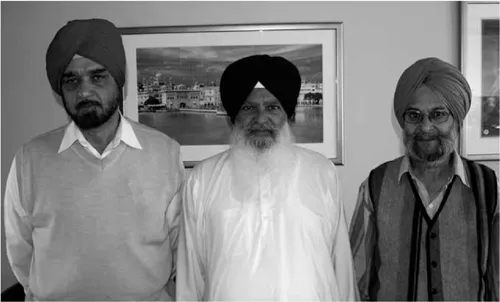
Figure 1.1 To the right, Amarjit Singh Kamboz, the first Sikh who arrived in Norway in 1969. In the middle, Santokh Singh, who was for several periods of time the leader of the Gurduara Sri Guru Nanak Dev Ji, and to the left, Darshan Singh. Photo: Knut A. Jacobsen, May 2010
Others tell stories about disappointments and personal crises being turned into tales of heroic success. One early Sikh immigrant who arrived in 1972 had traveled to Germany but was unable to find a job and realized he had to return to India, something he did not look forward to as he thought it was shameful having wasted a large amount of money on a trip that led to nothing. However, a neighbor asked him to deliver a letter to Denmark, and there he learned that getting a job in Norway would be easy. Consequently, he continued to Norway and a few years later brought his wife and children.
For those who arrived between 1969 and 1975 there were no legal restrictions on labor immigration, but in 1975 constraints were implemented, although not on wives and children of foreigners with work permits.7 Some of the males who were already married and had left their wives and children in Punjab brought them to Norway once the economic situation had stabilized, while others married after the settlement and brought their Indian wives to Norway.8
As is often the case in the diaspora, religious traditions in the new country become fully organized only after the first male settlers build a family and bring their wives and children. In the beginning, the most important festivals were celebrated in schools and other buildings that were rented for the day. The first copies of the Sikh scripture Guru Granth Sahib were brought to Norway in 1979/1980. However, the first Sikhs realized that their religious and cultural traditions would not be transferred to the next generation in Norway without an extraordinary effort. In response to this, the Gurdwara Seva Sabha was founded, and in 1981 money was collected to purchase a building. The following year the congregation bought a property in Oslo, and after refurnishing, the first gurdwara, now called Gurduara Sri Guru Nanak Dev Ji, was opened in 1983. At this time the Sikh community in Norway was still quite small. In the first years, only 150 to 200 people would participate in the meetings in the gurdwara. On occasions the gurdwara also had a turbulent history, with political disagree...
Table of contents
- Cover Page
- Half Title Page
- Title Page
- Copyright Page
- Contents
- List of Figures
- List of Tables
- Notes on Contributors
- Introduction: Sikhs in Europe
- Part I Sikhs in Northern and Eastern Europe
- Part II Sikhs in Southern Europe
- Part III Sikhs in the United Kingdom and Ireland
- Glossary
- Index
Trusted by 375,005 students
Access to over 1.5 million titles for a fair monthly price.
Study more efficiently using our study tools.
Frequently asked questions
Yes, you can cancel anytime from the Subscription tab in your account settings on the Perlego website. Your subscription will stay active until the end of your current billing period. Learn how to cancel your subscription
No, books cannot be downloaded as external files, such as PDFs, for use outside of Perlego. However, you can download books within the Perlego app for offline reading on mobile or tablet. Learn how to download books offline
Perlego offers two plans: Essential and Complete
- Essential is ideal for learners and professionals who enjoy exploring a wide range of subjects. Access the Essential Library with 800,000+ trusted titles and best-sellers across business, personal growth, and the humanities. Includes unlimited reading time and Standard Read Aloud voice.
- Complete: Perfect for advanced learners and researchers needing full, unrestricted access. Unlock 1.5M+ books across hundreds of subjects, including academic and specialized titles. The Complete Plan also includes advanced features like Premium Read Aloud and Research Assistant.
We are an online textbook subscription service, where you can get access to an entire online library for less than the price of a single book per month. With over 1.5 million books across 990+ topics, we’ve got you covered! Learn about our mission
Look out for the read-aloud symbol on your next book to see if you can listen to it. The read-aloud tool reads text aloud for you, highlighting the text as it is being read. You can pause it, speed it up and slow it down. Learn more about Read Aloud
Yes! You can use the Perlego app on both iOS and Android devices to read anytime, anywhere — even offline. Perfect for commutes or when you’re on the go.
Please note we cannot support devices running on iOS 13 and Android 7 or earlier. Learn more about using the app
Please note we cannot support devices running on iOS 13 and Android 7 or earlier. Learn more about using the app
Yes, you can access Sikhs in Europe by Kristina Myrvold, Knut A. Jacobsen in PDF and/or ePUB format, as well as other popular books in Theology & Religion & Asian Religions. We have over 1.5 million books available in our catalogue for you to explore.