eBook - ePub
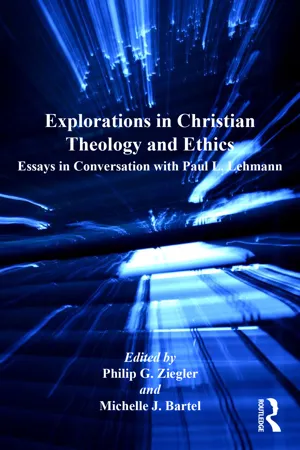
Explorations in Christian Theology and Ethics
Essays in Conversation with Paul L. Lehmann
- 206 pages
- English
- ePUB (mobile friendly)
- Available on iOS & Android
eBook - ePub
Explorations in Christian Theology and Ethics
Essays in Conversation with Paul L. Lehmann
About this book
Engaging variously with the legacy of Paul L. Lehmann, these essays argue for a reorientation in Christian theology that better honours the formative power of the gospel to animate and shape doctrine and witness, as well as ethical and political life. The authors explore key themes in Christian theology and ethics - forgiveness, discernment, responsibility, spirituality, the present day tasks of theology and the role of faith in public life - making plain the unabated importance of Lehmann's work at this juncture in contemporary theology. The internationally recognized contributors draw crucial connections between the gospel of reconciliation, the form of Christian theology and witness, and the challenges of contemporary ethical and political reflection. This book demonstrates why this close friend of Dietrich Bonhoeffer, and author of Ethics in a Christian Context and The Transfiguration of Politics continues to influence generations of theologians in both the English-speaking world and beyond.
Information
Chapter 1
Introduction: Paul Lehmann – The Man and the Teacher
Paul Lehmann inspired an unusual amount of devotion in many of his students, but even the most devoted of these would have to admit that not everyone ‘got’ him, not by a long way. Since his conversation, sermons and lectures were laced with untranslated German, Hebrew and Greek, quotations without attribution from Scripture as well as from Shakespeare, W.H. Auden, Samuel Beckett, e.e. cummings and so forth, his listeners were frequently bewildered. Then, too, there was the love of paradox and wordplay, the complicated – some would say tortured – syntax, and the daring leaps of imagination, all of which contributed to the frequent feeling that one simply could not follow him. One of his most adoring graduate students, later a distinguished teacher, heard someone quoting Lehmann and said, ‘It sounds just like him – but does it mean anything?’ That student was, of course, speaking affectionately for many of us who felt that if we really tried, we could understand perhaps one-third of what he said. We made the effort, because we were pretty sure that he did indeed ‘mean something’ of ultimate importance and that we were blessed if we could grasp even that one-third.
The most immediately noticeable feature of Lehmann’s teaching was the compelling power of his unique voice and presence, which conveyed passion and elicited fascination even though he so often could not be fully understood. Many of us thought that once he had been, in his own habitual expression, ‘gathered to my fathers’, no one would read him any more, so inseparable was his personality from his communication. It is a singular gift of the Holy Spirit that Philip Ziegler, who never met Paul Lehmann kata sarka, has been able to appropriate his meaning and message to a degree equal to the very top rank of the students and colleagues who knew him when he was alive. Better still, Ziegler’s relative youth equips him to carry Lehmann’s work forward into a new generation – a consequence which would have delighted its author more than anything.
For Paul Lehmann truly cared about students. He was the only one of the Union Seminary faculty in the seventies who invited all of his seminar students to gather after class every week in his grand apartment in Knox Hall, which was spectacularly furnished with a Viennese chandelier, Steinway piano, and Biedermeier sofa. He called these occasions ‘sherry and conversation’. Much as he enjoyed ardent spirits – one-hundred-proof Wild Turkey being a particular favourite – as well as the pleasures of the table, it was the conversation that was of supreme importance to him. Unlike many professors who have achieved a certain stature, he did not ‘hold forth’. It was the exchange that he cared about. He was one of the most engagé people imaginable. I never once saw him act dismissively or indifferently toward anyone, either in class or at social occasions. If he was making a point, he would draw a student in by using the student’s name, weaving it into his comments, inviting a response. In settings such as these where he felt at ease, he was never threatened by or hostile to any opposing view, but curious about it and eagerly seeking to discuss its merits.
He was utterly consistent in his efforts to encourage students even if he had to use his rapier. I still have a copy of a paper I wrote for Dr Lehmann in an advanced course on Bonhoeffer that I took at Union in 1973. I keep it, not for the content of the quite dreadful paper itself, but for the comments that Lehmann wrote in the margins and on the last page. I was a first-year Master of Divinity student taking an advanced course, had no idea what I was doing, and really did not belong in the class. I cherish the comments, because Lehmann was able to combine quite serious, sharp, and specific criticism with warm encouragement and appreciation. Not only was I not crushed, I was determined to do better.
Lehmann paid virtually everyone the high compliment of talking to them as though they were on the same intellectual level as he. Many people have testified to this: I remember especially the wife of one of his colleagues who spoke feelingly of the way he always paid attention to her with the same keen interest and respect as if she had been a fellow scholar. I often wondered how a man who was so exceptionally gregarious and other-directed could at the same time muster the discipline for scholarly work. His care for people extended to the very ‘least of these’. When he left Union, he went around the seminary to say goodbye to all the support staff, from the lowliest assistant in the library to the labourers in the boiler room. Reflecting at the time of Lehmann’s death, James F. Kay testified to what many of us had seen: ‘He was extraordinarily kindly. One Sunday I accompanied him to church on Madison Avenue, and afterward he told me to wait a moment. He walked half a block to a man without legs in a wheelchair. He gave the man some bills, then lingered and had a genuine conversation. There always had to be a conversation.’ This recognition of the humanity of every person linked his theology to his way of life; at the most fundamental level, Lehmann lived what he believed. He worked not only at a political level – for instance as chairman of the American Committee for the Protection of the Foreign Born – but also at the direct human level.
The irony regarding this generosity of Lehmann’s lies in the effect that he had on many of his colleagues and some of his students who took great offence at him. There were many reasons for this. To begin with, he came to Union in New York trailing controversy behind him because of his close association with the person and theology of Karl Barth. Union at mid-century represented the high noon of classic liberal American Protestantism, a milieu very much at odds with Barth’s – and Lehmann’s – radical theology and polemical style. Lehmann’s arrival on the faculty in 1963 was therefore an event. The great strength at the seminary in that era was in Biblical scholarship; there had been no powerful systematic theologian for some time. Barth, in absentia, loomed over the scene – he had once called Union that place with ‘the false Gothic architecture’ – and as has always been the case on the American scene, provoked a hostility which as often as not was based in a lack of comprehension.
Lehmann came representing the Reformation that Dietrich Bonhoeffer famously said had never come to America.1 Some at Union recognized in Paul Lehmann the genuine theologian they had been looking for, and those few who had been drawn to Barth’s work rejoiced. Many others were suspicious or hostile. Lehmann enjoyed a battle, however, and waded in with gusto. Often he did not mean his polemics personally, for he was genuinely sociable and did not expect intellectual disputation to deteriorate into attacks on individuals. At other times, it is true, he would indulge in personal animosity; he had a tendency to construct conspiracy theories, and he did not always exercise good judgement. His great passion was for ‘the freedom we have in Christ Jesus’, and his intemperance at times resembled that of the author of the Epistle to the congregation in Galatia where that very freedom was at stake.
J. Louis Martyn said that he and Lehmann ‘recognised one another as comrades in the trenches’. Union in the late 1960s and early 1970s was experiencing upheavals of various sorts, particularly an extended dispute about the shape of the curriculum. It was ironic in the extreme that Lehmann, one of the most revolutionary of all Christian thinkers of his generation, was branded by some as ‘conservative’. It must be confessed that Lehmann’s combative style did not always help in these disputes. His lightning-quick use of similes and metaphors, often drawn from Scripture, came as naturally to him as do profane epithets to many people today. When a faculty committee reached a decision on an urgent matter, Lehmann said, ‘The Philistines have won’, and walked out of the room. When a colleague who was enamored of 1960s Esalen-style revisionism had his students lie on the floor for his classes, Lehmann denounced it as ‘Ba’alism’. The James Chapel, where such luminaries as Reinhold Niebuhr, Tillich and Muilenberg had preached, became the locus for various experimental liturgies, and Lehmann began to refer to it as ‘the Ichabod chapel’ – i.e., a place from which ‘the glory has departed’.
Needless to say, these sorts of remarks did not endear him to some of the faculty. Lehmann was much more intelligent and far more deeply learned than some of his colleagues, quicker and sharper in debate. This exacerbated the tensions. Some of the most distinguished members of the faculty recognized Lehmann’s essential integrity and intellectual stature, and a few were willing to fight. Lehmann’s favourite term for these theological allies was ‘comrades’. He was very much like his namesake the Apostle in this regard. If the gospel was at stake, then there could be no compromise. Some of the more irenically-minded among the traditional faculty were discomfited by his polemical style if not his content, whereas others recognized the content itself as radically threatening to all projects centred on human potential.
Here lay the real issue. The theology of Karl Barth, with which Lehmann was essentially in tune – although often arguing with it and seeking to expand it – represented a challenge of the most fundamental sort to the presuppositions of liberal Protestantism. Barth’s – and Lehmann’s – Pauline-Augustinian emphasis on divine agency in creation and redemption was deemed by American liberals to be ethically defective, encouraging passivity and undermining human responsibility. One of Lehmann’s chief purposes was to refute this charge in the most vigorous terms. The Transfiguration of Politics was finished and published during these years, and although now dated in certain ways, it is still distinguished by its advocacy of political activism from within a theological and biblical context.
Looking back, it is hard to understand how a man who was dedicated body and soul to the cause of justice for the oppressed and defenseless could ever have been construed as a reactionary. Certainly it was not because he did not work overtime to appreciate the contributions of his colleagues. He went out of his way, in his written work, to quote whatever he could find to approve in the work of others with whom he essentially disagreed. A particular example of this is the section on ‘Feminist Repudiation of Patriarchal Co-optation’ in The Decalogue and a Human Future.2 In this remarkable discussion he shows that he has read various feminist critiques with the utmost seriousness, seeking to understand what was being said and how it might be instructive. His interpretations of Scripture in the light of the ‘new occasions’ that bring ‘new duties’ (in the words of the poem by James Russell Lowell) were often dazzling in their advanced thinking.3
If Lehmann had lived another twenty years he would have been at home with the resurgence of premodern readings of Scripture. The poetic imagination and fire that he brought to biblical interpretation is not unlike that of Chrysostom and other Church Fathers, which has risen dramatically in critical esteem in these days of waning respect for purely scientific exegesis. A memorable example of Lehmann’s humour arose out of these academic currents. A lot of his twinkling wit sailed over the heads of less learned conversation partners because of its allusiveness, but it was one of his most attractive qualities and was almost never mean. During the late 1970s, a collection of faculty from the biblical and theological fields met together monthly at Union with their graduate students to discuss the Pauline Epistles. The purpose of this gathering, informally called ‘the Paul group’, was to encourage cross-fertilization between the two disciplines. Lehmann was among comrades in this group and so he was entirely at ease; however, he sometimes confessed himself baffled and frustrated by the scientific strictures of the biblical scholars. When a section of The Transfiguration of Politics was under discussion,4 he wrote a very funny memo to the members in which he presented himself as ‘an untutored and faltering exegetical seeker’ who needed to be rescued by the ‘illuminati’ of the Society of Biblical Literature:
Having learned from the Society a ‘new thing’, e.g. that there is a ‘Baur (Historicus) principle’ (or is it ‘Bauer’ [Agricolus]?) of exegetical hermeneutics or hermeneutical exegesis (or both), does the exegetical hermeneutical effort set down in Section 5A apply or violate or ignore the ‘Baur principle’?
He goes on in this vein:
Will the doctores Scripturae ecclesiae among you please suggest (a) a succinct distinction between exegesis and hermeneutics; and (b) in how far the exegetical? hermeneutical? or exegetical-hermeneutical undertaking of Section 5A may or may not be allowed? In exegetical? hermeneutical? extremis, in how far could the discussion of Romans 13:1–10 be warranted by John 14:15–26?
There is some energetic ribbing going on here, but at the same time Lehmann really did seek to understand what others were saying to him, and his earnest inquiring gave much pleasure to those who appreciated his style. Again, it was the exchange that meant the most to him and he was always willing to throw all of his considerable energies into it. His humour was fuelled by his dynamism. Lehmann did not hesitate to invoke ‘the faith once delivered to the saints’ as a criterion by which contemporary theologians – and exegetes! – should be measured, but he would always insist that this faith was ‘dynamics on deposit’. This paradoxical combination of deposit, suggesting something given, firm, and fixed, contrasted with dynamics, connoting something living, active and explosive, was vintage Lehmann.
It would be impossible to overstate the care that Paul Lehmann gave to everything that came his way. He lavished attention on people he cared about, high and low. He remembered children’s names, sent greetings to spouses, and inquired anxiously about those who were troubled. Over the years he must have written hundreds of letters of congratulation or sympathy as the occasion demanded, always pouring the full measure of himself into the composition. I treasure one that he wrote to me when I was ordained on June 10, 1975 – five long, heartfelt, handwritten paragraphs concluding with verses from Scripture and a benediction. I cannot resist quoting the first sentence of this letter, which combines so many characteristic Lehmannian touches:
It is surely a wondrous incongruity that finds your ordination to the holy ministry of Our Lord in His church being celebrated on the Feast of St. Basil, noted among those liturgically innocent and/or otherwise in pursuit of foreign gods as Flag Day.
This could not have been written by anyone other than Paul Lehmann. The elaborate syntax; the identification of an ‘incongruity’; the use of the word ‘wondrous’ to denote the divine activity; the humour found in the aforesaid incongruity; the utterly serious identification of ministry as ‘holy’; the use of ‘Our Lord’ as a shared personal confession; the capital ‘H’ to honour Christ and to show that the church is His; the love of proper liturgy; the skewering of national idolatry; the almost imperceptible allusion to Scripture; the punch line held back to the very end – here in one sentence is a rich combination of many of Paul Lehmann’s unique qualities. He was endlessly generous with himself in this way.
The great tragedy of Paul and Marion Lehmann’s lives was the loss of their only child, born to them in almost Abrahamic fashion relatively late in their marriage. This calamity was borne by him in all the ensuing years with a grace and courage that awed everyone. The fact that the intensity of his suffering was never concealed made the strength of Paul Lehmann’s faith all the more striking. He continued for the rest of his life to bear witness to the promise of the Resurrection. When the daughter of a student was stricken with a potentially fatal illness, he sent a lavishly beautiful copy of Dante’s Paradiso, inscribed by him as ‘this surpassing account of our greatest hope’. Such was his faith; such was his care for those foster children that the Lord had given to him by adoption and grace.
When Wilhelm Pauck died, Lehmann wrote ‘In Memory of Wilhelm Pauck: Colleague and Friend’ to be delivered at Union. The two of them had very different temperaments, but Lehmann’s tribute is wholehearted and generous in the highest degree. He put his usual painstaking effort into what he wrote, evoking his colleague’s unusual career and his many unique gifts. The tribute is all about Pauck and not at all about Lehmann, but there is one passage in particular that speaks volumes about Lehmann’s gratitude for their relationship in Christ that transcended any grievances:
It belongs to the mystery of selfhood that who Wilhelm was as a colleague should be congruent with Wilhelm as a friend. Our friendship spanned half a century. And as I think of him today, in recollection and remembrance, I think especially of…the experience of his unmistakable being with one, even when one knew that he wished with all his heart that in this, that, or the other respect, one had been or had done otherwise.
The humility implicit in this insight might surprise those who did not know how very much Paul Lehmann wanted to maintain collegial relationships with everyone in his purview. If he often did not succeed in this, it was not because he did not wish it differently. His recognition of Pauck’s steadfastness discloses a heart always longing for loyal friendship and a readiness to extend that same friendship to others.
In the end, Paul Lehmann was simul peccator et iustus, a man who knew himself to be justified in Christ, a humble servant of the ministerium Verbi divini. Once, at a very long ordination service where scores of clergy of all denominations were seated together, Lehmann was observed in prayer while most of the clergy were chatting, fidgeting, and looking around. In fact, one observer said later in awe, the only one who remained in prayer the whole time was Paul Lehmann. This silent but powerful witness took place not long after the acute agony of Peter Lehmann’s death. The bereaved father never flagged...
Table of contents
- Cover Page
- Halftitle Page
- Title Page
- Copyright
- Table Of Contents
- List of Contributors
- Editors’ Preface
- 1 Introduction: Paul Lehmann – The Man and the Teacher
- PART I
- PART II
- PART III
- Select Bibliography
- A Paul L. Lehmann Bibliography
- Index
Trusted by 375,005 students
Access to over 1.5 million titles for a fair monthly price.
Study more efficiently using our study tools.
Frequently asked questions
Yes, you can cancel anytime from the Subscription tab in your account settings on the Perlego website. Your subscription will stay active until the end of your current billing period. Learn how to cancel your subscription
No, books cannot be downloaded as external files, such as PDFs, for use outside of Perlego. However, you can download books within the Perlego app for offline reading on mobile or tablet. Learn how to download books offline
Perlego offers two plans: Essential and Complete
- Essential is ideal for learners and professionals who enjoy exploring a wide range of subjects. Access the Essential Library with 800,000+ trusted titles and best-sellers across business, personal growth, and the humanities. Includes unlimited reading time and Standard Read Aloud voice.
- Complete: Perfect for advanced learners and researchers needing full, unrestricted access. Unlock 1.5M+ books across hundreds of subjects, including academic and specialized titles. The Complete Plan also includes advanced features like Premium Read Aloud and Research Assistant.
We are an online textbook subscription service, where you can get access to an entire online library for less than the price of a single book per month. With over 1.5 million books across 990+ topics, we’ve got you covered! Learn about our mission
Look out for the read-aloud symbol on your next book to see if you can listen to it. The read-aloud tool reads text aloud for you, highlighting the text as it is being read. You can pause it, speed it up and slow it down. Learn more about Read Aloud
Yes! You can use the Perlego app on both iOS and Android devices to read anytime, anywhere — even offline. Perfect for commutes or when you’re on the go.
Please note we cannot support devices running on iOS 13 and Android 7 or earlier. Learn more about using the app
Please note we cannot support devices running on iOS 13 and Android 7 or earlier. Learn more about using the app
Yes, you can access Explorations in Christian Theology and Ethics by Michelle J. Bartel, Philip G. Ziegler in PDF and/or ePUB format, as well as other popular books in Theology & Religion & Religion. We have over 1.5 million books available in our catalogue for you to explore.