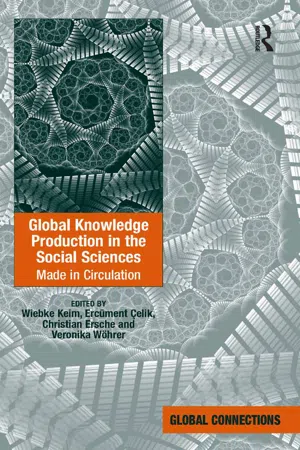
eBook - ePub
Global Knowledge Production in the Social Sciences
Made in Circulation
- 288 pages
- English
- ePUB (mobile friendly)
- Available on iOS & Android
eBook - ePub
Global Knowledge Production in the Social Sciences
Made in Circulation
About this book
An innovative contribution to debates on the internationalization and globalization of the social sciences, this book pays particular attention to their theoretical and epistemological reconfiguration in the light of postcolonial critiques and critiques of Eurocentrism. Bringing together theoretical contributions and empirical case studies from around the world, including India, the Americas, South Africa, Australia and Europe, it engages in debates concerning public sociology and explores South-South research collaborations specific to the social sciences. Contributions transcend established critiques of Eurocentrism to make space for the idea of global social sciences and truly transnational research. Thematically arranged and both international and interdisciplinary in scope, this volume reflects the different theoretical and thematic backgrounds of the contributing authors, who enter into dialogue and debate with one another in the development of a more inclusive, more representative and more theoretically relevant stage for the social sciences. A rigorous critique of the contemporary state of the social sciences as well as an attempt to find another way of doing transnational sociology, Global Knowledge Production in the Social Sciences will appeal to scholars of sociology, political science and social theory with interests in the production of social scientific knowledge, postcolonialism and transnationalism in research.
Information
PART I
Current Challenges Regarding Time, Space and Concepts of Circulation: Suggestions
Chapter 1
Feminist Vocabularies in Time and Space
Introduction
What might the concerns of the present volume on the circulation of knowledges in the social sciences look like from the perspectives of feminism? I hope to address this problematic from the location of India and its history of the women’s question. The terrain of my discussions will be pre-academic and extra-academic, by which I mean to include concepts and knowledges that pre-dated the establishment of the university and its modes of structuring higher education and/or came to be created outside such institutional contexts, including those associated with political and social movements. Certainly in the case of feminism, and there are surely many other examples as well, we are dealing not just with ideas or beliefs but with forms of conceptual knowledge that played a constitutive role in shaping the more recognizable fields and disciplinary orientations of the social sciences.
My attempt here is simultaneously to offer an alternate mode of engagement with the problem of Third World/First World theoretical dependencies. Considerable concern and debate has quite rightly focused on the fact that relationships of power and inequality from colonial times to the present have not only taken material form. Indeed, the role that knowledges of the ‘East’ played in making possible the very durability of colonialism by Western powers has been a foundational tenet at least since the publication of Edward Said’s Orientalism (1978), and should not require rehearsal here. Other dimensions of relationships of dependency have been explored through conceptions of ‘travelling theories’ from the First to the Third World and of ‘travelling theorists’ who move in the opposite direction.1 Let me therefore venture to say that, allowing full play to the working out of power across unequal contexts, I nonetheless find many of the ideas that seem to undergird discussions on dependency theory, indigenous theory or Southern theory, to be fundamentally flawed. Certainly the following assumptions are misleading if not false: firstly, that a given theory is necessarily most true at its point of origin; secondly, that there is a problem when a theory or a concept is mobile (after all, is not that the very definition of a theory or a concept, namely that it enjoys some degree of generalizability in order to qualify in the first place?); and, thirdly, that when theories are to be found in unequally structured terrain they are simply and only alien impositions, if not handmaidens of dominance. As the rest of this chapter will be demonstrating, I would rather suggest that we think more about intersecting conceptual histories that work simultaneously as much as sequentially; where we do not assume that ‘Western’ theories are only true in their ‘Western locations’ and have to be somehow adapted at some later point to a non-Western context, where they always suffer a lack of fit. I am interested rather in what happens when a given theory or conceptual vocabulary is put to use in a particular context, without valorizing origin over destination. There has been far too much obsession, for instance, with the Westernness of theory as though this fact alone made it suspect, rather than paying attention to the entangled contexts and complex relations that in fact characterize all theoretical endeavours. Concepts may well have multiple contexts of origin, and complex careers of use and transformation. Especially given power-laden relationships between places and peoples, it is the capacity of concepts to provide not just meaning but also insight that should be our focus, rather than their ostensible purity in relation to a singular original source. This seems more useful for the periods that concern us in terms of theory production and consumption, namely the last two centuries in particular, intersected as they have been by colonial, postcolonial, neoliberal and various other globalizations.
With knowledge about, and the production of emancipatory vocabularies for ‘women’ as my focus, my approach is as follows: rather than list and thematize the vast corpus of knowledge on women (which in any case would be impossible), I would like to discuss the kinds of epistemes, that is to say, the broad discursive grids that have played a structuring role in the history of the women’s question in India since the nineteenth century. An episteme is not just an idea, much less a position or perspective, and more than a ‘frame’ for thinking and debate. In their introduction to what became a classic text of colonial history, Kumkum Sangari and Sudesh Vaid have put it thus: ‘a feminist historiography rethinks historiography as a whole and discards the idea of women as something to be framed by a context, in order to be able to think of gender differences as both structuring and structured by the wide set of social relations’ (Sangari and Vaid 1989: 2–3, emphasis original). Or as the historian of modern China Tani Barlow has phrased it, ‘the subjects of gendered histories are themselves embedded in the history of thinking’ (Barlow 2004: 5). At the same time, as I hope to show, the question of how exactly a history of women in feminism is to set about its task turns out to be more complex than these very instructive formulations seem to allow for. After all, even the most empirically oriented among us would not make a pitch for an unmediated mode of access to a given time and the social relations that constitute it, whether past or present, other than through the range of sources and representations available of that moment. Nor do I see this exercise as in some way belittling the emancipatory project of the struggles of women and feminism, by setting up epistemes as the external constraints that fettered them. Rather this is about the very languages and terms – at once enabling and limiting – within which creative change was articulated, worlds were challenged, and also subsequently recovered.
Therefore, there is more to this problem – one that is often lost sight of – namely the recursive and multilayered quality of this very access, which takes on a very special form when it comes to understanding the past, given the interpretations of the past in the present by historians and theorists who thereby render their accounts intelligible and meaningful to a contemporary reader. It is these cumulative grids of intelligibility that I find particularly fascinating, especially when, in spite of major differences and disagreements, they nonetheless take on a relatively stable quality, at least over a certain period, after which changes and sometimes shifts are discernable. When it comes to the subject of ‘women’ for a broadly feminist analysis, given the proneness of women to marginalization if not invisibilization in most mainstream historiography and theory, reflecting on the very modes whereby she becomes legible turns out to be all the more instructive. Though my inquiry is undoubtedly shaped by the Indian case, I will be raising questions that could be of relevance for broader comparative analyses in South–North and South–South conversations.
Here in broad outline is what I wish to reflect on: in my view, there have been three main epistemes or grids of intelligibility in the history of ‘women’ and ‘feminism’ in India – the colonial, the national and the postnational. The colonial episteme is by far the longest in temporal terms – whose first rudiments are discernible in the early nineteenth century and come to fullness in the first decades of the twentieth – it begins to fracture during the 1930s and 1940s, in the years preceding the attainment of independence in 1947 and the ratification of the Republic and its Constitution in 1950, but has not, for all that, gone away. The colonial is still very much with us, as I will come to attest, and indeed, has found new life in numerous postcolonial analyses. The national episteme came to be constructed by a founding generation of nationalists from the 1940s into the 1950s and 1960s and is subjected to critique by the 1970s and 1980s – this is my second episteme. The third episteme has been gathering force since the 1990s – which I have called the postnational – and is the one we are uneasily inhabiting at present. To clarify, even though I am granting them sequential space across time, this does not imply that each simply supplants the previous one. Rather, the most powerful of them all – the colonial episteme – continues into the present, and has received the most extensive treatment and corroboration to date. And the most recent of them is precisely for this very reason the most fragile and poorly articulated, including the deployment of the term the ‘postnational’, one that would doubtlessly invite considerable contestation.
Before I begin, an important caveat. The discussion opens with the period of colonial modernity. Surely the question could be raised about pre-modern and pre-colonial times and places and the kinds of epistemes that may have existed and circulated then. I certainly would not want to be saying that theories and concepts begin to be organized into larger stable epistemes only from the time under consideration here. There is now a growing body of work on histories of thought that have opened up pre-modern eras to analysis in many parts of the world. This includes, though to a lesser degree, ideas relating to women, though it remains unclear whether one can usefully speak of theories relating to feminism, as a political agenda and world view prior to modernity. At this stage in my own thinking I would not wish to foreclose on this question, though it remains beyond the scope of my explorations here.
The Colonial Episteme
India was subjected to colonization efforts by different European powers from the time of the Portuguese invasion and Vasco da Gama’s first visit to the western sea coast in 1494, but the most significant and far-reaching was the subsequent period of colonization under the British from the latter part of the eighteenth century till independence was achieved in 1947. During this long period large parts of the subcontinent came under direct British rule, and were administered under three different Presidencies – the Bengal Presidency in the East, Bombay Presidency in the West, and Madras Presidency in the South. The colonial experiences within the Bengal Presidency have been the most extensively studied, and this includes the women’s question as well, though there is now a considerable literature spanning the entire subcontinent. The first campaigns, public debates and fierce controversies on women and their status, initiated by men (Indian, British, missionary, and so on), which stretched across the nineteenth century, set in motion a new vocabulary under colonial rule which, therefore, preceded the establishment of Western-style universities and their disciplinary structures (a late nineteenth- and early twentieth-century phenomenon). The most taken-for-granted naming of this period has been that of ‘social reform’, one that gave colonial power the wherewithal for its civilizing mission, through the reform of India’s backward if not barbaric practices. A neologism in its own time, produced by stitching together the ‘social’ with ‘reform’, the idea of social reform was energized by women’s status as a profound problem requiring improvement – marked therefore by conceptions of lack, lowliness, backwardness and oppression. Notions of the ‘social’ turn out to be critical indices of intelligibility for women’s issues, and vice versa – a social issue became quintessentially a women’s issue – and with long-term repercussions into the present. In other words, the very notion of a social issue accrued meaning through the first debates and controversies such as the practice of sati or widow-burning at the turn of the nineteenth century, followed by demands for widow remarriage, major campaigns and conflicts over women’s education, raising the age of consent for marriage, and so on.2 Colonial society was fiercely divided over all of these, even as there was considerable movement and fundamental, even profoundly positive change by the turn of the century. For instance, to take the extremely significant issue of women’s education – from having been opposed by many groups in the mid-nineteenth century, a certain vision of education became part of the world view of a new upwardly mobile middle class by the end of that century, making possible the emergence of a ‘new woman’ and a modern subjectivity, buttressed by profound transformations in notions of the family, caste and community, law and the state (Sarkar and Sarkar 2007; see also Devika 2007).
My purpose here, however, is not to provide an account of this history, but rather to emphasize the reiterative modes whereby a terminology came into being which in turn received substantiation through the interpretative grids supplied by scholars in our own time. If there were debates in the past, even fierce ones, this has been true of present efforts to make sense of the past as well, albeit located within the halls of academia. A number of historians – Lata Mani, Partha Chatterjee, Tanika Sarkar, Mrinalini Sinha – to name a few of those who have engaged with the history of gender and feminism in colonial Bengal, identified critical ingredients of the colonial episteme, even though there have been deep differences among them. The women’s question took shape, as I have already mentioned, through the key idea of the ‘social’, which came to be variously supplemented by notions of ‘tradition’ and ‘culture’. These meanings were further developed in contrast to questions of the ‘political’. In relation to our interest in the social sciences, terms such as these – the social and the political, or society and the state – were in turn upheld and carried forward by colonial knowledges, such as colonial sociology/anthropology (especially of communities and castes), theories of religion (including Orientalisms of various kinds), as well as in political theories such as liberalism. Again, it is necessary to emphasize that these processes were well in place before the establishment of departments of sociology, anthropology and the like. (See Sundar et al. 2007 for biographical accounts of early anthropologists and sociologists in India.)
According to Lata Mani, for instance, the first debates on women were contained within what she has called a colonial discourse about India in the opening decades of the nineteenth century – women, according to her reading, were not in fact the subject of these debates at all, but rather the ground on which the debate on ‘India’ came to be written. Through the long-drawn question of the status of women in ancient and colonial times, the very nature of Indian tradition, its authenticity through the notion of scripture came to be produced (Mani 1989; 1998). Much further on, by the turn of the nineteenth century, and not only in the region of colonial Bengal, social reform agendas were being increasingly taken over and recast by the rising politics of nationalism. As Partha Chatterjee formulated it, nationalist discourses were able to successfully resolve the women’s question, which was accomplished, in his view, because nationalism was a cultural discourse well before it was a political one. Women, then, became the bearers of Indian culture and tradition, but a recast, indeed modernized tradition, bearers of sovereignty for colonized men, in contrast to the public colonial world where men had been subjected by and lost to colonialism. The inner and the outer realms, the spiritual and material, the cultural and political, the home and the world – these are the binaries of the reworked colonial episteme, with women as the fulcrum (Chatterjee 1989; 1993). As a consequence, the most conflicted terms of the women’s question and for a first generation of feminists by the turn of the twentieth century, were culture and modernity. The new woman for the nation in the making could not be modern like the Western woman, or without culture like lower-class/caste women – but had to be schooled, indeed educated into the right kind of tradition for the future. The sphere of the home, of conjugal relations, of religion and domesticity – these were the critical spheres of sovereignty for the colonized – since the colonial state had conquered the material economic public political spheres. Arguing on similar terrain but from a different vantage point, Tanika Sarkar has asserted that the sphere of the home within revivalist nationalist discourses was a deeply Hindu patriarchal construct, with infant marriage as its ideal. By the turn of century, public debates over conjugal violence and the age of consent, penetrating the innermost structures of the Hindu family, were not just the preserve of Hindu nationalism, but also, in her view, became the basis for the first articulations of a language of rights, thus marking the very first inchoate links between a social issue and a political one (Sarkar 2001; Sarkar and Sarkar 2007).
The subject of women thus came to occupy a place of tension between the social and political realms at the close of the nineteenth century, the very years that saw the development of the first women’s organizations and the growing force of nationalism. By virtue of the special relationship between women and culture in curtailing the energies of social reform, with Hindu na...
Table of contents
- Cover Page
- Title Page
- Copyright Page
- Contents
- Notes on Contributors
- Preface
- Acknowledgements
- Introduction
- Part I: Current Challenges Regarding Time, Space And Concepts Of Circulation: Suggestions
- Part II: Social Science Networks Across The South
- Part III: Alternative Perspectives From The South
- Part IV: Epistemological Rearrangement Of The Social Sciences After Critiques Of Eurocentrism And The Postcolonial Turn
- Index
Trusted by 375,005 students
Access to over 1.5 million titles for a fair monthly price.
Study more efficiently using our study tools.
Frequently asked questions
Yes, you can cancel anytime from the Subscription tab in your account settings on the Perlego website. Your subscription will stay active until the end of your current billing period. Learn how to cancel your subscription
No, books cannot be downloaded as external files, such as PDFs, for use outside of Perlego. However, you can download books within the Perlego app for offline reading on mobile or tablet. Learn how to download books offline
Perlego offers two plans: Essential and Complete
- Essential is ideal for learners and professionals who enjoy exploring a wide range of subjects. Access the Essential Library with 800,000+ trusted titles and best-sellers across business, personal growth, and the humanities. Includes unlimited reading time and Standard Read Aloud voice.
- Complete: Perfect for advanced learners and researchers needing full, unrestricted access. Unlock 1.5M+ books across hundreds of subjects, including academic and specialized titles. The Complete Plan also includes advanced features like Premium Read Aloud and Research Assistant.
We are an online textbook subscription service, where you can get access to an entire online library for less than the price of a single book per month. With over 1.5 million books across 990+ topics, we’ve got you covered! Learn about our mission
Look out for the read-aloud symbol on your next book to see if you can listen to it. The read-aloud tool reads text aloud for you, highlighting the text as it is being read. You can pause it, speed it up and slow it down. Learn more about Read Aloud
Yes! You can use the Perlego app on both iOS and Android devices to read anytime, anywhere — even offline. Perfect for commutes or when you’re on the go.
Please note we cannot support devices running on iOS 13 and Android 7 or earlier. Learn more about using the app
Please note we cannot support devices running on iOS 13 and Android 7 or earlier. Learn more about using the app
Yes, you can access Global Knowledge Production in the Social Sciences by Wiebke Keim,Ercüment Çelik,Veronika Wöhrer in PDF and/or ePUB format, as well as other popular books in Politics & International Relations & Globalisation. We have over 1.5 million books available in our catalogue for you to explore.