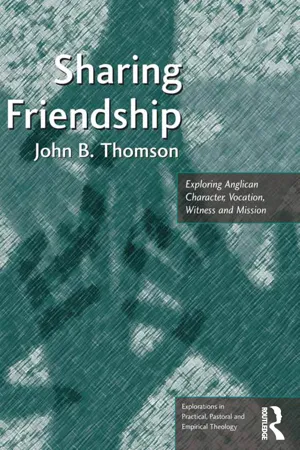
eBook - ePub
Sharing Friendship
Exploring Anglican Character, Vocation, Witness and Mission
- 282 pages
- English
- ePUB (mobile friendly)
- Available on iOS & Android
eBook - ePub
About this book
Sharing Friendship represents a post-liberal approach to ecclesiology and theology generated out of the history, practices and traditions of the Anglican Church. Drawing on the theological ethics of Stanley Hauerwas, this book explores the way friendship for the stranger emerges from contextually grounded reflection and conversations with contemporary Anglican theologians within the English tradition, including John Milbank, Oliver O'Donovan, Rowan Williams, Daniel Hardy and Anthony Thiselton. Avoiding abstract definitions of character, mission or friendship, John Thomson explores how the history of the English Church reflects a theology of friendship and how discipleship in the New Testament, the performance of worship, and the shape of Anglican ecclesiology are congruent with such a theology. The book concludes by rooting the theme of sharing friendship within the self-emptying kenotic performance of Jesus' mission, and looks at challenges to the character of contemporary Anglican ecclesiology represented by secularization and globalization as well as by arguments over appropriate new initiatives such as Fresh Expressions.
Information
Practice
Chapter 1
Friendship as Character1
In Approaching the End: Eschatological Reflections on Church, Politics and Life, Stanley Hauerwas asserts that
the very grammar of Christian speech presumes that those who use the language have a character commensurate with it. This is the key reason why theology and ethics cannot be separated; indeed theology is first and foremost an exercise in practical reason.2
Character, the mark or stamp of a person’s or community’s identity, forms a central theme in Hauerwas’s work, which has involved a re-articulation of the place of the church as a distinctive community of Christological witness. For Hauerwas the central feature of this witness is political and Christological, peaceableness expressed through friendship for the stranger whether encountered in the special needs community, the sick, the unborn or indeed the world beyond the church. This is not a pacifism which seeks to justify itself as a strategy based on a calculation but is a witness to the social agenda of Christ’s life and passion.3 It is an experiment with truth through sharing in God’s justice since ‘to do justice is to be a part of the community whose life is centred on and ordered by Jesus, God’s justice’. It is a justice seen especially in the giving and receiving of friendship in a ‘Spirit blown mobile community’ with those estranged from us such as Alzheimer’s sufferers.4 Friendship for the stranger identifies a community as Christian and it is my contention that such friendship for the stranger is central to the worship, polity and performance of Anglicans which, as Hauerwas suggests, reflects the fact that ‘Anglicanism is a holiness movement’ in which ‘what we do with our bodies is more indicative of who we are than what we say we believe’.5 Hauerwas’s work, therefore, forms the backdrop to the rest of this book which is an implicit conversation with his challenge to focus on churches as communities of character. It is therefore an attempt to tease out the character of Anglican mission through its practice, reflection and ongoing performance. To situate this exploration and to show why clarifying character is vital for the mission of the church, this chapter will outline key themes from Hauerwas’s work. These will not determine the remainder of the book so much as contextualise it as part of an ongoing conversation about how contemporary Christians seek to share in God’s mission within late modern societies in ways which are faithful to their historic vocation and yet able to engage creatively with new challenges.
Stanley Hauerwas, Character and the Church
Stanley Hauerwas’s theological ethics is an attempt to articulate a distinctively Christian character embodied as the church. This is not simply about recognising the corporate character of Christian discipleship but is about recognising the hermeneutical implications of ecclesial identity. How we see or interpret the world is relative to the communities we are formed by. There is no abstract spectator perspective divorced from the contingencies of time and place. Consequently the effect of participating within the Christian community is to understand God, the Scriptures, the Christian story and the world in a distinctive manner. Hauerwas’s understanding of the place of the Church in Christian character emerges most clearly in his 1981 collection of essays entitled A Community of Character. In these essays he sought ‘to reassert the social significance of the church as a distinctive society with an integrity peculiar to itself … the truth of whose convictions cannot be divorced from the sort of community the church is and should be’.6 He thereby attempted to generate a specific politics of the church by asking ‘what kind of community the church must be to rightly tell the stories of God?’7 A Community of Character begins with 10 Theses which Hauerwas uses to articulate the architecture of his theology. Immediately evident in each thesis is the social and narrative character of Christian ethics consequent upon its fundamentally ecclesial nature. The primary vocation of the church is to live its story as a people on a journey convinced of the lordship of God in the world and serving the world on the terms implied by this cross-informed story. Jesus is known today through this social ethic and the Scriptures are interpreted within the politics of the church.8 Furthermore the canon of Scripture are those stories which express the forgiving life of God experienced by God’s people and the tradition called church is an ongoing argument about the way these should be interpreted.9 Appealing to Scripture for Hauerwas is appealing not to texts but to a narrative community called church.10
Hauerwas’s hermeneutics flags up the importance of tradition and community in the Christian story. The church is a school of virtue rooted in an apprentice model of education, whose authorities, the saints, are those who have more fully appropriated and displayed the faith and are thereby able to educate other disciples in living and dying in ways appropriate to the story. The truthfulness of the Christian tradition is witnessed to in its capacity to sustain hope and patience in the face of the tragic, since tragedy subverts the possibility of self-deception.11 Yet it is definitively established by the peaceable performance of the church as the contemporary story of the peaceable Christ.12 In his work on Bonhoeffer he argues that there is a necessary connection between peaceableness, non-violence and the quest for a truthful politics.13 Peaceableness, therefore, is not an abstract ideal which judges the church but a hermeneutical way of living in which the church continues to embody the way of Jesus witnessed to in the cross.14 It is a form of life which challenges the liberal pragmatism of Reinhold Niebuhr and is indebted to the Anabaptist tradition of John Howard Yoder. It is this awareness of the significance of the history of Jesus for Christology that Hauerwas believes to be at the core of a recovery of a church of integrity. This is in contrast to other accounts which in their concentration upon the teaching of the Kingdom lost sight of the whole of Jesus’ life as a resource for imitation by the church. For Hauerwas, Jesus’ life was a recapitulation of God’s way with Israel, which discloses the sort of God Christians and Jews worship. For Christians, the cross is the supreme illustration of this peaceful trust in the ways of God, whose virtues are renunciation, humility and service. Hence his ecclesiology, rooted in Christological peaceableness, is intrinsically eschatological, since the victory of Christ witnessed to in the resurrection, gives the church the confidence to risk living peaceably in a world as yet uncommitted to peaceful living since this is to live with the grain of the universe.15 This is what living the kingdom means for it reflects what Jesus showed, namely that this sort of peaceable life is possible now since God is sovereign since this is reality.16 Friendship of the outcast, peaceful resistance to the evil one, forgiveness all illustrate kingdom-living informed by this eschatology.
Ecclesial formation, character and virtue therefore dispose Christians to inhabit the world in a distinctive way thereby enabling them to ‘gain the experience to negotiate and make positive contributions in whatever society we may find ourselves’.17 In particular this will enable Christians in America to recognise that liberalism forms them to interpret the world in a manner that conflicts with the Christian story, particularly in the latter’s assumptions about the right to life and happiness, individualism and freedom of choice. Indeed ‘the story that liberalism teaches us is that we have no story and as a result we fail to notice how deeply that story determines our lives’.18 The church therefore serves the world by being a contrast community and thereby supplies the world with a truthful story about its own identity. It acts as a hermeneutic for the world as well as for itself since the world has no integrating narrative that makes sense of its constituent parts without the story of God witnessed to in the church. Yet at the same time Hauerwas believes that ethical demands such as the Decalogue are community-specific and contextual. They cannot be understood apart from the story of God’s covenant with Israel. Rather than abstracting them and setting them up as transcendent universals, such stories supply the church with a tradition and history through which to see how the same God works at different times and in different places and thereby suggests how the church might rightly envision God’s ways with the world in the present context. Likewise there is a plurality of discipleship stories which are embraced in God’s story. Indeed part of the church’s character is to be able to listen to the ‘otherness’ of these stories with respect and attentiveness.
Hauerwas does not equate the church with the kingdom. Instead the life of the kingdom is broader than the church. For ‘the church does not possess Christ; his presence is not confined to the church. Rather it is in the church that we learn to recognise Christ’s presence outside the church’.19 The church is therefore a foretaste of this kingdom, a community whose training enables it to identify the presence of the kingdom beyond itself and whose presence also identifies the world as that community that as yet does not believe. The church therefore ‘tries to develop the resources to stand within the world witnessing to the peaceable kingdom and thus rightly understanding the world’.20 The virtues required for this involve trust, hope and love and as an empirical reality, the marks of this church, which represent the social witness of this church, are the resources of its sacraments, preaching and distinctive living.
In stressing the communal character of hermeneutics, Hauerwas is not implying that there is only one horizon within the interpretative dynamic. Agreeing with Iris Murdoch’s criticism of the narcissistic implications of Cartesian thinking and her work on attention and art, Hauerwas believes that we need to be trained to see the ‘other’ as beyond our own self consciousness.21 Indeed the ‘other’ is to be regarded as a gift and someone to be befriended.22 C...
Table of contents
- Cover Page
- Title Page
- Copyright Page
- Contents
- Preface
- Part I Practice
- Part II Reflection
- Part III Challenge
- Conclusion: Sharing Friendship: English Anglican Mission Today
- Select Bibliography
- Index
Trusted by 375,005 students
Access to over 1.5 million titles for a fair monthly price.
Study more efficiently using our study tools.
Frequently asked questions
Yes, you can cancel anytime from the Subscription tab in your account settings on the Perlego website. Your subscription will stay active until the end of your current billing period. Learn how to cancel your subscription
No, books cannot be downloaded as external files, such as PDFs, for use outside of Perlego. However, you can download books within the Perlego app for offline reading on mobile or tablet. Learn how to download books offline
Perlego offers two plans: Essential and Complete
- Essential is ideal for learners and professionals who enjoy exploring a wide range of subjects. Access the Essential Library with 800,000+ trusted titles and best-sellers across business, personal growth, and the humanities. Includes unlimited reading time and Standard Read Aloud voice.
- Complete: Perfect for advanced learners and researchers needing full, unrestricted access. Unlock 1.5M+ books across hundreds of subjects, including academic and specialized titles. The Complete Plan also includes advanced features like Premium Read Aloud and Research Assistant.
We are an online textbook subscription service, where you can get access to an entire online library for less than the price of a single book per month. With over 1.5 million books across 990+ topics, we’ve got you covered! Learn about our mission
Look out for the read-aloud symbol on your next book to see if you can listen to it. The read-aloud tool reads text aloud for you, highlighting the text as it is being read. You can pause it, speed it up and slow it down. Learn more about Read Aloud
Yes! You can use the Perlego app on both iOS and Android devices to read anytime, anywhere — even offline. Perfect for commutes or when you’re on the go.
Please note we cannot support devices running on iOS 13 and Android 7 or earlier. Learn more about using the app
Please note we cannot support devices running on iOS 13 and Android 7 or earlier. Learn more about using the app
Yes, you can access Sharing Friendship by John B. Thomson in PDF and/or ePUB format, as well as other popular books in Theology & Religion & History of Religion. We have over 1.5 million books available in our catalogue for you to explore.